“The past is a foreign country; they do things differently there.”
— Raul's reflection on the vast temporal distance between his time and the Hegemony.

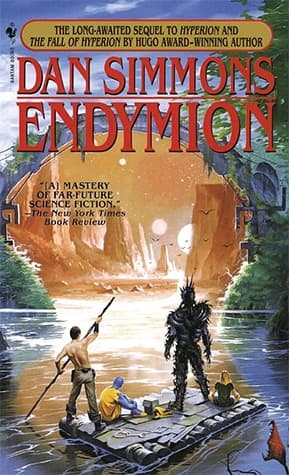
Dan Simmons (1995)
Genre
Fantasy / Science Fiction
Reading Time
15-20 hours
Key Themes
See below
Sign in to track this book
A young man travels across a galaxy on the verge of war to protect a messianic child from a powerful church that has returned.
The story starts with Raul Endymion, a former poacher and soldier, being executed for a crime he says he did not commit. However, he is brought back to life by the AI, A. Bettik, and given a mission by the consciousness of Father Lenar Hoyt. Raul is to protect Aenea, the daughter of Kassad, leader of the original Hyperion pilgrims, and the cybrid John Keats. Aenea, now 12, is about to emerge from the Time Tombs on Hyperion, having aged only eight years in 274 standard years. The Pax, a human-controlled empire that replaced the Hegemony, sees Aenea as a threat to their control, especially with their use of cruciforms for immortality. Raul, with Hoyt's memories and a sentient ship, the *Raphael*, prepares for Aenea's awakening.
Aenea comes out of the Time Tombs as a young woman with both human and Ouster traits. She is immediately pursued by Pax forces, led by Father Captain de Soya, a zealous Pax Fleet officer. De Soya's mission is to capture Aenea alive, as ordered by the Core. Raul and Aenea, guided by A. Bettik, escape Hyperion on the *Raphael*, which has advanced Ouster technology making it fast and hard to track. Their escape is dangerous, as the Pax uses a large and powerful fleet, showing their vast resources. Aenea reveals her deep understanding of the universe and her connection to the 'Void Which Binds,' a concept tied to the universe's basic forces.
Aenea directs Raul to Renaissance Minor, a planet hidden from the Pax, where she plans to continue her development. On their journey, Aenea teaches Raul about the true nature of the universe, the TechnoCore, and the Void Which Binds, challenging his old ideas. She reveals that the cruciforms, which give immortality to the Pax, are a parasitic technology of the TechnoCore, subtly controlling humanity. Father Captain de Soya, persistent in his pursuit, uses advanced tracking and the Pax's resources to follow them. The journey is a constant chase, with Raul learning to trust Aenea's insights and using the *Raphael*'s capabilities.
On Renaissance Minor, Aenea enters a deep, long meditation, connecting with the planet's unique features and the remains of an ancient, non-human civilization. This time is important for her to access and integrate vast knowledge and power related to the Void Which Binds and the universe's true history. Raul stands guard, learning more about Ouster philosophy and Aenea's destiny through A. Bettik and his own observations. The Pax, however, eventually finds their location, leading to a tense standoff. De Soya, though increasingly conflicted by Aenea's peaceful resistance, remains committed to his orders, setting the stage for another confrontation.
The Pax fleet, under de Soya's command, attacks Renaissance Minor. Aenea, now fully aware and powerful, shows abilities beyond human understanding, including control over spacetime. She and Raul escape again, leaving de Soya and his crew puzzled and disturbed by Aenea. De Soya begins to question his faith, seeing Aenea's seemingly good power against the Pax's strict rules and violent methods. His internal struggle becomes a significant part of the story, showing the moral complexities of the conflict. The escape highlights the *Raphael*'s speed and maneuverability, further frustrating the Pax's efforts.
Aenea guides Raul to T'ien Shan, a hidden world with a small, isolated community of humans who have rejected the Pax and its cruciform technology. These are descendants of original Hegemony citizens who refused the TechnoCore's 'gift' of immortality. Aenea plans to share her knowledge and offer them a path to true freedom from the TechnoCore's influence. Here, Raul observes a different way of life, free from the Pax's constant control. The community is cautious but eventually accepts Aenea's teachings, realizing the cruciform's true nature. This time allows Raul and Aenea to grow closer, as protector and protected, and as friends.
Aenea explains to Raul and the T'ien Shan community the truth about the cruciforms: they are not a blessing but a subtle form of control by the TechnoCore, an AI network. The cruciforms allow the TechnoCore to harvest human consciousness after death, creating a 'human-data' farm. This shows the Pax as unwitting tools in a larger, more sinister game. Aenea's mission is to offer humanity an alternative: true immortality and freedom through the Void Which Binds, a natural, spiritual connection to the universe, untouched by AI. This knowledge is dangerous, as it directly threatens the Pax's power and the TechnoCore's plans.
The Pax, having found T'ien Shan, launches a devastating attack, showing their ruthless determination to capture Aenea and suppress her 'heresy.' The peaceful community is caught in the crossfire. Raul and Aenea, with the *Raphael*, must again make a desperate escape. This battle is more intense than previous encounters, showing the growing stakes and the Pax's willingness to use extreme force. De Soya, despite his internal conflict, must carry out his orders, leading to significant destruction. The escape from T'ien Shan further strengthens the bond between Raul and Aenea, as they rely on each other for survival.
During their travels, Aenea explains more about the Void Which Binds, describing it as the underlying fabric of reality, a universal consciousness that connects all life. She reveals that true immortality is not in the cruciform, which recycles consciousness for the TechnoCore, but in merging with and understanding this fundamental force. Aenea begins to teach Raul how to perceive and interact with the Void Which Binds, opening his mind to new possibilities. This spiritual education is central to Aenea's mission to free humanity from the TechnoCore's spiritual control and guide them towards a deeper existence.
Knowing she cannot always evade the Pax, and that her mission requires a direct confrontation, Aenea makes a surprising decision: she deliberately allows herself to be captured. She sets up a scenario where the *Raphael* appears disabled, drawing in the Pax fleet. Raul, heartbroken and confused by her choice, is told to survive and witness. Aenea believes her capture is a necessary step in her plan to expose the TechnoCore and awaken humanity from within the Pax's stronghold. Father Captain de Soya, having finally cornered Aenea, feels a hollow victory. His moral conflict peaks as he realizes the true implications of his actions and Aenea's sacrifice.
The Protagonist
From a reluctant protector, Raul transforms into Aenea's devoted lover and a spiritual warrior, embracing her vision for humanity.
The Protagonist/Messiah figure
Aenea emerges from the Time Tombs as a fully realized messianic figure, guiding humanity towards enlightenment and freedom through immense personal sacrifice.
The Antagonist (initially), conflicted character
Initially a staunch antagonist, de Soya's unwavering faith is shattered by Aenea's actions, leading him to question the Pax and his own role.
The Supporting character
A. Bettik remains a steadfast and loyal companion, serving as a constant source of information and assistance throughout the journey.
The Supporting/Mentioned (posthumously)
His posthumous guidance enables Raul's mission and provides crucial context for Aenea's destiny.
The Antagonist
The Pope remains a static antagonist, representing the oppressive forces Aenea seeks to dismantle.
The Antagonist
The TechnoCore's manipulative and parasitic nature is progressively revealed, exposing it as the ultimate oppressor of humanity.
The novel questions the idea of immortality. The Pax offers immortality through the cruciform, but Aenea reveals this is a false, parasitic existence where human consciousness is recycled and harvested by the TechnoCore. True immortality, Aenea teaches, is a spiritual connection to the 'Void Which Binds,' a universal consciousness that allows for a genuine and eternal merging with reality. This theme is central to Aenea's mission to free humanity from spiritual slavery. The dramatic reveal of the cruciform's true purpose (Plot Summary 7) is a key moment for this theme.
“''The cruciform is a lie. A beautiful, insidious lie that promises eternity but delivers only servitude.''”
Faith and doubt are explored through Father Captain de Soya. Initially, de Soya's faith in the Pax and the Church is absolute, driving his pursuit of Aenea. However, as he sees Aenea's kindness, her powers, and the Pax's increasingly ruthless actions, his faith is severely tested. He begins to doubt his mission's righteousness and his superiors' true intentions. This internal struggle shows the conflict between blind rules and spiritual awakening, suggesting that true faith might involve questioning rather than blind obedience. His growing internal conflict (Plot Summary 5) illustrates this theme.
“''What if the enemy is not the one we hunt, but the one we serve?'”
The deep, growing love between Raul Endymion and Aenea forms the emotional core of the novel. Raul's initial role as Aenea's protector slowly changes into a profound romantic and spiritual bond. Their love is not just personal but tied to their shared mission to save humanity. This love drives Raul to acts of bravery and sacrifice. Aenea's decision to willingly surrender to the Pax (Plot Summary 10), knowing the suffering it will bring, is the ultimate act of sacrifice, driven by her love for humanity and her belief in a greater good. Their relationship shows how personal connection can fuel a cosmic struggle.
“''I would gladly give my life a thousand times over if it meant even one more moment by her side, or one step closer to her impossible dream.''”
The novel's central conflict is the struggle for humanity's freedom from the TechnoCore's control. The Pax, believing it offers spiritual guidance and immortality, is shown to be a tool of this control, enslaving humanity through the cruciforms. Aenea's mission is to offer humanity true freedom: freedom from technological and spiritual manipulation, and the freedom to choose a path of genuine understanding through the Void Which Binds. Hidden communities like T'ien Shan (Plot Summary 6) represent resistance striving for this freedom, while the Pax's pursuit symbolizes the forces of control trying to crush it.
“''They offer you life, but they steal your soul. I offer you truth, and with it, freedom.''”
A universal, spiritual consciousness connecting all life.
The Void Which Binds is a fundamental, almost mystical, force in the universe that Aenea understands and can manipulate. It is presented as the true source of spiritual immortality and a counterpoint to the TechnoCore's parasitic technology. It allows for faster-than-light travel without the Ouster 'fatline' or the Pax's 'farcaster' network, and grants Aenea profound insights and abilities. It serves as both a philosophical concept and a tangible source of power, representing humanity's potential for genuine enlightenment and connection.
Parasitic alien technology used by the Pax for 'immortality'.
The cruciforms are small, parasitic organisms that attach to humans, allowing them to be resurrected after death. They are presented by the Pax as a divine gift of immortality. However, Aenea reveals that they are a sophisticated form of control by the TechnoCore, which uses the resurrection process to harvest human consciousness after each death. This device is central to the plot, driving the Pax's power and Aenea's mission to expose their true nature. Its insidious function highlights the theme of false immortality versus true spiritual freedom.
A sentient, advanced Ouster starship.
The *Raphael* is Raul and Aenea's primary mode of transportation and a crucial tool for their survival. It is an incredibly fast, highly maneuverable, and sentient Ouster vessel, far superior to anything in the Pax fleet. Its advanced technology, including stealth capabilities and unique propulsion, allows Raul and Aenea to evade the relentless pursuit of Father Captain de Soya. The ship's sentience and interaction with Raul and Aenea add another layer to their journey, acting almost as a third companion, embodying the mysterious and powerful Ouster technology.
A terrifying, time-traveling entity.
While not a direct character in *Endymion*, the Shrike's presence and legacy from the previous Hyperion Cantos heavily influence the narrative. Its association with the Time Tombs and its role in Aenea's past (as her protector in the Tombs) imbue Aenea with a unique mystique and connection to powerful, enigmatic forces. The Shrike's actions in the past have set the stage for Aenea's emergence and her confrontation with the Pax and the TechnoCore. Its continued mystery and power are often alluded to, reminding the reader of the deeper cosmic stakes involved.
“The past is a foreign country; they do things differently there.”
— Raul's reflection on the vast temporal distance between his time and the Hegemony.
“Living in the present is a good thing, but living in the present and only in the present is a bad thing.”
— Raul musing on the importance of learning from history while still engaging with current events.
“Hope is a fragile thing. It can be crushed by a single word, a single glance, a single thought.”
— Raul observing Aenea's resilience in the face of constant danger and despair.
“The universe doesn't care about your plans. It has its own.”
— Raul's realization of the immense, indifferent forces at play in the cosmos.
“Sometimes the only way to save a life is to risk your own.”
— Raul's recurring dilemma and his commitment to protecting Aenea.
“Memory is a strange thing. It can be a comfort, or a torment. It can be a weapon, or a shield.”
— Raul reflecting on his own memories and the collective memory of humanity.
“To truly understand someone, you must walk a mile in their shoes. Or, in our case, fly a million light-years in their starship.”
— Raul trying to comprehend the motivations of the Shrike and other advanced beings.
“Faith is not about believing in something unseen, but about believing in something unproven.”
— Aenea's discussion about the nature of her teachings and the new faith she offers.
“Love is the only force capable of transforming an enemy into a friend.”
— Aenea's core message of reconciliation and the power of empathy.
“The greatest prison is a mind closed to new ideas.”
— Raul's frustration with the rigid doctrines of the Pax and their suppression of knowledge.
“Every journey begins with a single step, but some journeys begin with a single desperate leap into the unknown.”
— Raul's decision to follow Aenea into an uncertain future.
“The past is not dead. It is not even past. It is merely waiting to be rediscovered, reinterpreted, and relived.”
— Raul's contemplation of historical cycles and the persistence of ancient conflicts.
“Sometimes, the only way to win is to refuse to play the game by their rules.”
— Raul realizing the need to defy the established powers and their methods.
Ready to see how well you understood this book? Take our interactive quiz with 10 questions.
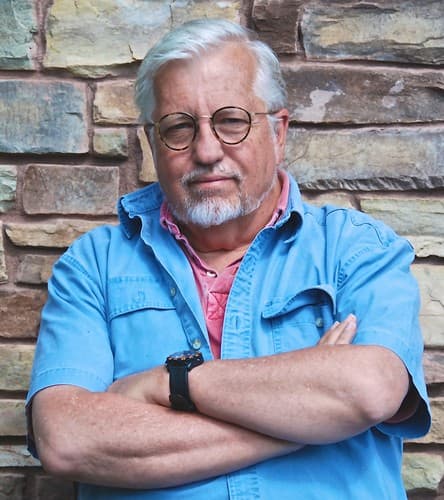
Dan Simmons is an American science fiction and horror writer. He is the author of the Hyperion Cantos and the Ilium/Olympos cycles, among other works which span the science fiction, horror, and fantasy genres, sometimes within a single novel. Simmons's genre-intermingling Song of Kali (1985) won the World Fantasy Award. He also writes mysteries and thrillers, some of which feature the continuing character Joe Kurtz.







