“I am not a weapon. I am a person.”
— Bean's internal struggle with being used for his intellect and physical abilities.

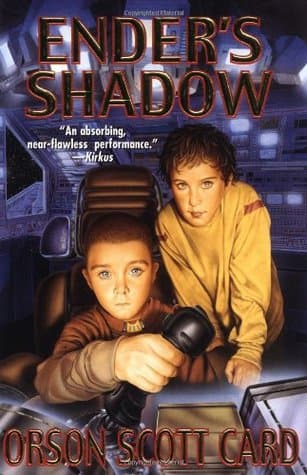
Orson Scott Card (1999)
Genre
Fantasy / Science Fiction / Young Adult
Reading Time
9-10 hours
Key Themes
See below
Sign in to track this book
From the brutal streets of a dystopian Earth to the strategic battlegrounds of outer space, a small but brilliant boy named Bean must outwit ruthless gangs and alien invaders alike, all while navigating his complex rivalry with Ender Wiggin, to save humanity.
Bean, an intelligent and undersized orphan, navigates the brutal streets of Rotterdam, using his wits to survive. He leads a small gang of younger children, including the loyal Poke and the strong Achilles, who he protects in exchange for their assistance in scavenging and defending territory. Bean's primary challenge is finding food and avoiding larger, more violent gangs. He plans their foraging routes and escape strategies, always observing, always learning. His analytical skills are evident as he calculates risks and opportunities, ensuring his group's precarious survival amidst the squalor and danger of the city's underbelly.
Bean initially forms an alliance with Achilles, a charismatic but disturbed older boy, who eventually takes over Bean's gang. Achilles's leadership is marked by cruelty and a thirst for power. He murders Poke, one of Bean's closest companions, to assert dominance and to eliminate anyone who challenges him. This act solidifies Bean's understanding of Achilles's psychopathy and fuels a deep, personal vendetta. Bean realizes he must escape Achilles's control, not just for his own safety but to prevent further harm to others under Achilles's influence, setting the stage for their long-standing antagonism.
Sister Carlotta, a nun working for the International Fleet to identify gifted children for Battleschool, observes Bean from a distance. She is astounded by his intellect and leadership, despite his small stature and the harsh environment he inhabits. After a series of discreet tests and observations, she approaches him, offering a chance at a better life and the opportunity to use his mind to save humanity. Bean, ever cautious, initially distrusts her, but the promise of food, safety, and intellectual challenge, combined with the desperate circumstances of his street life, eventually persuades him to accept her offer, marking his departure from Rotterdam.
Upon arrival at Battleschool, orbiting Earth, Bean is immediately recognized for his intelligence but also for his diminutive size. He quickly grasps the rules and mechanics of the zero-gravity battle simulations, excelling in tactical analysis. He notices the subtle biases and expectations of the teachers, particularly Colonel Graff, who is orchestrating the training of the children. Bean deliberately underperforms in physical aspects to avoid unwanted attention, choosing to observe and understand the system before revealing his full capabilities. He begins to form an impression of the other recruits, particularly a quiet, intense boy named Ender Wiggin, who seems to be the focus of the school's intense psychological manipulation.
Bean, assigned to Ender Wiggin's launch group, quickly identifies Ender as a strategic prodigy and the central figure in the International Fleet's plans. He observes Ender's rapid ascent through the ranks, his unconventional tactics, and his ability to inspire loyalty and fear in his fellow students. Bean makes a conscious decision to position himself as Ender's most valuable subordinate, providing critical tactical insights without overtly challenging Ender's leadership. He studies Ender's emotional responses, his interactions with others, and his ability to adapt, recognizing that Ender is being groomed for a singular, crucial purpose: to lead humanity against the Formics.
When Ender is given command of the legendary Dragon Army, Bean is one of the first children Ender chooses, recognizing Bean's exceptional mind. Dragon Army, composed of younger, less experienced soldiers, is designed to be a challenge, yet under Ender's leadership and with Bean's tactical brilliance, it becomes unbeatable. Bean serves as Ender's primary strategist, often suggesting innovative maneuvers and anticipating enemy movements. His unique perspective and ability to see beyond conventional solutions are crucial to Dragon Army's success, making him indispensable to Ender, even though Ender often takes credit for Bean's ideas, a dynamic Bean understands and accepts for the greater good.
Bean observes Ender's struggle with the 'Mind Game,' a psychological simulation designed to probe and manipulate the students' psyches. He recognizes the game's true purpose: to push Ender to his limits and reveal his deepest fears and leadership potential. Bean deduces that the game is not merely a test but a tool for psychological conditioning, subtly guiding Ender's development. His insights into the game's design and its impact on Ender highlight his understanding of human psychology and the Machiavellian tactics employed by the International Fleet. He sees the game as another layer of the intricate web of manipulation surrounding Ender.
Bean becomes increasingly aware of Colonel Graff's manipulation of Ender and the entire Battleschool system. He realizes that Graff is deliberately isolating Ender, pitting him against his peers, and pushing him to the brink to forge the ultimate commander. Bean, using his analytical skills, begins to piece together the larger picture, understanding that the stakes are far greater than mere school rivalries. He seeks out Sister Carlotta to share his concerns and findings, fearing for Ender's psychological well-being and questioning the ethics of the Fleet's methods. This investigation reveals the moral ambiguities inherent in their mission to save humanity.
Through his conversations with Sister Carlotta, Bean learns more about his own origins. Carlotta, having investigated his unusual intelligence and small stature, discovers that Bean is not merely a genius orphan but a genetically engineered child, part of a secret experiment to create super-soldiers. He was designed by a rogue scientist named Volescu, who later abandoned him on the streets. This revelation explains his extraordinary intellect and rapid growth, but also his physical fragility. The truth of his creation adds a layer of existential crisis to Bean's character, as he grapples with the implications of being a manufactured human.
Bean follows Ender to Command School, where the children are tasked with simulated battles against the Formics. He continues to serve as Ender's most trusted tactician, often working in the background to provide critical data and strategic options. During the final 'simulation,' which is, in fact, the real battle against the Formics, Bean's insights into fleet movements and enemy weaknesses are instrumental. He understands the psychological burden on Ender, who is unknowingly commanding the genocide of the Formic race. Bean's quiet support and tactical genius are vital to the victory, even as he grapples with the moral implications of their actions.
Following the Formic War and Ender's departure, Bean remains on Earth. He learns the full extent of his genetic engineering: while it granted him intelligence and accelerated growth, it also causes him to age and grow at an unsustainable rate, leading to an early death. With this grim prognosis, Bean dedicates himself to finding a cure or at least a way to prolong his life. He marries Petra Arkanian, a fellow Battleschool graduate, and begins to plan for a future, despite the looming threat of his condition. His quest for survival shifts from the streets to the scientific and political arenas, seeking to outwit his own biology.
Determined to understand and potentially reverse his genetic condition, Bean tracks down Volescu, the scientist responsible for his creation. The confrontation is tense, as Bean seeks answers about his accelerated growth and aging, and the potential for a cure. Volescu is a morally ambiguous figure, more concerned with his scientific legacy than the well-being of his 'creations.' Bean forces Volescu to acknowledge his responsibility and to provide any information or resources that could help. This encounter is crucial for Bean, as it represents a direct confrontation with his origins and a desperate attempt to reclaim control over his own destiny.
The Protagonist
Bean evolves from a desperate street survivor to a critical, behind-the-scenes strategist who saves humanity, then becomes a man battling his own engineered biology.
The Supporting
Ender is molded into a ruthless commander, ultimately leading humanity to victory but suffering immense psychological trauma from the unintended genocide.
The Supporting
Carlotta evolves from a recruiter to an investigative figure, uncovering the truth about Bean's origins and advocating for the children's welfare within the IF.
The Antagonist
Achilles remains a consistent force of evil, driven by a desire for power and control, his psychopathy escalating throughout his life.
The Supporting
Graff consistently maintains his role as the orchestrator of humanity's defense, unwavering in his pragmatic, results-driven approach, even as others question his ethics.
The Supporting
Petra grows from a capable but sometimes overlooked student to a confident leader and a supportive, loving partner to Bean.
The Mentioned
Volescu's arc is primarily revealed through flashbacks and Bean's investigation, showing him as a creator haunted by his past actions.
The novel explores the extraordinary intellect of its characters, particularly Bean and Ender, and the immense burdens that come with such gifts. Bean's genius allows him to survive the streets and strategize humanity's victory, but it also isolates him and leads to his unique genetic condition. Ender's genius is exploited, leading to psychological trauma and the weight of genocide. The narrative questions whether such exceptional minds are a blessing or a curse, often showing them as tools to be used by others, rather than free agents. Their brilliance comes at the cost of normal childhoods and emotional well-being, as seen in Bean's detachment and Ender's suffering during the Mind Game and final battle.
“Smallness had saved him, time and again. His smallness was a weapon, because people forgot him. His smallness was a shield, because people didn't believe he could be dangerous.”
The story explores the morally gray area of fighting a war for survival, where the ends are seen to justify the means. Colonel Graff's manipulation of child soldiers, the psychological abuse inflicted on them, and the ultimate deception of the 'final simulation' highlight this theme. Bean, with his keen insight, recognizes the ethical compromises being made, yet participates because of the existential threat posed by the Formics. The novel forces the reader to confront whether sacrificing individual well-being and moral purity is acceptable when the survival of the entire human race is at stake. The manipulation of children like Ender and Bean is a constant, unsettling undercurrent.
“We're not here to make friends. We're here to make soldiers.”
Bean's journey is one of searching for his identity and a place where he belongs. As an orphan, then a genetically engineered child, he struggles with his unique nature and the feeling of being an outsider. He yearns for connection but often keeps others at a distance, using his intellect as a shield. His quest to understand his origins and to find a cure for his genetic condition is a search for self-acceptance and a future where he can truly belong, not just as a tool or an experiment. His relationships, particularly with Sister Carlotta and Petra, help him to forge a sense of family and belonging, countering his initial isolation.
“He knew he was different. He had always known it. But to have it confirmed, to have it explained, was something else entirely.”
Bean's primary strength is not in brute force, but in his ability to observe, analyze, and subtly influence situations. From his survival on the streets by noticing patterns and weaknesses to his strategic contributions in Battleschool by providing insights Ender might miss, observation is his core tool. He understands that overt power is not always the most effective, often choosing to work from the shadows, providing critical information without seeking direct credit. This theme highlights how understanding and quiet influence can be more potent than direct command, allowing Bean to be indispensable despite his physical limitations and subordinate role.
“He didn't need to be the general. He only needed to be the one who understood the general better than the general understood himself.”
The systematic psychological and emotional manipulation of child soldiers.
This device is central to the plot, as the International Fleet, primarily through Colonel Graff, engineers every aspect of the children's lives at Battleschool and Command School. They isolate, provoke, and push the children to their emotional and intellectual limits to forge them into perfect commanders. This includes creating rivalries, controlling information, and even designing psychological 'games' like the Mind Game. Bean's awareness of this manipulation, and his ability to navigate it, is a key aspect of his character and his contribution to the war effort, highlighting the ethical compromises made for humanity's survival.
Bean's unique genetic makeup, granting him genius but also a fatal condition.
Bean's genetically engineered origins serve as a major plot twist and a driving force for his post-war narrative. It explains his prodigious intellect, accelerated growth, and physical smallness, while also introducing a ticking clock in the form of his rapid aging and inevitable early death. This device adds a layer of personal stakes for Bean beyond the war, fueling his quest for a cure and providing a unique perspective on human potential and scientific ethics. It distinguishes him from other characters and sets up the trajectory for the 'Shadow' series.
A psychological computer game used to test and manipulate the students.
The Mind Game is a sophisticated psychological simulation within Battleschool that probes the students' subconscious and pushes them to confront their fears and moral dilemmas. For Ender, it's a tool for the Fleet to analyze and shape his psyche. For Bean, it's another system to be observed and understood. This device allows the narrative to explore the characters' inner worlds, reveal their psychological vulnerabilities, and demonstrate the depth of the Fleet's manipulative tactics. Bean's analysis of the game's purpose and impact on Ender underscores his exceptional analytical abilities.
The story runs concurrently with the events of 'Ender's Game' from a different perspective.
This novel is a 'parallel novel' to 'Ender's Game,' meaning it tells the same overarching story of the Formic War but from the perspective of Bean, rather than Ender. This allows for a deeper exploration of the behind-the-scenes machinations, the ethical dilemmas, and the experiences of the 'supporting' characters who were crucial to Ender's success. It provides new insights into familiar events, revealing hidden motivations and overlooked details, and showcasing Bean's often uncredited contributions to humanity's victory. This structure enriches the original narrative by offering a complementary, equally vital viewpoint.
“I am not a weapon. I am a person.”
— Bean's internal struggle with being used for his intellect and physical abilities.
“Sometimes you have to choose between a good plan and a bad plan, and sometimes you have to choose between a bad plan and no plan at all.”
— Bean contemplating difficult strategic decisions in battle school.
“The world is not a safe place, and it never will be. But it can be a place where we fight for what is right, even when we are afraid.”
— Bean's perspective on the ongoing struggle against the Formics and the nature of conflict.
“He knew that he was a genius, but he also knew that he was a tool.”
— Bean's awareness of his extraordinary intelligence and how it makes him valuable, but also manipulable.
“You can't make people love you, but you can make them respect you.”
— Bean's understanding of how to earn loyalty and influence among his peers.
“The greatest danger is not in losing, but in never trying.”
— A general philosophy guiding the children in battle school to take risks and learn.
“He understood that the game was not about winning, but about surviving.”
— Bean's early realization about the stakes of his life, both on the streets and in battle school.
“Children are not meant to be soldiers, but sometimes the world gives them no choice.”
— The poignant reality of the child soldiers in battle school.
“Isolation can be a weapon, but it can also be a shield.”
— Bean's experience with being an outcast and how he uses his solitary nature.
“Sometimes the smartest thing to do is to pretend to be stupid.”
— Bean's tactical use of feigned ignorance to gain information or avoid unwanted attention.
“He had never known what it was to be safe, so he didn't miss it.”
— Bean's early life on the streets of Rotterdam, highlighting his adaptation to a dangerous environment.
“The trick to winning is to make the other guy think he's already lost.”
— Bean's understanding of psychological warfare and demoralizing an opponent.
“Even the smallest person can change the course of the future.”
— A recurring theme about Bean's impact despite his physical size.
Ready to see how well you understood this book? Take our interactive quiz with 10 questions.

Orson Scott Card is an American writer known best for his science fiction works. He is the first and only person to win both a Hugo Award and a Nebula Award in consecutive years, winning both awards for both his novel Ender's Game (1985) and its sequel Speaker for the Dead (1986). A feature film adaptation of Ender's Game, which Card co-produced, was released in 2013. Card also wrote the Locus Fantasy Award-winning series The Tales of Alvin Maker (1987–2003).







