“In the moment when I truly understand my enemy, understand him well enough to defeat him, then in that very moment I also love him.”
— Ender reflecting on his relationship with the Formics and his own actions.

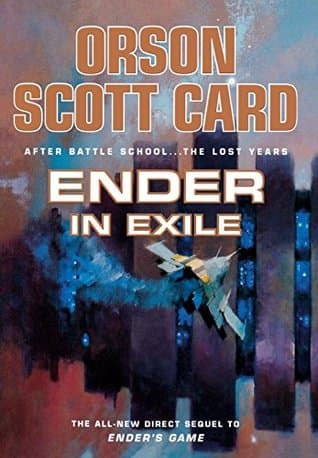
Orson Scott Card (2008)
Genre
Fantasy / Science Fiction / Young Adult
Reading Time
300 min
Key Themes
See below
Sign in to track this book
Haunted by his past as humanity's savior, Ender Wiggin embarks on an interstellar quest for redemption, only to find himself entangled in new political intrigue and the target of a vengeful colonist determined to destroy his hard-won peace.
After the Bugger War, Ender Wiggin, now revered as the Savior of Earth but also feared, chooses exile over becoming a political pawn for his brother, Peter Wiggin (the Hegemon). He embarks on a relativistic journey with his sister, Valentine, and a group of colonists aboard the colony ship 'Shakespeare.' During the decades-long voyage, Valentine, under the pseudonym Demosthenes, writes the first volume of her history of the Bugger Wars, transmitting it back to Earth via ansible. Ender, meanwhile, forms bonds with the colonists and begins to process his trauma. He also carries the nascent AI, later known as Jane, within his mind. Their destination is the first human colony world, also named Shakespeare, where Ender is expected to serve as governor.
Upon arrival at Shakespeare, Ender is installed as the first governor. He dedicates himself to establishing a peaceful and functional society, mediating disputes and encouraging cooperation among the diverse colonists. His leadership style, marked by empathy and a commitment to justice, earns him the respect and affection of the settlers, a stark contrast to his reputation on Earth. During his exploration of the planet, Ender discovers a dormant pupa of a Bugger Hive Queen, a shocking revelation. He realizes that the xenocide was not complete and that he carries the last hope for the Bugger species, placing an immense burden of responsibility upon him.
Ender realizes that Shakespeare is not a suitable long-term habitat for the Hive Queen due to its established human population and the risk of discovery. He resigns his governorship, entrusting the colony to its people, and embarks on a new quest: to find a world where the Bugger species can be reborn in peace and isolation. Valentine, who has returned to Earth to continue her writing and influence politics under Demosthenes, remains in contact with Ender via ansible, keeping him informed of Peter's machinations and the shifting political situation. This connection reminds Ender that even in exile, Earth's shadow still looms large.
Ender's starship, 'The Wanderer,' arrives at the Ganges colony world, a planet known for its unique flora and fauna and its established human settlement. The current governor, Umbo, is a former high-ranking officer in the Hegemony military and a veteran of the Bugger Wars. Umbo holds a deep-seated resentment towards Ender, viewing him as a dangerous figure, a child killer, and a potential threat to his authority. He believes Ender's presence is a Hegemony ploy to undermine his rule or even a direct challenge. Umbo immediately isolates Ender, restricts his movements, and begins to subtly turn the colonists against him, creating an atmosphere of distrust.
The political tension on Ganges increases with the arrival of Admiral Jakt, a powerful military figure sent by the Hegemon (Peter Wiggin). Jakt's true agenda is ambiguous, but he seems to be testing Ender, possibly to gauge his loyalty or to eliminate him if he proves to be a liability. Umbo attempts to use Jakt's presence to his advantage, hoping to get rid of Ender permanently. Meanwhile, Ender, despite being aware of the danger, remains focused on his secret mission to find a suitable home for the Hive Queen. The political maneuvering forces Ender to navigate a treacherous situation of alliances and betrayals.
Among the Ganges colonists, an ambitious young woman named Abra emerges as an antagonist to Ender. Abra, a former student of Umbo, is loyal to him and believes Ender is a threat to the colony's peace and Umbo's leadership. She begins to actively undermine Ender's reputation, spreading rumors and manipulating events to paint him as a dangerous, unstable figure. Abra's actions worsen existing divisions within the colony, creating factions that either support or oppose Ender. Her cunning and strategic mind make her a significant challenge for Ender, who is more accustomed to direct confrontation than subtle political warfare.
Through his direct mental connection, the dormant Hive Queen communicates with Ender, sharing the history of her species and their regret for the misunderstanding that led to the Bugger Wars. She conveys their peaceful nature and their desire to find a new home where they can live without fear of human destruction. This communication deepens Ender's resolve to protect the Queen, but also intensifies his dilemma: how to find a safe haven for her while navigating the treacherous political situation of Ganges and the persistent threat from Earth's Hegemony. He feels the weight of two species' fates resting on his young shoulders.
Through careful observation and strategic conversations, Ender uncovers the true nature of Admiral Jakt's mission. Jakt is not merely an enforcer but a scout for Peter Wiggin, tasked with assessing the loyalty and stability of the colony worlds. Peter's ultimate goal is to establish a unified human empire under his control, and any independent-minded colony or potential rival, like Ender, must be dealt with. Ender realizes that his exile is not truly an escape but a strategic placement by Peter, who intends to use him as a figurehead or eliminate him if he proves too independent. This revelation confirms the enduring reach of Earth's politics.
Ender, recognizing that Umbo's hostility stems from misunderstanding and fear, seeks a direct confrontation. He reveals the truth about his role in the Bugger War, his remorse, and his true mission to find a safe home for the Hive Queen. He explains his intention to leave Ganges peacefully and not to interfere with Umbo's governance. This honest and vulnerable exchange, combined with the intervention of other colonists who have come to trust Ender, begins to chip away at Umbo's prejudice. A fragile truce is established, and Umbo, still wary but less hostile, agrees to allow Ender to continue his search.
Despite Umbo's softening stance, Abra remains unconvinced and stages a final, desperate attempt to expose Ender as a threat. Her plan involves public accusations and manipulation of evidence, but Ender, with the help of Jane (the AI) and his growing support among the colonists, counters her claims. During the confrontation, Ender's genuine empathy and commitment to peace are clear. Abra, witnessing his integrity firsthand and seeing the positive impact he has had, begins to question her own prejudices. In a moment of realization, she understands the depth of Ender's burden and the purity of his intentions, leading to her eventual change of heart.
Through tireless exploration and the advanced capabilities of Jane, Ender discovers a pristine, uninhabited planet ideally suited for the re-establishment of the Bugger species. This world, rich in unique ecosystems and far from human interference, represents the culmination of his quest. He carefully transports the Hive Queen pupa to this new home, ensuring its safety and providing the conditions necessary for its awakening and the eventual rebirth of the Bugger civilization. This act solidifies Ender's role as the 'Speaker for the Dead' and sets the stage for the events of the next book, offering hope for interspecies understanding.
With the Hive Queen safely re-established on her new world, Ender prepares to leave Ganges. He has faced down political intrigue, personal animosity, and the lingering trauma of his past, emerging with renewed purpose. He bids farewell to Umbo, Abra, and the other colonists, leaving behind a more unified and understanding community. Ender's journey continues, now not just as an exile but as the 'Speaker for the Dead,' a role he embraces with responsibility. He is committed to speaking the truth of all beings, understanding their lives, and facilitating peace, forever carrying the burden of xenocide and the hope of redemption.
The Protagonist
Ender evolves from a guilt-ridden exile to a more confident and compassionate leader, embracing his role as the 'Speaker for the Dead' and finding purpose in protecting the Bugger species.
The Supporting
Valentine solidifies her role as a powerful intellectual and political influencer, while also remaining Ender's steadfast confidante and protector.
The Antagonist
Peter continues to consolidate his political power on Earth, his manipulative nature remaining a constant threat to Ender's freedom and peace.
The Supporting
Umbo transitions from a prejudiced and antagonistic governor to a more understanding and accepting leader who forms a fragile alliance with Ender.
The Supporting
Abra evolves from a determined antagonist to an enlightened supporter of Ender, realizing the truth of his character and mission.
The Supporting
Jakt remains a loyal agent of the Hegemon, serving as a catalyst for conflict and revealing Peter's ongoing ambitions.
The Supporting
The Hive Queen remains dormant for much of the story, serving as the central motivation for Ender's journey, until she is finally given a chance for rebirth on a new world.
The Supporting
Jane develops from a nascent AI to a more sophisticated and integral companion, proving her value as an intelligent and loyal assistant to Ender.
The Mentioned
Miro's role is primarily to demonstrate the positive impact Ender had as governor of Shakespeare.
The Mentioned
Novinha is introduced as a child, setting the stage for her future role in Ender's life.
Ender's entire journey in 'Ender in Exile' is driven by his guilt over the xenocide of the Buggers. He seeks atonement not through self-punishment, but by dedicating his life to ensuring the survival and rebirth of the last Hive Queen. This theme appears in his tireless search for a suitable planet, his willingness to endure political hostility, and his embrace of the 'Speaker for the Dead' role. His actions, from mediating disputes on Shakespeare to confronting Umbo and Abra, are all informed by a desire to make amends and prove his capacity for good.
“He had done the unforgivable, and now he would spend his life undoing it, one small act of kindness at a time.”
Ender struggles constantly with his identity as 'Ender Wiggin, the xenocide.' His past actions and the legend surrounding him precede him wherever he goes, making it difficult for him to form new relationships or simply live in peace. On Ganges, Governor Umbo and Abra's hostility is entirely based on Ender's reputation, forcing him to continually explain and defend himself. This theme explores how a person's past, especially one as traumatic as Ender's, can define and constrain their present, even in distant parts of the galaxy. Ender's journey is about proving that he is more than just his most infamous act.
“They knew him as the child killer, the xenocide, the savior of Earth. But he was just Ender, a boy who wanted to find a home for a queen.”
Despite Ender's physical exile from Earth, the political maneuvering of his brother, Peter Wiggin (the Hegemon), relentlessly pursues him. Peter's ambition to control all human colonies and consolidate his power is a constant undercurrent. Admiral Jakt's mission to Ganges, Valentine's political activities on Earth, and the general suspicion Ender faces from colonial governors like Umbo, all show the pervasive nature of political power. Ender's attempts to remain independent are continually challenged by the Hegemony's desire for control, demonstrating that true escape from politics is nearly impossible.
“Even in the farthest reaches of space, Peter's shadow stretched long and cold.”
A core theme is the importance of empathy and the ability to understand 'the other.' Ender's unique ability to connect with the Bugger Hive Queen, to truly understand her species' perspective, drives his mission. He applies this same empathetic approach to his interactions with hostile humans like Umbo and Abra, seeking to understand their fears and motivations rather than simply retaliating. The eventual reconciliation with these characters shows the power of empathy in bridging divides and overcoming prejudice, advocating for communication over conflict.
“To truly understand, to speak for the dead, meant to put yourself in their place, to feel their life, their death.”
Ender is repeatedly placed in positions of leadership, first as governor of Shakespeare and then as the guardian of the Bugger species. He grapples with the immense responsibility that comes with these roles, always striving to act justly and for the greater good. His leadership style is characterized by humility, strategic thinking, and a deep concern for the well-being of those under his care, whether human colonists or the last Bugger. This theme explores the moral complexities of leadership, especially when one's decisions have far-reaching consequences for entire species.
“He did not want to lead, but leadership was thrust upon him, and he bore it with a quiet, heavy grace.”
Instantaneous communication device connecting distant worlds.
The ansible is a fictional device that allows for instantaneous communication across interstellar distances, regardless of the relativistic effects of space travel. In 'Ender in Exile,' it serves as a critical link between Ender in the colonies and Valentine on Earth. It allows Valentine to transmit her 'Demosthenes' writings and keep Ender informed of Peter's political maneuvers, and for Ender to receive updates. This device is essential for maintaining the connection between the exiled protagonist and the political landscape he seeks to escape, highlighting that true isolation is impossible in this universe.
A physical symbol of Ender's guilt and his mission for redemption.
The dormant pupa of the last Bugger Hive Queen is a tangible plot device that embodies Ender's central conflict and mission. It is the physical manifestation of his xenocide and, simultaneously, the focus of his atonement. Carrying it with him, Ender is constantly reminded of his past and his responsibility. The pupa's existence drives the entire plot, forcing Ender into exile and through various colony worlds in search of a suitable home. Its eventual re-establishment represents the hope for reconciliation and new beginnings.
A scientific principle shaping the timeline and character development.
Relativistic travel, where time passes differently for those traveling near light speed compared to those on stationary planets, is a fundamental aspect of the narrative. It explains why Ender, though only a few years older, finds decades have passed on Earth, allowing Peter to rise to power and Valentine to become Demosthenes. This device creates a temporal disconnect, emphasizing Ender's isolation and the irreversible changes that occur in his absence. It also contributes to his sense of being 'out of time' with Earth's politics and society.
A narrative technique providing insight into Ender's thoughts and an essential source of information.
Ender's internal thoughts and his developing mental connection with the nascent AI, Jane, serve as a crucial narrative device. This allows the reader direct access to Ender's guilt, his strategic thinking, his emotional struggles, and his burgeoning empathy. Jane, initially a voice in his head, becomes an invaluable source of information and analysis, helping Ender navigate political traps and find suitable planets. This device underscores Ender's intelligence and his unique ability to connect with non-human intelligences, reinforcing his eventual role as the Speaker.
A foreshadowing and thematic anchor for Ender's future role.
Though the formal title 'Speaker for the Dead' isn't fully established until later books, its underlying concept is central to 'Ender in Exile.' Ender's desire to understand the Buggers from their perspective, to speak their truth, and to find them a new home, lays the groundwork for this future role. His empathetic approach to understanding all beings, even his enemies, foreshadows his dedication to speaking the true story of those who have died. This concept provides a thematic anchor for Ender's journey of atonement and purpose.
“In the moment when I truly understand my enemy, understand him well enough to defeat him, then in that very moment I also love him.”
— Ender reflecting on his relationship with the Formics and his own actions.
“Humanity does not ask us to be happy. It merely asks us to be brilliant on its behalf.”
— A conversation about the expectations placed on Ender and other gifted children.
“The enemy's gate is down.”
— A reference to Battle School tactics, used metaphorically for overcoming obstacles.
“We are what we are, and we're doing the best we can. It isn't a very good best, but we're doing it.”
— A character discussing human flaws and efforts in the face of imperfection.
“The power to cause pain is the only power that matters, the power to kill and destroy, because if you can't kill then you are always subject to those who can, and nothing and no one will ever save you.”
— A dark reflection on the nature of power and survival in the universe.
“You think you're the first to love a bugger?”
— A surprising revelation about another character's connection to the Formics.
“It's not the world that's cruel, it's the people in it.”
— A discussion on morality and responsibility in human society.
“The only way to keep a secret is to never tell anyone, not even yourself.”
— Advice given about handling sensitive information and self-deception.
“We are all just stories in the end.”
— A philosophical moment about legacy and the nature of existence.
“You can't make people love you, but you can make them fear you, and that's almost as good.”
— A cynical view on leadership and control among characters.
“Home isn't where you're from, it's where you're needed.”
— Ender contemplating his sense of belonging after his exile.
“The difference between a child and an adult is that an adult knows when to be afraid.”
— Reflection on maturity and the burdens of knowledge.
“We are all monsters, in our own way. The trick is to be the monster that does the least harm.”
— A moral dilemma about the compromises of power and action.
“Hope is the thing that gets you killed, but it's also the only thing worth living for.”
— A paradoxical statement about the dangers and necessity of hope.
Ready to see how well you understood this book? Take our interactive quiz with 10 questions.

Orson Scott Card is an American writer known best for his science fiction works. He is the first and only person to win both a Hugo Award and a Nebula Award in consecutive years, winning both awards for both his novel Ender's Game (1985) and its sequel Speaker for the Dead (1986). A feature film adaptation of Ender's Game, which Card co-produced, was released in 2013. Card also wrote the Locus Fantasy Award-winning series The Tales of Alvin Maker (1987–2003).







