“He understood then that they were all in the same boat, all of them, and that the only thing that mattered was to keep rowing.”
— Brady Hartsfield's manipulations and the characters' shared struggle.

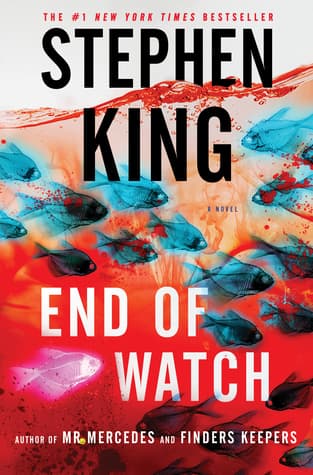
Stephen King (2016)
Genre
Thriller / Fantasy / Mystery
Reading Time
540 min
Key Themes
See below
Sign in to track this book
A comatose serial killer, now with psychic powers, causes a wave of suicides from his hospital bed, making retired detective Bill Hodges and his team face a final, supernatural fight to save a city.
Five years after the Mercedes Massacre, Brady Hartsfield is in Room 217 of the Lakes Region Traumatic Brain Injury Clinic, seemingly in a coma. However, his doctors don't know that Brady has woken up with strong psychic powers. He can project his mind into others, controlling their thoughts and actions, even making them commit suicide. He practices on hospital staff and other patients, improving his control. Dr. Felix Babineau, Brady's main doctor, starts to notice strange things and an unusual brain wave pattern, but thinks it's a breakthrough in his experimental treatment, unaware of the truth.
Retired detective Bill Hodges, now running 'Finders Keepers' investigations with Holly Gibney, goes to the scene of Peter Huntley's apparent suicide. Huntley, a Mercedes Massacre survivor, shot himself after playing a video game called 'Zappit.' Hodges finds a Zappit console nearby and feels something is wrong, noticing how calm Huntley's suicide note is and how random the act seems. The link to the Mercedes Massacre immediately worries Hodges, who knows Brady Hartsfield is alive, though in a coma.
More suicides start to happen, all involving people who were either victims or connected to the Mercedes Massacre, and all had recently played the 'Zappit' game. Hodges and Holly begin to make a list, realizing this is not a coincidence. They ask Jerome Robinson, Hodges's young friend and computer expert, to investigate the 'Zappit' game. Jerome discovers that 'Zappit' is a new, highly addictive game that uses hidden messages, meant to be given out through free tablets from a company called 'InFact.' Hodges suspects Brady is behind it, using the game to spread his psychic influence.
Holly, while researching the 'Zappit' game, plays it briefly and feels a disturbing, quick sense of control and dark thoughts, confirming Hodges's suspicions about its harmful nature. Meanwhile, Jerome, looking deeper into the game's code and distribution, accidentally gets Brady's attention. Brady tries to influence Jerome's sister, Barbara, to hurt him, but Barbara's strong will and love for her brother help her resist most of the compulsion, though she is deeply troubled by the experience.
Dr. Babineau, increasingly worried by Brady's brain activity and the strange events, starts to confide in Hodges. He shares details about Brady's difficult childhood, his abusive mother, and the trauma that shaped him. Babineau guesses that Brady's dormant psychic abilities might have woken up or gotten stronger because of the experimental drug he gave, though he doesn't fully understand how evil Brady is. This information helps Hodges and Holly understand Brady's deep depravity and his long-held desire for revenge.
Through Jerome's continued investigation, Hodges, Holly, and Jerome find out the full extent of Brady's plan. He plans to give out thousands of 'InFact' tablets pre-loaded with 'Zappit' to children and teenagers across the city, especially targeting a big rock concert. His goal is to cause a mass suicide, much larger than the Mercedes Massacre, as a final act of revenge against society. This discovery makes their mission more urgent, as they realize they are racing against time to prevent a huge disaster.
Adding to the immense pressure, Bill Hodges's health gets much worse. He is diagnosed with pancreatic cancer, which is getting worse quickly. This personal fight mixes with his professional one, making his pursuit of Brady Hartsfield not just a duty, but a race against his own death. His illness makes him more vulnerable to Brady's psychic attacks, and he feels more tired and in pain, but his determination to stop Brady remains strong, driven by a desire to protect his friends and the city.
Knowing he has little time, both for himself and for the city, Bill Hodges decides on a desperate step. He goes to the Lakes Region Traumatic Brain Injury Clinic to confront Brady Hartsfield directly. He enters Room 217, where Brady seems to be in a coma. Hodges, now very ill, begins a mental battle with Brady, using his own willpower and his intense hatred for the killer as a weapon. He fights against Brady's psychic projections and attempts to control him, enduring great mental and emotional stress.
During the intense psychic fight in Room 217, Hodges, weakened by cancer, realizes that the only way to truly stop Brady and prevent the mass suicide is to kill Brady. With a burst of willpower, he grabs a pillow and smothers Brady Hartsfield. In doing so, Hodges uses his last bit of strength. He collapses, having finished his final mission. Brady's terror is finally over, but at the cost of the detective's own life, a sad and heroic end to his long battle.
Afterward, Holly Gibney and Jerome Robinson are heartbroken by Bill Hodges's death. They mourn their friend and mentor but also find new purpose. The 'Zappit' tablets are recalled, and the city is saved from Brady's terrible plan. Holly, having grown significantly with Hodges's guidance, takes over 'Finders Keepers' and continues his work, carrying on his legacy of seeking justice. Jerome, though still young, provides important tech support, ensuring that Hodges's spirit of watching out for evil lives on through them.
The Protagonist
From a suicidal recluse, Hodges finds purpose and ultimately sacrifices himself to stop Brady Hartsfield, achieving redemption.
The Antagonist
Brady evolves from a physical killer to a psychic manipulator, seeking ultimate revenge until his final defeat.
The Supporting
From a timid, dependent woman, Holly transforms into a confident, independent investigator, capable of leading and carrying on Hodges's legacy.
The Supporting
Jerome matures from a talented teenager to a vital member of the investigative team, facing real danger and contributing significantly to stopping evil.
The Supporting
From a hopeful scientist, Babineau becomes a horrified witness to Brady's true nature, burdened by his unwitting role in unleashing the terror.
The Mentioned
Barbara experiences a brief, terrifying encounter with supernatural evil, highlighting the pervasive threat, but ultimately remains unharmed.
The novel shows how evil can change and adapt, moving from physical violence to mind control. Brady Hartsfield, first a killer, becomes a psychic being, proving that evil isn't limited by physical form or closeness. His ability to cause suicide through a simple video game, 'Zappit,' shows how modern technology can become a new weapon for old evils. This theme highlights King's exploration of both human wickedness and supernatural horror, showing evil's widespread and harmful nature.
“What he had done before was a warm-up. This was the main event.”
Bill Hodges's journey through the trilogy is one of redemption. Starting as a suicidal, retired detective, he finds purpose in chasing Brady Hartsfield. In 'End of Watch,' his fight against his own terminal illness mixes with his final confrontation with Brady. Hodges ultimately gives his life to stop Brady's mass suicide plan, choosing to die a hero rather than give in to his illness or Brady's influence. His sacrifice shows his strong moral compass and his deep commitment to protecting others, even at the highest cost.
“He would die, but not without taking the bastard with him.”
The novel looks at how everyday technology can be used for bad purposes. Brady Hartsfield uses the 'Zappit' video game, given out on free tablets, to spread his psychic control. This shows how vulnerable a technology-dependent society is and how seemingly harmless digital entertainment can be used for harm. The story warns about the dark side of technological progress, where privacy and mental health can be hurt through digital means, making the threat feel very current.
“The game was the delivery system, the sugar coating on the poison pill.”
Amidst the darkness, the lasting power of human connection and friendship is a main theme. The bond between Bill Hodges, Holly Gibney, and Jerome Robinson is what finally stands against Brady Hartsfield's evil. Their combined strengths—Hodges's experience, Holly's intuition, and Jerome's tech skills—are key to finding and fighting Brady's plan. Their mutual support, loyalty, and love for each other give them emotional strength against Brady's psychological attacks and motivate them to keep fighting, even when facing huge challenges and personal loss.
“They were a team, and that was something Brady Hartsfield would never understand.”
Brady Hartsfield's ability to control minds and induce suicide.
Brady Hartsfield develops the ability to project his consciousness into others, manipulating their thoughts, emotions, and actions. This allows him to induce suicidal ideation, particularly through the 'Zappit' game, without ever leaving his hospital bed. This device elevates Brady from a conventional serial killer to a supernatural threat, making him virtually untouchable by traditional law enforcement. It creates a pervasive sense of dread, as anyone could potentially become a victim, and makes the confrontation with Hodges a battle of wills rather than physical strength.
A seemingly innocent video game used as a conduit for psychic influence.
The 'Zappit' game, distributed on free 'InFact' tablets, serves as the primary mechanism for Brady's psychic attacks. It's designed to be addictive and contains subliminal messages that make players susceptible to his influence. This device grounds the supernatural threat in a tangible, contemporary form, highlighting the dangers of unchecked technology and mass media. It allows Brady to scale his plan for revenge to a city-wide catastrophe, making the stakes incredibly high and the threat insidious, as it targets unsuspecting children and teenagers.
The protagonist's battle with pancreatic cancer adds urgency and personal stakes.
Bill Hodges's diagnosis of terminal pancreatic cancer is a crucial plot device. It introduces a ticking clock for the protagonist, intensifying the urgency of stopping Brady Hartsfield. His deteriorating health makes him more vulnerable to Brady's psychic attacks and forces him to confront his own mortality, elevating the final confrontation to a deeply personal and sacrificial act. This device amplifies the emotional impact of the story, making Hodges's ultimate sacrifice more poignant and heroic as he races against both an external and internal enemy.
“He understood then that they were all in the same boat, all of them, and that the only thing that mattered was to keep rowing.”
— Brady Hartsfield's manipulations and the characters' shared struggle.
“The past is a ghost, the future a dream, and all we ever have is now.”
— Reflections on time and existence amidst the ongoing threat.
“Sometimes the only way to beat the devil is to become a little bit of a devil yourself.”
— Bill Hodges contemplating the lengths he might need to go to stop Brady.
“The world was a beautiful place, even with all its sharp edges and hidden dangers.”
— A moment of appreciation despite the surrounding darkness.
“It was impossible to kill a thought, even a bad one. It just changed shape.”
— The persistence of evil and negative influences.
“There are no ordinary people. Everyone has a story, a universe inside them.”
— Holly Gibney's growing understanding of human complexity.
“Fear was a powerful weapon, especially when wielded by someone who understood its nuances.”
— Brady Hartsfield's psychological tactics.
“Hope was a fragile thing, easily shattered, but sometimes it was all you had.”
— Characters clinging to hope in dire circumstances.
“The end of one watch was just the beginning of another.”
— A recurring theme about the ongoing fight against evil.
“Some monsters were born, others were made, and some just grew in the darkness of neglect.”
— Exploring the origins of evil and Brady Hartsfield's past.
“The greatest trick the devil ever pulled was convincing the world he didn't exist.”
— Discussing the insidious nature of evil, referencing a common saying.
“You never knew how strong you were until being strong was the only choice you had.”
— A character facing an ultimate test of their resolve.
“The brain was a maze, and sometimes even its owner got lost inside.”
— Brady Hartsfield's complex and disturbed mental state.
“Death was not the end, but merely a doorway to something else.”
— The supernatural elements and the continuation of consciousness.
Ready to see how well you understood this book? Take our interactive quiz with 10 questions.

Stephen Edwin King is an American author of horror, supernatural fiction, suspense, crime, science-fiction, and fantasy novels. Described as the "King of Horror", his books have sold more than 350 million copies as of 2006, and many have been adapted into films, television series, miniseries, and comic books. King has published over 65 novels/novellas, including seven under the pen name Richard Bachman, and five non-fiction books. He has also written approximately 200 short stories, most of which have been published in book collections.







