“The greatest mystery is not that we are in this universe, but that this universe is in us.”
— A philosophical reflection on the nature of existence and consciousness.

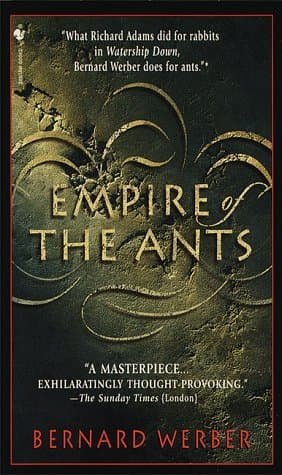
Bernard Werber (1996)
Genre
Fantasy / Science Fiction
Reading Time
320 min
Key Themes
See below
Sign in to track this book
A family's forbidden trip into a cellar starts a war with a smart ant civilization, making both species face their shared future and what survival means.
Jonathan Wells, his wife Lucie, and their son Nicolas move into the Paris apartment at 3, rue des Sybarites, inherited from Jonathan's Uncle Edmond. The apartment is dusty and full of strange machines, showing Edmond's quiet and scientific nature. With the property, they get a strong, unclear warning: 'Never go down into the cellar.' At first, the family thinks this is another of Edmond's odd habits, but the unusual feel of the building and the warning's mystery start to make them curious, setting the stage for the strange events to come. Jonathan, a former journalist, is especially interested in his uncle's hidden life.
The Wells family's dog, Othello, a golden retriever, slips past the cellar door and disappears into the dark below. Worried about his pet, Jonathan, despite the warning, feels he must follow. With a flashlight, he goes down the steps, calling for Othello. The cellar is unexpectedly large and like a maze, filled with strange equipment and a heavy silence. As Jonathan goes deeper, the air gets thick, and a strange sense of fear comes over him. He soon gets lost and, like Othello, vanishes, leaving Lucie and Nicolas alone and confused upstairs.
After Jonathan is gone for a long time, Lucie gets more and more worried. She tries to call the police, but her story of a vanishing cellar is met with doubt. Desperate, she decides to investigate herself, taking Nicolas with her. They go into the cellar, calling for Jonathan. The cellar's layout seems to change, confusing them. As they explore, Nicolas, drawn by a strange sound, separates from Lucie. Lucie eventually finds him near a strange, glowing device, but before she can reach him, both she and Nicolas are swallowed by an unseen force, disappearing just as Jonathan and Othello did. The apartment at 3, rue des Sybarites is now empty.
In a large pine stump in a park near the Wells' apartment, the well-organized and smart russet ant nation of Bel-o-kan thrives. The colony is a complex society with millions of ants, each with a specific job, communicating through chemical signals and antenna contact. They grow fungi, herd aphids for 'honeydew,' and keep up detailed tunnels. But a series of strange deaths has begun to affect the colony, especially among ants looking for food. These deaths are blamed on an invisible, odorless weapon, causing confusion and fear among the ants, threatening their survival and prompting investigation by the colony's smartest members.
Among the many ants of Bel-o-kan, a young female ant, 103683, has an unusual curiosity and intelligence, making her different from her peers. She feels that her purpose goes beyond the usual tasks of a worker. She is deeply troubled by the unexplained deaths in her colony and feels a strong need to understand why. This natural drive for knowledge and her ability to think beyond immediate needs mark her as a possible future leader. She starts to watch her surroundings more closely and questions the usual ways, setting her on a path of discovery and leadership.
Because of the urgent mysterious deaths, 103683 decides she must investigate the source of the danger. She gets help from a skilled warrior ant, 327, known for his bravery and smart thinking. They agree to separate, believing two independent investigations might get results faster. 327 goes towards the 'edge of the world' – the dangerous and unknown area beyond the immediate colony, where the most dangerous threats are thought to be. 103683, meanwhile, focuses her investigation closer to the colony, trying to understand the 'invisible weapon' that is killing her comrades.
As 103683 and 327 go out, they face the harsh realities of the world outside their colony. They move through a dangerous landscape: fierce birds that grab ants from above, hungry lizards, and the constant threat of rival ant species like the fighting dwarf ants and greedy termites. They also have to deal with poisonous beetles, and the incredibly large, fast, and deadly 'monsters' known as 'cars' – giant guards of the 'edge of the world' that crush everything in their path. Each encounter sharpens their survival skills and expands their understanding of the vast, dangerous world beyond their nest.
103683's ongoing investigation into the mysterious deaths eventually leads her beyond the park's familiar borders. Her journey takes her through strange, man-made landscapes, ending with her finding the 'city of the giants' – the human world. She watches the huge buildings, the strange movements, and the odd behaviors of the 'fingers' (humans) that rule this place. This exposure to a completely different, very powerful civilization begins to change her understanding of the world and the possible source of the dangers facing her colony, hinting at a connection to the beings who live at 3, rue des Sybarites.
Through great effort and a series of dangerous encounters, 103683's quest eventually leads her to the cellar at 3, rue des Sybarites. Here, she uncovers the strange secret: the 'invisible weapon' and the disappearances are linked to Uncle Edmond's scientific work. The cellar has advanced equipment made to study and control ant behavior, including a complex 'ant farm' that traps and watches ants, and devices that emit the radiation causing the mysterious deaths in her colony. She also finds proof of the vanished humans, showing the true extent of the interaction between the two species.
Inside the cellar, 103683 meets the remaining human, a young girl named Laetitia, who is Uncle Edmond's daughter and was also trapped. Despite the huge size difference and the natural fear of the 'giants,' 103683, driven by her intelligence and the need to save her colony, tries to communicate. This 'unthinkable connection' is a key moment, as both species, through their shared problem and a desperate need to survive, begin to close the large communication gap. 103683 realizes that understanding and perhaps even working with humans might be the only way to ensure her ant nation's future.
Having learned much about the human world and its dangers, 103683 returns to the Bel-o-kan colony. Her experiences have changed her; she is no longer just a smart worker but a leader with vision. She uses her new understanding to guide her colony, preparing them for future interactions with humans and changing their survival plans. Her unique journey and insights confirm her place as a natural leader, and she is set to become the new queen, bringing in a time of new understanding and smart adaptation for the Bel-o-kan nation, forever changed by its meeting with humanity.
The Protagonist
She transforms from an inquisitive worker ant into a visionary leader and eventually, a queen, guiding her colony with newfound knowledge of the human world.
The Protagonist (initial)
His initial curiosity leads to his disappearance, making him a victim of the cellar's secrets and a symbol of human vulnerability to the unknown.
The Supporting
Her concern for her family leads her into the cellar, where she, too, becomes a victim, emphasizing the cellar's mysterious power.
The Supporting
His childlike curiosity leads him into danger, becoming another victim of the cellar's secrets.
The Mentioned/Supporting
His past scientific endeavors, though unseen, directly shape the present conflict and the interaction between humans and ants.
The Supporting
He serves as a brave explorer and protector, showcasing the physical challenges and dangers of the ant world.
The Supporting
Initially a victim of her father's legacy, she becomes a bridge for communication and understanding between humans and ants.
The novel looks at the big challenges and possible benefits of communication between very different species. Ants, with their chemical signals and antenna contact, and humans, with their spoken language, live in separate sensory worlds. The story shows humanity's arrogance in thinking its intelligence is unique, while also showing the complex societies and individual intelligence within the ant colony. The 'unthinkable connection' between 103683 and Laetitia in the cellar is the best example of this theme, suggesting that empathy and shared survival can bridge even the deepest biological and mental differences, as seen when 103683 brings back important information about humans to her colony.
“What if the true rulers of Earth were not those who built cities of concrete, but those who moved mountains of earth?”
Werber questions human-centered views of civilization by showing the ant colony of Bel-o-kan as a very advanced, complex society with its own laws, economy, military, and even art and philosophy. The novel carefully details the ants' social structure, their farming (aphid herding, fungal growing), and their war strategies, making the reader rethink what 'civilization' means. The ants' group intelligence and their ability to adapt and create are compared with human individualism, asking which form of intelligence is truly better or more lasting. This theme is clear in the ants' smart response to the mysterious deaths, using their resources for investigation.
“They were an organism of millions of cells, each with its own task, yet all acting as one. Was this not a more perfect form of society?”
The novel quietly criticizes humanity's often destructive and unaware impact on nature. Uncle Edmond's experiments, while driven by scientific curiosity, accidentally cause disaster in the ant colony. The 'invisible weapon' of radiation and the giant 'cars' that crush ants are human creations, showing how human actions, often unplanned or unconsidered, can have terrible results for other species. The story makes us think about humanity's responsibility towards other life forms and the environments it lives in, highlighting how little humans understand about the delicate balance of nature they so easily upset, as seen in the casual destruction of ant groups looking for food by unknown forces.
“The giants lived in a world of their own making, oblivious to the smaller universes they trampled underfoot.”
At its heart, the book is a story of survival against huge odds. Both the Wells family and the Bel-o-kan colony face threats to their existence. The ants, especially, show great strength and ability to adapt when facing predators, rival species, and the mysterious 'weapon.' Their group problem-solving and willingness to send out explorers like 103683 and 327 show their drive to survive and change. The theme extends to the human characters trapped in the cellar, forced to adapt to their terrible situation. This constant fight for life and the new ways both species respond to challenges are central to the story's tension.
“To survive was to constantly learn, to constantly adapt, to never yield to the crushing weight of the unknown.”
Alternating perspectives between humans and ants.
The novel employs a dual narrative structure, switching between the human story of the Wells family and the ant story of the Bel-o-kan colony. This device allows the reader to experience the world from two vastly different scales and perspectives. It highlights the parallel struggles, the mutual ignorance, and the eventual intersection of these two civilizations. The juxtaposition of human domestic drama with the epic struggles of the ant world creates irony and deepens the thematic exploration of intelligence and civilization, allowing for a comprehensive view of the overarching mystery.
A forbidden space that acts as a portal and a scientific laboratory.
The cellar at 3, rue des Sybarites functions as a central plot device. It is initially presented as a forbidden, mysterious space, building suspense. It serves as a physical 'portal' between the human and ant worlds, where the two species' fates become intertwined. More importantly, it is revealed to be Uncle Edmond's advanced scientific laboratory, housing the experiments that cause the conflict. This device not only drives the plot by luring characters into danger but also provides the scientific explanation for the interspecies interaction and the source of the ants' plight.
Attributing human-like thoughts and motivations to ants to aid reader understanding.
While striving for biological accuracy, the novel utilizes a limited form of anthropomorphism for the ants. It grants them complex thoughts, emotions (like curiosity, fear, determination), and motivations that are relatable to human readers. This device is crucial for allowing the audience to empathize with the ants and understand their intricate society, making them compelling protagonists rather than mere insects. It helps bridge the conceptual gap between human and ant intelligence, enabling the exploration of themes like civilization and communication from an ant's perspective without fully humanizing them in a fantastical way.
An unseen threat to the ant colony, later revealed to be human-made radiation.
The 'invisible weapon' is a major source of conflict and mystery for the ant colony. Initially unexplained, it causes widespread deaths among foraging ants, driving 103683's quest for understanding. This device creates suspense and highlights the ants' vulnerability to forces beyond their comprehension. Its eventual revelation as human-generated radiation from Uncle Edmond's experiments serves as a powerful commentary on humanity's often unconscious and destructive impact on other species and the environment, tying the dual narratives together and revealing the true nature of the threat.
“The greatest mystery is not that we are in this universe, but that this universe is in us.”
— A philosophical reflection on the nature of existence and consciousness.
“Ants are not intelligent in the human sense. They are intelligent in the ant sense.”
— Describing the unique form of intelligence observed in the ant colony.
“To really understand a creature, you must try to think like it, feel like it, even if just for a moment.”
— A human character attempting to empathize with the ants to understand their world.
“Fear is the greatest enemy of knowledge.”
— A maxim highlighting the impediment fear poses to scientific discovery and learning.
“The true measure of a civilization is not its technology, but its ability to coexist with nature.”
— A critique of human civilization in contrast to the ants' more integrated existence.
“Every problem has at least three solutions: one that's obvious, one that's impossible, and one that's crazy enough to work.”
— A human character's approach to problem-solving, often requiring unconventional thinking.
“We are all just parts of a larger whole, whether we realize it or not.”
— Emphasizing the interconnectedness of all living things, especially in the context of the ant colony.
“The future belongs to those who adapt, not those who resist change.”
— A principle observed in the evolution and survival strategies of the ant species.
“Silence is not empty. It is full of answers.”
— A character seeking wisdom and understanding through quiet observation and contemplation.
“Sometimes, the greatest discoveries are made when you're looking for something else entirely.”
— Reflecting on serendipitous moments in scientific research and exploration.
“The world is full of wonders, if only we take the time to look.”
— Encouraging a sense of awe and curiosity about the natural world, particularly the unseen.
“To conquer, one must first understand.”
— A strategic principle applied by both human and ant characters in their respective conflicts.
“What we perceive as chaos, life perceives as opportunity.”
— A different perspective on seemingly disordered natural processes.
“The most dangerous illusion is that we are separate from the rest of life.”
— A central theme challenging anthropocentric views and highlighting ecological interdependence.
Ready to see how well you understood this book? Take our interactive quiz with 10 questions.
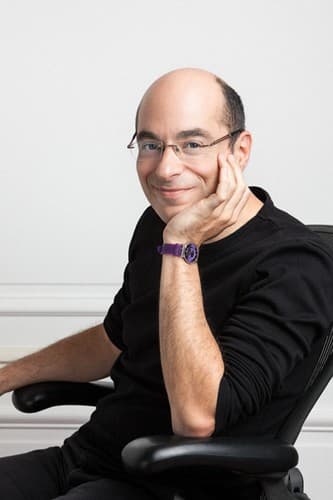
Bernard Werber is a French author celebrated for his imaginative blend of science fiction, philosophy, and humor. His most famous work, "Empire of the Ants," explores themes of societal structures and intelligence through the lens of ant colonies. Werber's novels often combine scientific concepts with profound existential questions, making him a unique voice in contemporary fiction.







