“The greatest treasures are not always gold and jewels, but the stories they tell, and the history they unlock.”
— Exploring an ancient site, contemplating the significance of archaeological finds.

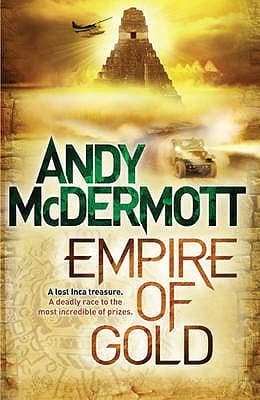
Andy McDermott (2011)
Genre
Thriller / Historical Fiction / Mystery
Reading Time
576 min
Key Themes
See below
Sign in to track this book
Archaeologist Nina Wilde and ex-SAS soldier Eddie Chase race through South American jungles, battling soldiers and cartels to unearth El Dorado before its gold falls into the wrong hands.
Archaeologist Nina Wilde and her husband, ex-SAS soldier Eddie Chase, are asked by Interpol agent Ricardo Perez to help identify smuggled artifacts. Nina recognizes a unique Inca ceremonial dagger and gold tablets with symbols. She realizes these are not just antiques but parts of a puzzle, pointing to a lost Inca city. The deciphered tablets form a partial map, reigniting their passion for discovery and leading them to a new, dangerous quest in South America.
Using the clues from the gold tablets, Nina and Eddie go deep into the remote Venezuelan jungle. Their journey has many challenges, including dense wilderness, natural obstacles, and suspicious local groups. With Eddie's survival skills and Nina's archaeological knowledge, they find a well-preserved, undiscovered Inca settlement. Nina identifies it as a possible outpost of Vilcabamba, the last Inca refuge. This discovery confirms their theory about the smuggled artifacts and strengthens their resolve.
Inside the newly found Inca city, Nina and Eddie find more artifacts and ancient texts. Nina deciphers these, realizing the first artifacts were part of a system meant to lead to something grander. The texts speak of a 'Golden King' and a 'City of Gold,' directly referencing El Dorado as a real place, not a myth. This discovery excites them, changing their mission from finding a lost city to pursuing one of history's greatest legends, believed to hold immense wealth and power.
As Nina and Eddie continue their quest, they attract unwanted attention. Colonel Vargas, a corrupt Venezuelan military officer, learns of their activities and the potential for vast treasure. Vargas and his soldiers intercept Nina and Eddie, thinking them trespassers. A tense confrontation follows, with Vargas demanding they reveal the gold's location. Nina and Eddie escape, but this encounter shows the growing danger and the powerful forces against them in their search for El Dorado.
On the run from Colonel Vargas, Nina and Eddie find themselves in territory controlled by a revolutionary group led by Mateo. Needing safe passage through the jungle and protection from both the military and criminals, Nina and Eddie reluctantly agree to a temporary alliance with Mateo's rebels. They offer their knowledge of ancient sites and treasures for safe conduct. This alliance is tense, as Mateo's true motives are unclear, always threatening to turn against them.
The path to El Dorado crosses with the operations of a drug lord, 'El Fantasma' (The Phantom), who controls much of the jungle. El Fantasma has his own network and learns of Nina and Eddie's search for treasure. He sees El Dorado as a source of wealth to fund his operations. Nina and Eddie are caught between El Fantasma's cartel and Colonel Vargas's military, making their jungle journey increasingly dangerous and forcing them into desperate actions.
Despite constant threats, Nina works to decipher the remaining ancient texts and maps. She discovers a complex system of astronomical alignments and geographical markers that point to a hidden location deep in the Amazon basin. This final breakthrough reveals that El Dorado is not a city in the usual sense, but a sacred site, perhaps a vast temple complex or a natural wonder adorned with gold. The clues describe a 'sacred trail' only those with proper knowledge can follow, confirming the legend's true nature.
With El Dorado's location pinpointed, the race intensifies. Colonel Vargas, El Fantasma, and even Mateo's revolutionaries, having learned enough from Nina and Eddie, are now heading to the same jungle coordinates. Nina and Eddie, though outmatched, want to protect El Dorado's historical importance and prevent its treasures from falling into the wrong hands. They must use their combined skills and ancient knowledge to outmaneuver their enemies and reach the city first, before its sanctity is destroyed.
After a difficult journey and a final confrontation with their pursuers, Nina and Eddie arrive at El Dorado. What they find is beyond imagination: not a city, but a stunning natural wonder, perhaps a massive cavern or hidden valley, integrated with ancient Inca architecture and adorned with natural gold and artifacts. The site's scale and beauty are overwhelming, confirming the legends and showing the Inca civilization's ingenuity and spiritual depth. The sight is both a triumph and a great challenge.
Colonel Vargas, El Fantasma, and their forces arrive, breaking the peace of El Dorado. A brutal battle erupts within the sacred site as each group tries to claim the treasure. Nina and Eddie, with surprising help from a changed Mateo, fight not for the gold, but to protect El Dorado from desecration. They use their knowledge of the site's ancient traps and combat skills to defend its integrity, understanding its true value is historical and cultural, not monetary. The legendary city's fate hangs in the balance.
The chaotic battle at El Dorado ends with heavy losses. Colonel Vargas and El Fantasma are defeated, their greed leading to their downfall. Nina and Eddie, though tired, succeed in preventing El Dorado's complete plunder. Interpol agent Ricardo Perez and a small, loyal group of Venezuelan military help secure the site. While El Dorado's full treasures remain secret, its location is now known. Nina and Eddie reflect on their journey, the dangers, and the impact of uncovering one of history's greatest legends, looking forward to future adventures.
The Protagonist
Nina evolves from an academic pursuer of history to a fierce protector of ancient sites, forced to employ combat skills she never envisioned needing.
The Protagonist
Eddie consistently uses his combat and survival skills to protect Nina, while also growing to appreciate the historical significance of their discoveries beyond mere survival.
The Antagonist
Vargas descends further into villainy, his greed ultimately leading to his downfall and the destruction of his forces.
The Antagonist
El Fantasma's pursuit of wealth leads him into direct conflict with Nina and Eddie, ultimately resulting in the loss of his empire and his life.
The Supporting
Mateo transitions from a self-interested ally to one who recognizes the greater good of protecting El Dorado, evolving into a more principled leader.
The Supporting
Perez grows to fully trust Nina and Eddie's methods, becoming a more active and supportive ally rather than just an official contact.
The novel explores how the promise of immense wealth, like El Dorado's gold, can drive people to incredible discoveries and terrible acts of violence. Colonel Vargas and El Fantasma show this, their pursuit of gold leading to betrayal and destruction. In contrast, Nina and Eddie seek El Dorado for its history, valuing knowledge over money. This highlights the different motivations people have when faced with such temptation. The story shows how greed can blind people to history's true value.
““Gold, for some, was a key to power; for others, it was simply the weight of history.””
A main conflict is between preserving ancient sites and exploiting them for personal gain. Nina Wilde's goal is to study and protect historical heritage, ensuring lost civilizations' stories are understood. Conversely, the antagonists—Colonel Vargas, El Fantasma, and initially some revolutionaries—see the Inca city and El Dorado as resources to be plundered. The story supports the ethical approach, showing the damage caused by greed and the importance of cultural stewardship.
““To plunder history was to erase it, to steal not just treasure, but the very soul of a people.””
The novel looks at the idea that many myths, like El Dorado, are based on some historical truth, even if exaggerated. Nina's archaeological work changes the mythical El Dorado from a fantasy to a real, hidden historical site. The story shows how deciphering ancient clues and separating fact from folklore can reveal the real origins of legends. It makes readers reconsider the line between myth and reality, suggesting the 'impossible' might just be undiscovered.
““Legends were not just stories; they were maps, waiting for the right eyes to read them.””
The Venezuelan jungle is a challenging setting, representing both the natural world's difficulties and the political instability of a region with corruption, military control, and revolutionary groups. Nina and Eddie constantly navigate dangerous terrain, wildlife, and human conflict. The presence of Colonel Vargas and El Fantasma shows the lack of central authority and the existence of illegal power structures, making the search for El Dorado a journey through a lawless and unpredictable place where alliances are weak and danger is everywhere.
““In the heart of the jungle, the lines between law and lawlessness blurred, and survival depended on knowing which side to trust.””
The elusive El Dorado, driving all character motivations.
El Dorado serves as the central MacGuffin in 'Empire of Gold.' While Nina Wilde is driven by the desire to uncover and preserve its historical significance, the antagonists—Colonel Vargas, El Fantasma, and even Mateo to some extent—are motivated by the immense wealth and power they believe the legendary city holds. The actual nature and location of El Dorado remain shrouded in mystery for much of the novel, constantly propelling the plot forward as various factions race to find it, creating conflict and setting the stage for the book's thrilling conclusion.
Initial focus on a 'lost Inca city' that leads to the greater mystery of El Dorado.
The initial investigation into smuggled artifacts suggests that Nina and Eddie are looking for a 'lost Inca settlement,' which serves as a red herring. While a lost city is indeed found (Vilcabamba), it is quickly revealed to be merely a stepping stone or a clue to the far grander and more legendary El Dorado. This device builds suspense by offering a seemingly significant discovery, only to then reveal an even larger, more tantalizing mystery, keeping both the characters and the reader engaged and surprised by the true scope of the quest.
Nina Wilde, an academic archaeologist, forced into combat and survival situations.
Nina Wilde, a brilliant archaeologist, often finds herself in 'fish out of water' scenarios. While she is intellectually adept at deciphering ancient clues, her natural environment is a library or a dig site, not the treacherous jungles of South America or intense firefights. Her reliance on Eddie's combat and survival skills highlights this contrast, forcing her to adapt quickly to life-threatening situations far removed from her academic comfort zone. This device adds tension and showcases her resilience and determination beyond her scholarly abilities.
Nina Wilde and Eddie Chase as foils to each other, and to the antagonists.
Nina Wilde and Eddie Chase act as foils to each other: Nina represents intellect, history, and preservation, while Eddie embodies action, survival, and protection. Their complementary skills are essential for their success. Furthermore, they serve as foils to the antagonists (Colonel Vargas, El Fantasma) who are driven by greed and destruction. This contrast highlights the novel's themes of preservation versus exploitation, and the moral choices characters make when faced with immense temptation. The clear distinction in their motivations underscores the story's core conflicts.
“The greatest treasures are not always gold and jewels, but the stories they tell, and the history they unlock.”
— Exploring an ancient site, contemplating the significance of archaeological finds.
“Sometimes, the only way to find what you're looking for is to stop looking where everyone else expects.”
— Navigating a complex puzzle or a misdirection set by an antagonist.
“Fear is a powerful motivator, but hope is an even stronger one, if you can find it.”
— Facing a life-threatening situation, reflecting on the psychological state of characters.
“History isn't just about dates and names; it's about the echoes of human ambition and folly.”
— Discussing the motivations behind historical figures and their impact.
“The past is never truly buried, not when there are secrets waiting to be unearthed.”
— Discovering a hidden chamber or a long-lost artifact.
“Loyalty is a rare commodity, especially when empires are at stake.”
— Questioning the allegiances of various characters involved in the search for the 'Empire of Gold'.
“Every legend has a kernel of truth, no matter how much it's been embellished over time.”
— Investigating ancient myths and trying to separate fact from fiction.
“The desert holds its secrets close, but it always leaves clues for those who know how to read them.”
— Navigating treacherous desert landscapes in search of a hidden location.
“There are some things worth dying for, and some things worth killing for. The trick is knowing the difference.”
— A moral dilemma faced by the protagonists as they confront dangerous adversaries.
“Power corrupts, but the pursuit of it can be even more destructive.”
— Observing the actions of an antagonist driven by greed and a lust for control.
“Sometimes the greatest discovery isn't what you find, but what you learn about yourself in the process.”
— Reflecting on personal growth and challenges faced during the adventure.
“The past is a weapon in the right hands, and a trap in the wrong ones.”
— Understanding how historical knowledge can be used for good or ill.
“Even the most impenetrable fortress has a weakness, if you know where to look.”
— Formulating a plan to infiltrate a heavily guarded location.
“Gold may buy empires, but it cannot buy immortality, only a legacy.”
— Contemplating the ultimate goals of those seeking the 'Empire of Gold' and the fleeting nature of material wealth.
Ready to see how well you understood this book? Take our interactive quiz with 10 questions.







