“The only thing that makes life worth living is the possibility of experiencing a similar, if not greater, joy to that which you felt in your first love.”
— Jorg reflects on life and love's enduring impact.

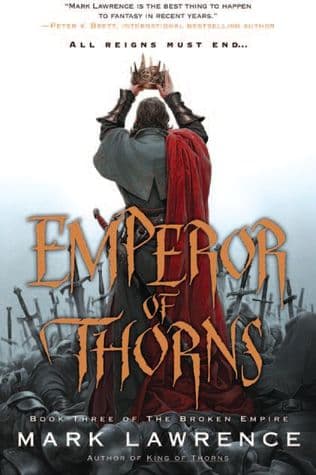
Mark Lawrence (2012)
Genre
Fantasy / Science Fiction
Reading Time
1000 min
Key Themes
See below
Sign in to track this book
To claim the emperorship by vote, the ruthless King Jorg must outmaneuver a legendary necromancer and harness lost technology, all while battling the intensifying demons of his past and the specter of his father's revenge.
Jorg Ancrath, having consolidated power over seven nations, sets out for the Grand Conclave, a gathering of kings and queens intended to elect an Emperor for the Broken Empire. He is accompanied by his loyal men, including Makin, and his wife, Miana. Jorg's primary motivation remains avenging the murder of his mother and brother by his father, King Olidan, and achieving ultimate power. Along the journey, Jorg reflects on his past and the brutal choices that led him to this point. He carries the weight of his actions and the ghosts of those he's killed, but his ambition burns brighter than ever. He also begins to encounter strange occurrences and whispers of the Dead King, hinting at a larger, more ancient threat than he initially anticipated.
As Jorg approaches the Conclave, he receives unsettling reports and encounters evidence of the Dead King's influence spreading across the land. The Dead King, a powerful necromancer, is not merely a rival for the throne but a being with a much more sinister agenda related to the ancient 'Builders' and their forgotten technology. Jorg learns that the Builders were not just a precursor civilization but also responsible for a catastrophic event that warped the world. The Dead King seeks to reactivate their most dangerous creations, specifically a device capable of altering reality itself. This revelation shifts Jorg's focus from mere political ambition to a desperate struggle for survival against a cosmic threat.
Upon arriving at the Conclave, Jorg finds himself amidst a den of vipers, with numerous kings and queens vying for the imperial crown. He employs his characteristic blend of intimidation, cunning, and calculated alliances to gain an advantage, but the political landscape is complicated by the omnipresent shadow of the Dead King. Powerful figures like the Prince of Arrow and other major rulers are either already under the Dead King's sway or are actively working against Jorg. Jorg navigates treacherous negotiations and subtle threats, all while trying to decipher the Dead King's ultimate plan and prevent him from seizing the Builders' technology, which would give him unimaginable power.
Makin, Jorg's most loyal companion, undertakes a dangerous mission to infiltrate the Dead King's growing army. This task forces Makin to make difficult choices and feign allegiance to the enemy, placing immense strain on his relationship with Jorg. He witnesses firsthand the horrifying scale of the Dead King's power and the twisted nature of his necromancy. Makin's mission is crucial for gathering intelligence, but it also puts him in direct peril and forces him to confront his own moral compass. Ultimately, Makin's actions, though appearing as a betrayal, are a testament to his deep loyalty and play a critical role in unraveling the Dead King's schemes.
Through various encounters, visions, and the guidance of figures like the Scholar, Jorg gains a deeper understanding of the Builders' civilization. He learns they were not just advanced but also hubristic, experimenting with reality-altering technology that led to a cataclysmic event, known as the 'Day of a Thousand Suns,' that reshaped the world and opened portals to other dimensions. The Builders' creations, including powerful weapons and the very fabric of the 'Broken Empire,' are revealed to be remnants of their failed attempts to manipulate existence. This knowledge is vital for Jorg to understand the Dead King's true goals and how to potentially stop him.
Jorg eventually discovers that the Dead King is a being from before the 'Day of a Thousand Suns,' a former Builder who survived the cataclysm and now seeks to use their ancient technology to 'reset' the world. His motivation stems from a deep grief and a desire to undo the mistakes of his past and the destruction wrought by his people. The Dead King believes that by reactivating the 'flicker-machine,' he can revert reality to a pre-cataclysmic state, effectively erasing the Broken Empire and all its inhabitants. This revelation paints the Dead King not just as a power-hungry villain, but as a tragic figure driven by immense loss and a misguided sense of redemption.
As the Conclave descends into chaos, the Dead King makes his move, unleashing his vast army of undead and manipulated forces. Jorg, despite his initial reluctance to unite with his former rivals, finds himself leading a desperate alliance of kings, queens, and their armies against the overwhelming threat. The battle is not just for the throne, but for the very existence of their world. Jorg employs every ounce of his tactical genius and ruthlessness, but the Dead King's power seems limitless. The stage is set for a climactic showdown, with the fate of the Broken Empire hanging in the balance, and Jorg facing his most formidable adversary yet.
The climax of the battle sees Jorg, accompanied by a small band of loyal companions, directly confronting the Dead King at the location of the 'flicker-machine' – the Builders' ultimate reality-altering device. This confrontation is not just a physical battle but a clash of ideologies and wills. Jorg must not only defeat the Dead King but also prevent him from activating the machine and erasing existence. The Dead King, through his advanced technology and necromancy, proves to be a formidable opponent, forcing Jorg to push his limits and make unimaginable sacrifices. The fate of the world rests on Jorg's ability to overcome this ancient and powerful foe.
During the confrontation, Jorg is presented with a choice regarding the flicker-machine. He could potentially use its power for his own ends, to undo past mistakes, or even to claim ultimate dominion. However, understanding the catastrophic implications of its use, Jorg makes a selfless decision. He, with the help of his allies and the remnants of the Builders' technology, manages to disable or destroy the flicker-machine, preventing the Dead King's plan to reset reality. This act signifies a change in Jorg's character, moving beyond pure self-interest towards a genuine desire to protect the world, albeit in his own brutal way. The cost of this victory is immense, both personally and for his allies.
With the Dead King defeated and the flicker-machine neutralized, the immediate threat to the Broken Empire is averted. Jorg, though victorious, is left to grapple with the consequences of the war and his own actions. He has achieved a form of power, but it is not the simple revenge he once sought. The Conclave and the empire are in disarray, and Jorg must decide what kind of ruler he will be. He reflects on his past, his relationships, and the heavy price of his ambition. The ending leaves a sense of bittersweet triumph, with Jorg having fulfilled his destiny, but forever changed by the journey and the sacrifices made along the way. His future, though uncertain, is now defined by a greater purpose than mere vengeance.
The Protagonist
Jorg transforms from a purely self-serving, revenge-driven youth into a figure who, while still ruthless, makes a selfless choice to save the world, demonstrating a nascent sense of responsibility beyond his own desires.
The Supporting
Makin's loyalty is tested and ultimately reaffirmed through a perilous mission, solidifying his role as Jorg's steadfast right-hand man.
The Supporting
Miana navigates her complex role as Jorg's queen, maintaining her integrity and subtly influencing his path towards a greater purpose.
The Antagonist
The Dead King's ancient plan to reset the world is ultimately thwarted by Jorg, leading to his final defeat.
The Supporting/Mentioned
Olidan's influence as Jorg's primary motivation for revenge is gradually overshadowed by the Dead King's larger threat.
The Supporting
The Prince of Arrow, initially a rival, becomes a reluctant ally in the face of the Dead King's existential threat.
The Supporting
Gog remains a steadfast and loyal warrior in Jorg's service throughout the final conflict.
The Supporting
The Scholar provides critical exposition and guidance, enabling Jorg to understand and confront the Dead King's plan.
The novel explores whether a character as ruthless as Jorg can find redemption, and what true power entails. Jorg's journey begins with a quest for vengeance and personal dominion, but as he confronts the existential threat of the Dead King, his understanding of power shifts. He realizes that ultimate control over others is less significant than the power to protect, and that true leadership requires sacrifice. His ultimate decision to destroy the flicker-machine, rather than wield it, signifies a brutal form of redemption. The theme questions whether one can escape their past and what responsibilities come with immense power.
“I was a king. I was a monster. I was a child. And I was the emperor.”
The legacy of the Builders and the 'Day of a Thousand Suns' hangs heavily over the entire narrative. The Broken Empire itself is a direct consequence of a past cataclysm, and the Dead King's entire motivation is rooted in his desire to undo that past. Jorg too is constantly haunted by his own past actions and the ghosts of those he's killed. The story illustrates how past events, both personal and global, shape the present and dictate future choices. It suggests that while the past cannot be truly undone, its lessons must be learned and its consequences dealt with.
“The past is a road on which we travel, but it is not our destination.”
Jorg's character arc is a constant battle between his ruthless ambition and the vestiges of his humanity. Throughout his journey, he commits horrific acts in pursuit of power and revenge. However, moments of vulnerability, his complex relationships with Miana and Makin, and his eventual decision to protect the world, reveal that a spark of humanity still exists within him. The theme questions the cost of unbridled ambition and whether it can ultimately coexist with, or even lead to, a greater good. It explores the idea that even the most broken individuals can find a sliver of purpose beyond their selfish desires.
“A man is defined by his actions, not his intentions.”
The revelation of the Builders' technology, particularly the 'flicker-machine,' introduces a strong science fiction element that questions the very fabric of reality. The idea that the world can be 'reset' or altered fundamentally challenges the characters' understanding of existence. This theme explores the fragility of reality, the dangers of playing God, and the philosophical implications of a world that has been previously broken and remade. It adds a cosmic dimension to the struggle, elevating it beyond mere political conflict to a battle for the integrity of existence itself.
“The world is not as it seems, boy. It is a broken thing, patched together by the dead.”
A political gathering intended to elect an Emperor, serving as the story's central stage.
The Conclave is the primary setting for much of the novel's political maneuvering and serves as the convergence point for all major players. Initially presented as a traditional political arena for electing an Emperor, it quickly becomes the battleground for the larger conflict against the Dead King. It acts as a device to bring together disparate factions, force alliances, and expose the true stakes of the conflict, transitioning from a political contest to an existential war.
An ancient Builder device capable of altering reality, central to the Dead King's plan.
The flicker-machine is the ultimate MacGuffin and central plot device. It is a piece of advanced Builder technology capable of 'resetting' reality to a previous state, effectively erasing the Broken Empire and all its inhabitants. The Dead King seeks to activate it to undo the past, making it the focal point of the final confrontation. Its existence raises the stakes to a cosmic level, transforming the conflict from a struggle for power into a fight for the very existence of the world.
Ancient knowledge and technology from a precursor civilization that explains the world's state.
The lore surrounding the Builders and the 'Day of a Thousand Suns' is a crucial plot device that gradually reveals the true nature of the Broken Empire and the Dead King's motives. This ancient history, uncovered through Jorg's investigations and the Scholar's revelations, provides the necessary context for understanding the advanced technology, the world's fractured state, and the existential threat. It bridges the gap between the apparent fantasy setting and the underlying science fiction elements, elevating the narrative's scope.
Jorg's internal thoughts and past memories provide context and character development.
Jorg's extensive inner monologue and frequent flashbacks to his past are key devices for character development and plot exposition. They reveal his motivations, the trauma that shaped him, his moral struggles, and the details of his earlier conquests. This allows the reader to understand the complex layers of his personality and the psychological weight he carries, making his eventual choices more impactful. It provides insight into the 'monster' he often appears to be, while also hinting at the humanity beneath.
“The only thing that makes life worth living is the possibility of experiencing a similar, if not greater, joy to that which you felt in your first love.”
— Jorg reflects on life and love's enduring impact.
“You can’t just turn it off. It’s like a song you can’t get out of your head. You can try to ignore it, but it’s always there, playing in the background.”
— Jorg describes the persistent nature of grief or a past trauma.
“There are no good men. Only good decisions.”
— Jorg's cynical view on morality and human nature.
“It’s hard to kill a belief. Even when it’s wrong, it’s still part of you.”
— Jorg contemplates the resilience of deeply held convictions.
“Some men are born to be great, others have greatness thrust upon them. And then there are those who just want to watch the world burn.”
— Jorg's observation on different types of ambition and destructive tendencies.
“The world is a wheel, and it keeps turning, no matter what we do.”
— Jorg's fatalistic view on the unchanging nature of the world and destiny.
“Power is a strange thing. It can corrupt, but it can also reveal.”
— Jorg reflects on the dual nature of power's influence.
“A king doesn't ask. A king takes.”
— Jorg's philosophy on leadership and the assertion of authority.
“War is like a game of chess, only with real pieces. And the pieces bleed.”
— Jorg's brutal analogy for the realities of warfare.
“The past is a stubborn thing. It doesn't let go easily.”
— Jorg's thoughts on the lingering impact of past events.
“It’s not the destination, it’s the journey. But sometimes the journey is just a path to a worse destination.”
— Jorg's cynical twist on a common saying, highlighting potential futility.
“Fear is a powerful weapon. But hope is even stronger.”
— Jorg considers the contrasting forces of fear and hope.
“Sometimes you have to burn bridges to light your way.”
— Jorg's willingness to make drastic choices for his goals.
“The greatest trick the devil ever pulled was convincing the world he didn't exist. The second greatest was convincing it that he was evil.”
— Jorg's provocative thought on the nature of good and evil, and perception.
Ready to see how well you understood this book? Take our interactive quiz with 10 questions.
Biography coming soon.







