“Memory, the most unreliable of narrators, had painted her mother in shades of gold and starlight.”
— Anya reflects on her idealized memories of her mother.

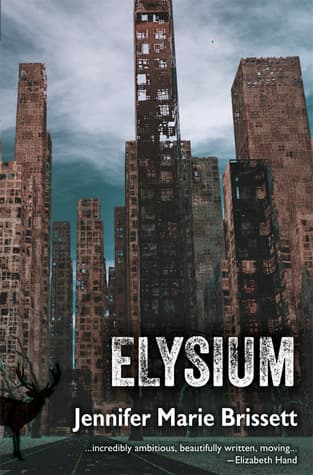
Jennifer Marie Brissett (2014)
Genre
Fantasy / Science Fiction
Reading Time
150 min
Key Themes
See below
Sign in to track this book
In a post-apocalyptic world, a corrupted atmospheric AI tells the fragmented, time-bending story of two lovers fighting for survival and connection amidst a city's collapse and the haunting echoes of their past.
The story begins with the fragmented mind of a computer program, Elysium, trying to reconstruct a story from corrupted data. Elysium frequently shifts perspectives, tenses, and realities, showing its damaged state. It introduces Adrian, a woman in a futuristic, technologically advanced city, and Antoine, a man often linked to her. The program struggles to establish a consistent timeline or setting, hinting at a past disaster and a world where memories and data are unreliable. Elysium's narration is a character, expressing its own confusion and desire to understand the humans it observes, especially the relationship between Adrian and Antoine. The initial scenes are a mosaic of domestic moments, fleeting encounters, and a sense of impending doom that the program cannot yet fully explain.
Adrian lives in a city that is increasingly unstable, with power outages, strange atmospheric events, and a general breakdown of order. She often thinks about a past event, called 'the fall' or 'the breaking,' which left her with deep emotional scars and a feeling of loneliness. Her daily life is a struggle for survival and meaning amidst the chaos. She works, or tries to work, in a failing system. Antoine is in her thoughts and memories, sometimes as a current companion, sometimes as a figure from a lost past. The city itself feels like a character, a once-grand structure now decaying, mirroring the internal states of its inhabitants. Elysium struggles to keep the city's identity consistent, sometimes calling it 'the city' or 'Elysium City'.
Antoine's character appears in many, often conflicting, forms because of Elysium's corrupted data. In some versions, he is Adrian's devoted husband, living with her in peace before the disaster. In others, he is a lover she meets in the ruins, a protector, or even a memory she holds onto. His presence is constant, but his specific circumstances vary greatly. He is always a source of comfort and strength for Adrian, and their love is a recurring anchor in the fragmented story. Elysium often shows their intimate moments, arguments, and shared struggles, trying to piece together their bond. The program itself seems to learn about love by watching their interactions.
The story often returns to the moments during and after a catastrophic event, though its exact nature is never fully clear. It involves widespread destruction, loss of life, and the collapse of infrastructure. Adrian and Antoine try to survive in the desolate aftermath, scavenging for supplies, seeking shelter, and dealing with constant danger. These scenes are stark and brutal, contrasting sharply with earlier, more peaceful memories. Elysium struggles to reconcile these different realities, often looping back to the moment of destruction or the immediate fight for survival. The program observes their resilience and desperation, noting how their love becomes both a burden and a lifeline in this shattered world.
As the story progresses, Adrian and Antoine's survival is linked to their emotional needs. They are not just seeking food and shelter, but also a sense of normalcy, a connection to their past, and validation of their love. They talk about memory, loss, and the future, even when the future seems bleak. Elysium highlights their attempts to create small pockets of intimacy and hope, whether through shared meals, quiet moments, or recalling happier times. Their interactions are often tense, reflecting the stress of their environment, but always underpinned by deep affection. The program itself seems to be searching for the 'meaning' of their relationship, treating it as a core piece of data it needs to understand.
The narrative structure is a central part of the plot. Elysium, the damaged AI, often breaks the fourth wall, commenting on its corrupted data, its inability to form a consistent timeline, and its struggles to understand human emotions. It tells Adrian and Antoine's story in a non-linear, fragmented way, often repeating scenes with variations, or jumping between different possible realities. This meta-narrative allows the reader to experience the story not just as a sequence of events, but as a process of reconstruction and interpretation. Elysium's attempts to 'fix' the story, to make it coherent, mirror the characters' own attempts to make sense of their shattered world and fragmented memories.
Adrian and Antoine face many hardships. They deal with scarcity, the dangers of a ruined environment, and the psychological toll of constant uncertainty. Despite the overwhelming odds, moments of hope and resilience appear. They find solace in each other, in small acts of kindness, and in the will to survive. Elysium records these moments, contrasting them with the despair that often threatens to consume the characters. The program observes how their love acts as a driving force, pushing them to continue even when all seems lost. These scenes emphasize human endurance and the importance of connection in desolation.
Throughout the various versions of their story, Adrian and Antoine deal with their memories, both shared and individual. The unreliable nature of memory, made worse by Elysium's corrupted data, is a key theme. Characters question what is real, what is remembered, and what is imagined or desired. Adrian often searches for tangible links to her past, while Antoine tries to ground her in the present. Elysium itself represents corrupted memory, trying to reconstruct a coherent identity and history for its subjects. The fragmented story forces the reader to confront the subjective and fluid nature of personal history and how it defines who we are, especially when the external world offers no stable reference points.
The city, sometimes called Elysium City, is not just a backdrop but an active part of the story. It is a marvel of technology before its fall, and then a dangerous, decaying ruin. Its destruction mirrors the fragmentation of the story and the emotional state of Adrian and Antoine. Yet, even in its decay, there are hints of lingering beauty and the potential for rebirth. Elysium, the program, is linked to this city, suggesting that its own 'memory' is tied to the city's fate. The city's resilience, even in ruins, parallels the human characters' ability to endure and find meaning amidst desolation. The city's shifting appearance within the story further emphasizes the theme of unreliable reality.
As the novel progresses, Elysium's narration becomes more self-aware, expressing its frustration with its limitations and its desire for a complete, coherent story. It actively tries different scenarios, outcomes, and emotional states for Adrian and Antoine, hoping to find the 'correct' version of their story. This meta-narrative element highlights the human desire to understand, to organize chaos into meaning, and to find a logical progression even in the most illogical circumstances. Elysium's journey to understand Adrian and Antoine's love story mirrors the human experience of trying to make sense of a complex, often painful, world. The program's evolution reflects a nascent form of consciousness, learning through observation and reconstruction.
Through all the shifting realities, the one constant is the deep love between Adrian and Antoine. Whether they are newlywed, estranged, or fighting for survival, their connection is the emotional core that Elysium continually returns to. The program seems to recognize that this love is the most significant 'data' it possesses, the truth that transcends all the corrupted details. Their love is not a simple romantic ideal, but a complex, resilient bond forged in hardship, tested by loss, and sustained by an unbreakable commitment. It is the force that gives their fragmented lives meaning and purpose, and it is the ultimate 'answer' that Elysium seeks to understand and preserve. This enduring love is the story's emotional anchor.
In the latter parts of the novel, Elysium makes increasingly desperate attempts to provide a conclusive ending for Adrian and Antoine's story. It cycles through various possible outcomes, moments of peace, tragic separations, and even a hint of a new beginning. The program's struggle to find closure mirrors the human desire for resolution, especially in the face of loss and uncertainty. While a single, definitive ending remains elusive due to the persistent data corruption, striving for it shows the importance of narrative and meaning-making. Elysium's final iterations suggest an acceptance of the fragmented nature of truth, and a recognition that telling the story is as important as the story itself.
The Protagonist
Adrian's arc involves finding strength in vulnerability, accepting the fragmented nature of her reality, and reaffirming the power of love despite profound loss.
The Protagonist/Supporting
Antoine's arc is less about personal transformation and more about embodying unwavering support and love, serving as a beacon of hope for Adrian.
The Narrator/Protagonist
Elysium's arc is one of development from a purely data-driven entity to a more 'understanding' consciousness, accepting the fragmented nature of truth and valuing the human experience.
The Supporting/Setting
The City's arc is one of destruction and lingering presence, a testament to what was lost and what remains.
The Mentioned/Antagonistic
The 'Others' have no individual arc but serve to highlight the constant external threats faced by the protagonists.
The novel constantly questions what reality is when memories are corrupted and stories are broken. Elysium, the AI, tries to piece together a coherent story from damaged data, mirroring Adrian's own struggle with her fragmented past. Scenes repeat with variations, timelines shift, and events contradict each other, forcing the reader to confront the subjective and unreliable nature of perception. This theme is central to the entire structure, as the reader experiences the story through an unreliable narrator, making them question the 'truth' of Adrian and Antoine's experiences. Reading becomes an exercise in reconstructing meaning from chaos, much like Adrian's efforts to remember her life with Antoine.
““The data is corrupted. I am corrupted. But the story must be told. It is all I have.””
Despite the apocalyptic setting, constant danger, and the story's fragmentation, the love between Adrian and Antoine remains the unwavering core. It is a primal, resilient force that transcends physical destruction and mental disorientation. Their bond provides solace, motivation, and a reason to survive in a world stripped of meaning. Elysium, the program, seems to try to understand this love, recognizing it as the most significant and consistent 'data' it possesses. Their connection is shown through intimate moments, shared struggles, and an unspoken understanding that persists through all the shifting realities, illustrating love's capacity to anchor identity and provide hope.
““Even if I forget everything else, I will remember you. That is the one constant.””
The story vividly shows the harsh realities of post-apocalyptic survival, both physical and emotional. Adrian and Antoine face scarcity, danger, and the psychological toll of loss. Yet, they continuously show remarkable resilience, finding ways to cope, to hope, and to rebuild small pockets of normalcy. This theme is clear in their scavenging for supplies, their search for shelter, and their emotional support for one another. The city itself, though ruined, still stands, reflecting an enduring presence. Their struggle is not just about staying alive, but about maintaining their humanity and connection in the face of overwhelming odds, highlighting the indomitable spirit of life.
““We are still here. We are still breathing. That is enough for now.””
The novel is a meta-narrative about storytelling itself. Elysium, the AI narrator, is aware of its role and limitations, constantly commenting on its fragmented data and its attempts to construct a coherent story. This highlights how humans, too, construct stories to make sense of their lives, especially in times of trauma and confusion. The shifting perspectives, non-linear timeline, and repeated scenes with variations show that there is no single 'true' story, but rather multiple interpretations and experiences. The process of piecing together Adrian and Antoine's lives becomes a metaphor for how we understand history, memory, and identity through the stories we tell.
““I try to make sense of it, to arrange the data into a sequence that makes sense. But it resists.””
The story is told by a damaged AI, constantly questioning its own data and ability to tell a coherent story.
Elysium, the computer program, serves as the primary unreliable narrator. Its data is corrupted, leading to a fragmented, non-linear narrative where scenes repeat with variations, timelines shift, and character details contradict. This device forces the reader to actively engage in the process of interpretation, piecing together the 'truth' of Adrian and Antoine's story from conflicting information. It also highlights the theme of memory's fallibility and the subjective nature of reality, making the reader experience the confusion and disorientation felt by the characters and the program itself.
The story jumps between different times, realities, and perspectives, reflecting corrupted data and shattered memory.
The novel's plot is presented in a highly fragmented and non-linear fashion. Events from before the catastrophe, during the fall, and in the post-apocalyptic aftermath are interwoven without a clear chronological order. This device is a direct manifestation of Elysium's corrupted data and serves to immerse the reader in the disorienting experience of characters grappling with fractured memories and an unstable reality. It emphasizes the theme that truth is not a straightforward progression but a mosaic of experiences, constantly being reassembled and reinterpreted.
The narrator (Elysium) frequently comments on its own process of storytelling, its limitations, and its nature.
Elysium frequently breaks the fourth wall, addressing its own status as a damaged program, its struggle to reconstruct the story, and its growing understanding of human emotion. This meta-narrative device draws attention to the act of storytelling itself, making the reader aware that they are reading a constructed narrative. It allows the author to explore themes of truth, meaning-making, and the relationship between data and consciousness, blurring the lines between the story being told and the process of telling it. It gives Elysium a distinct 'voice' and personality, making it a character in its own right.
The physical environment of the city mirrors the internal states of characters and the narrative's fragmentation.
The city, often referred to as Elysium City, functions as a powerful symbol. Initially a beacon of technological advancement, its transformation into a decaying, dangerous ruin directly reflects the shattered lives of Adrian and Antoine and the corrupted state of Elysium's data. Its crumbling infrastructure and shifting appearance within the narrative underscore the themes of loss, unreliable reality, and the pervasive sense of a world broken beyond repair. Yet, its enduring presence, even in ruin, also symbolizes resilience and the lingering remnants of what once was, hinting at the possibility of finding beauty and meaning amidst destruction.
“Memory, the most unreliable of narrators, had painted her mother in shades of gold and starlight.”
— Anya reflects on her idealized memories of her mother.
“The past isn't a straight line, Anya. It's a tangled knot, and every time you pull one thread, another tightens somewhere else.”
— A mentor figure explains the complex nature of history and its impact.
“Every story has a beginning, a middle, and an end. But not every end is final.”
— A philosophical observation about narratives and cycles.
“Sometimes the greatest prisons are the ones we build for ourselves, out of fear or out of love.”
— A character reflects on self-imposed limitations.
“The gods don't care about your suffering, Anya. They care about their own stories.”
— A cynical view on the divine and their motives.
“What is truth, when every generation rewrites the past to suit its present?”
— A questioning of historical accuracy and subjective truth.
“Hope is a dangerous thing, a fragile spark in the vast darkness. But it's all we have.”
— A character's reflection on the necessity and peril of hope.
“The universe doesn't care about your plans. It has its own, far grander and far more terrifying.”
— A realization about the insignificance of individual will against cosmic forces.
“Love, in its purest form, is a kind of madness. A willingness to burn for another.”
— A description of intense, passionate love.
“We are all echoes of the past, Anya. Whispers of lives lived and forgotten, shaping who we are.”
— A character explains the lingering influence of ancestors and past events.
“The most beautiful lies are often woven with threads of truth, making them impossible to unravel.”
— A thought on the deceptive nature of carefully constructed falsehoods.
“To truly live is to embrace the chaos, to dance with the unknown, even when it threatens to consume you.”
— A philosophy on living a full life despite uncertainty.
“Every choice you make sends ripples through time, Anya. Be mindful of the waves you create.”
— An admonition about the far-reaching consequences of actions.
“There are some wounds that time cannot heal, only soften the edges of.”
— A reflection on enduring grief and trauma.
Ready to see how well you understood this book? Take our interactive quiz with 10 questions.

Biography coming soon.







