“The purpose of a storyteller is not to tell you what to think, but to give you questions to think about.”
— Sarene often reflects on the nature of stories and their impact on society.

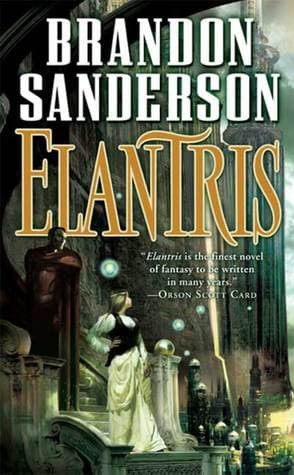
Brandon Sanderson (2005)
Genre
Fantasy / Science Fiction / Romance
Reading Time
15-20 hours (based on average reading speed for 638 pages)
Key Themes
See below
Sign in to track this book
Divine magic becomes a curse, forcing a fallen prince, a cunning princess, and a zealous priest into conflict over a kingdom's fate, unaware that salvation lies in the very city that caused their despair.
Crown Prince Raoden of Arelon is struck by the Shaod, the magical transformation that once turned people into radiant Elantrians. Ten years earlier, the Shaod began to fail, turning those it touched into broken, leper-like creatures called Hoed, who suffer constant pain. Raoden's father, King Iadon, declares his son dead and banishes him to the crumbling city of Elantris, where the Hoed live. Upon arrival, Raoden finds a desolate, chaotic city where the former Elantrians, now Hoed, scavenge for food and struggle to survive, their Aons now useless.
Princess Sarene of Teod arrives in Arelon for her arranged marriage to Prince Raoden. To her shock, she is immediately told Raoden has died. Due to a clause in their marriage contract, she is still his widow and the Princess of Arelon. This gives her a powerful position in court, which she quickly uses. She finds Arelon's court filled with idle nobles and a weak king, Iadon. Sarene, known for her sharp mind, decides to use her new status to form alliances and counter the growing influence of the Fjordell High Priest Hrathen, who has arrived in Kae to convert Arelon to his religion, Shu-Dereth, within three months.
Inside Elantris, Raoden is horrified by the squalor and despair. He realizes that the Hoed, while physically broken, are not evil. He meets Galladon, a cynical former Elantrian, and Karata, a practical leader, and begins to understand the city's harsh realities. Raoden starts by organizing small communities, offering hope and purpose to the despondent Hoed. He establishes a trade system using scavenged goods and encourages intellectual pursuits, teaching and learning from others. His efforts bring some order and hope to the forgotten city, though he struggles to understand why the magic failed.
High Priest Hrathen begins his aggressive conversion campaign in Arelon. He is a formidable, charismatic, and zealous figure, determined to bring Arelon under Fjordell's control and Shu-Dereth, even if it means manipulation and intimidation. He preaches fiery sermons, exploits existing social tensions, and uses both promises and threats to sway the populace. Sarene and her growing faction of nobles actively work to undermine his efforts, often through economic and political moves, creating a tense standoff between the two powerful figures.
Sarene proves to be a strong political opponent for Hrathen. She forms a secret society, the 'Club of the Cynics,' to discuss politics and gather intelligence, using her wit and charm to win over skeptical nobles. She disrupts Hrathen's plans by funding counter-propaganda, supporting local businesses threatened by Fjordell influence, and exposing his tactics. Her actions frustrate Hrathen and force him to adapt, while also angering King Iadon, who sees her influence as a threat to his own power.
While exploring Elantris, Raoden studies the Aons, the symbols Elantrians use to channel magic. He notices that Arelon's geography is reflected in the Aons, leading him to believe that the magic is linked to the land. He discovers that the city itself, and its surrounding landscape, form a giant Aon. He theorizes that the Shaod's failure and Elantris's decay are connected to a change in the land, specifically the fissure caused by the Reod, a catastrophic event that happened ten years earlier.
As Hrathen's deadline approaches, the threat of a Fjordell invasion becomes clear. It is revealed that Hrathen's mission is not just conversion, but to destabilize Arelon and prepare for a military takeover if conversion fails. Sarene, realizing the danger, redoubles her efforts to unite Arelon and strengthen its defenses. She tries to convince King Iadon of the impending threat, but his paranoia and focus on internal power struggles make him resistant to her warnings, further complicating the kingdom's position.
Raoden's leadership and compassion in Elantris attract the attention of the Gyorn, a feared group of former Elantrians who had retreated into the city's depths. He learns that the Gyorn, led by the enigmatic Jindo, were once the most powerful Elantrians and know the city's secrets. Raoden convinces them to join his efforts to protect the Hoed from the outside world and to work towards understanding and restoring Elantrian magic, forming an alliance that strengthens his position within the cursed city.
On Hrathen's deadline, a confrontation erupts. Sarene, in a desperate attempt to protect Arelon, publicly declares war against Fjordell. Meanwhile, Raoden, having discovered the flaw in the AonDor—that the Reod had changed Arelon's geography, making the Aons ineffective—finds a way to correct the Aons by adding a new line representing the fissure. Just as Hrathen is about to execute his final, brutal plan, Raoden, now a fully restored Elantrian, bursts from the city, radiant and with his magic returned.
With the corrected Aons, Raoden restores Elantris and heals the Hoed, transforming them back into radiant Elantrians. He reveals himself to Sarene, and their pre-arranged marriage, now a true union, is finally consummated. Together, they unite Arelon's forces against the invading Fjordell army, led by Dilaf. Hrathen, having a change of heart and realizing Dilaf's fanaticism, sacrifices himself to protect Sarene and Raoden. Elantris is reborn, Arelon is saved, and the combined forces prepare to face the broader threat of the Fjordell Empire, now with powerful Elantrians at their side.
The Protagonist
Raoden transforms from a naive prince into a wise and effective leader who not only saves his people but also restores a lost civilization.
The Protagonist
Sarene evolves from a politically astute but somewhat isolated princess into a beloved and effective queen who finds true partnership and love.
The Antagonist (initially), Supporting (later)
Hrathen's arc involves a profound internal conflict that leads him from a fanatical antagonist to a tragic hero who sacrifices himself for a greater good.
The Supporting
Galladon slowly sheds his cynicism and regains hope and purpose through his friendship with Raoden, eventually becoming a trusted ally.
The Supporting
Iadon remains largely static, representing the entrenched corruption and weakness that Raoden and Sarene must overcome.
The Antagonist
Dilaf's arc unveils him as the ultimate, unyielding antagonist, driven by hatred and fanaticism.
The Supporting
Karata, initially focused on survival, finds renewed hope and purpose through Raoden's leadership, becoming a key figure in the city's reformation.
The Supporting
Telrii's arc remains largely consistent, serving as a representation of the self-serving nobility that Sarene must manage.
The novel explores the contrast between hope and despair. In Elantris, the Hoed live in utter despair, suffering constantly and having lost all purpose. Raoden's arrival brings hope as he works to rebuild their society and rekindle their spirits. This theme is mirrored in Arelon, where Sarene battles apathy among the nobles and common folk, who feel powerless against Fjordell's influence. The final restoration of Elantris shows hope's triumph over despair, as seen when Raoden organizes the Hoed into a functional society despite their pain.
“A man is not defined by his flaws, but by what he does to overcome them.”
This theme is central to Hrathen's character and the Fjordell empire. Hrathen, initially driven by a rigid, often brutal faith, grapples with the true meaning of his beliefs. His journey shows the line between devout faith and destructive fanaticism, especially when compared with Dilaf's unyielding zealotry. The conflict between Shu-Dereth and Elantrian beliefs, and Hrathen's eventual realization of Dilaf's true nature, highlights how faith can be corrupted for malevolent purposes or lead to selfless acts of redemption.
“There is no evil in the world that does not find a way to justify itself.”
The novel presents various forms of leadership, contrasting Raoden's empathetic approach with King Iadon's paranoid, self-serving rule, and Sarene's strategic, politically astute governance. Raoden's efforts to organize Elantris's broken society demonstrate leadership through service and inspiration. Sarene's political maneuvers highlight the complexities of leading a nation through diplomacy and alliances. Arelon's ultimate success depends on the collaborative leadership of Raoden and Sarene, showing that effective governance requires both compassion and cunning.
“A leader is not one who is given power, but one who can inspire others to believe in themselves.”
The core mystery of Elantris is the failure of its magic, AonDor. Raoden's study reveals that the Aons, the symbols used for magic, are not arbitrary but are representations of Arelon's geography. The catastrophic Reod, which created a fissure in the land, subtly altered the landscape, making the existing Aons ineffective. This theme emphasizes the deep connection between the land and its magic, suggesting that true power and prosperity are intertwined with understanding one's environment. Elantris is restored by correcting this fundamental connection.
“The Aons are not just symbols, Sarene. They are the land.”
A magical transformation that bestows power but now curses its victims.
The Shaod is the central magical phenomenon of the story. It is a seemingly random transformation that once turned ordinary Arelonians into radiant, powerful Elantrians. However, since the Reod, the Shaod has become a curse, turning its victims into Hoed—physically decaying, constantly suffering beings. This device serves as the primary catalyst for Raoden's banishment and the central mystery surrounding Elantris. It also creates a powerful sense of urgency and despair, as anyone could be struck by the Shaod and condemned to Elantris.
A political arrangement that grants Sarene power despite Raoden's 'death'.
The marriage contract between Sarene and Raoden is a crucial plot device. Its unique clause, stating Sarene would become Raoden's widow and Princess of Arelon even if he died before their wedding, immediately thrusts her into a position of power. This allows her to actively engage in court politics and challenge Hrathen, rather than being dismissed. It's a convenient, yet effective, way to ensure Sarene's continued presence and influence in Arelon's court, driving her plotline forward independently of Raoden's.
Hrathen's ultimatum to convert Arelon or face invasion.
Hrathen's three-month deadline to convert Arelon to Shu-Dereth creates a strong sense of impending doom and urgency for Sarene's political struggle. This ticking clock device forces both Sarene and Hrathen to escalate their strategies and actions, preventing the narrative from becoming stagnant. It also serves to reveal the true, aggressive intentions of Fjordell, transforming a religious mission into a prelude to invasion, thereby uniting the various plot threads towards a climactic confrontation.
The symbol-based magic system of Elantris.
AonDor is the magic system unique to Elantris, based on drawing specific symbols (Aons) that channel power. This device is central to Raoden's journey in Elantris, as his study of the Aons and their connection to Arelon's geography leads him to discover the flaw that doomed Elantris. The Aons are not just a source of power but also a puzzle to be solved, representing the intellectual challenge Raoden faces. Their failure and eventual restoration are key to the plot's resolution and the world-building.
“The purpose of a storyteller is not to tell you what to think, but to give you questions to think about.”
— Sarene often reflects on the nature of stories and their impact on society.
“A man's worth is not measured by the greatness of his wealth, but by the greatness of his heart.”
— This sentiment is expressed by various characters, particularly in discussions of leadership and character.
“The most important step a man can take is always the next one.”
— Often said by characters facing overwhelming odds, emphasizing perseverance.
“Hope is not a thing. It is a choice.”
— Raoden grapples with despair in Elantris, but ultimately chooses to maintain hope.
“Sometimes the only way to win is to change the rules.”
— Sarene's approach to politics and problem-solving, often subverting expectations.
“True strength is not found in the ability to dominate others, but in the ability to lift them up.”
— A core theme explored through the leadership styles of Raoden and Sarene.
“Fear is a tool. It can be used to control, or it can be used to inspire.”
— Hrathen's manipulative philosophy, contrasting with the protagonists' use of inspiration.
“Knowledge is not power. It is a potential. Applied knowledge is power.”
— Sarene, a scholar and strategist, constantly seeks to apply her understanding to practical problems.
“There is always another secret.”
— A recurring motif in the Cosmere, hinting at deeper mysteries, often applicable to the world of Elantris.
“A leader does not just make decisions. A leader inspires people to act.”
— Raoden's evolution as a leader within Elantris, moving beyond mere governance.
“It is not the size of the dog in the fight, it is the size of the fight in the dog.”
— Often used to describe the tenacity of characters like Raoden and Sarene against overwhelming odds.
“Sometimes, the only way to save a person is to let them save themselves.”
— Characters often learn the importance of empowering others rather than simply rescuing them.
“The greatest prison people live in is the fear of what other people think.”
— Sarene, in particular, often defies societal expectations and norms.
“Even in the darkest places, there can be light, if you only choose to see it.”
— Raoden's perspective as he tries to bring hope and order to the decaying city of Elantris.
Ready to see how well you understood this book? Take our interactive quiz with 10 questions.

Brandon Sanderson is a prolific American author of epic fantasy and science fiction. He is best known for his expansive Cosmere universe, featuring series like Mistborn and The Stormlight Archive, as well as his completion of Robert Jordan's Wheel of Time series. Sanderson's intricate magic systems and compelling world-building have earned him a dedicated global fanbase and critical acclaim.







