“Each Peach Pear Plum, I spy Tom Thumb.”
— The opening lines establishing the seek-and-find pattern.

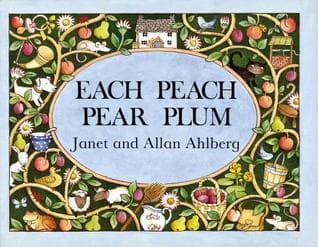
Janet Ahlberg (1978)
Genre
Fantasy / Children's
Reading Time
5 min
Key Themes
See below
Sign in to track this book
In a world of hidden fun, young readers play 'I spy' with their favorite fairy tale characters, each page a new search to find who's peeking next.
The book starts with the rhyme 'Each Peach Pear Plum, I spy Tom Thumb,' setting up the interactive nature of the story. On the first pages, a detailed country scene shows a small cottage, hills, and a tree with peaches, pears, and plums. Readers look for Tom Thumb, who is hidden in the picture, peeking from behind a tree. This first scene establishes the playful mood and the 'I spy' game, drawing young readers into the search for familiar fairy tale and nursery rhyme characters who will appear on later pages.
After finding Tom Thumb, the story continues with the rhyme, 'Tom Thumb in the wood, I spy Cinderella Hood.' The picture changes to a cozy indoor scene, where Cinderella bathes in a large wooden tub. Her glass slippers are nearby, and a towel hangs ready. Tom Thumb is subtly hidden here, peeking through a window or from behind a curtain, watching Cinderella. This moment shows a new character and continues the chain of watching, with each found character then becoming the 'spy' for the next.
The story goes on with 'Cinderella on the stairs, I spy the Three Bears.' The setting changes to a sunny forest. Papa Bear, Mama Bear, and Baby Bear have a picnic, with porridge, honey, and berries on a blanket. Cinderella is hidden in this picture, perhaps peeking from behind a tree or a bush, watching the bears. This scene adds another classic fairy tale group to the growing cast and keeps the gentle, observant nature of the 'I spy' game going.
As the rhyme progresses, 'Three Bears in a row, I spy Goldilocks, you know.' The picture moves inside the bears' cottage, specifically their bedroom. Goldilocks is asleep in Baby Bear's bed, with the other two beds visible. The Three Bears are hidden, watching Goldilocks from a doorway or through a window, having come home to find their guest. This scene refers directly to the 'Goldilocks and the Three Bears' story, adding some story context to the 'I spy' game and building excitement for the characters' interactions.
The next rhyme is 'Goldilocks with a frown, I spy the Wicked Witch from town.' The setting darkens slightly, moving to a spooky, twisted forest. The Wicked Witch stirs a bubbling pot over a fire, surrounded by strange items and maybe a black cat. Goldilocks, having woken up, is now hidden in the scene, watching the Witch with a careful look. This introduces a more villainous character, adding a hint of mild suspense and contrast to the earlier friendly characters, while keeping the book's gentle tone.
The rhyme continues, 'Wicked Witch in a fix, I spy Jack and Jill with sticks.' The picture shows a steep, grassy hill with a well at the top. Jack and Jill tumble down the hill, having just gotten water, their pail rolling away. The Wicked Witch is hidden in this scene, watching their accident, perhaps from behind a tree or a rock. This moment brings in another well-known nursery rhyme pair and continues the chain of watching, showing a moment of classic misfortune from a hidden spot.
Next, 'Jack and Jill in the street, I spy Little Bo Peep with feet.' The scene changes to a country setting, with green fields and a few trees. Little Bo Peep looks sad, her shepherd's crook in hand, searching for her lost sheep. Jack and Jill, recovered from their fall, are hidden in the picture, watching Bo Peep from a distance. This adds another tender nursery rhyme character to the group, highlighting the theme of searching and finding that runs through the whole book.
The rhyme then says, 'Little Bo Peep, half asleep, I spy the Wolf, oh dear me, oh dear me, oh dear me!' The picture becomes a bit darker, showing a dense part of the forest. The Big Bad Wolf is cleverly hidden among the trees, his eyes gleaming. Little Bo Peep is hidden in this scene, watching the Wolf, perhaps with some worry. This brings back a classic enemy and adds a mild element of danger, leading up to all the characters eventually gathering.
The story loop begins to close with 'Wolf in the wood, I spy Tom Thumb, it's understood.' The picture returns to a scene like the beginning, with trees and bushes. Tom Thumb is again hidden, perhaps peeking from behind a mushroom or a leaf, now being watched by the Wolf. This moment brings the first and last 'spy' into a direct (though still hidden) relationship, showing the circular nature of the 'I spy' game and preparing for the big ending.
The final pages bring all the characters together. 'Everybody in the book, Eating plum pie, take a look!' Tom Thumb, Cinderella, the Three Bears, Goldilocks, the Wicked Witch, Jack and Jill, Little Bo Peep, and even the Wolf (who seems to have changed, or at least enjoys the pie) all gather around a large table outdoors. They happily share and eat a plum pie, made from the very plums seen at the start of the book. This joyful gathering provides a satisfying ending, uniting all the different fairy tale figures in a harmonious, celebratory meal.
The Protagonist/Observer
Tom Thumb begins as the first 'spy' and is the last character to be spied, completing the observation loop before joining the final feast.
The Supporting/Observer
Cinderella is spied by Tom Thumb and then spies the Three Bears, eventually joining the group for plum pie.
The Supporting/Observers
The Three Bears are spied by Cinderella, then spy Goldilocks, and finally join the other characters for plum pie.
The Supporting/Observer
Goldilocks is spied by the Three Bears, then spies the Wicked Witch, and eventually shares plum pie with everyone.
The Supporting/Observer/Antagonist (mild)
The Wicked Witch is spied by Goldilocks, then spies Jack and Jill, and ultimately joins the other characters for plum pie, suggesting a temporary truce or change of heart.
The Supporting/Observers
Jack and Jill are spied by the Wicked Witch, then spy Little Bo Peep, and later enjoy plum pie with everyone.
The Supporting/Observer
Little Bo Peep is spied by Jack and Jill, then spies the Wolf, and ultimately joins the communal plum pie feast.
The Supporting/Observer/Antagonist (mild)
The Wolf is spied by Little Bo Peep, then spies Tom Thumb, and finally joins all the characters in eating plum pie, suggesting a moment of peace and integration.
The main theme is that different characters, even traditional bad guys like the Wicked Witch and the Wolf, can come together peacefully. The book ends with all the characters, from Tom Thumb to Cinderella to the Three Bears, sharing a plum pie. This final scene shows that differences can be put aside for shared joy and community, creating a sense of belonging and peaceful living. It gently teaches young readers about acceptance and the chance for unexpected friendships, going beyond usual character roles.
“Everybody in the book, Eating plum pie, take a look!”
The whole design of 'Each Peach Pear Plum' is built around watching and finding things. The 'I spy' rhyme encourages children to actively look for characters hidden in the detailed pictures. This theme helps with visual understanding and attention to detail, making reading interactive and fun. Each character, once found, becomes the next one to watch, keeping a chain of discovery going that moves the story forward and creates a sense of wonder.
“With your little eye, Take a look, And play 'I spy'.”
The book skillfully combines beloved characters from various fairy tales and nursery rhymes. By featuring figures like Cinderella, Goldilocks, Jack and Jill, and the Big Bad Wolf, the book uses children's existing knowledge of these stories. This use of familiar stories creates a sense of comfort, while also showing these characters in new, connected ways. It celebrates the rich world of children's literature, showing how classic figures can interact in a fresh, imaginative story.
“Each Peach Pear Plum, I spy Tom Thumb.”
The book ends with all the characters happily sharing a plum pie, a simple yet powerful symbol of joy and contentment. This final image highlights that happiness can be found in basic, shared activities. The story does not rely on big adventures or complex plots but on the quiet pleasure of finding familiar friends and sharing a meal. It promotes valuing the everyday moments that bring people together, creating a heartwarming and satisfying ending.
“Everybody in the book, Eating plum pie, take a look!”
A repetitive, interactive verse that guides the reader.
The 'I spy' rhyme scheme is the central plot device, creating a call-and-response interaction between the book and the reader. Each page presents a couplet that identifies the current observer and then prompts the reader to 'spy' the next character. This repetitive, predictable structure makes the book highly engaging for young children, encouraging participation and aiding in memory. It transforms the passive act of reading into an active game, making the narrative unfold through discovery.
Characters are subtly integrated into the detailed artwork.
This device is crucial for the 'I spy' game. Each new character is not explicitly presented but must be actively sought out within the detailed and often busy illustrations. The characters are not always in obvious places; they might be peeking from behind a tree, through a window, or camouflaged within the scenery. This encourages close observation, develops visual literacy, and adds a layer of fun and challenge to the reading experience, making each discovery a small triumph for the child.
Each found character leads to the discovery of the next.
The story employs a cumulative chain, where the discovery of one character directly leads to the introduction of the next. Tom Thumb spies Cinderella, Cinderella spies the Three Bears, and so on. This creates a clear, logical progression that is easy for young children to follow and provides a satisfying sense of momentum. It builds anticipation for who will be spied next and reinforces the interconnectedness of the characters and their stories within this unique narrative.
The narrative returns to earlier elements, creating a complete loop.
The plot features a subtle cyclical structure. It begins with 'Each Peach Pear Plum' and the sighting of Tom Thumb, and eventually, the Wolf spies Tom Thumb, bringing the observation chain full circle. The final scene features all characters eating plum pie, linking back to the initial mention of plums. This creates a sense of completion and harmony, reinforcing the idea that all elements of the story are connected and resolved in a satisfying, unified conclusion.
“Each Peach Pear Plum, I spy Tom Thumb.”
— The opening lines establishing the seek-and-find pattern.
“Tom Thumb in the cupboard, eating currant bun.”
— Tom Thumb is discovered in a familiar place for children.
“I spy Mother Hubbard.”
— The narrator spies Mother Hubbard after Tom Thumb is found.
“Mother Hubbard in the cupboard, getting something out.”
— Mother Hubbard is seen retrieving an item from the cupboard.
“I spy the Three Bears.”
— The narrator spots the Three Bears in the garden.
“The Three Bears in the woods, looking for a treat.”
— The bears are depicted searching for something to eat.
“I spy Cinderella.”
— Cinderella is seen after the Three Bears.
“Cinderella in the cellar, mending her shoe.”
— Cinderella is shown performing a mundane task.
“I spy the Wolf.”
— The narrator spots the Wolf, adding a touch of mild suspense.
“The Wolf in the woods, having a good read.”
— The Wolf is surprisingly engaged in reading, subverting expectations.
“I spy Baby Bunting.”
— Baby Bunting is seen next, continuing the chain.
“Baby Bunting, fast asleep, in her little bed.”
— Baby Bunting is depicted peacefully sleeping.
“And everyone is here!”
— The culmination of the search, with all characters gathered.
“Hooray! Let's have a party!”
— The final celebratory suggestion as all characters are found.
Ready to see how well you understood this book? Take our interactive quiz with 10 questions.







