“Each kindness makes the whole world a little better.”
— The teacher, Ms. Albert, drops a stone into a bowl of water to demonstrate how kindness ripples outward.

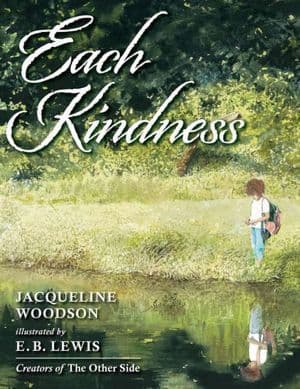
Jacqueline Woodson (2012)
Genre
Children's
Reading Time
5 min
Key Themes
See below
Sign in to track this book
Chloe learns the lasting effect of an act of kindness she did not show to Maya, a new girl, changing their world forever.
On a windy day, a new girl named Maya comes to Chloe's class. Maya looks different from the other children; her clothes are old, her hair is messy, and her shoes are too big. When she smiles at Chloe, Chloe looks away, feeling uncomfortable and disapproving. During recess, Maya asks Chloe and her friends if she can play. Chloe's friend, Kendra, quickly says "No," and Chloe does not say anything, agreeing with the rejection. Maya is left to play alone, picking dandelions and blowing their seeds, which makes Chloe feel a bit bad.
Days turn into weeks, and Maya keeps trying to connect with Chloe and her friends. Each time, they are cold to her. At lunch, Maya offers to share her meal, which is an apple and a sandwich, but Chloe's friends make fun of her simple food, making Chloe laugh along. In class, Maya tries to answer a question, but her voice is soft, and Chloe's friend, Kendra, mocks her, causing the group to laugh. Chloe watches Maya's quiet loneliness, often seeing her playing by herself, picking up shiny things and putting them in a small box, a private world Chloe and her friends never try to enter.
One morning, Chloe comes to school and sees Maya's seat is empty. The teacher, Mrs. Albert, tells the class that Maya and her family have moved away. The news is given without much fuss, and the other children quickly move on. However, Chloe feels a strange pang of guilt or regret. She remembers all the times Maya tried to smile at her, to share with her, to play with her, and how each time, Chloe and her friends had pushed her away. Maya's leaving settles heavily on Chloe, leaving her with an uncomfortable feeling she cannot shake.
A few days after Maya leaves, Mrs. Albert teaches a lesson on kindness. She fills a bowl with water and drops a small stone into it, showing how the ripples spread out. She explains that each act of kindness, no matter how small, sends out ripples that can change the world. She asks each student to think of a kind act they have shown. As the other children share their stories, Chloe is silent, unable to think of a single kind act she had shown to Maya. The idea of spreading ripples makes Chloe realize that her actions toward Maya created no ripples of kindness, only stillness and emptiness.
The kindness lesson deeply affects Chloe. She imagines the ripples of kindness spreading, but for her, there is only a vast, still pool where Maya used to be. She remembers all the specific times she rejected Maya: turning away from Maya's smile, laughing at her simple lunch, ignoring her attempts to play. Chloe realizes she had many chances to be kind, to include Maya, to offer a friendly word, but she did not. A deep regret washes over her, understanding that she missed the chance to create positive ripples, to make Maya feel welcome, and to possibly gain a friend. The weight of her unkindness becomes a heavy burden.
Chloe leaves school that day feeling sad. She imagines what it would have been like if she had been kind to Maya — if she had smiled back, invited her to play, or shared her lunch. She pictures Maya's smile, now gone. The lesson about kindness, which was meant to inspire, instead shows Chloe's failure. She understands that while she can choose to be kind to others in the future, the chance to be kind to Maya is gone forever. The story ends with Chloe holding the memory of Maya and the painful lesson of kindness never given, showing the lasting effect of even small acts of unkindness and the importance of being compassionate.
The Protagonist
Chloe transforms from a passive participant in exclusion to someone deeply burdened by regret and a newfound understanding of kindness's importance.
The Supporting
Maya remains consistent in her attempts at friendship and quiet resilience, her arc concluding with her departure, which serves as a powerful lesson for Chloe.
The Supporting
Kendra remains consistently unkind, serving as a foil to Chloe's later regret and realization.
The Supporting
Mrs. Albert's arc is static, serving as a wise mentor figure whose lesson provides the catalyst for Chloe's transformation.
The main theme looks at the effect of kindness, or the lack of it, on people and the world. Chloe's repeated rejection of Maya shows the pain caused by unkindness and the need for empathy toward those who are different or vulnerable. The teacher's lesson about ripples of kindness shows how even small acts can have far-reaching effects, emphasizing that no kindness leaves an emptiness. Chloe's regret highlights the lasting emotional cost of not being compassionate.
“Each kindness, no matter how small, sends a ripple out into the world.”
This theme is explored through Chloe's experience after Maya leaves. Chloe is bothered by the many chances she had to be kind to Maya but ignored. Her realization that these chances are gone forever creates a deep regret. The story shows that some moments for connection and compassion are brief, and once missed, they cannot be brought back, leaving a lasting burden on the person who did not act. Chloe's struggle with her past actions is central to the story's emotional impact.
“And I knew that I'd left a space inside myself where Maya could have been. And it was too late to fill it now.”
The book clearly shows the quiet but harmful nature of social exclusion. Maya is pushed away not through physical harm, but through repeated rejections, mockery, and being ignored by Chloe and her friends. Her worn clothes and quiet manner make her an easy target for those trying to strengthen their own social position. The story shows how even just being part of exclusion, like Chloe was, adds to the victim's pain, illustrating the shared responsibility in creating a welcoming environment. Maya's loneliness during recess is a strong symbol of this exclusion.
“'No,' Kendra said quickly. 'You can't play.'”
The teacher's lesson about dropping a stone into water, creating spreading ripples, is a main theme. It shows how every action, good or bad, has effects that go beyond the immediate moment. For Chloe, this idea brings a painful understanding that her unkindness toward Maya created no good ripples, only an absence, a stillness where friendship and connection could have been. The theme shows how human actions are connected and their ability to either build or break relationships and communities.
“And the water moved out and out and out in a circle.”
Represents vulnerability, difference, and a quiet inner world.
Maya's worn clothes and too-big shoes immediately set her apart, symbolizing her socioeconomic difference and vulnerability, making her a target for exclusion. Conversely, her habit of collecting 'shiny things' in a small box symbolizes her quiet resilience, her ability to find beauty and value in small, overlooked items, and her rich inner world that Chloe and her friends never bother to explore. These details visually reinforce her 'otherness' and the missed opportunity for connection.
Illustrates the far-reaching impact of kindness and unkindness.
The central metaphor introduced by Mrs. Albert, where dropping a stone into water creates ripples, is a powerful plot device. It visually and conceptually explains how every action, big or small, has consequences that spread outward. For Chloe, this device acts as an epiphany, making her understand the profound absence of positive ripples from her actions towards Maya and the lasting impact of her unkindness. It's the catalyst for her deep regret and the story's moral lesson.
Provides intimate access to the protagonist's internal conflict and regret.
The story is told entirely from Chloe's point of view, allowing the reader to experience her initial discomfort, her participation in Maya's exclusion, and ultimately, her overwhelming regret. This perspective is crucial for conveying the internal shift and the emotional weight of her realization. By seeing the events through Chloe's eyes, the reader gains empathy not just for Maya, but also for Chloe's journey of understanding and remorse, making the moral lesson more impactful and relatable.
Highlights the stark difference in character and the opportunities for kindness.
The narrative repeatedly sets up scenes where Maya makes an overture of friendship (smiling, asking to play, offering to share lunch) only to be met with rejection from Chloe and her friends. This stark contrast emphasizes the active choice being made to exclude Maya and underscores the many missed opportunities for kindness. It builds a pattern that culminates in Chloe's regret, making the 'what if' scenarios more poignant and the lesson about valuing chances for connection more powerful.
“Each kindness makes the whole world a little better.”
— The teacher, Ms. Albert, drops a stone into a bowl of water to demonstrate how kindness ripples outward.
“I watched the water ripple out, becoming bigger and bigger.”
— Chloe observes the teacher's demonstration about the effects of kindness.
“Maya smiled at me. I didn't smile back.”
— Chloe reflects on her initial rejection of Maya's friendly gesture.
“Every time Maya asked to play with us, I said no.”
— Chloe recounts her repeated refusal to include the new girl, Maya.
“I felt the weight of that stone in my pocket.”
— Chloe carries a stone as a reminder of her missed chance to be kind.
“That day, Maya was absent. And the next day. And the day after that.”
— Maya stops coming to school, and Chloe realizes she may never see her again.
“Ms. Albert told us that Maya's family had moved away.”
— The teacher informs the class that Maya has left the school for good.
“I thought of all the kindnesses I had thrown away.”
— Chloe reflects on her missed opportunities to be kind to Maya.
“The chance of a kindness with Maya was gone.”
— Chloe comes to terms with the permanence of her missed opportunity.
“Like a stone dropped in water, I could feel it rippling out.”
— Chloe internalizes the lesson about how unkind actions also have ripple effects.
“I watched the water still.”
— After the demonstration, Chloe observes the calm water, symbolizing her inaction.
“This is what kindness does, Ms. Albert said. Each little thing we do goes out, like a ripple into the world.”
— The teacher explains the broader impact of small acts of kindness.
“I never got to tell Maya I was sorry.”
— Chloe expresses her deep regret for not apologizing to Maya.
“And I missed my chance.”
— Chloe acknowledges that her opportunity to be kind to Maya has passed.
Ready to see how well you understood this book? Take our interactive quiz with 10 questions.

Jacqueline Woodson is an American writer of books for children and adolescents. She is best known for Miracle's Boys, and her Newbery Honor-winning titles Brown Girl Dreaming, After Tupac and D Foster, Feathers, and Show Way. After serving as the Young People's Poet Laureate from 2015 to 2017, she was named the National Ambassador for Young People's Literature, by the Library of Congress, for 2018 to 2019. She was named a MacArthur Fellow in 2020.

Dan Gemeinhart
4.5

Kate O'Hearn
4.4

Jeanne Birdsall
4.4

Jen Wang
4.4
Wendelin Van Draanen
4.3

John Marsden
4.3

Chris Van Allsburg
4.3
Jennifer A. Nielsen
4.2