“The past is a road, not a destination.”
— Reflecting on history and moving forward.

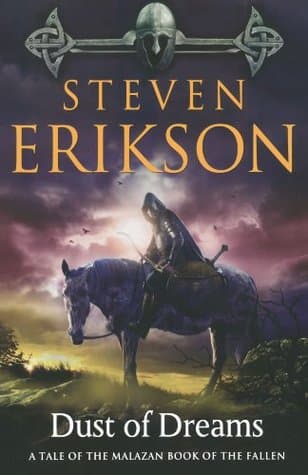
Steven Erikson (2009)
Genre
Fantasy
Reading Time
2500 min
Key Themes
See below
Sign in to track this book
A Malazan army marches into an unknown wasteland, their purpose unclear, as ancient races, disillusioned soldiers, and forgotten gods converge for a final stand against an incomprehensible dread.
Adjunct Tavore Paran leads the Malazan Fourteenth Army, the Bonehunters, east into the vast Wastelands of Lether. Their march is marked by hardship and a feeling of pointlessness, as the soldiers do not know their destination or enemy. Squint, the sapper, deals with the weight of past wars and his squad's growing tiredness. Fiddler, the Bridgeburner Sergeant, keeps order and morale among his company. Bottle, the scout and mage, struggles with his growing powers and the dark signs he senses. The army's purpose remains a mystery, adding to the psychological strain of their journey.
The Barghast, led by Hetan, are at a crossroads after their failed revenge against the Tiste Edur. Their traditions are challenged, and they must find new lands and enemies. Meanwhile, Onos Toolan, the T'lan Imass who chose mortality, struggles as commander of the White Face clan. His attempts to lead are met with resistance, especially from younger, more aggressive warriors. Toolan carries the burden of his past and responsibility for his clan's future, as old traditions clash with a changing world.
The Perish Grey Helms, led by their High Chieftain, journey through the treacherous kingdom of Bolkando. Their mission is to meet the Malazan Bonehunters, to whom they have sworn loyalty. Their passage through Bolkando involves diplomatic challenges and the constant threat of betrayal from the court. The Grey Helms' vows and honor are tested by Bolkandan schemes and the land's dangers. Their loyalty to the Malazan cause drives them, despite mounting obstacles and losses.
Ancient K'Chain Che'Malle face a threat from the Nah'ruk. The last K'Chain Che'Malle stronghold, a sky-keep, is under attack. In a desperate move, some of these Elder Races turn to humans for help, believing humanity holds a key to their future. K'Chain Che'Malle matriarchs and soldiers prepare for a final stand, using their advanced technology and ancient knowledge against the Nah'ruk. The fate of an entire race is at stake.
The Malazan Bonehunters, after many trials, are ready for one final stand. Their purpose, though mostly unknown to them, is framed as a quest for redemption. This upcoming battle raises questions about heroism and sacrifice. If their deeds are unwitnessed, can they still be considered heroic? This thought weighs on many soldiers, including Fiddler and Tavore, as they prepare for what they believe will be a catastrophic fight. The weight of their past and uncertain future affects the entire army.
The ancient Deck of Dragons is read, unleashing a power that no one fully understands. This reading starts a chain of catastrophic events, linking the fates of various groups across the continent. The consequences affect the Malazans, Barghast, Perish Grey Helms, and even the Elder Races. The mystical forces reshape the land and destinies, hinting at a cosmic struggle beyond mortal understanding. The world is on the edge of a transformation.
Toc the Younger, now an ascendant and the Mortal Sword of the Shake, arrives in the Wastelands with his warriors. Their presence adds a new, mysterious element to the forces gathering in the region. Toc, having changed greatly, carries the burden of his past and his new responsibilities. The Shake, with their unique customs and connection to ancient powers, become an important, though unpredictable, factor in the conflict. Their loyalty and goals remain somewhat unclear, adding to the tension.
Whispers and signs of the Forkrul Assail, an ancient and powerful Elder Race known for their strict justice, appear across the Wastelands. Their presence signals their upcoming involvement in the conflicts. The Forkrul Assail are powerful and seemingly unstoppable, their motives often unclear to mortals. Their arrival promises to escalate the war's scale and brutality, bringing a terrifying, uncompromising judgment. The various groups, especially the Malazans, become aware of this threat, understanding that their war is about to become far more complicated and deadly.
As the Bonehunters continue their march, internal conflicts and despair begin to weaken morale. Many soldiers question the point of their journey and the sacrifices they make. Casualties from skirmishes, exhaustion, and the harsh environment increase the despondency. Officers like Stormy and Gesler struggle to maintain order and prevent mutiny. Tavore remains silent, adding to the army's uncertainty. The emotional and psychological toll on the Bonehunters is immense, showing the brutal realities of war where purpose is lost and suffering is constant.
All major groups—the Malazan Bonehunters, the Barghast, the Perish Grey Helms, the Shake, and the Elder Races—are drawn to a single confrontation in the desolate Wastelands. Their journeys, motives, and struggles converge, setting the stage for a monumental clash that will decide many fates. The ancient powers unleashed by the Deck of Dragons and the Forkrul Assail's arrival ensure this will be a battle of epic proportions, with consequences beyond any single army or race. Destinies intertwine, leading to a violent end.
The Protagonist
Tavore's arc is one of silent, unwavering sacrifice and leadership, moving from a figure of mystery to a symbol of ultimate devotion to a hidden cause.
The Supporting
Fiddler continues to grapple with the horrors of war, evolving into a more introspective leader who understands the profound cost of sacrifice.
The Supporting
Bottle's arc involves a struggle to master his burgeoning, often terrifying magical abilities, as he becomes more attuned to the world's ancient powers.
The Supporting
Tool's arc explores the complexities of mortality and leadership, as he struggles to reconcile his ancient past with his present responsibilities to his clan.
The Supporting
Hetan's arc involves leading her people through a period of profound change, seeking new purpose and identity for the Barghast.
The Supporting
Toc's arc is one of profound transformation and acceptance of his ascendant role, grappling with the burdens of his past and his new responsibilities.
The Supporting
The Matriarch's arc is defined by her desperate struggle to preserve her ancient race against an overwhelming enemy, seeking unconventional solutions.
The Supporting
Squint's arc shows him grappling with the psychological toll of endless war, finding solace and purpose in the bonds of his squad.
This theme is central to 'Dust of Dreams,' exploring the physical and psychological toll war takes on soldiers and civilians. The Malazan Bonehunters' endless march into the Wastelands, without a clear goal, shows this futility. Characters like Fiddler and Squint constantly question their sacrifices, and the narrative highlights the despair and exhaustion within the army. The Barghast's struggles after their failed revenge also show how war often leaves participants with only loss and a search for new meaning. The book vividly portrays the destruction of lives and lands, emphasizing that even in victory, there is great loss.
“In war everyone loses. This brutal truth can be seen in the eyes of every soldier in every world…”
Despite the despair, redemption and the need for sacrifice are deep themes. Adjunct Tavore Paran's mission is ultimately a monumental act of sacrifice for the greater good, a desperate attempt to redeem humanity and the world. The Bonehunters, though unaware of the full scope, participate in this quest for redemption through their loyalty and willingness to face an unknown enemy. The Perish Grey Helms' loyalty to their vows, even through hardship, also speaks to this theme, as does the K'Chain Che'Malle Matriarch's desperate fight for her race. The book explores whether deeds are heroic when unwitnessed, suggesting that true sacrifice does not require recognition.
“And this last great army of the Malazan Empire is resolved to make one final defiant, heroic stand in the name of redemption.”
A significant philosophical theme is the importance of witnessing and memory in defining heroism and historical truth. The narrative repeatedly asks: 'Can deeds be heroic when no one witnesses them? And can what is not witnessed forever change the world?' This challenges the usual understanding of heroism, suggesting that actions' impact may not need an audience or a chronicler. The Bonehunters' march into the desolate Wastelands, far from any civilization, directly addresses this idea. The book implies that even forgotten acts of bravery and sacrifice can profoundly shape the future, leaving a lasting mark, regardless of human memory.
“But can deeds be heroic when there is no one to witness them? And can that which is not witnessed forever change the world?”
Many characters change greatly or deal with their changing identities. Onos Toolan, a T'lan Imass who chose mortality, struggles to lead his Barghast clan while balancing his ancient past with his current vulnerabilities. Toc the Younger's return as an ascendant and Mortal Sword of the Shake means a complete transformation, forcing him to adapt to new powers and responsibilities while carrying his past suffering. Even the Barghast people, led by Hetan, must redefine their identity and purpose after their traditional path of revenge is blocked. These individual and group journeys highlight the dynamic nature of self and constant adaptation in a changing world.
“Destines are rarely simple, truths never clear but one certainty is that time is on no one's side.”
A symbolic and literal journey into the unknown.
The Malazan Fourteenth Army's relentless march into the vast, desolate eastern Wastelands serves as a central plot device. Literally, it isolates the army from known civilization and resources, intensifying their physical and psychological hardships. Symbolically, it represents a journey into the unknown, a quest for an unclear purpose, and a descent into the depths of despair and sacrifice. This setting amplifies the themes of futility, unwitnessed heroism, and the ultimate cost of war, as the barren landscape mirrors the emotional desolation of the soldiers. It also serves to converge all major plotlines and characters towards a single, isolated point of confrontation.
A powerful divinatory tool that unleashes cosmic forces.
The reading of the Deck of Dragons acts as a critical plot device, unleashing ancient and powerful forces that drive the narrative forward. While its specific revelations are often cryptic, its influence is profound, setting in motion a chain of events that intertwine the fates of mortals and ascendants alike. It signifies the involvement of cosmic powers and ancient entities in the unfolding conflicts, elevating the stakes beyond mere mortal warfare. The Deck's prophecies and pronouncements serve as harbingers of doom and catalysts for destiny, ensuring that the characters' actions are part of a much larger, predetermined, yet still malleable, cosmic game.
A source of existential dread and narrative tension.
The Malazan army's march towards an unknown enemy for an unknown cause is a pervasive plot device that generates significant narrative tension and psychological depth. This lack of clear objective fuels the soldiers' despair and questioning of their purpose, highlighting the theme of the futility of war. It forces the characters to rely on faith in their command, particularly Adjunct Tavore, and to find meaning in their bonds with each other rather than in an external goal. The slow reveal of the enemy and the true cause of the war builds suspense, transforming the conflict from a simple military campaign into a profound existential struggle.
A last bastion of an ancient race, symbolizing fading power and desperate survival.
The K'Chain Che'Malle sky-keep, under siege by the Nah'ruk, functions as a powerful plot device representing the fading power of ancient races and their desperate struggle for survival. It provides a focal point for the conflict between Elder Races and introduces the formidable Nah'ruk as a major threat. The sky-keep, with its advanced technology and ancient inhabitants, serves as a literal and symbolic anchor for the past, connecting the present conflicts to the deep history of the world. Its precarious existence highlights the themes of extinction, unexpected alliances, and the universal drive for preservation against overwhelming odds.
“The past is a road, not a destination.”
— Reflecting on history and moving forward.
“Hope is a coin. You can spend it for a season, or for a lifetime.”
— Considering the nature and duration of hope.
“We are not the sum of our mistakes, but the sum of what we learned from them.”
— An observation about personal growth and redemption.
“There is no justice in war. There is only the game.”
— A cynical view on the reality and futility of conflict.
“The world is not always what it seems. Sometimes, it is more.”
— Hinting at hidden depths and complexities.
“To forget is to forgive. To remember is to punish.”
— A stark statement on memory, forgiveness, and resentment.
“A hero is someone who has nothing to lose, but chooses to fight anyway.”
— Defining heroism in the face of despair.
“The heart of darkness is not a place, but a choice.”
— Exploring the origin of evil and moral decisions.
“Love is a wound. A beautiful, agonizing wound.”
— Describing the painful yet profound nature of love.
“The true measure of a civilization is not its monuments, but its compassion.”
— Critiquing societal values and true progress.
“Silence is not empty. It is full of answers.”
— Emphasizing the wisdom found in quiet contemplation.
“Every step taken is a step closer to the end. Or a new beginning.”
— Reflecting on the dual nature of progress and destiny.
“To suffer is to live. To live is to suffer. The two are intertwined.”
— Acknowledging the inherent suffering in existence.
“There is no greater burden than a secret, unless it is a shared one.”
— Discussing the weight of secrets and the relief of confession.
Ready to see how well you understood this book? Take our interactive quiz with 10 questions.

Biography coming soon.







