“There’s no harm in a man being friends with his own past, even if the past is a sad one.”
— Edgar contemplating his past and his new life on Duma Key.

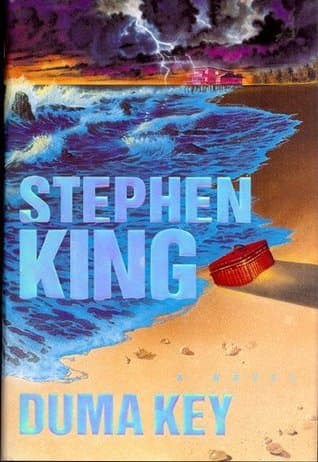
Stephen King (2007)
Genre
Thriller / Fantasy / Mystery
Reading Time
12-15 hours
Key Themes
See below
Sign in to track this book
An amputee artist's new talent on a remote Florida key unleashes a terrifying supernatural force tied to a dying old woman's dark past and his own increasingly vivid, dangerous paintings.
Edgar Freemantle, a wealthy construction magnate from Minnesota, loses his right arm and sustains severe brain injuries in a crane accident. The accident leaves him with aphasia, memory loss, and uncontrollable rage. His marriage to Pamela, his wife of 25 years, ends, and he contemplates suicide. His psychologist, Dr. Kamen, suggests a 'geographic cure' and encourages him to revisit his childhood hobby of sketching. Edgar sells his company, gives Pamela their house, and moves to Duma Key, a secluded, undeveloped island off the coast of Florida, renting a house named 'Big Pink.' He is drawn to the island's unique atmosphere and begins to feel a strange pull towards art once more, sketching the sunsets and the island's peculiar details.
On Duma Key, Edgar meets Jerome Wireman, a quiet, philosophically inclined man who becomes his caretaker and friend. Wireman has his own mysterious past and seems to understand the island's strange undercurrents. As Edgar continues to draw and paint, his artistic abilities explode with an astonishing, almost supernatural, intensity. He discovers he can paint with his left hand as if he'd always been ambidextrous. His paintings, especially those depicting sunsets and the island's landscape, begin to possess a disturbing realism and, occasionally, a prophetic quality. He starts painting a series of 'sunset girls' and other figures that seem to come to life on the canvas, often with unsettling implications for his own reality.
Edgar's daughter, Ilse, visits him on Duma Key, helping him settle into Big Pink and encouraging his art. During her visit, Edgar paints a picture of a red teacup, which then appears in his kitchen. This is one of the first clear indications that his art is not merely representational but can manifest objects or influence reality. He also paints a disturbing image of a woman drowning, which later seems to foreshadow a local incident. Ilse is initially delighted by his newfound talent, but the strange power of his art begins to unnerve her, though she tries to remain supportive. The bond between father and daughter remains strong, an important anchor for Edgar.
Edgar is introduced to Elizabeth Eastlake, the elderly, ailing owner of Duma Key and the island's true matriarch. Elizabeth suffers from advanced dementia and is attended by her lawyer, Roger Hatton, and a nurse. She lives in a grand, decaying mansion, and her mind often drifts between past and present. Edgar learns that Elizabeth was once an artist herself, and her family has a long, troubled history on the island. He discovers she has a connection to a malevolent entity named Perse, an ancient, powerful spirit associated with the sea and childhood fears, which she attempted to contain through her own art. Perse is responsible for a long history of tragedies on the island.
As Edgar's artistic talent grows, so does the danger it presents. He paints a picture of a girl with a broken arm, and shortly after, a local girl suffers a similar injury. He paints a series of 'sunset girls' that seem to exert a hypnotic influence on those who view them. The power of his art is directly linked to Perse, and as he paints, he inadvertently empowers the entity. Wireman recognizes the escalating threat and tries to guide Edgar, warning him about the responsibility that comes with such a gift. Edgar struggles to control the visions and impulses that drive his painting, often feeling possessed by an external force.
Elizabeth's fragmented memories, often triggered by Edgar's presence or art, begin to coalesce. Through her ramblings and old documents, Edgar and Wireman piece together the tragic history of the Eastlake family and their ongoing battle with Perse. They learn that Perse is an ancient, parasitic entity that feeds on human misery, especially that of children, and has been responsible for numerous deaths and disappearances on Duma Key for generations. Elizabeth, as a child, was uniquely susceptible to Perse's influence and had attempted to trap it through her own drawings, but the entity proved too powerful, leaving her deeply traumatized and eventually leading to her mental decline.
Perse, now significantly empowered by Edgar's prolific painting, directly attacks Ilse, attempting to drown her in a pond. Ilse barely survives, leaving her severely traumatized and hospitalized. This event galvanizes Edgar, turning his fear into a fierce determination to destroy Perse. He realizes that his art, while a gift, has also been a conduit for the entity. He, Wireman, and Roger Hatton, Elizabeth's lawyer who has also come to understand the supernatural threat, decide they must take decisive action to stop Perse. They prepare for a final, dangerous confrontation, knowing the entity is ancient and immensely powerful.
The climax occurs at Elizabeth Eastlake's decaying mansion, where Perse's power is concentrated. Edgar, Wireman, and Roger Hatton, along with a few others, gather to confront the entity. Elizabeth, in a moment of lucidity, guides them. Perse manifests as a horrifying, multi-limbed creature, feeding on fear and despair. The mansion itself becomes a deathtrap, collapsing under the entity's influence. Edgar uses his art as a weapon, painting images that weaken and bind Perse, drawing on his immense talent and newly understood connection to the spiritual world. Wireman provides crucial support, fighting physically and spiritually against the manifestation.
During the chaotic battle, Wireman makes the ultimate sacrifice, using himself as a vessel to trap Perse within a specific location in the collapsing mansion. This act of selflessness allows Edgar an opportunity to complete the task of binding the entity. Edgar, despite his injuries and grief, paints a final, powerful image that seals Perse away, effectively neutralizing its immediate threat, though not necessarily destroying it entirely. The mansion collapses, burying Wireman and Perse. Edgar is left physically and emotionally scarred, but the island is finally free from the immediate terror of Perse, at a great personal cost.
In the aftermath, Edgar leaves Duma Key, taking with him the experiences and the lingering spiritual connection to the island. He continues to paint, but with a newfound caution and understanding of the immense power he wields. He dedicates his art to Wireman's memory, creating beautiful, less dangerous pieces. He maintains a close relationship with Ilse, who is recovering from her trauma. Edgar accepts his altered life, the loss of his arm, his past, and his friendship with Wireman, finding a measure of peace and purpose in his art and his continued existence. He understands that while Perse is contained, true evil can never be fully eradicated, but it can be fought.
The Protagonist
From a broken, rage-filled man, Edgar transforms into a powerful artist and reluctant hero, accepting his unique abilities and confronting a malevolent entity at great personal cost.
The Supporting
Wireman guides Edgar through his journey of discovery and ultimately sacrifices himself to contain Perse, fulfilling his long-held purpose.
The Supporting
Elizabeth, initially a victim of Perse, finds a measure of peace and purpose by guiding Edgar in the final confrontation, sharing her knowledge before her death.
The Antagonist
Perse attempts to fully manifest and expand its power through Edgar's art, but is ultimately contained, though not destroyed, by the combined efforts of Edgar and Wireman.
The Supporting
Ilse transforms from a supportive daughter to a traumatized victim, whose suffering fuels Edgar's final confrontation with Perse.
The Supporting
Roger evolves from a skeptical lawyer to a believer and active participant in the fight against Perse, demonstrating loyalty and courage beyond his professional duties.
The Mentioned
Pamela's story is largely concluded before the main narrative begins, representing Edgar's past life and the initial catalyst for his move.
The novel explores creativity as a double-edged sword, capable of both healing and destruction. Edgar's art initially provides therapy and purpose after his accident, allowing him to express his inner world and even manifest objects. However, his talent is also a conduit for the malevolent entity Perse, turning his beautiful creations into dangerous weapons or invitations for evil. The story illustrates that true artistic power comes with immense responsibility and can tap into forces beyond human control, requiring a 'hedge against the night' to prevent it from consuming the artist and those around them. This is exemplified by both Edgar and Elizabeth Eastlake, whose art becomes intertwined with Perse.
“You need hedges... hedges against the night.”
A central theme is Edgar Freemantle's journey of recovery from catastrophic physical and psychological trauma. After losing his arm, suffering brain damage, and enduring the dissolution of his marriage, Edgar is consumed by rage and suicidal thoughts. Duma Key and the act of painting become his 'geographic cure' and a path to healing. His struggle to regain his memory, control his emotions, and find a new purpose shows the human capacity for resilience. Even after confronting Perse and suffering further losses, Edgar finds a way to continue living, painting, and finding peace, demonstrating that healing is a continuous process, not an endpoint.
“Pain is a part of life. Sometimes it's a large part, and sometimes it's not, but either way it's a part of the deal. The truth is, most of us are going to hurt. And some of us are going to hurt bad enough to want out.”
Duma Key examines ancient, parasitic evil embodied by Perse. This entity is not merely a ghost or a demon but an elemental force of corruption, feeding on human misery and manifesting through creative conduits. The novel suggests that some evils are primordial, deeply rooted in the land and history, and cannot be simply 'killed' but must be contained or fought continuously. Perse represents a cosmic indifference to human suffering, a force that preys on innocence and despair. The generational struggle of the Eastlake family against Perse highlights the enduring presence of such evil and the heavy burden of those who must confront it.
“Perse was old. Older than the island. Older than the sea. Maybe older than the world.”
The bond between Edgar Freemantle and Jerome Wireman is a cornerstone of the novel, showing the impact of true friendship. Wireman, initially hired as a caretaker, becomes Edgar's confidant, spiritual guide, and unwavering ally. Their relationship is built on trust, mutual respect, and shared understanding, particularly in the face of the supernatural. Wireman's loyalty is absolute, culminating in his ultimate sacrifice to protect Edgar and contain Perse. This friendship provides Edgar with the strength and guidance he needs to navigate his artistic awakening and confront the island's evil, emphasizing the importance of human connection in overcoming adversity.
“There are no friends at the end of the line, Edgar. But I'll be there.”
The novel explores how the past, particularly traumatic or suppressed memories, shapes the present. Elizabeth Eastlake's fragmented memories are crucial to understanding Perse's history and how to combat it. The island itself is steeped in a dark history that continually resurfaces, influencing its inhabitants. Edgar's own memory loss from the accident forces him to rebuild his sense of self, while the lingering presence of his past trauma informs his new life. The story suggests that confronting and understanding the past, even the most painful parts, is essential for both individual and collective healing, and that ignoring it only allows old evils to fester.
“The past is never dead. It's not even past.”
Moving to a new location to escape past trauma and find healing.
This device is the initial catalyst for Edgar's journey. Suggested by his psychologist, the 'geographic cure' involves relocating to a distant, unfamiliar place to break free from the associations and triggers of past trauma. For Edgar, moving to Duma Key is intended to provide a fresh start and a space for recovery. While it initially works as a form of escapism and provides a fertile ground for his artistic awakening, it also inadvertently places him in the path of a new, supernatural danger, demonstrating that one cannot truly escape oneself or certain destinies simply by changing location.
Art that can influence or manifest reality.
Edgar's art is not merely talent; it possesses a supernatural ability to affect the real world. His paintings can manifest objects, predict events, or even directly harm people. This device serves as the primary mechanism through which the antagonist, Perse, operates and gains power. It raises questions about the responsibility of creation and the fine line between inspiration and possession. The progression of Edgar's artistic power, from innocent sketches to dangerous, reality-altering masterpieces, drives the plot and escalates the stakes, making his art both his greatest gift and his most terrifying weapon.
A seemingly idyllic location imbued with a dark, ancient evil.
Duma Key itself functions as a character and a key plot device. Initially presented as a beautiful, tranquil, and isolated paradise, it slowly reveals its true nature as a place imbued with an ancient, malevolent force (Perse). The island's isolation allows the evil to fester unnoticed, and its unique atmosphere draws Edgar into its orbit. The crumbling Eastlake mansion, the 'Big Pink' house, and specific geographical features like the 'sunset shore' become focal points for the entity's power. The island's beauty serves as a deceptive facade for the deep-seated horror beneath, creating a pervasive sense of dread and entrapment.
A wise, experienced character who guides the protagonist.
Wireman serves as a classic mentor figure to Edgar. He possesses an intimate knowledge of Duma Key, its history, and its supernatural elements, which he gradually imparts to Edgar. His cryptic advice and philosophical observations guide Edgar through his artistic awakening and the escalating threat of Perse. Wireman's past experiences and spiritual understanding make him uniquely qualified to prepare Edgar for the coming battle. His role is crucial in helping Edgar understand the nature of his gift and the enemy he faces, ultimately enabling Edgar to wield his power effectively, even at great personal cost to himself.
“There’s no harm in a man being friends with his own past, even if the past is a sad one.”
— Edgar contemplating his past and his new life on Duma Key.
“We were all in the dark, and some of us are still there.”
— Edgar reflecting on the initial mystery of Duma Key and the supernatural events.
“The world is a much more interesting place than it appears to be on the surface.”
— Edgar's growing awareness of the supernatural forces at play on the island.
“Sometimes the things you can’t get rid of are the things you have to learn to live with.”
— Edgar grappling with the persistent influence of the island's power.
“You can’t outrun the past, not really. It always catches up, one way or another.”
— Edgar realizing that his past trauma and the island's history are intertwined.
“Art is a lie that makes us realize truth, at least the truth that is given us to understand.”
— Edgar reflecting on the power of his painting and its connection to reality.
“The world is full of doors, Edgar. Some of them lead to places you don’t want to go.”
— Jerome Wireman warning Edgar about the dangers of his artistic power.
“It’s not what you draw, it’s what draws you.”
— A play on words highlighting the compelling, almost possessive nature of Edgar's art.
“Grief is a ghost that haunts you, and sometimes it’s a ghost that helps you.”
— Edgar's complex relationship with his grief over his daughter and its role in his art.
“There are things in the world that don’t want to be found, and sometimes you find them anyway.”
— Edgar's discovery of the true, dark history of Duma Key.
“The mind is a battlefield, and sometimes the war is fought with paintbrushes.”
— Edgar's struggle to control his artistic abilities and the dark forces behind them.
“Sometimes the only way to beat the devil is to become a little bit of a devil yourself.”
— Edgar's understanding that he must use the island's power against itself.
“You can’t truly know a place until you’ve seen its darkest corners, and sometimes, those corners are inside you.”
— Edgar's journey of self-discovery intertwined with the island's malevolent history.
Ready to see how well you understood this book? Take our interactive quiz with 10 questions.

Stephen Edwin King is an American author of horror, supernatural fiction, suspense, crime, science-fiction, and fantasy novels. Described as the "King of Horror", his books have sold more than 350 million copies as of 2006, and many have been adapted into films, television series, miniseries, and comic books. King has published over 65 novels/novellas, including seven under the pen name Richard Bachman, and five non-fiction books. He has also written approximately 200 short stories, most of which have been published in book collections.







