“Tell me, how are we to understand the world if we don't even understand the most basic things?”
— Janina struggles with understanding human nature and animal cruelty.

Genre
Literary Fiction / Mystery
Reading Time
240 min
Key Themes
See below
Sign in to track this book
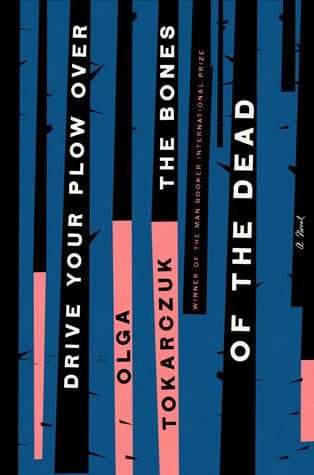
In a secluded Polish village, an eccentric astrologer and animal lover embarks on a personal crusade to uncover a series of bizarre murders, convinced the perpetrators are not human and that only she can decipher the celestial clues.
The story opens with Janina Duszejko, an elderly woman living in a remote Polish village near the Czech border, discovering the body of her neighbor, Big Foot, who was a poacher. His death is gruesome, having choked on a deer bone. Janina, a reclusive former bridge engineer with a deep love for animals and an interest in astrology and William Blake, immediately suspects that animals are taking revenge on humans for their cruelty. She reports the death to the police, but her theories are dismissed. She lives an isolated life, often only interacting with her few neighbors and the animals she adores, seeing herself as their protector. This event starts a chain of mysterious deaths that Janina believes are connected and driven by a primal justice.
Shortly after Big Foot's death, another prominent villager, the President of the Local Hunting Club, is found dead in his home. His body is discovered by Janina and her friend Oddball, who had gone to check on him after he failed to respond to calls. The President's death is also unusual; he is found naked, face down, with beetle larvae crawling on his body. Janina notes the absence of any human tracks around his house and the presence of numerous animal tracks, further solidifying her conviction that animals are punishing those who harm them. The local authorities, including Chief Inspector Wozny, continue to disregard Janina's 'insane' theories, much to her frustration, as they search for human perpetrators.
After the President's death, Janina becomes concerned about his hunting dogs, which are missing. She believes they might have been involved in his death or are suffering. Her attempts to involve the police in finding the dogs are met with indifference. Janina spends her days translating William Blake's poetry and meticulously charting astrological transits, convinced that celestial alignments offer clues to the earthly events unfolding around her. She sees the deaths as a manifestation of cosmic justice, a karmic retribution for the mistreatment of animals. Her astrological readings often point to difficult planetary aspects, particularly those involving Saturn, which she interprets as a harbinger of suffering and fate, reinforcing her conviction that these deaths are not random.
The President's funeral becomes a public spectacle, attended by many villagers and hunters. During the sermon, the local Priest delivers a eulogy that Janina finds offensive. The Priest praises the President's hunting prowess, portraying him as a righteous man and a provider, and even suggests that hunting is a divinely sanctioned activity. Janina, a staunch animal rights advocate, is incensed by this glorification of violence against animals, especially in a sacred space. She silently protests, her anger simmering, seeing the church as complicit in the cruelty. This event further isolates Janina from the community, deepening her sense of alienation and reinforcing her belief that society is morally corrupt.
The series of mysterious deaths continues with the discovery of the Commandant, a former military officer and a prominent figure in the local hunting community, dead in his car. He is found with his head covered in a swarm of flies, and there are strange, unexplained marks on his body. Janina is among the first to arrive at the scene. She notices the peculiar circumstances and the lack of any obvious human foul play, once again attributing the death to animal revenge. The police, however, are baffled and continue to pursue human suspects, dismissing Janina's persistent attempts to connect the deaths to animal cruelty and astrological patterns. This further solidifies her resolve to investigate on her own.
Despite the general dismissal from the community and authorities, Janina finds a few allies who tolerate or even entertain her eccentric theories. These include Oddball, her elderly neighbor and friend, who often helps her with practical matters; Dizzy, a former student of hers and now an entomology enthusiast who shares her love for nature; and Good News, a young woman who runs a second-hand clothes shop and has a gentle spirit. These individuals provide Janina with some measure of companionship and a sounding board for her unconventional ideas, though even they often struggle to fully grasp the depth of her convictions. Their willingness to listen provides Janina with a sense of validation in an otherwise hostile environment.
The wave of mysterious deaths reaches a new peak with the discovery of the Priest's body. He is found dead in the forest, near a game camera, having seemingly died of exposure. Janina, upon seeing the body, notes the presence of a deer's head lying nearby, positioned in a way that suggests a deliberate act. This scene deeply affects her, confirming her belief that the animals are delivering a powerful message. The police are now under immense pressure to solve the string of murders, which are increasingly seen as ritualistic or connected to some local vendetta. Janina's theories, though still dismissed, become more urgent in her own mind as she feels closer to understanding the pattern.
Throughout the investigation, Janina tirelessly tries to convince Chief Inspector Wozny and the other officers that the deaths are not random and are linked to the victims' cruelty towards animals. She presents her astrological charts, her observations of animal tracks, and her interpretations of the 'signs' left at each crime scene. However, her efforts are consistently met with skepticism, ridicule, and condescension. The authorities view her as an eccentric old woman, her theories as fantastical, and her presence as a nuisance. This constant dismissal fuels Janina's frustration and reinforces her conviction that she must act independently to bring justice to the animals.
As the hunting season approaches and another prominent hunter, the Warden, remains alive, Janina meticulously plans her final act. She learns of a hunting party and, using her knowledge of the terrain and the hunters' habits, sets a 'trap' for the Warden. The Warden is found dead, having been struck by a falling tree branch, and then attacked by a swarm of angry hornets. It is at this point, through a series of internal monologues and subtle hints, that the truth is revealed: Janina herself has been orchestrating these 'animal' revenge killings. She meticulously planned each death, using her intimate knowledge of the area and the victims' routines to make them appear as accidents or animal attacks.
After the Warden's death, Janina confides in Dizzy and Good News, revealing her role in the killings. She explains her motivation: to avenge the animals that the hunters so cruelly slaughtered and to bring a form of justice that the human legal system refused to acknowledge. Dizzy, initially shocked, grapples with the revelation, while Good News seems to understand, perhaps even sympathize, with Janina's extreme actions. Knowing that she cannot remain in the village, Janina prepares to flee. Her escape is aided by Dizzy and Good News, who understand that her actions, however extreme, stemmed from a moral conviction and a deep love for the natural world. The novel concludes with Janina disappearing into the wilderness, leaving the village to ponder the mysterious deaths.
The Protagonist
From a dismissed eccentric, she transforms into a vigilante seeking justice for animals, culminating in her confession and escape.
The Supporting
He remains a constant, supportive presence, largely unchanged by the events, representing loyalty and pragmatic friendship.
The Supporting
Initially a distant admirer of Janina's intellect, he becomes a shocked but ultimately understanding accomplice and helper in her escape.
The Supporting
She remains a sympathetic and understanding figure, ultimately helping Janina escape after her confession.
The Antagonist
He remains stubbornly conventional in his investigation, never truly understanding the nature of the crimes or Janina's role.
The Mentioned
His death is the inciting incident, establishing the novel's central conflict.
The Mentioned
His death reinforces Janina's theory and escalates the mystery.
The Mentioned
His death serves as another confirmation of Janina's 'animal revenge' theory.
The Mentioned
His sermon provokes Janina's moral outrage, and his death is a pivotal, highly symbolic event in her plan.
The Mentioned
His death marks the completion of Janina's vengeful mission.
The novel explores the concept of justice, specifically whether human laws adequately protect the natural world. Janina believes that conventional justice fails animals, leading her to enact a brutal form of retribution. The mysterious deaths are presented as 'animal revenge,' challenging the reader to consider if such violent acts can be justified when conventional systems fail. This theme is central to Janina's character, as her actions are driven by a moral conviction that those who harm animals deserve punishment, even if it means stepping outside human law. Her personal justice system is a direct response to the perceived injustice against nature.
“What kind of world is this, where killing and suffering are the norm?”
A core theme is the often-abusive relationship between humans and the natural world, particularly through hunting and exploitation. Janina acts as the voice of nature, condemning human cruelty and advocating for animal rights. The hunters represent humanity's dominion over animals, while Janina champions a more harmonious, biocentric view. The plot is a direct consequence of this strained relationship, as Janina's actions are a violent protest against the perceived subjugation and suffering of animals at the hands of humans. The book forces a re-evaluation of anthropocentric views.
“We live in a world that is dying, and we are the ones killing it.”
The novel questions the boundaries between sanity and madness, particularly through Janina's character. Her unconventional beliefs, such as her deep connection to animals and her astrological interpretations, lead the community and authorities to dismiss her as a 'mad old woman.' This theme explores who society deems worthy of a voice and whose perspectives are marginalized. Janina's 'madness' can also be interpreted as a heightened moral clarity, making her an outcast whose insights are ignored. Her isolation is a direct consequence of her refusal to conform to societal norms.
“People who are considered mad are often the only ones who see the truth.”
Astrology is more than just a hobby for Janina; it is a framework through which she understands fate and the interconnectedness of events. She meticulously charts planetary movements, believing they reveal the underlying patterns of life and death, suggesting that the deaths are not random but fated. This theme explores the tension between predetermined destiny and individual agency, with Janina ultimately taking free will into her own hands to fulfill what she sees as a cosmic imperative. Her belief in fate provides a moral justification for her actions, framing them as inevitable.
“The stars do not lie. They show us the way, if only we learn to read them.”
As the narrator, Janina controls the story, and her unique voice shapes the reader's perception of events. This theme explores whose stories get told and whose are silenced. Janina's voice, initially dismissed by the authorities, becomes the sole lens through which the reader experiences the mystery and its resolution. Her narrative challenges the dominant, human-centric narratives of the village, asserting an alternative, animal-centric perspective. The novel itself is an act of giving voice to the marginalized and the unheard, both Janina and the animals she champions.
“A human life is worth no more than an animal's.”
Janina's subjective perspective as the sole narrator.
The entire story is told from Janina Duszejko's first-person perspective. This device immerses the reader in her unique worldview, her philosophical musings, and her deep empathy for animals. It also creates a dynamic tension around her reliability as a narrator. While she presents her theories about animal revenge with conviction, the reader is left to question the extent of her 'madness' versus her 'truth,' until the very end when her role as the perpetrator is revealed, retroactively re-contextualizing her narrative as both deeply subjective and cunningly manipulative.
Used as interpretive frameworks for understanding events and Janina's worldview.
Janina's twin passions, astrology and the poetry of William Blake, serve as powerful interpretive lenses within the narrative. Astrology provides a cosmic framework for her understanding of fate, character, and the unfolding murders, allowing her to connect earthly events to celestial patterns. Blake's poetry, particularly his themes of innocence, experience, and divine retribution, offers a moral and philosophical backdrop for her actions and beliefs. These devices are not merely hobbies; they are integral to Janina's worldview, providing her with a language and a justification for her radical actions and challenging conventional, rational explanations for the deaths.
Animals are central to the plot, representing victims, avengers, and moral compasses.
Animals are not just background elements but central characters and symbols in the novel. Janina's deep empathy leads her to almost anthropomorphize them, seeing them as capable of complex emotions and even organized retribution. Each death is attributed to 'animal revenge,' with specific animals or animal-related elements (deer bones, beetle larvae, swarming flies, a deer's head) featuring prominently at the crime scenes. This device highlights the theme of humanity's relationship with nature and forces the reader to consider the moral agency of non-human beings, as well as Janina's own complex psychology.
The village's remoteness amplifies Janina's isolation and the insular nature of its community.
The isolated setting of the Kłodzko Valley, a remote village near the Czech border, plays a crucial role. This geographical isolation mirrors Janina's social isolation from the community and the wider world. The harsh winters and dense forests create an atmosphere of foreboding and allow the murders to occur with minimal immediate scrutiny. The insular nature of the community, where hunters hold significant sway and outsiders like Janina are easily dismissed, further amplifies the sense of injustice and the lack of external intervention, making Janina's vigilante actions seem almost inevitable in this contained world.
The narrative consistently points to animal revenge, obscuring Janina's true role.
The novel masterfully employs misdirection, consistently presenting the mysterious deaths as acts of 'animal revenge.' Janina's theories, while dismissed by the police, are presented to the reader with such conviction and circumstantial evidence (animal tracks, specific animal-related details at crime scenes) that the reader is led to believe, or at least seriously consider, the possibility of animals as perpetrators. This sustained red herring effectively conceals Janina's true role as the murderer until the very end, making the revelation a shocking and impactful twist that re-frames the entire narrative.
“Tell me, how are we to understand the world if we don't even understand the most basic things?”
— Janina struggles with understanding human nature and animal cruelty.
“The world is a machine, and we are just its cogs. If one cog breaks, another takes its place.”
— Janina's fatalistic view on life and the indifference of the universe.
“Every animal knows the world better than we do. They are part of it, whereas we just visit.”
— Janina's deep empathy for animals and critique of human detachment.
“Evil is always somewhere else, never here. That's why it's so hard to fight.”
— Janina reflecting on the elusive nature of evil and injustice.
“There is nothing more dangerous than a person who thinks they are doing good.”
— Janina's observation on self-righteousness and its potential for harm.
“To be alone means to be free.”
— Janina cherishes her solitude and independence in the Kłodzko Valley.
“People are like moths, always drawn to the light, even if it burns them.”
— Janina's cynical view of human behavior and their pursuit of fleeting desires.
“The dead don't care about anything. They are beyond all earthly concerns.”
— Janina contemplating death and the finality of existence.
“All living creatures are connected, like threads in a great tapestry.”
— Janina's belief in the interconnectedness of all life forms.
“The world is full of signs, if only we knew how to read them.”
— Janina's mystical perspective on deciphering the hidden meanings in nature and events.
“It's a peculiar thing, this human need to categorize everything, to put it into neat little boxes.”
— Janina's resistance to conventional classifications and societal norms.
“What is memory if not a story we tell ourselves about the past?”
— Janina musing on the subjective and often unreliable nature of memory.
“Sometimes the greatest truth lies in the most unlikely places.”
— Janina's pursuit of truth often leads her to unconventional conclusions.
“We are all just trying to make sense of the chaos, each in our own way.”
— Janina acknowledging the universal human struggle to find meaning.
Ready to see how well you understood this book? Take our interactive quiz with 10 questions.
Biography coming soon.







