“If a man has no talent, that is a virtue.”
— Said by Baoyu, reflecting his disdain for conventional scholarly pursuits and his appreciation for feminine qualities.

Genre
Historical Fiction / Romance
Reading Time
Approximately 12-15 hours (based on 352 pages and average reading speed)
Key Themes
See below
Sign in to track this book
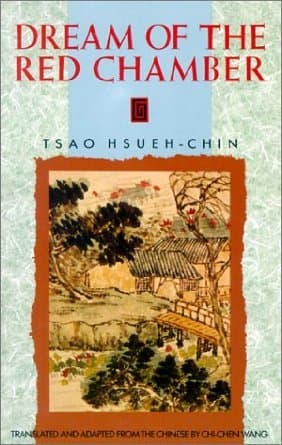
The passionate and tragic love between Jia Baoyu and Lin Daiyu unfolds against the backdrop of an aristocratic family's decline in 18th-century imperial China.
The story starts with the mythical origins of a sentient stone, which the goddess Nüwa rejected for mending the heavens. This stone, later called the Stone of Spiritual Understanding, remains at the foot of Greensickness Peak. Over time, it gains sentience and a wish to experience the human world. A Buddhist monk and a Taoist priest, seeing its potential, turn it into a piece of jade and allow it to descend to the mortal realm. There, it is destined to be born as Jia Baoyu, the main character. Before its reincarnation, the Stone sees the Crimson Pearl Fairy, who grew from a flower, crying tears of thanks for the dew it gave her. She promises to repay this kindness in the human world by crying for him, hinting at the tragic romance between Baoyu and Lin Daiyu.
The story moves to the wealthy Rongguo and Ningguo Mansions, homes to two branches of the powerful Jia clan in the capital. The Jia family is very rich and influential, holding high positions in the imperial court. The Rongguo branch, led by Grandmother Jia (Shi Taijun), is especially prominent. We meet many characters, including Baoyu's parents, Jia Zheng and Lady Wang, and numerous cousins, servants, and retainers. The family's wealth is clear in their lavish life, complex social structure, and the large number of people living in their homes. The story sets the stage for the drama, showing the grandeur and complexity of this aristocratic world, though hinting at hidden weaknesses.
After her mother Jia Min (Baoyu's aunt) dies, the delicate and intelligent Lin Daiyu, Baoyu's maternal cousin, comes to live in the Rongguo Mansion under Grandmother Jia's care. Her arrival causes excitement; everyone notices her ethereal beauty and refined manners. Baoyu, meeting her, feels an immediate, deep connection, recognizing her from a 'previous life.' Daiyu, however, is very aware of her dependent status and the complexities of the large household, which makes her feel insecure and melancholic. Her presence immediately sets up the main romantic entanglement, as her sensitive nature contrasts with the more outgoing and practical members of the Jia family.
Soon after Daiyu arrives, another cousin, Xue Baochai, from the wealthy Xue family (Lady Wang's brother's family), also comes to live in the Rongguo Mansion. Baochai is the opposite of Daiyu: strong, friendly, practical, and skilled in household management and classical learning. She wears a golden lock with words that match the inscription on Baoyu's jade, leading to family speculation about their destined union. Her presence creates a love triangle, as she represents a more conventional and socially beneficial match for Baoyu. Baochai's calm manner and diplomatic skills quickly make her popular in the household, including with Grandmother Jia and Lady Wang, who see her as an ideal daughter-in-law.
To celebrate the upcoming imperial visit of Jia Yuanchun, Baoyu's eldest sister who became an Imperial Concubine, the Jia family builds the Grand View Garden (Daguan Yuan). This grand garden is a masterpiece of classical Chinese landscape design, with pavilions, rockeries, ponds, and various plants. Its construction shows the Jia clan's great wealth and influence. When it is finished, Yuanchun visits and is impressed, telling her younger siblings and cousins, including Baoyu, Daiyu, and Baochai, to write poetry in its beautiful settings. The garden becomes the main home for Baoyu and the girls, a utopian sanctuary where they spend their youth, developing their literary talents and deepening their relationships, but also isolating them from the harsher outside world.
Inside the Grand View Garden, Baoyu, Daiyu, Baochai, and their female cousins and friends live a life of poetry, art, and leisure. They form literary clubs, like the Crab-Apple Club and the White-Seagull Club, where they write verses, engage in witty talk, and enjoy the garden's beauty. These scenes show the intellectual and artistic pursuits of the aristocratic youth, highlighting their education and refinement. While seemingly carefree, these gatherings also subtly reveal the characters' personalities, their growing affections, jealousies, and the tensions, especially between the sensitive Daiyu and the more practical Baochai, as they compete for Baoyu's attention and affection. This period marks the peak of the Jia family's wealth and the innocence of the young characters.
As Baoyu, Daiyu, and Baochai grow up, the unspoken tensions of their love triangle become clearer. Daiyu's delicate health and sensitive nature make her prone to jealousy and sadness, often causing arguments and misunderstandings with Baoyu. Her frequent crying, fulfilling her mythical promise, becomes a key part of their relationship. Baochai, with her composed and sensible manner, often appears as a more stable and suitable match in the eyes of the family elders, especially Lady Wang, who values her practicality. Baoyu is torn between his spiritual connection with Daiyu and the societal expectations Baochai represents. These emotional struggles are made worse by gossip and schemes from servants and the household's strict social rules, slowly chipping away at the garden's youthful happiness.
Underneath the surface of wealth, the Jia family's fortunes begin to decline. Poor financial management by incompetent male heirs, uncontrolled extravagance, and corruption among their servants slowly reduce their wealth. The once-strict discipline in the mansions loosens, leading to scandals and moral decay, especially in the Ningguo branch. The story introduces characters like Jia She, Baoyu's greedy and immoral uncle, and Jia Lian, Baoyu's dissolute cousin. These internal weaknesses combine with external pressures, as the imperial court becomes less favorable to the Jia clan. These early signs of decline foreshadow the inevitable collapse of their once-great house, marking a shift from the Grand View Garden's idyllic setting to a more somber reality.
The family elders, especially Lady Wang and Grandmother Jia, increasingly prefer Baochai as Baoyu's bride. They believe her to be a more suitable and practical match, given Daiyu's frail health and perceived melancholic nature. A cruel trick is planned: Baoyu is led to believe he is marrying Daiyu, but it is Baochai who is brought to him in the wedding ceremony. Overwhelmed by grief and betrayal, and her long illness made worse by her heartbreak, Lin Daiyu dies alone, shedding her last tears, just as Baoyu learns the truth of the trick. Her death is a tragic turning point in the novel, symbolizing how worldly concerns and family manipulation destroy pure, spiritual love. Baoyu is devastated, and the Grand View Garden loses its last bit of innocence.
The long-feared downfall of the Jia clan finally happens. Imperial officials, acting on accusations of corruption, embezzlement, and other crimes, raid both the Rongguo and Ningguo Mansions. The once-grand residences are ransacked, valuables seized, and many family members arrested or exiled. The extent of their mismanagement and moral decay is revealed. Baoyu, now married to Baochai but heartbroken by Daiyu's death, is mostly unaware or indifferent to the material losses. This devastating event shatters the illusion of the Jia family's invincibility and marks their complete ruin, forcing them to face their past excesses and the consequences of their actions. The Grand View Garden, once a paradise, is now desolate and abandoned, reflecting the family's shattered fortunes.
After Daiyu's tragic death, the forced marriage to Baochai, and the complete destruction of his family's prestige and wealth, Jia Baoyu experiences a deep spiritual awakening. The illusions of the mortal world, its attachments, and its suffering become clear to him. Despite Baochai's continued devotion and her giving birth to a son, Baoyu feels an overwhelming detachment from earthly concerns. He achieves the highest literary honor by passing the imperial examinations, fulfilling his father's long-held wish. Immediately after, he gives up his worldly life. He leaves his family, including his wife and child, to follow the Buddhist monk and Taoist priest who first brought him to the human world, shedding his jade and embracing a life of asceticism and spiritual enlightenment. His departure symbolizes the ultimate rejection of the 'red dust' of the mortal realm.
The story ends by reflecting on the scattered remnants of the once-powerful Jia family. Some members face poverty, others exile, and a few adapt to their drastically changed circumstances. Baochai, left to raise their child alone, shows resilience and quiet suffering. The Grand View Garden lies in ruins, a physical symbol of their lost glory. The story reinforces Buddhist themes of impermanence, karma, and the illusory nature of worldly attachments. Baoyu's transformation into a monk signifies a return to his spiritual origins as the sentient stone. The novel leaves a poignant message about the cyclical nature of prosperity and decline, the futility of human ambition, and the lasting power of both love and suffering, all set against the backdrop of a vanished aristocratic world.
The Protagonist
Baoyu evolves from a pampered, sensitive youth into a heartbroken man who ultimately renounces the world for spiritual enlightenment, shedding his earthly attachments.
The Protagonist / Love Interest
Daiyu's character arc is one of escalating emotional suffering and physical decline, culminating in her tragic death from a broken heart, fulfilling her mythical vow.
The Love Interest / Supporting
Baochai remains consistently pragmatic and virtuous, enduring the pain of an unrequited love and the decline of her family with stoic grace, ultimately becoming a symbol of enduring, practical womanhood.
The Supporting / Antagonist
Xifeng's arc shows her rise to immense power within the household, followed by her gradual decline as her health deteriorates and her past misdeeds catch up to her, leading to her eventual downfall.
The Supporting
Grandmother Jia maintains her position as matriarch throughout the story, but her influence wanes as the family's fortunes decline, and she witnesses the tragedies unfold with increasing helplessness.
The Supporting
Jia Zheng remains largely consistent in his traditional values, but his frustration with Baoyu is eventually replaced by a sense of duty and later, a quiet acceptance of his son's spiritual path.
The Supporting
Lady Wang's character remains somewhat static, embodying maternal concern and conventional piety, but her decisions ultimately lead to tragic consequences, leaving her with profound regret.
The Supporting
Qingwen's arc is tragic, as her spirited nature and perceived 'impropriety' lead to her unjust expulsion from the mansion and early death, deeply affecting Baoyu.
The novel details the Jia family's great wealth and grandeur, only to show its inevitable collapse. This theme highlights the Buddhist idea of 'red dust' – the transient and ultimately illusory nature of worldly attachments, including power, wealth, and even human relationships. The construction and subsequent desolation of the Grand View Garden perfectly show this, changing from a lively paradise to a desolate ruin. The downfall of the Jia clan serves as a strong symbol for the fleeting nature of all material things and the cyclical pattern of rise and fall.
“What is real is unreal, what is unreal is real. Where there is nothing, there is something. Where there is something, there is nothing.”
The central love triangle between Baoyu, Daiyu, and Baochai shows this conflict. Daiyu represents a pure, spiritual, and often melancholic love, based on a past-life connection and intellectual closeness. Baochai, in contrast, represents a more practical, conventional, and socially acceptable love, emphasizing stability, family duty, and worldly success. Baoyu is torn between these two ideals. His final choice to renounce the world after Daiyu's death and his marriage to Baochai means spiritual detachment wins over earthly attachments, suggesting that true love, in its purest form, cannot exist in the 'red dust' of the mortal realm.
“Though they are of the same heart and mind, they are not destined to be together.”
Despite the presence of strong female characters like Xifeng and the intelligence of Daiyu and Baochai, the novel consistently illustrates the limits and suffering placed on women in a patriarchal Confucian society. Their lives are largely controlled by male authority, arranged marriages, and the expectation to have male heirs. Even powerful figures like Xifeng are eventually restricted and judged by male-dominated structures. The tragic fates of many female characters, including Daiyu's death, Qingwen's unjust expulsion, and the general confinement of women to the inner quarters, highlight the systemic oppression and lack of control they face, regardless of their talents or virtues.
“A girl is a pearl before she leaves her parents' house, but after she marries, she turns into a fish's eye.”
The Jia family's downfall is not only due to outside forces but is largely a result of its internal moral decay. The novel exposes widespread corruption, extravagance, mismanagement, and moral laxity within the mansions. Characters like Jia She's greed, Jia Lian's womanizing, and Xifeng's ruthless schemes contribute to the family's ruin. The once-strict Confucian principles that supposedly govern the clan are shown to be hollow or applied inconsistently. This theme criticizes the decadent and corrupt nature of the aristocratic class, suggesting that their fall is a fair consequence of their departure from true virtue and responsible governance.
“The great family is decaying, and the new shoots are not thriving.”
A framing device that establishes the divine origins and fated romance of Baoyu and Daiyu.
This opening mythical framework establishes the fantastical origins of Jia Baoyu (the sentient stone) and Lin Daiyu (the Crimson Pearl Fairy). It explains their fated connection and Daiyu's vow to repay Baoyu with tears in the mortal world. This device imbues their love story with a sense of cosmic destiny and tragedy from the outset, elevating it beyond a mere human romance. It also introduces the Buddhist and Taoist philosophical underpinnings of the novel, foreshadowing Baoyu's eventual spiritual awakening and renunciation of the 'red dust' of the mortal realm. It provides a meta-narrative layer, suggesting that the entire story is but a dream or an illusion.
A microcosm of the Jia household and a symbolic paradise for its youthful inhabitants.
The Grand View Garden is more than just a setting; it's a central plot device. Initially built for an imperial concubine, it becomes the primary residence for Baoyu and the girls, serving as a utopian sanctuary for their youth, poetry, and developing relationships. It functions as a microcosm of the Jia family's prosperity and its eventual decline. Its beauty mirrors the innocence and idealism of the young inhabitants, while its eventual desolation reflects the family's ruin and the loss of that innocence. The garden isolates the characters from the harsher realities outside, making their eventual confrontation with those realities all the more impactful.
Symbolic objects representing destiny and societal expectations in the love triangle.
Baoyu's magical jade, born with him, and Baochai's golden lock, inscribed with matching words, serve as powerful symbolic plot devices. The matching inscriptions are interpreted by the family as a sign of their destined union, fueling the societal pressure for Baoyu to marry Baochai. The jade represents Baoyu's spiritual essence and his connection to the divine, while the golden lock, given by a monk, represents the worldly protection and conventional blessings associated with Baochai. Their pairing creates a tangible manifestation of the conflict between Baoyu's spiritual connection to Daiyu and the worldly expectations embodied by Baochai, ultimately contributing to the tragic marriage deception.
Supernatural elements that foreshadow future events and reveal deeper truths.
Throughout the novel, characters, especially Baoyu, experience vivid dreams and visions that serve as prophetic warnings or reveal underlying truths about their destinies. The most significant is Baoyu's visit to the Land of Illusion, where he sees the 'Register of the Twelve Beauties of Jinling,' which foreshadows the tragic fates of many of the female characters. These dreams function as a narrative device to hint at future plot developments, reinforce the theme of predestination, and provide a metaphysical commentary on the illusory nature of the human world. They often serve to deepen the sense of impending doom and highlight the characters' helplessness against fate.
“If a man has no talent, that is a virtue.”
— Said by Baoyu, reflecting his disdain for conventional scholarly pursuits and his appreciation for feminine qualities.
“The flowers will fade, and the beauty will pass.”
— Lin Daiyu's lament, often associated with her 'Burying Flowers' poem, symbolizing her own fragile existence.
“All things are determined by fate, and nothing is accidental.”
— A recurring philosophical theme throughout the novel, often expressed by characters reflecting on their misfortunes or successes.
“Better to be a jade than a tile.”
— A proverb often invoked by characters aspiring to nobility or moral purity, even if it leads to a shorter, more intense life.
“The world is full of sorrow, and life is but a dream.”
— A common sentiment of disillusionment, particularly among the more introspective characters like Daiyu and Baoyu.
“When the tree falls, the monkeys scatter.”
— A proverb describing the disintegration of a family or institution once its central figure or power structure collapses, particularly relevant to the Jia family's decline.
“A beautiful woman is a bane of contention.”
— Reflects the societal view of women as objects of desire and sources of conflict, often leading to tragic outcomes.
“The road to enlightenment is paved with suffering.”
— A Buddhist-influenced idea, suggesting that hardship is necessary for spiritual growth, particularly relevant to Baoyu's eventual path.
“One day, when the jade and gold are gone, who will care for them?”
— A poignant question about the transience of wealth and status, and the ultimate loneliness that can accompany their loss.
“Even the most beautiful banquet must come to an end.”
— A metaphor for the eventual decline of prosperity and joy, often used by characters reflecting on the Jia family's good fortune.
“The heart of a woman is a needle at the bottom of the sea.”
— A proverb highlighting the perceived inscrutability and complexity of women's emotions and intentions.
“Love is a snare, and passion a delusion.”
— A more cynical view of romantic relationships, often expressed by characters who have experienced heartbreak or disillusionment.
“To be born into a noble family is a blessing, but also a curse.”
— Reflects the double-edged nature of privilege, as the Jia family experiences both immense luxury and profound tragedy.
“The prosperity of a great house will not last forever.”
— A prophetic statement that foreshadows the inevitable downfall of the Jia family, a central theme of the novel.
Ready to see how well you understood this book? Take our interactive quiz with 10 questions.

Cáo Xuěqín ; was a Chinese novelist and poet during the Qing dynasty. He is best known as the author of Dream of the Red Chamber, one of the Four Great Classical Novels of Chinese literature. His given name was Cáo Zhān (曹霑) and his courtesy name was Mèngruǎn.







