“I'm not who I think I am. I'm not even who you think I am.”
— Bethany reflects on her identity crisis after discovering she is a clone.

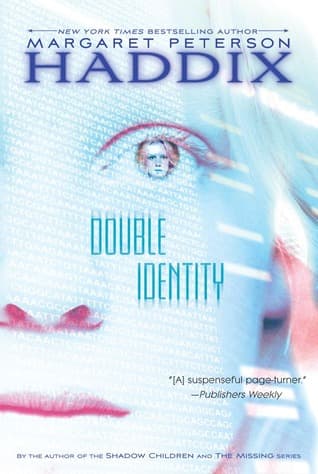
Margaret Peterson Haddix (1970)
Genre
Fantasy / Children's / Mystery / Science Fiction / Young Adult
Reading Time
210 min
Key Themes
See below
Sign in to track this book
Abandoned by her cryptic parents with an unknown aunt, a young girl unravels a mystery involving multiple identities, a missing 'Elizabeth,' and a town that sees a ghost in her face, forcing her to confront the truth of her own existence.
On the eve of her thirteenth birthday, Bethany Cole's parents, especially her father, act increasingly strange and secretive. One morning, they abruptly pack the family into their car and drive for hours, eventually leaving Bethany with an aunt she never knew existed, Myrlie, in a small, isolated town. Her parents leave without explanation, only telling Myrlie, "She doesn't know anything about Elizabeth." Bethany is confused and hurt, feeling abandoned. She tries to get answers from Aunt Myrlie, but her aunt avoids the topic, only hinting at a secret past. Bethany also notices that many townspeople react to her with shock and fear, as if they've seen a ghost. This deepens the mystery around her identity and her family's sudden disappearance.
Bethany is increasingly frustrated by her aunt Myrlie's secrecy about 'Elizabeth.' She overhears conversations and notices the peculiar reactions of the townspeople, many of whom seem to recognize her but are afraid to speak directly to her. Some whisper 'Elizabeth' when they see her, and their expressions range from shock to terror. Bethany learns that 'Elizabeth' died twelve years ago, around the time Bethany was born. This connection makes Bethany question her own identity and the real reason for her parents' actions. She feels a growing sense of unease and realizes that her resemblance to the deceased Elizabeth is central to the town's strange behavior and her family's mystery.
Bethany receives a package from her father containing thousands of dollars in cash and, more concerning, four different birth certificates, each with a different last name and from a different state. This confirms her parents have been lying and that her own identity is made up. The certificates list her birthdate as March 26th, but her parents always celebrated it on March 27th. The money and false documents suggest her parents are in serious trouble or on the run. Soon after, a mysterious man named Mr. Hemmings arrives in town, asking questions about Bethany and her family. His presence makes Bethany realize that she is not only searching for answers but also possibly in danger, as others are also looking for her.
Under pressure from Bethany and the increasing danger, Aunt Myrlie finally reveals the truth. Bethany is a clone of Myrlie's daughter, Elizabeth, who died twelve years ago at the age of thirteen. Bethany's parents, Dr. and Mrs. Cole, were scientists who, consumed by grief over Elizabeth's death, secretly cloned her using her DNA. They then raised Bethany as their own daughter, moving often and creating multiple identities to hide their project. This explains Bethany's resemblance to Elizabeth, the townspeople's reactions, and her parents' secrecy. Bethany deals with the effects of this discovery, realizing her entire life has been a carefully constructed lie.
Bethany struggles to accept being a clone, questioning her own humanity and identity. Aunt Myrlie explains that Bethany's parents believed they were bringing Elizabeth back, but Myrlie always saw Bethany as a distinct individual. Meanwhile, Mr. Hemmings, an agent from an organization investigating illegal cloning, searches more intensely. He believes Bethany is Elizabeth and wants to expose the Coles. Bethany and Myrlie realize they must protect Bethany from Hemmings, who is a threat to her freedom and represents a world that might not accept her existence. They plan to hide Bethany and mislead Hemmings, showing the urgency of their situation.
To escape Mr. Hemmings and the organization he represents, Bethany and Aunt Myrlie devise a plan: to fake Bethany's death. They decide to use Elizabeth's old belongings and a staged accident to convince Hemmings that Bethany has died, allowing her to assume a new, truly independent identity. They gather Elizabeth's clothes, a distinctive locket, and plan to leave clues that suggest Bethany met an unfortunate end near the river. This will give Bethany a chance to disappear and live a normal life, free from the scrutiny and danger associated with being a clone. The plan is risky, but it is their only hope for Bethany's future.
Bethany and Myrlie carry out their plan to fake Bethany's death. They leave Elizabeth's locket and a shoe near the river, creating a scene that suggests Bethany drowned. As they are finishing their deception, Mr. Hemmings appears, having tracked them down. A tense confrontation happens, where Myrlie tries to mislead Hemmings, but he is suspicious. Bethany, hidden nearby, sees the exchange and realizes how close they are to being discovered. They manage to escape his immediate grasp, but the encounter reinforces the danger and the cleverness of their adversary, making them more determined to succeed in their trick.
Bethany successfully fakes her death, convincing Mr. Hemmings and his organization that the 'Elizabeth Project' has ended with her demise. With the help of Aunt Myrlie and the few trusted townspeople who now understand her situation, Bethany disappears. She sheds her old identity and prepares to start a new life, truly her own, away from the ethical and legal complexities of her origins. The book concludes with Bethany embracing her individuality, ready to forge her own path, having finally escaped the shadow of Elizabeth and the secrets of her past. She is no longer just a clone, but a unique individual with a future ahead of her.
The Protagonist
Bethany transforms from a bewildered child into a self-aware individual who embraces her unique identity despite her origins.
The Supporting
Myrlie moves from being a woman burdened by a secret to a courageous protector who helps Bethany forge her own identity.
The Supporting
Their role shifts from Bethany's loving, albeit secretive, parents to the originators of her unique and dangerous existence.
The Mentioned
As a deceased character, Elizabeth has no personal arc, but her legacy profoundly shapes Bethany's journey.
The Antagonist
Hemmings's arc is primarily that of an antagonist whose pursuit drives the plot's tension, ultimately being thwarted.
The Supporting
Joss's arc involves a gradual realization of the unusual circumstances surrounding Bethany, leading to her quiet support.
The Supporting
The Minister moves from being a representative of the town's fear and judgment to an understanding and supportive figure.
The Supporting
The Kindergarten Teacher's arc mirrors the Minister's, shifting from apprehension to active support for Bethany.
The main theme is Bethany's struggle to define who she is after discovering she is a clone. She questions whether she is just a copy of Elizabeth or a unique individual. The multiple birth certificates and the constant need to hide her past force her to create her own identity, separate from her genetic origins and the expectations placed upon her. Her determination to live a life truly her own, rather than continuing the deception of being Elizabeth, shows this theme.
“"She wasn't Elizabeth. She would never be Elizabeth. She was Bethany. And she would be herself, no matter what."”
The book discusses the moral and ethical effects of human cloning. Dr. and Mrs. Cole's decision to clone Elizabeth, driven by grief, raises questions about the right to create life, the potential for exploitation, and the psychological effect on the cloned individual. The 'Elizabeth Project' is presented as a violation of nature and societal norms, leading to a life of secrecy and danger for Bethany. Mr. Hemmings's pursuit represents the societal and legal pushback against such scientific advancements without ethical oversight.
“"They thought they were bringing Elizabeth back. They didn't understand that you can't bring back the past. You can only create something new."”
The story is about grief and the difficulty of letting go of loved ones. The Coles' cloning of Elizabeth is a direct result of their inability to cope with her death. Aunt Myrlie, though she grieved deeply, eventually accepted Elizabeth's passing, which allows her to see Bethany as distinct. The townspeople's reactions to Bethany also reflect their collective memory and unresolved grief for Elizabeth. The story suggests that true healing comes not from recreating the past, but from accepting loss and moving forward, allowing new life to flourish.
“"You can't bring back the past. You can only create something new."”
From the beginning, Bethany's life is full of secrets. Her parents' constant moves, the multiple birth certificates, and their refusal to explain their actions create an atmosphere of deception. This theme explores the burden of secrets, the damage they cause to trust and relationships, and the lengths people go to protect them. The entire plot is driven by the unraveling of these secrets, ending with the revelation of the cloning project and Bethany's true origins. The ultimate solution involves a final, elaborate deception to secure Bethany's future.
“"How many lives had her parents faked? How many names had they used? How many times had they started over, just to protect this one terrible secret?"”
A physical object that reveals critical plot information and raises stakes.
The package Bethany receives from her father containing thousands of dollars and four different birth certificates serves as a crucial plot device. It not only confirms her parents' deception and the fabricated nature of her identity but also raises the stakes by indicating they are on the run and in danger. This device acts as a tangible manifestation of the secrets Bethany's parents have kept, pushing her to seek answers and accelerating the unraveling of the central mystery. It directly leads to her realization of her precarious situation.
A character who is an exact genetic copy, driving identity conflict.
The concept of Bethany being a clone of Elizabeth is the core plot device of the entire novel. It creates the central mystery, explains the townspeople's reactions, and fuels Bethany's existential crisis. This device allows the author to explore themes of identity, the ethics of science, and the nature of humanity. Bethany's physical identicality to Elizabeth is the primary reason for the conflict and the pursuit by Mr. Hemmings, as it represents a violation of scientific ethics that must be contained or exposed. It forces Bethany to define herself against her genetic template.
The initial narrative is shaped by the parents' withheld information.
While Bethany is the primary narrator, the initial mystery is created by the 'unreliable' information provided (or withheld) by her parents. Their secretive behavior, vague explanations, and eventual abandonment force Bethany (and the reader) to question everything. The truth is deliberately obscured by the parents' actions and Myrlie's initial evasiveness, making Bethany's journey one of uncovering a hidden reality. This device builds suspense and allows for the dramatic reveal of the cloning project, as the reader experiences the mystery alongside Bethany.
A confined environment that heightens mystery and community involvement.
The choice of a small, isolated town as the setting is a significant plot device. Its tight-knit community ensures that everyone knew Elizabeth and is highly sensitive to Bethany's appearance, making it impossible for her to blend in. The limited number of residents means secrets are hard to keep, and reactions are immediate and intense. This setting amplifies the sense of mystery and confinement, making Bethany's situation more urgent and her need to escape more pressing. It also provides a stark contrast to her transient life with her parents, highlighting the stability and interconnectedness she has lacked.
“I'm not who I think I am. I'm not even who you think I am.”
— Bethany reflects on her identity crisis after discovering she is a clone.
“Sometimes the truth is more dangerous than the lie.”
— A warning given to Bethany about the secrets surrounding her existence.
“You can't run from who you are, no matter how hard you try.”
— Bethany grapples with the inevitability of her genetic destiny.
“Every life is precious, even if it's a copy.”
— A moral dilemma about the value of cloned life.
“The past has a way of catching up with you, especially when it's written in your DNA.”
— Bethany realizes her genetic connection to her sister Elizabeth.
“Family isn't just about blood; it's about who stands by you.”
— Bethany finds support in unexpected people despite her origins.
“Fear is a prison, but courage is the key.”
— Bethany decides to confront the truth about her identity.
“In a world of copies, be an original.”
— Bethany's determination to define herself beyond her cloning.
“Secrets have a weight, and eventually, they crush you.”
— The burden of hidden truths in Bethany's family.
“What makes us human isn't our origin, but our choices.”
— A philosophical insight about humanity and free will.
“The mirror shows a face, but it doesn't show the soul.”
— Bethany questions her identity beyond physical appearance.
“Sometimes the greatest mystery is the one inside yourself.”
— Bethany's journey of self-discovery throughout the novel.
“Love doesn't care about genetics; it cares about the heart.”
— The emotional bonds Bethany forms despite her cloned nature.
“The future is unwritten, even for a clone.”
— Bethany's hope for her own path despite her predetermined origins.
Ready to see how well you understood this book? Take our interactive quiz with 10 questions.

Biography coming soon.







