“There was no such thing as a fair fight. All advantage must be sought and taken.”
— Kivrin reflecting on the realities of survival in the past.

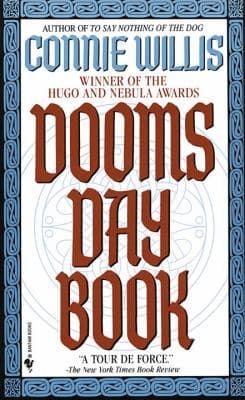
Connie Willis (1992)
Genre
Fantasy / Historical Fiction / Science Fiction
Reading Time
12-15 hours
Key Themes
See below
Sign in to track this book
A 21st-century historian, inoculated and with an alibi, finds herself stranded in the Black Death, becoming an unexpected source of hope amid medieval plague.
In 2054 Oxford, Kivrin Engle, a young history student, plans a dangerous time-travel mission to study the medieval period. Her destination is Oxford, England, in 1320, a time before the Black Death. Professor James Dunworthy, her mentor, and Mr. Gilchrist, head of the time-travel lab, are anxious. Kivrin is prepared, with inoculations and training. Her departure is set for a precise spot and time, with a planned retrieval. As she makes the jump, a small problem occurs. Dunworthy notices a fleeting detail about the drop-off coordinates, but dismisses it as a glitch.
Kivrin's arrival in the past is rough. Instead of a meadow outside Oxford, she lands in a muddy, unknown forest, confused and with a severe concussion. She quickly realizes something is wrong: the coordinates are off, and she is not in 1320. Villagers, who are hostile and superstitious, think she is a demon or witch because of her strange clothes and sudden appearance. She is taken to a nearby manor, cared for by Lady Imeyne and Father Roche, a kind but sick priest. Kivrin struggles to understand her surroundings and the dialect, making her dangerous situation worse as she tries to find the exact year and her location.
Back in 2054, a severe, fast-spreading flu, called 'Nero' by students, sweeps through Oxford. The outbreak quickly grows, forcing the university into lockdown and overwhelming medical facilities. Professor Dunworthy, already worried about Kivrin's jump, feels isolated as the time-travel lab is quarantined, and most staff are ill or sent home. His attempts to contact Kivrin through the time-travel equipment are hindered by the crisis and the illness of Badri, the technician for the 'net.' The city descends into chaos, mirroring the historical plagues Kivrin meant to study, creating a terrifying link between past and present.
As Kivrin recovers from her concussion, she slowly learns the truth: she is not in 1320 but in December 1348. This is just before the Black Death reached England, the deadliest pandemic in history. She was inoculated against it but not ready to see it firsthand. She stays at Lord Tibble's manor, surrounded by his family and staff, including young Lady Agnès, her brother Sir Gawain, and stern Mistress Dabney. Kivrin, with her modern medical knowledge and hygiene understanding, becomes a desperate caregiver as the plague's first symptoms appear in the village and manor. She tries to introduce basic sanitation, but people meet her efforts with superstition and resistance.
In the chaos of the 2054 plague, Professor Dunworthy finds an ally in Colin, a bright but mischievous young boy, his grand-nephew. Colin, meant to be evacuated, is stranded with Dunworthy in the quarantined university. Together, they navigate the deserted and dangerous campus, trying to reach the time-travel lab and figure out what went wrong with Kivrin's jump. Badri, the technician, is very ill, and the equipment malfunctions due to power fluctuations and infrastructure breakdown. Dunworthy suspects sabotage or a terrible miscalculation, fearing for Kivrin's life in a past much more dangerous than intended.
The Black Death hits the village and manor with speed and force. Kivrin's medical knowledge, though advanced, is useless against the bubonic plague. She sees villagers die in agony, and soon, members of Lord Tibble's household. Father Roche, despite his own illness, continues to care for the dying, and Kivrin helps him, offering comfort and basic care. The sheer amount of suffering and death is overwhelming. Kivrin struggles to stay calm and sane. She faces the brutal realities of medieval life and death, far beyond what her studies prepared her for. The survivors' fear and desperation grow daily.
Amid the 2054 plague, Dunworthy and Colin finally reach the time-travel lab. With Badri's help, Dunworthy reviews the jump data. He discovers the original coordinates for Kivrin's drop were subtly changed, shifting the date from 1320 to 1348. He realizes Mr. Gilchrist, a meticulous but rigid technician, made a critical error in entering the longitude. This, with a specific celestial alignment, caused the temporal displacement. The realization fills him with urgency to fix the error and get Kivrin back before it's too late, but the lab's capabilities are severely limited.
As the plague rages, Kivrin suffers great personal loss. She sees Lady Agnès, Sir Gawain, and many others she cared for die. The manor becomes a house of the dead, its inhabitants quickly dwindling. Despite her despair and helplessness, Kivrin finds new purpose in caring for the few remaining survivors, especially the orphaned children: young Lady Eliwys and her brother, now the sole heirs to the manor. She dedicates herself to protecting them, giving what little comfort and hope she can in a world consumed by death. Her role changes from observer to active participant, an angel of mercy in overwhelming darkness.
The plague in 2054 starts to lessen, and the lockdown slowly lifts. Badri, though weak, helps Dunworthy more effectively. They work to recalibrate the time-travel equipment, facing many technical problems and the virus's lingering effects. The window for Kivrin's retrieval is narrow and precise, depending on specific celestial alignments that happen rarely. Dunworthy is tormented by the thought of Kivrin alone in the past, facing the Black Death, and the chance he might not get her back. He pushes himself and Badri to their limits, knowing every minute matters.
On Christmas Day, 1348, Kivrin is near death, ravaged by the plague, exhaustion, and grief. She has kept a few children alive, including Eliwys, and finds a moment of peace in the desolate manor. Just as she feels her strength fail, the time-travel 'net' appears, signaling her retrieval. The villagers, seeing her sudden disappearance, are awed, believing her a miraculous figure. Kivrin is pulled back to 2054, critically ill but alive, covered in medieval dirt and plague signs, proof of her ordeal. Her return is a great relief for Dunworthy, who immediately gets her medical care.
Kivrin recovers slowly in 2054. Physically healed, she is mentally and emotionally scarred by the horrors she saw. She struggles to return to modern life, finding the future's conveniences and trivialities jarring after 1348's brutal realities. Dunworthy, also recovering from his ordeal and the emotional toll of the search, offers support. They discuss the parallels between the medieval Black Death and the 2054 flu pandemic, noting similar patterns of fear, superstition, and human resilience. Kivrin's experience changes her understanding of history, humanity, and her place in the world, leaving her with both grief and enduring hope.
As Kivrin fully recovers, she and Dunworthy discuss the ethics and future of time travel. Kivrin's detailed, firsthand account provides insights into the medieval period beyond any historical text. However, the near-catastrophe highlights the technology's dangers and unpredictability. Dunworthy, humbled by the experience, promises to prevent such errors again. Kivrin, though traumatized, emerges with deeper empathy for humanity and a belief that history is not just facts, but a living story of human experience, suffering, and survival. Her ordeal shows the power of human connection, even across centuries, and the resilience of the human spirit in the face of great adversity.
The Protagonist
Kivrin transforms from an academic observer into an active participant and caregiver, losing her innocence and gaining a profound understanding of human suffering and resilience.
The Supporting
Dunworthy overcomes his anxieties and technological ineptitude to navigate a deadly pandemic and rescue Kivrin, reaffirming his dedication to his students and the ethical use of time travel.
The Supporting
Colin matures through his experience of the 2054 plague, demonstrating courage and loyalty while assisting Dunworthy in a desperate search.
The Supporting
Father Roche remains a beacon of faith and compassion amidst the plague's devastation, finding solace in his duties and a unique connection with Kivrin.
The Supporting
Lady Agnès tragically succumbs to the plague, her death serving as a poignant symbol of the pandemic's indiscriminate cruelty.
The Supporting
Badri's illness and recovery mirror the broader struggle against the 2054 plague, demonstrating resilience and dedication to his work.
The Supporting
Gilchrist remains largely static, his character serving as a foil to Dunworthy and a representation of the systemic flaws that can lead to catastrophe.
The Supporting
Lady Imeyne remains a steadfast figure of support and practicality within the manor until she, too, is ultimately affected by the plague.
This theme explores humanity's capacity for resilience, compassion, and hope in the face of suffering and death. Kivrin, a modern woman, sees the medieval villagers' and Father Roche's unwavering faith and kindness amid the Black Death. This inspires her to care for the sick and orphaned children despite her own despair. In 2054, Dunworthy and Colin's perseverance in the quarantined, plague-ridden university to rescue Kivrin also shows this theme. It demonstrates that even in crisis, people try to protect and connect with one another.
““They were so brave. So terribly, terribly brave.””
The novel questions how history is seen, studied, and experienced. Kivrin's time in 1348 shows history as a visceral, terrifying, and deeply human ordeal, not a sterile academic subject. The book highlights the limits of historical records and the need for empathy in understanding the past. The parallel plagues in 2054 and 1348 suggest human experience is cyclical. Despite technology, basic human reactions to crisis – fear, superstition, compassion, and resilience – remain constant.
““History isn't a story. It's what's left behind when the story's over.””
Time-travel technology allows historical study but also creates ethical dilemmas. Kivrin's accidental displacement to the Black Death era shows the dangers of technological arrogance and unpredictable consequences of altering or observing the past. The debate among scientists about the 'net's' purpose – research versus intervention – highlights the moral responsibility that comes with such powerful tools. The novel suggests that even with good intentions, the past needs extreme caution and respect for its complexities and the lives lived within it.
““You don't tamper with the past, not even to save it.””
Both Kivrin and Dunworthy experience great loss. Kivrin sees nearly everyone she knows and cares for in 1348 die, experiencing a level of grief beyond academic understanding. Dunworthy, in 2054, fears losing Kivrin, loses colleagues to the modern plague, and sees his familiar world break down. The novel explores how people cope with overwhelming grief, find meaning in loss, and eventually heal, stressing that processing such trauma is a long journey.
““The dead were everywhere, silent witnesses to the living's terror.””
The medieval setting shows the clash and coexistence of faith and superstition during the plague. Villagers blame the disease on God's wrath, witchcraft, or demons, leading to fear-driven reactions. Father Roche, in contrast, embodies quiet, unwavering faith, offering comfort and spiritual guidance. Kivrin, with her scientific understanding, initially clashes with these beliefs but comes to respect faith's role in providing solace. The 2054 plague also sees a rise in irrational fears and conspiracy theories, showing that modern society is not immune to superstitious thinking when faced with the unknown.
““They believed in God, and they believed in demons, and sometimes it was hard to tell the two apart.””
A futuristic device allowing travel to the past.
The 'net' is the central technological marvel, allowing individuals to physically travel to specific historical periods. It functions by creating a localized spacetime distortion, but its precision is highly dependent on accurate coordinate input and stable energy. Its malfunction, caused by a seemingly minor error in longitude, is the catalyst for the entire plot, sending Kivrin to the wrong, and vastly more dangerous, time. The 'net' also serves as a critical plot point for the retrieval, emphasizing the urgency and technical challenges faced by Dunworthy.
The simultaneous outbreaks of the Black Death in 1348 and a virulent influenza in 2054.
This is a key structural and thematic device. The simultaneous outbreaks of the Black Death in Kivrin's past and the 'Nero' influenza in Dunworthy's present create a powerful parallel, highlighting the universal human responses to pandemic: fear, isolation, medical chaos, and eventual resilience. It underscores the novel's message that history, while distant, is deeply relevant to contemporary experience, and that human nature, in crisis, remains remarkably constant across centuries.
Kivrin's modern appearance and knowledge are misinterpreted in the medieval world.
Upon her arrival, Kivrin's strange clothing, unusual language, and sudden appearance lead the medieval villagers to believe she is either a demon, a witch, or an angel. This mistaken identity creates immediate conflict and danger for her. Her modern understanding of hygiene and medicine also clashes with medieval superstition and limited knowledge, often hindering her efforts to help but occasionally granting her an almost miraculous aura, allowing her to gain trust and leverage in a hostile environment.
The arrival and retrieval of Kivrin both occur around Christmas.
Kivrin arrives in the medieval period in early December 1348 and is retrieved on Christmas Day of that year. This setting adds a layer of poignant irony and symbolic significance. Christmas, a time of hope, birth, and miracles, stands in stark contrast to the death and despair of the Black Death. Kivrin's retrieval on this day can be seen as a 'Christmas miracle,' emphasizing the themes of hope and redemption even amidst overwhelming tragedy. It also provides a specific, memorable anchor for the timeline of her ordeal.
“There was no such thing as a fair fight. All advantage must be sought and taken.”
— Kivrin reflecting on the realities of survival in the past.
“Every time you go back, you risk changing the future. Even the smallest thing can have unforeseen consequences.”
— Mr. Dunworthy explaining the dangers of time travel.
“The past is a foreign country; they do things differently there.”
— A common saying among time travelers, emphasizing the cultural differences.
“The problem with the past is that it's already happened.”
— Kivrin realizing the immutability of certain historical events.
“When you're trying to save the world, it's always one more thing.”
— Colin, exasperated by the continuous crises in the present.
“It was not a question of good or evil, but of what was necessary.”
— Kivrin observing the harsh realities of medieval life.
“Hope was a terrible thing. It was a thing that made you do things that you shouldn't.”
— Kivrin's internal thought during a desperate situation.
“The whole point of history is to understand how we got here.”
— Mr. Dunworthy's philosophical view on the study of history.
“Sometimes the best thing you can do is nothing.”
— A piece of advice given regarding intervention in the past.
“Fear was a very good motivator. It made people do things they would never do otherwise.”
— Kivrin reflecting on the reactions of people during the plague.
“It wasn't about changing history; it was about witnessing it.”
— Kivrin's original goal for her time travel mission.
“There are some things that cannot be fixed, only endured.”
— Kivrin facing the overwhelming tragedy of the Black Death.
“Plague knows no season, nor does it know any master.”
— A statement made in the medieval period about the indiscriminate nature of the plague.
“The past is never dead. It's not even past.”
— A variation of a famous quote, applied to the immediacy and impact of historical events on the present.
“You can't save everyone, but you can try.”
— Kivrin's internal struggle and determination amidst widespread death.
Ready to see how well you understood this book? Take our interactive quiz with 10 questions.

Connie Willis is a celebrated American science fiction and fantasy author, renowned for her intricate plots and deeply human characters. Her most acclaimed works include the Hugo and Nebula Award-winning novel 'Doomsday Book' and the critically lauded 'Blackout/All Clear' duology. Willis's writing often explores themes of history, faith, and the resilience of the human spirit, earning her numerous accolades within the genre.







