“For neither good nor evil can last for ever; and hence it follows that as evil has lasted long, good must now be nigh at hand.”
— Don Quixote's optimistic outlook during a difficult journey.

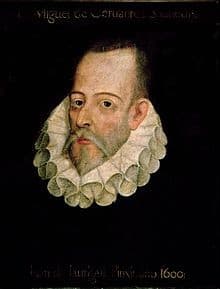
Miguel de Cervantes Saavedra (2002)
Genre
Historical Fiction
Reading Time
1567 min
Key Themes
See below
Sign in to track this book
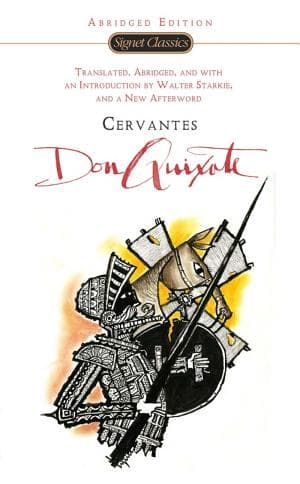
A deluded hidalgo, fueled by archaic tales of chivalry, renames himself Don Quixote and sets forth with his pragmatic squire, Sancho Panza, to revive a bygone era of knighthood through a series of increasingly anachronistic and comical misadventures.
In a village in La Mancha, an aging hidalgo named Alonso Quijano spends his days reading books of chivalry, eventually losing his sanity. Convinced that the world needs a knight-errant to right wrongs, he renames himself Don Quixote de la Mancha, polishes an old suit of armor, and renames his old nag Rocinante. He declares a local peasant girl, Aldonza Lorenzo, to be his lady love, Dulcinea del Toboso, though she is unaware of his affections. Don Quixote then sets out on his first sally, determined to find adventures and prove his worth as a knight, despite having no squire or proper knighting.
Don Quixote's first adventure leads him to an inn, which he believes is a magnificent castle. He demands to be knighted by the innkeeper, whom he mistakes for a castellan. The innkeeper, an astute and humorous man, plays along with Quixote's delusions, performing a mock knighting ceremony. During his watch over his armor in the inn's courtyard, Quixote attacks mule drivers who try to move it, causing chaos. After his 'knighting,' Don Quixote continues his journey, encountering merchants whom he forces to declare Dulcinea the most beautiful woman, leading to him being beaten and left for dead.
After being rescued and returned home by a neighbor, Don Quixote's niece and housekeeper, along with the barber and priest, try to cure his madness by burning his books of chivalry. However, Quixote remains undeterred. He then convinces a simple farmer named Sancho Panza to become his squire, promising him governorship of an island in return for his service. Sancho, despite his common sense, is swayed by Quixote's grand promises. Together, the mismatched pair embarks on their second sally, with Sancho riding his donkey, Dapple, and Quixote mounted on Rocinante, ready for new adventures.
One of Don Quixote's most iconic delusions occurs when he mistakes a group of windmills for monstrous giants. Despite Sancho's protests, Quixote charges at them with his lance, resulting in him and Rocinante being thrown to the ground and injured. Later, he encounters a flock of sheep, which he believes to be two mighty armies clashing in battle. He charges into the flock, slaughtering several sheep before being pelted with stones by the angry shepherds. These incidents further show his detachment from reality and Sancho's growing exasperation mixed with loyalty.
Don Quixote's delusions continue as he encounters a barber wearing a basin on his head to protect himself from rain. Quixote immediately believes it to be the fabled Helmet of Mambrino, a magical golden helmet, and takes it by force. Sancho, ever the pragmatist, recognizes it as a simple basin. Later, Quixote encounters a group of galley slaves being led to their punishment. Believing them to be unjustly imprisoned, he attacks their guards and frees the convicts, who then turn on him and Sancho, robbing them and beating them before fleeing. This act of misguided heroism further complicates their journey.
Don Quixote decides to perform penance in the Sierra Morena mountains, mimicking the legendary knight Amadis of Gaul, after Sancho suggests he needs a noble reason for his madness. He sends Sancho to deliver a letter to Dulcinea in Toboso, detailing his 'sufferings' for her love. While Sancho is away, he encounters the priest and barber from Quixote's village, who have come searching for him. They learn of Quixote's whereabouts and Sancho's mission. Sancho, rather than delivering the letter, fabricates a story about seeing Dulcinea and her indifference, but eventually confesses his lie, prompting the priest and barber to devise a plan to bring Quixote home.
In the second part of the novel, Don Quixote and Sancho meet a Duke and Duchess who have read about their previous adventures and decide to entertain themselves by playing pranks on them. They treat Quixote with mock reverence, fulfilling his chivalric fantasies. They invent a quest involving the 'Countess Trifaldi' (a disguised male steward) and a flying wooden horse named Clavileño, which they convince Quixote and Sancho to ride blindfolded, all while remaining stationary. These deceptions show the cruelty and amusement derived from Quixote's madness, while Sancho often sees through the charade but is compelled to play along.
As part of their pranks, the Duke and Duchess make Sancho Panza governor of a fictional island, Barataria. To their surprise, Sancho, despite his simple background, shows wisdom and common sense in administering justice and resolving disputes. He demonstrates a natural aptitude for governance, often cutting through bureaucratic nonsense with practical solutions. However, the Duke's servants continue to play tricks on him, subjecting him to ridiculous situations and a strict diet. Eventually, Sancho, tired of the constant torment and the responsibilities, resigns from his post, concluding that governing is not for him.
Don Quixote and Sancho continue their travels, eventually arriving in Barcelona. There, Quixote is challenged to a duel by the Knight of the White Moon, who is secretly Sansón Carrasco, a bachelor from Quixote's own village, disguised once again. The terms of the duel are that if Quixote loses, he must return home and abandon his life as a knight-errant for a full year. Quixote, despite his bravery, is easily defeated by the Knight of the White Moon. Humiliated and bound by his knightly word, Don Quixote reluctantly agrees to return to his village.
Don Quixote returns to his village, defeated and melancholic. During his journey home, he begins to express doubts about his chivalric adventures. Upon reaching his home, he falls ill. As he lies on his deathbed, his fever breaks, and he regains his sanity, transforming back into Alonso Quijano. He renounces all books of chivalry, admitting his past delusions were foolish. His niece, housekeeper, Sancho, the priest, and the barber are present as he makes his will, advises his niece against marrying men who read chivalric romances, and then peacefully passes away, leaving Sancho and the others heartbroken but relieved that he died a sane man.
The Protagonist
Transforms from a sane hidalgo into a mad knight-errant, experiences numerous adventures, and ultimately regains his sanity on his deathbed, renouncing his chivalric past.
The Supporting
Starts as a skeptical, materialistic peasant, but gradually grows in wisdom and develops a profound loyalty and affection for his master, even adopting some of his master's idealism.
The Mentioned
Remains an idealized, static figure, never truly appearing as herself, but her symbolic power evolves as Quixote's journey progresses.
The Supporting
Consistently attempts to intervene in Don Quixote's madness, acting as a voice of reason and concern throughout the narrative.
The Supporting
Acts as a consistent aid to the Priest in trying to cure Don Quixote, often taking on disguises to facilitate their plans.
The Supporting
Remains deeply concerned for her uncle's sanity, consistently trying to bring him back to reality and protect him.
The Supporting
Consistently expresses worry and takes practical, if sometimes misguided, actions to cure Don Quixote's madness.
The Supporting
Transforms from a playful deceiver to a determined figure who ultimately defeats Quixote in a duel to force his return home, acting out of a desire for his friend's well-being.
The Antagonists
Remain static in their pursuit of amusement, with their actions serving to highlight the contrast between Quixote's idealism and worldly cynicism.
This is the central conflict of the novel, shown by Don Quixote's idealism and Sancho Panza's realism. Don Quixote lives in a world of chivalric fantasy, interpreting mundane objects and events through his beloved romances. He sees giants in windmills and armies in sheep. Sancho, on the other hand, is grounded in reality, constantly pointing out the truth of their situations. Their interactions highlight the tension between a noble, albeit deluded, pursuit of ideals and the harsh, often disappointing, realities of the world. The novel explores whether an idealistic vision, even if based on delusion, can be more fulfilling than a purely realistic one.
“"Look, your worship," said Sancho, "what you see there are not giants but windmills, and what seem to be their arms are the vanes that turn them in the wind and make the millstone go." "It is clear," replied Don Quixote, "that you are not experienced in this matter of adventures; they are giants; and if you are afraid, move aside and start praying while I engage them in fierce and unequal battle."”
The novel constantly blurs the lines between what is real and what is imagined. Don Quixote genuinely believes his illusions, while others either play along with them (like the innkeeper or the Duke and Duchess) or try to dispel them (like Sancho, the Priest, and the Barber). This theme questions how reality is constructed, both individually and collectively. Is Quixote's imagined world any less 'real' if he experiences it as such? The book also highlights how characters react to Quixote's delusions—some with genuine concern, others with cruel amusement—reflecting different perspectives on truth and sanity.
“"For I would have you know, Sancho, that all these matters of knights-errant are but a dream, and that there are no knights-errant in the world, nor ever were, save in our histories and fables."”
Don Quixote's madness is directly attributed to his excessive reading of chivalric romances, showing the influence literature can have on an individual's perception of the world. The burning of his books by the Priest and Barber is an attempt to control this influence. However, the novel itself, by being a work of fiction that influences its characters (the Duke and Duchess read the first part), also comments on its own power. It explores how stories shape identity, inspire action, and can lead to both grand folly and insights, making a commentary on storytelling itself.
“"In short, his brain dried up from his much reading, and he lost his wits. He came to conceive the strangest notion that ever madman in this world conceived, and that was that it seemed to him fitting and necessary, in order to increase his honor and serve his nation, to become a knight-errant and roam the world with his arms and his horse to seek adventures and practice everything that he had read that knights-errant practiced."”
The novel frequently addresses the social hierarchy of 17th-century Spain and the concept of justice. Don Quixote, despite his delusions, genuinely seeks to right wrongs and protect the downtrodden, often intervening in disputes between different social classes, such as freeing the galley slaves or defending the mistreated Andres. Sancho Panza's brief governorship of Barataria offers a perspective on justice from the viewpoint of a common man, as he applies practical wisdom rather than strict legal codes. The Duke and Duchess's treatment of Quixote and Sancho also highlights the power dynamics between the nobility and commoners, and the casual cruelty that can accompany privilege.
“"He saw himself in a world where good was not always rewarded, and evil was not always punished, and his heart was filled with a desire to right these wrongs."”
The theme of freedom is explored through Quixote's desire to escape his mundane life and the societal expectations of an aging hidalgo by embracing knight-errantry. Ironically, his pursuit of freedom often leads to physical injury and social confinement (being returned home against his will). Conversely, characters like the galley slaves are literally confined, and Quixote's act of freeing them has complex consequences. Sancho's short-lived governorship on Barataria, while offering power, also becomes a form of confinement due to the Duke's pranks and the burdens of responsibility, leading him to choose the freedom of his simple life.
“"Liberty, Sancho, is one of the most precious gifts that heaven has bestowed upon men; with it, all the treasures that earth contains, or the sea conceals, cannot be compared."”
The novel comments on its own existence and the act of storytelling.
Cervantes employs metafiction throughout 'Don Quixote,' particularly in the second part. Characters within the novel, such as Sansón Carrasco and the Duke and Duchess, have read the first part of 'Don Quixote' and react to it. This allows Cervantes to comment on his own work, the nature of authorship, the reception of literature, and even to address critical responses to the first part. It blurs the line between the fictional world and the reader's reality, making the audience aware of the story as an artificial construct while simultaneously drawing them into its world.
The narrative perspective is often questioned, adding layers of ambiguity to the 'truth' of events.
The narration in 'Don Quixote' is famously complex. Cervantes claims to be merely translating a manuscript by an Arab historian named Cide Hamete Benengeli, whose reliability he occasionally questions. This narrative framing device creates distance and allows for multiple interpretations of events. The reader is constantly invited to doubt the 'facts' presented, particularly when they concern Don Quixote's fantastical perceptions. This unreliable narration underscores the novel's themes of illusion versus reality and the subjective nature of truth, making the reader an active participant in discerning what truly happens.
The novel uses humor and exaggeration to critique chivalric romances and societal norms.
'Don Quixote' is a masterful work of satire and parody, primarily targeting the popular chivalric romances of Cervantes's time. Don Quixote's absurd adventures, his anachronistic behavior, and his misinterpretations of the world directly mock the clichés, exaggerated heroism, and fantastical elements of these books. Beyond chivalry, Cervantes also uses satire to comment on social class, justice, and human folly, often through the contrast between Quixote's idealism and Sancho's pragmatism, or the manipulative behavior of the Duke and Duchess. The humor serves to highlight deeper philosophical and social critiques.
Numerous independent stories are interwoven into the main narrative.
While the primary narrative follows Don Quixote and Sancho Panza, Cervantes frequently interjects seemingly unrelated stories and novellas into the main plot. Examples include 'The Curious Impertinent,' the story of Cardenio, Lucinda, and Fernando, and the Captive's Tale. These embedded tales often interrupt the main action and feature different characters and settings. They serve multiple purposes: to entertain the reader, to provide moral lessons, to expand the novel's thematic scope, and to comment on different literary genres, demonstrating Cervantes's mastery of various narrative forms within a single work.
Characters are paired to highlight contrasting ideas and perspectives.
The most prominent example of a thematic foil is the pairing of Don Quixote and Sancho Panza. Quixote, the idealistic dreamer, stands in stark contrast to Sancho, the pragmatic realist. This dynamic allows Cervantes to explore the central themes of the novel—idealism vs. realism, madness vs. sanity, fiction vs. reality—through their constant dialogue and differing interpretations of events. Other characters, like the Priest and the Barber, also serve as foils to Quixote, representing conventional reason and society's attempts to 'cure' him, further emphasizing his unique worldview.
“For neither good nor evil can last for ever; and hence it follows that as evil has lasted long, good must now be nigh at hand.”
— Don Quixote's optimistic outlook during a difficult journey.
“When life itself seems lunatic, who knows where madness lies? Perhaps to be too sane is madness itself. And maddest of all: to see life as it is, and not as it should be!”
— A reflection on the nature of sanity and idealism.
“The greatest madness a man can commit is to let nobody vex him, but to let the world vex him.”
— Don Quixote's perspective on confronting life's challenges.
“I am I, and I am what I am; and I do what I do; and I say what I say; and I think what I think.”
— Don Quixote asserting his identity and resolve.
“It is one thing to write as a poet, and another thing to write as a historian.”
— A meta-commentary on different forms of storytelling and truth.
“There are only two roads in this life, the one of prosperity and the one of adversity.”
— Sancho Panza's simple, practical view of life's paths.
“To convert the world into a better place, one must first be a knight errant.”
— Don Quixote's belief in the power of chivalry to improve the world.
“Diligence is the mother of good fortune, and idleness, its opposite, never brought a man to the goal of any of his best wishes.”
— A proverb shared by Sancho Panza, emphasizing hard work.
“Hunger is the best sauce in the world.”
— Sancho Panza's pragmatic observation about appetite and simple pleasures.
“A man who is honest and has good intentions, even if he sometimes makes mistakes, is always better than one who is clever but malicious.”
— A moral reflection on character versus intelligence.
“Every man is the son of his own works.”
— A common saying in the book, emphasizing personal responsibility and achievement.
“The brave man carves out his fortune, and every man is the son of his own works.”
— Don Quixote's belief in agency and self-determination.
“It is not the business of women to be going about like vagabonds, but to be at home, spinning and sewing, and doing other things proper to them.”
— A reflection of societal expectations for women during the period.
“Too much sanity may be madness itself. And the maddest of all, to see life as it is and not as it should be.”
— A profound statement on idealism versus realism, often attributed to the character.
Ready to see how well you understood this book? Take our interactive quiz with 10 questions.
Biography coming soon.







