“History is a nightmare from which I am trying to awake.”
— A character reflects on the Vietnam War's impact and the broader historical context.

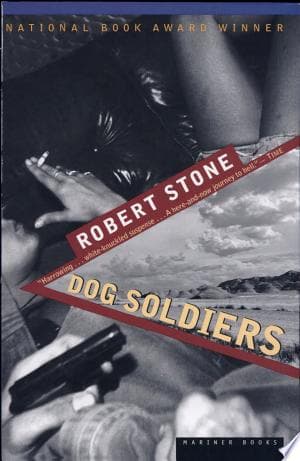
Robert Stone (2019)
Genre
Literary Fiction / Historical Fiction / Mystery
Reading Time
10-12 hours
Key Themes
See below
Sign in to track this book
A journalist's bad plan to smuggle heroin from Vietnam to California traps him and his wife in a cycle of betrayal, violence, and drug-fueled paranoia.
In 1971 Saigon, John Converse, a cynical, drug-using journalist, plans to smuggle two kilos of heroin into the United States. He asks Ray Hicks, an old marine friend and martial artist, to help. Converse feels trapped by his life and the war's pointlessness, seeing this as a way to get money and escape his mental health problems. Hicks, despite his moral doubts and personal code, agrees. He wants a fresh start and distrusts regular society. Converse carefully plans the operation, thinking he can control everything.
Ray Hicks successfully brings the heroin, hidden in Buddhist statues, from Vietnam to Oakland, California. He does not know the whole operation has been compromised. Converse, trying to secure his own position and perhaps out of a twisted self-preservation, told his contact, a shady figure named Smitty, about the shipment. However, Smitty, a corrupt federal agent, has his own plans and intends to take the drugs for himself. Hicks, arriving in the US, feels out of place, navigating a society he finds strange and corrupt, further isolating him.
When Converse returns to the US, he leaves the heroin with his wife, Marge Converse. She struggles with her own drug addiction and disillusionment. Marge, once lively but now worn down by her husband's choices and the general moral decay, must protect the valuable and dangerous package. She grows anxious and paranoid, sensing the danger around her. Her vulnerability exposes the entire operation, as she is not ready for the growing threats closing in on her and the drugs.
Smitty, acting alone and seeing a chance, sends his violent enforcers, Antheil and Danskin, to Marge's apartment to take the heroin. They attack Marge, who fights back despite her weakened state. Ray Hicks, sensing trouble and driven by a need to protect, arrives at the apartment as the attack happens. He steps in violently, stopping Antheil and Danskin, and rescues Marge and the heroin. This act of violence pulls Hicks deeper into a more dangerous conflict, changing him from a reluctant participant to an active defender.
With the heroin, Ray Hicks and Marge Converse become fugitives, fleeing Smitty's pursuit and, increasingly, federal authorities who now know about the stolen drugs. They begin a desperate journey through the American West, looking for safety and a way out. Their flight includes close calls, betrayals, and stark realizations about their situation. Marge, at first a passive victim, starts to show surprising strength, while Hicks, always stoic, deals with the moral issues of his actions and his growing care for Marge.
Meanwhile, John Converse, back in the US, is consumed by paranoia and worsening drug addiction. He realizes his plan went wrong and he lost control of the heroin, his wife, and his own mind. His attempts to fix things are often clumsy and self-destructive, making matters worse for Hicks and Marge. He becomes more detached from reality, his mind full of conspiracy theories and drug-induced delusions. His decline mirrors the chaotic, morally unclear world he lives in, showing the destructive power of his choices.
Hicks and Marge find temporary safety in a remote commune in the mountains, home to disillusioned Vietnam veterans and hippies. This short break contrasts sharply with the violence and corruption they left behind, but it also shows how fragile their peace is. There, Hicks tries to understand his own moral compass and the meaning of his actions, while Marge struggles with her addiction and past trauma. However, their presence and the valuable heroin they carry draw unwanted attention, making their stay risky.
The fragile peace at the commune breaks when Smitty's men, led by Antheil and Danskin, find Hicks and Marge. A brutal, chaotic shootout follows, turning the peaceful retreat into a bloodbath. Hicks, using his military training and instincts, fights fiercely to protect Marge and the drugs. Commune members, caught in the fight, are hurt or killed, further showing how far the drug trade's destruction reaches. This violent peak forces Hicks to make final choices about his survival and his commitment to Marge.
After the bloody commune shootout, Hicks and Marge escape, but they are more isolated and desperate than ever. They are now wanted criminals, with no safe place. The heroin, the constant source of their problems, stays with them, a burden and a potential help. Their journey continues, a grim path through a landscape that reflects their inner emptiness. Marge's addiction returns stronger, and Hicks, despite his strength, begins to show signs of tiredness and moral exhaustion, questioning the worth of their fight.
The chase ends in a desolate desert. Smitty, with his remaining men, corners Hicks and Marge. A final, brutal fight unfolds. Hicks, driven by a desperate need to protect Marge and perhaps find some meaning in his violent journey, fights Smitty and his men to the death. The battle is raw and unforgiving, reflecting the moral emptiness of their world. Marge, watching the violence, faces the full horror of their situation and the extent of the corruption around them. The outcome is final but leaves deep scars.
After the desert showdown, the heroin's fate is clear, highlighting the novel's themes of futility and greed's destructive nature. The drug, which started all the violence and despair, finally meets an inglorious end. Its destructive power is stopped, but at a huge cost. Its disposal comments on the random nature of their suffering and the ultimate emptiness of seeking illegal wealth. The end of the drug's journey offers a bleak view of addiction cycles and the impossibility of escaping consequences.
After the terrible events, Marge Converse, deeply traumatized but alive, begins a slow and hard journey to recovery. She must face her addiction, the loss, and the moral compromises she made. Her path is unsure, but there is hope for redemption and a chance to rebuild her life away from her husband's destructive influence and the drug world. Her survival, against all odds, suggests a chance to break free from despair and find some peace, however fragile.
John Converse's story ends in a way that shows the tragic results of his first choices and his later fall into addiction and paranoia. His fate is a clear warning about greed's destructive power and the inability to escape the moral decay he helped start. His end is a cautionary tale, showing how a desperate attempt to gain control ultimately leads to his complete undoing. He remains a symbol of the war's psychological toll and the moral bankruptcy in the novel's world.
Ray Hicks, having survived the violent journey, must deal with the deep psychological and moral impact of his experiences. He is a changed man, scarred by the violence he saw and did, but also with a deeper understanding of himself and the corrupt world around him. His survival is not a victory in the usual sense, but shows his strength and his adherence to a personal code, even if flawed. He is left to think about his actions and the chance of finding a new path, free from the past's shadows.
The Protagonist
Hicks evolves from a reluctant participant in a criminal enterprise to a fierce protector, forced to confront his own capacity for violence and his evolving sense of responsibility.
The Antagonist/Catalyst
Converse descends from a manipulative schemer into a paranoid, drug-addled wreck, losing everything he sought to gain.
The Protagonist/Victim
Marge transforms from a passive victim of circumstances and addiction to a survivor who begins to reclaim her agency and seek recovery.
The Antagonist
Smitty remains a consistently villainous figure, driven by unyielding greed until his violent end.
The Supporting/Antagonist
Antheil remains a consistently violent and menacing figure until his demise.
The Supporting/Antagonist
Danskin acts as a persistent and dangerous antagonist, contributing to the escalating violence.
The Supporting
Dieter serves as a temporary guide and philosophical counterpoint for Hicks and Marge, remaining largely static in his worldview.
The Supporting
Angel's brief appearance serves to highlight the innocence that is destroyed by the encroaching violence.
The Vietnam War casts a long shadow over the story, deeply affecting the characters' minds and choices. John Converse's cynicism and drug addiction come directly from his time as a journalist in Saigon. His attempts to escape its moral void lead him to the heroin plan. Ray Hicks, a former Marine, carries the war's violence and disappointment, shaping his calm demeanor and his ability for brutality. The war's influence spreads beyond the battlefield, infecting American society with a sense of moral decay and lost innocence. This suggests the war's real damage was psychological and societal, not just physical. The characters' inability to escape the war's influence, even in America, highlights its lasting, destructive legacy.
“What they were doing, what they had done to themselves, was part of the whole thing, the war, the drugs, the sex, the music, the whole sad mess.”
Dog Soldiers explores a world where clear morality is absent. Characters struggle to find meaning in a morally corrupt place. Hicks, despite his violent acts, lives by a personal code of honor, seeking some redemption by protecting Marge. Converse, however, has no moral compass, his actions driven by self-interest and addiction. The novel often makes the reader question who the 'good' or 'bad' characters are, showing that survival often requires moral compromises. The search for meaning becomes a desperate, often useless, effort in a world where truth and justice are hard to find, leaving characters lost in ethical uncertainty. Even the 'authorities' are corrupt, further blurring lines.
“There was no right or wrong, there was only what worked and what didn't.”
Addiction, to drugs and destructive ways of life, is a central theme. John Converse's heroin plan is fueled by his own drug use and a desperate need for an escape that addiction cannot provide. Marge Converse's struggles with her drug habit make her vulnerable and complicate her survival and recovery. The heroin itself symbolizes addiction's destructive power, driving the plot's violence and corruption. The novel clearly shows the physical and psychological cost of addiction, how it erodes character, distorts reality, and traps people in a cycle of craving and despair. It is a force that consumes and dehumanizes.
“The drug was a kind of truth, a terrible truth, but a truth nonetheless.”
A deep sense of disappointment and isolation fills the novel, reflecting the time after the Vietnam War. Characters like Hicks and Converse feel separate from mainstream society, unable to match their experiences with what they see as normal American life. The counter-culture commune, while a temporary refuge, also shows another kind of isolation, a retreat from a world they cannot accept. Marge's journey is one of growing isolation as she loses her illusions and faces the harsh realities of her situation. This pervasive detachment shows a generation's struggle to find a place in a world that feels fundamentally broken and untrustworthy, leading to deep feelings of anomie.
“America was a foreign country now, a place he didn't recognize.”
The novel examines the dangerous illusion of control, especially through John Converse's initial belief that he can manage the heroin smuggling without problems. His careful planning quickly falls apart, showing the chaotic and unpredictable nature of the criminal underworld. Each attempt to control things leads to more complications, violence, and a deeper loss of power for the characters. This theme shows how useless it is to try to order a fundamentally disordered world, especially when dealing with illegal substances and desperate people. The world of 'Dog Soldiers' is one where chaos ultimately rules, and any perceived control is brief and self-destructive.
“He thought he could control it, he thought he could make it work. He was wrong.”
The two kilos of heroin serve as the primary object driving the plot.
The two kilos of pure heroin function as the central MacGuffin in 'Dog Soldiers'. While its chemical properties and market value are significant, its primary role is to drive the narrative forward, motivate the characters' actions, and serve as the object of desire and conflict. It is the catalyst for all the betrayals, violence, and desperate flights. The heroin itself has little inherent meaning beyond its instrumental value in propelling the plot, allowing Stone to focus on the characters' reactions to its presence and the moral decay it precipitates, rather than the drug's intrinsic nature.
The physical journey across the American West mirrors the characters' internal struggles.
The novel employs a classic road trip or chase narrative structure, as Hicks and Marge flee across the American West. This device is not merely a means of advancing the plot geographically; it serves as a powerful metaphor for the characters' internal journeys. The desolate landscapes they traverse reflect their psychological states of alienation and despair. The constant movement and pursuit heighten the tension and force the characters into increasingly desperate situations, revealing their true natures under pressure. The journey becomes a crucible for their transformation, offering no escape but only a series of confrontations with themselves and their pursuers.
The roles of 'good' and 'bad' are frequently inverted or blurred.
Moral inversion is a key device, challenging conventional notions of heroism and villainy. Ray Hicks, a violent criminal, is often presented as more honorable and principled than John Converse, the journalist who initiated the scheme, or Smitty, the corrupt federal agent. The authorities are as compromised as the criminals, blurring the lines between law enforcers and lawbreakers. This inversion forces the reader to question their own moral judgments and highlights the pervasive corruption and ethical relativism of the post-Vietnam era. It underscores the idea that in a morally degraded world, traditional definitions of right and wrong cease to apply, and survival often dictates morality.
The war's influence extends beyond the battlefield, symbolizing a broader societal decay.
Beyond being a historical setting, the Vietnam War functions as a powerful extended metaphor for the moral and psychological decay permeating American society. The war's chaos, brutality, and moral ambiguity are mirrored in the characters' post-war lives and the criminal underworld they inhabit. It represents a loss of innocence, a fracturing of national identity, and a pervasive sense of disillusionment that infects individuals and institutions alike. The physical distance from Vietnam does not diminish its spiritual and psychological presence, suggesting that the war's destructive legacy is an inescapable condition for the characters and the nation.
“History is a nightmare from which I am trying to awake.”
— A character reflects on the Vietnam War's impact and the broader historical context.
“The world was not going to be saved by anybody. It was too late.”
— John Converse's cynical worldview as he plans his heroin smuggling operation.
“There was a certain sense of release, that the bottom had finally dropped out.”
— Ray Hicks experiences a moment of grim acceptance during a desperate situation.
“He knew that the only way to get through this was to go through it.”
— Ray Hicks's pragmatic approach to survival.
“The war had followed them home, like a bad smell.”
— A metaphor for the lingering psychological effects of the Vietnam War on its veterans.
“Everybody wanted to be a hero, but nobody wanted to do the work.”
— A commentary on the disillusionment and lack of genuine commitment among some characters.
“You could almost feel the moral fiber rotting, like old rope.”
— A character observes the moral decay and corruption around them.
“He felt like he was living in a movie, but a bad one, with no script.”
— Frankie Murchison's sense of unreality and loss of control.
“There was no place to hide, no place to run, only this.”
— A character's realization of their trapped situation.
“Sometimes you just had to do what you had to do, even if it was crazy.”
— Ray Hicks's philosophy on making impossible choices under duress.
“The only thing certain was uncertainty.”
— A reflection on the chaotic and unpredictable nature of the characters' lives.
“He had gone to war to find something, and he'd found nothing but the war itself.”
— A veteran's bitter realization about his service in Vietnam.
“They were all just dog soldiers, fighting in a war nobody understood.”
— A summary of the characters' predicament, referencing the book's title.
“The future was a dark tunnel, and he was at the wrong end of it.”
— A character's bleak outlook on what lies ahead.
Ready to see how well you understood this book? Take our interactive quiz with 10 questions.

Robert Stone may refer to:Rob Stone (entrepreneur), New York-based executive Robert Stone (attorney) (1866–1957), Speaker of the Kansas House of Representatives, 1915 Robert Stone (novelist) (1937–2015), American author, journalist Robert Stone (composer) (1516–1614), English composer Robert Stone (director), Oscar-nominated documentary director for Radio Bikini Robert Stone (1956–2005), Australian player for St. George Dragons Robert Stone (silversmith) (1903–1990), English silversmith Robert Stone (architect), American architect based in Southern California Robert Stone (scientist) (1922–2016), professor, doctor, past National Institutes of Health director Robert Stone, writer of hiking books Robert Stone (wrestler), American professional wrestler Robert L. Stone (1922–2009), chief executive of The Hertz Corporation Rob Stone (sportscaster), sports commentator Rob Stone (actor), American actor and director Rob Stone (rapper), American rapper Robert Stone (cricketer) (1749–1820), English amateur cricketer Robert Granville Stone (1907–2002), American philatelic scholar Robert King Stone (1822–1872), doctor who served U.S. President Abraham Lincoln during the American Civil War Robert Stone (athlete), Australian former sprinter Robert Stone (basketball), Australian basketball player Robert Stone (1890–1974) Robert Spencer Stone (1895–1966), Canadian American pioneer in radiology, radiation therapy and radiation protection







