“For the artist, the world is a stage for his own suffering, and his art is the means by which he makes this suffering productive.”
— Reflecting on Adrian Leverkühn's artistic struggles and the nature of creative genius tied to pain.

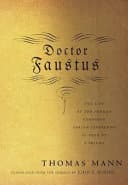
Thomas Mann (1999)
Genre
Literary Fiction / Historical Fiction
Reading Time
1200 min
Key Themes
See below
Sign in to track this book
A brilliant German composer trades his soul for artistic genius, his tragic decline mirroring Germany's catastrophic embrace of nihilism and the rise of the Third Reich.
The novel opens with Dr. Serenus Zeitblom, a humanist scholar, introducing himself as the biographer of his close friend, the composer Adrian Leverkühn. Zeitblom begins recounting Adrian's early life in Kaisersaschern, a small German town. Adrian shows extraordinary intellectual skill from a young age, especially in music and theology, but also a detached, almost cold, manner. His father, Jonathan Leverkühn, is a amateur scientist who introduces Adrian to nature and the occult. Adrian's early musical education is informal, but he shows an uncanny ability to grasp complex theoretical concepts. Zeitblom, despite his devotion, notes an unsettling, almost demonic, quality in Adrian's genius even then, hinting at the tragic path his friend will eventually take.
Adrian initially enrolls at the University of Halle to study theology, influenced by his family's religious background and his own intellectual curiosity about the divine. However, he is increasingly drawn to music, attending lectures by the eccentric and revolutionary music theorist, Wendell Kretzschmar. Kretzschmar's passionate and often bizarre lectures on musical aesthetics, especially his emphasis on the 'demonic' in art, deeply influence Adrian. Despite his theological studies, Adrian's true calling becomes clear. He eventually abandons theology to fully commit to music, recognizing that his unique genius demands a path outside conventional academic or spiritual pursuits, a decision Zeitblom views with apprehension.
After university, Adrian travels to Italy. While living in a brothel in Leipzig before his Italian journey, he deliberately seeks out a prostitute named Esmeralda, from whom he contracts syphilis. This act is presented not as a random mistake, but a conscious, almost ritualistic, embrace of the 'impure' and a catalyst for his artistic breakthrough. Later, during a feverish illness in Palestrina, Italy, Adrian has a vivid, extended hallucination—or genuine encounter—with the Devil. The Devil offers him twenty-four years of unparalleled musical genius and creative power, but at the cost of his soul, his ability to love, and eternal damnation. Adrian, in a moment of despair and artistic ambition, accepts the diabolical bargain.
Following his return from Italy and the 'pact,' Adrian settles in the quiet Bavarian village of Pfeiffering, seeking isolation to dedicate himself entirely to composition. He lives a reclusive life, attended by his landlady, Frau Schweigestill, and visited only by a select few, including Zeitblom and his friend Rüdiger Schildknapp. During this period, Adrian's musical output becomes astoundingly prolific and innovative, pushing the boundaries of harmony and form. His compositions are complex, challenging, and often unsettling, reflecting the demonic influence on his creative process. Zeitblom observes Adrian's increasing emotional detachment and the chilling intellectual rigor that now defines his art, recognizing the profound change brought by his Faustian bargain.
Adrian maintains a small, intellectual circle of friends and admirers, including Zeitblom, Schildknapp, Jeanette Scheurl, and later, Rudolf Schwerdtfeger. These gatherings often involve deep discussions on art, philosophy, and the state of German culture, which Zeitblom interweaves with his narrative, drawing parallels to the political climate of the 1930s. Despite his growing fame, Adrian remains aloof, his genius both admired and feared. Zeitblom, the humanist, often finds himself in intellectual opposition to Adrian's more radical and nihilistic artistic views, yet remains loyal, sensing the tragic trajectory of his friend's life and the impending doom for Germany itself.
Rudolf Schwerdtfeger, a charming and talented violinist, becomes one of Adrian's closest friends and an enthusiastic interpreter of his music. Rudolf tries to draw Adrian out of his isolation, even attempting to arrange a marriage for him with Marie Godeau, but Adrian's pact prevents him from forming genuine emotional attachments. Rudolf then falls in love with Inez Institoris, a mutual friend, and proposes to her. However, Inez, obsessed with Adrian, rejects Rudolf and later, in a fit of despair and unrequited love for Adrian, shoots and kills Rudolf. This tragic event further solidifies Adrian's isolation and reinforces the Devil's curse on his ability to love and connect with others.
Adrian's sister, Ursula, has a young son named Nepomuk Schneidewein, a beautiful, innocent child. Nepomuk, or 'Echo' as Adrian affectionately calls him, comes to live with Adrian in Pfeiffering for a period. Adrian, despite his emotional detachment, develops a deep and rare affection for his nephew. However, the Devil's curse dictates that Adrian's touch brings destruction. Nepomuk contracts meningitis and dies a slow, agonizing death. Adrian is devastated by this loss, seeing it as the ultimate proof of his damnation and the Devil's complete dominion over his life, reinforcing the idea that beauty and innocence cannot survive in his corrupted sphere.
As his twenty-four years draw to a close, Adrian dedicates himself to his greatest and most terrifying work, the oratorio 'Apocalypsis cum figuris' (Apocalypse with Figures). This monumental composition is a culmination of his radical musical theories and his pact with the Devil, a work of immense complexity, dissonance, and despair, reflecting the torment of damnation and the collapse of humanity. Zeitblom describes it as a work of artistic genius but also of chilling nihilism, embodying the Faustian bargain in every note. It is a musical representation of the end times, both for Adrian and, allegorically, for Germany itself, as the nation moves towards its own catastrophic fate.
On the eve of the first performance of the 'Apocalypsis cum figuris,' Adrian gathers his remaining friends and colleagues at his home in Pfeiffering. In a harrowing and emotional 'farewell speech,' he confesses the full story of his pact with the Devil, the syphilis, the hallucinatory encounter, and the cost of his genius. He recounts the details of his bargain, the loss of his ability to love, and the damnation that awaits him. His friends react with shock, disbelief, and horror. As he finishes his confession, Adrian is overcome by a sudden and irreversible mental collapse, succumbing to the tertiary stage of syphilis, which manifests as general paralysis of the insane.
Following his confession and collapse, Adrian Leverkühn lives for another decade in a state of complete mental deterioration, cared for by his mother and Zeitblom. He becomes childlike, losing all his intellectual faculties and artistic abilities, a tragic and pathetic shadow of his former genius. Zeitblom remains faithfully by his side, witnessing the slow, agonizing decline of his friend. Adrian eventually dies, his life ending not with a bang, but a whimper, a victim of his own ambition and the Devil's bargain. Zeitblom concludes his biography, lamenting Adrian's fate and the parallel tragedy unfolding in Germany, holding out a faint, desperate hope for redemption.
The Protagonist
Adrian moves from a precocious but detached youth to a composer of unparalleled genius, ultimately sacrificing his soul and ability to love for art, leading to madness and damnation.
The Narrator and Supporting Character
Zeitblom remains a steadfast friend, chronicling Adrian's life with increasing sorrow and a growing understanding of the tragic link between Adrian's fate and Germany's.
The Antagonist
The Devil initiates Adrian's tragic arc by making the Faustian bargain, then watches as the consequences unfold.
The Supporting
Kretzschmar's influence sets Adrian on his path toward radical musical innovation.
The Supporting
Rudolf attempts to bring warmth and love into Adrian's life but becomes a victim of the curse, reinforcing Adrian's isolation.
The Supporting
Nepomuk's brief life and tragic death serve to highlight Adrian's curse and the cost of his bargain.
The Supporting
Jonathan's early influence on Adrian's curiosity for the mystical foreshadows Adrian's later choices.
The Supporting
Inez's unrequited love for Adrian leads to a tragic act of violence, underscoring Adrian's destructive influence.
The central theme of the novel, the Faustian bargain, explores the idea of sacrificing one's soul and humanity for unparalleled genius and artistic achievement. Adrian Leverkühn consciously makes a pact with the Devil (or succumbs to the effects of syphilis, interpreted as such) to achieve a breakthrough in music, forsaking love and human connection for twenty-four years of creative power. This theme is clear in Adrian's hallucinatory encounter with the Devil in Italy and the subsequent transformation of his music into something both sublime and terrifying. It questions the price of ultimate artistic freedom and the moral implications of artistic ambition, suggesting that true genius might demand a diabolical sacrifice. The 'Apocalypsis cum figuris' is the ultimate expression of this theme, a work born of torment and damnation.
““The artist is the brother of the criminal and the madman.””
The novel explores the relationship between artistic creation and nihilism, particularly through Adrian's radical music. Adrian's compositions, especially the 'Apocalypsis cum figuris,' are characterized by dissonance, intellectual rigor, and despair, reflecting a rejection of traditional beauty and harmony. His art is not just innovative but often destructive, mirroring the nihilistic tendencies emerging in German society. The theme suggests that art, when pushed to its extreme, can lose its humanistic core and become an expression of chaos and meaninglessness, challenging the idea of art as a redemptive force. This is evident in Adrian's cold, intellectual approach to music, which avoids warmth and emotional connection.
““Is it not the artist’s task to make the world more beautiful?””
An allegory for Germany's fate in the first half of the 20th century, the novel links Adrian Leverkühn's personal damnation to the nation's descent into barbarism under Nazism. Adrian's genius, his isolation, his intellectual arrogance, and his embrace of the 'demonic' in art reflect the German character. His Faustian pact symbolizes Germany's 'selling its soul' for power and a misguided sense of destiny, leading to destruction. Zeitblom's narrative, written during the war, constantly draws parallels between Adrian's story and political events, lamenting how Germany, a land of culture and philosophy, could succumb to such darkness. The novel questions the nature of German genius and its potential for both creation and destruction.
““Germany, the land of the middle, had strayed to the outer edges.””
This theme examines the immense personal cost of extraordinary genius. Adrian Leverkühn's unparalleled musical talent comes at the expense of his humanity, his ability to love, and ultimately his sanity. The novel suggests that such a profound gift might require a sacrifice that goes beyond mere hard work, exploring the idea that genius can be a curse as much as a blessing. Adrian's isolation, the tragic deaths of those he cares for (like Rudolf and Nepomuk), and his final descent into madness all show the devastating price he pays for his artistic breakthroughs. His life is a cautionary tale about the burdens and responsibilities of the truly great artist.
““For genius is a disease, a malady, a monstrous perversion of nature.””
The novel presents a clear intellectual and moral conflict between the humanist perspective, represented by Serenus Zeitblom, and the radical, nihilistic romanticism embodied by Adrian Leverkühn. Zeitblom champions reason, tradition, morality, and human connection, lamenting Adrian's embrace of the irrational and the destructive. Adrian, on the other hand, seeks to transcend these humanistic constraints in his art, pushing into realms of pure intellect and form, even if it means embracing the 'demonic.' This tension reflects Mann's own worries about the trajectory of German culture and thought, questioning whether a purely intellectual or aesthetic pursuit, divorced from humanistic values, inevitably leads to moral and societal decay. It is a debate about the soul of art and humanity itself.
““The true humanism consists in a certain cheerfulness, a certain serenity, a certain clarity.””
Serenus Zeitblom's subjective, moralizing account of Adrian's life.
The novel is framed as a biography written by Adrian's lifelong friend, Serenus Zeitblom. This device allows for a deeply personal, yet also highly subjective and moralizing, account of Adrian's life. Zeitblom's humanist perspective provides a constant counterpoint to Adrian's radicalism, allowing Mann to inject direct commentary on the unfolding events and their allegorical connections to Germany's fate. The narrative voice is not omniscient but filtered through Zeitblom's anxieties, loyalties, and intellectual framework, making the reader question the 'truth' of the events and the nature of genius itself. This also allows for digressions and philosophical musings that enrich the thematic depth.
Adrian Leverkühn's life as a symbolic representation of Germany's fate.
The entire novel functions as a grand allegory. Adrian Leverkühn's Faustian bargain, his embrace of radicalism, his isolation, and his eventual damnation are symbolic of Germany's historical trajectory. His selling of his soul for artistic power mirrors Germany's 'selling its soul' for political power and a misguided sense of national destiny, leading to the horrors of Nazism and World War II. The descent into madness parallels the nation's descent into barbarism. This device allows Mann to critique and mourn the fate of his homeland through the lens of individual tragedy, making the personal story resonate with profound historical and cultural significance.
A modern reinterpretation of the classic German legend of a pact with the Devil.
Mann explicitly draws upon the classic German Faust legend, particularly Goethe's version, but reinterprets it for the 20th century. Adrian Leverkühn is a modern Faust, a brilliant intellectual and artist who makes a literal or metaphorical pact with the Devil for enhanced creative power. However, Mann updates the legend by linking Adrian's 'pact' to syphilis and grounding it in the context of modern music and German intellectual history. This intertextual device allows Mann to engage in a dialogue with a foundational German myth, exploring its contemporary relevance and using it as a framework to analyze themes of genius, damnation, and national identity in a new light.
Extensive discussions of music theory and composition as a reflection of Adrian's art and pact.
The novel heavily incorporates detailed discussions of music theory, aesthetics, and composition, particularly relating to Adrian's revolutionary and often dissonant works. These sections are not merely academic but serve to illuminate Adrian's artistic philosophy, his intellectual rigor, and the 'demonic' nature of his creative process. The descriptions of his compositions, like the 'Apocalypsis cum figuris,' are integral to understanding the consequences of his pact and the expression of nihilism in art. This device allows Mann to explore the intellectual and spiritual implications of artistic innovation, showing how Adrian's radical music is a direct manifestation of his Faustian bargain and his rejection of traditional humanistic values.
“For the artist, the world is a stage for his own suffering, and his art is the means by which he makes this suffering productive.”
— Reflecting on Adrian Leverkühn's artistic struggles and the nature of creative genius tied to pain.
“We are not in the business of making people happy. We are in the business of making people think.”
— A general reflection on the role of serious art and intellect, often attributed to Adrian's perspective.
“The devil's bargain is not for power, but for the ability to love, to be human.”
— A reinterpretation of the Faustian pact, focusing on Adrian's emotional barrenness rather than worldly gain.
“True originality is a product of isolation and obsession.”
— Describing Adrian Leverkühn's solitary and intense creative process.
“The greatest freedom is to choose one's own necessity.”
— A philosophical statement about self-determination and the artist's path, often discussed by Serenus Zeitblom.
“Melancholy is the true muse of all profundity.”
— Exploring the connection between Adrian's depressive states and his musical depth.
“What is genius but a higher degree of sickness?”
— A recurring theme linking Adrian's syphilis and mental state to his extraordinary musical talent.
“Culture is the mask of barbarism.”
— A critical observation on the superficiality of German culture during the rise of Nazism, narrated by Zeitblom.
“The tragic is not merely suffering, but suffering that has meaning.”
— Discussing the philosophical underpinnings of Adrian's life and art as interpreted by Zeitblom.
“Music is the most demonic of all arts.”
— Highlighting the powerful, often unsettling, and non-rational nature of Adrian's compositions.
“To be a German is to be world-historic.”
— A phrase loaded with irony and historical critique, reflecting on Germany's self-perception and its tragic path.
“The spirit of music is the spirit of ambiguity.”
— Reflecting on the complex and often contradictory nature of musical expression, particularly in Adrian's work.
“Life is a dream, a phantasmagoria, a deception.”
— A pessimistic worldview often held by Adrian, reflecting his detachment and the illusory nature of existence.
“The truly creative mind is always on the verge of madness.”
— A recurring idea connecting Adrian's genius with his mental and physical deterioration.
Ready to see how well you understood this book? Take our interactive quiz with 10 questions.
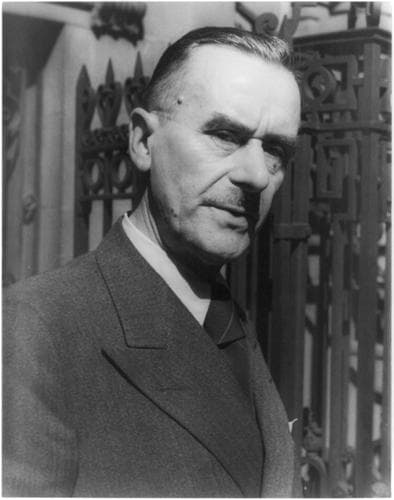
Paul Thomas Mann was a German novelist, short story writer, social critic, philanthropist, essayist, and the 1929 Nobel Prize in Literature laureate. His highly symbolic and ironic epic novels and novellas are noted for their insight into the psychology of the artist and the intellectual. His analysis and critique of the European and German soul used modernized versions of German and Biblical stories, as well as the ideas of Johann Wolfgang von Goethe, Friedrich Nietzsche, and Arthur Schopenhauer.







