“The past is a country we all inhabit, whether we know it or not.”
— A reflection on the pervasive influence of history on individuals and places.


Michael Ondaatje (2007)
Genre
Literary Fiction / Historical Fiction
Reading Time
6-8 hours
Key Themes
See below
Sign in to track this book
In 1970s Northern California, a violent act shatters a makeshift family, propelling its members across continents and decades as they grapple with the indelible echoes of their shared, fractured past.
In 1970s Northern California, Anna narrates her upbringing on a remote farm with her father, Claire (adopted after her parents' murder), and Coop, a young man who arrived at their farm as a child. Anna and Claire, though not blood sisters, share a deep bond, and Coop is an important, if quiet, presence. The story establishes their isolated life, filled with farm work, the girls' growing up, and unspoken tensions beneath the surface of their unique family. Anna often feels like an observer, detailing the interactions and subtle shifts in their relationships, especially as the two girls grow closer to Coop, setting the stage for the inevitable end of their fragile peace.
The farm family's delicate balance shatters when Anna's father finds Claire and Coop together in the barn. Enraged by what he sees as a deep betrayal, especially given Claire's adopted status and Coop's place in the family, he violently attacks Coop with a shovel. Claire intervenes, shielding Coop, and is also struck. Anna, watching the brutal scene, is frozen by shock and fear. The violence is sudden and devastating, permanently changing their relationships and ending their innocent, isolated life on the farm. This event is the central trauma from which all later stories branch.
After the violent incident, Coop flees the farm, disappearing. Claire, badly injured and traumatized, is sent away by her father to live with relatives, effectively banished from their home. Anna is left alone with her father, who is consumed by guilt, anger, and a deep sense of loss. The farm, once a place of shared work and quiet routines, becomes a desolate space filled with unspoken grief. Anna struggles to process the sudden break-up of her family, haunted by the images of violence and the sudden absence of the two people she loved most, her sister and Coop.
Years after the farm incident, Anna lives in San Francisco, working as a researcher and archivist. She immerses herself in the lives of others, particularly an obscure French writer named Lucien Segura. Her work allows her to explore fragmented histories, mirroring her own fragmented past. She lives a solitary life, still deeply affected by the trauma of her youth. Her narrative is mixed with her present-day thoughts as she gathers information and tries to understand the reasons for the violence that shattered her family, constantly searching for clues about Coop and Claire, whom she has not seen since that night.
The story shifts to Coop's perspective, revealing his life after fleeing the farm. He goes to Nevada, where he quickly adapts to the casino world, becoming a skilled card player and a professional gambler. He lives a transient, dangerous life, always moving, haunted by the violence he experienced. Coop's story is about survival, cleverness, and a desperate attempt to outrun his past. He forms temporary alliances and relationships in the gambling world, but his deep trauma and the memory of Claire and Anna continue to shape his decisions and his solitary life.
Years later, Coop encounters Claire by chance in a casino. She is a different woman now, married to a respectable man, having seemingly built a new life. Their reunion is full of unspoken history, grief, and a lingering attraction. Claire initially appears to have moved on, but the encounter reawakens dormant feelings and trauma from their shared past. This meeting shows how deeply the farm incident continues to affect both of them, no matter their separate paths, and hints at their lasting connection.
Anna's professional life becomes more connected with her personal search for understanding. Her research into Lucien Segura, a minor French writer from the early 20th century, becomes an obsession. Segura's life, marked by fragmentation, hidden relationships, and a connection to the French countryside, begins to mirror Anna's own experiences. She uncovers details of his affairs, his literary circles, and his isolated life, finding parallels between his emotional state and her own. This research is a metaphorical journey for Anna, a way to process her own fractured identity and search for meaning in her past.
Driven by her research and an unspoken need for distance from her past, Anna travels to the south of France. She visits the places where Lucien Segura lived and wrote, immersing herself in the physical landscape that shaped his life. This journey is not just academic; it is personal. She hopes to find insights into Segura's life and a clearer understanding of her own, a way to connect the pieces of her family's story. The French countryside, with its history and quiet beauty, contrasts sharply with the California farm, yet both landscapes hold secrets and memories.
In France, Anna explores Segura's life more deeply, uncovering a hidden and complex family history. She learns about his close and possibly incestuous relationship with his half-sister, Marie-Neige, and the illegitimate child they may have had. This discovery resonates with Anna's own family trauma, particularly the forbidden love between Claire and Coop. Segura's story, filled with unspoken desires, betrayals, and the consequences of hidden passions, offers a historical echo to Anna's personal experiences, helping her to understand the destructive forces that tore her own family apart.
While in France, Anna meets a local woman who shares a story about a blind weaver, a man whose life was connected to the region's history. This tale emphasizes connection, fate, and how lives intertwine across generations and places. The weaver's story is a metaphor for the novel, suggesting that individual lives, though seemingly separate, are threads in a larger, complex fabric. This encounter reinforces Anna's understanding that her own story is part of a broader human experience of love, loss, and the search for meaning.
After years of wandering and a life shaped by gambling and solitude, Coop eventually returns to the abandoned California farm. He goes back to the place where his life with Anna and Claire was tragically severed, seeking some form of closure. His return is a quiet, reflective act, a confrontation with his past. He finds the farm in disrepair, a stark reminder of what was lost. This pilgrimage shows his attempt to reconcile with the violence and heartbreak that defined his youth, hinting at a potential for healing or at least an end to his restless flight.
The novel implies, through various reflections and fragmented narratives, that Claire's life after the farm incident, despite her attempts to build a new identity, remained deeply marked by the trauma and her connection to Coop. Her encounter with Coop in the casino is a poignant reminder of their unbreakable bond. While a definitive reunion of all three characters is not explicitly shown, the narrative leaves the reader with a sense of their lasting, if often painful, interconnectedness. The story ends with the understanding that the past, especially moments of intense love and violence, continues to shape Anna, Claire, and Coop, even across continents and years.
The Protagonist/Narrator
Anna evolves from a passive observer to an active seeker of truth, traveling across continents to find answers and achieve a measure of peace.
The Supporting/Central Figure
Claire moves from a youthful, passionate girl to a woman trying to forge a new identity, constantly shadowed by her traumatic past and enduring love.
The Supporting/Central Figure
Coop transforms from a silent, stoic farmhand to a rootless gambler, eventually seeking to reconcile with his past.
The Supporting/Antagonist
His arc is one of tragic downfall, from a patriarch to a broken man haunted by his own actions.
The Mentioned/Thematic Figure
Not a character with an arc, but his discovered life provides a metaphorical arc for Anna's understanding.
The Mentioned/Thematic Figure
Not a character with an arc, but her discovered life provides a thematic parallel for Anna's understanding.
The novel explores how past events, especially traumatic ones, continue to shape characters' present lives. Anna's entire professional and personal quest is driven by her need to understand the violent incident on the farm, sifting through memories and historical records. Coop's life as a transient gambler is a direct result of his flight from the farm, and Claire's attempts to build a new life are always shadowed by her past. The fragmented narrative structure reflects the fractured nature of memory and how individuals try to reconstruct their histories. The past is not just remembered; it actively informs every decision and relationship.
“What had happened in that house, in that barn, never stopped happening. It was just in a different room now.”
Central to the novel's conflict is the theme of forbidden love, specifically the incestuous-coded relationship between Claire and Coop (given their family situation and Anna's father's reaction). This love, seen as a betrayal by Anna's father, starts a violent chain of events that shatters the family. The parallel story of Lucien Segura and his half-sister Marie-Neige reinforces this theme, showing how intense, transgressive desires, whether acknowledged or suppressed, can lead to deep suffering and permanently change lives. The novel suggests that such love, while powerful, often comes with a high, destructive price.
“That was the night we became a family, and the night we ceased to be one.”
Divisadero examines the fluid and often unconventional nature of family. The core unit of Anna, Claire, Coop, and their father is a 'makeshift family' formed by circumstance rather than blood (except for Anna and her father). The novel questions what truly makes a family, exploring the bonds of affection, loyalty, and shared experience that can be as strong as, if not stronger than, biological ties. When this unit is violently broken, each character searches for a new sense of belonging, whether through solitary wandering (Coop), reinvention (Claire), or historical investigation (Anna). The absence of a traditional family structure highlights the characters' deep longing for connection.
“We were a family, though not by blood, and that made us more fragile, perhaps, more fiercely loyal, more easily broken.”
Anna's profession as a researcher and her deep dive into Lucien Segura's life highlight the novel's interest in storytelling and the construction of history. The narrative itself is fragmented, told from multiple perspectives and across different timelines, reflecting the difficulty of ever finding a single, definitive 'truth.' Characters, especially Anna, try to make sense of their past by piecing together fragments, much like an archivist reconstructs a life from different documents. The novel suggests that truth is often subjective, layered, and found in the act of narration itself, with each story offering a different view of shared events.
“Every story, even the one you tell yourself, changes with time and the telling.”
The novel uses landscape not just as a setting but as a powerful holder of memory and an active 'character' influencing the protagonists. The Northern California farm, with its barn and fields, is filled with the innocence and subsequent trauma of the characters' youth. Later, the stark casinos of Nevada reflect Coop's transient, dangerous existence, while the quiet, historical landscapes of southern France provide Anna with a space for reflection and historical connection. The physical environment mirrors the characters' internal states and holds the echoes of their past actions, becoming a silent witness to their lives.
“The land remembers what the people forget.”
The story is told non-linearly, shifting between characters, timelines, and perspectives.
The novel employs a fragmented narrative, jumping between Anna's present-day life in San Francisco and France, Coop's experiences in Nevada, and flashbacks to their shared childhood on the farm. This non-linear approach mirrors the characters' own fractured memories and their struggle to piece together their past. It creates a sense of mystery and allows the reader to gradually uncover the full scope of the tragedy and its aftermath from multiple viewpoints, highlighting the subjective nature of truth and memory. The shifts in perspective also emphasize the lasting, pervasive impact of the central trauma on each character's individual journey.
The historical account of a French writer's life mirrors the main characters' experiences.
Anna's extensive research into the obscure French writer, Lucien Segura, functions as a parallel narrative. Segura's life, particularly his complex and possibly incestuous relationship with his half-sister, Marie-Neige, directly echoes the forbidden love between Claire and Coop and the resulting family breakdown. This device provides a historical and literary context for the emotional turmoil of the main characters, suggesting that their experiences are part of a broader human pattern of desire, transgression, and consequence. It allows Anna, and the reader, to explore themes of forbidden love and fractured families from a detached, yet deeply resonant, perspective.
The street name signifies division, separation, and the splitting of paths.
The title 'Divisadero,' a Spanish word meaning 'division' or 'lookout point,' is highly symbolic. It refers to a street in San Francisco, but metaphorically represents the central theme of separation and the divergent paths taken by Anna, Claire, and Coop after the traumatic incident on the farm. It also suggests a 'lookout point' from which characters (especially Anna) observe and reflect on their past, trying to gain perspective on the divisions in their lives. The name encapsulates the novel's core concerns: the splitting of a family, the fragmentation of identity, and the geographical and emotional distances that separate people.
Anna's perspective is dominant but incomplete, requiring the reader to synthesize information.
While Anna narrates a significant portion of the novel, particularly the childhood scenes and her research, her perspective is limited by her own trauma, observations, and lack of full knowledge about Claire and Coop's lives post-farm. The narrative occasionally shifts to Coop's internal thoughts or provides glimpses of Claire, but a single, omniscient voice is absent. This forces the reader to actively participate in constructing the story, filling in gaps, and inferring motivations, mirroring Anna's own struggle to piece together a coherent truth from fragmented memories and elusive facts. It highlights the subjective nature of memory and personal history.
“The past is a country we all inhabit, whether we know it or not.”
— A reflection on the pervasive influence of history on individuals and places.
“There are always two stories, two memories, two sets of facts. The truth lies somewhere between them, or perhaps nowhere at all.”
— Exploring the subjective nature of truth and memory when recounting events.
“You can never truly know a place until you've loved someone there.”
— The narrator reflecting on how emotional connections deepen one's understanding of a location.
“We are all just fragments of stories, trying to make sense of the whole.”
— A character's philosophical musing on the human condition and narrative.
“The silence was not empty; it was full of what had been said, what had been done.”
— Describing the weight of unspoken history and past events in a quiet moment.
“Sometimes the most important things are those you choose to forget.”
— A poignant observation on selective memory and the act of moving on.
“Every landscape holds a secret, a buried history that whispers to those who listen.”
— Emphasizing the hidden narratives embedded within physical environments.
“Love is not a straight line, but a labyrinth of desires and misunderstandings.”
— A character's complex view on the nature of romantic relationships.
“He carried his past like a shadow, always there, sometimes visible, sometimes not.”
— Describing a character burdened by their personal history.
“The trick was not to escape the past, but to learn how to live within its echoes.”
— A strategy for coping with enduring memories and historical influences.
“We invent our histories as much as we discover them.”
— Highlighting the active role individuals play in constructing their personal narratives.
“There are moments when the world seems to crack open, and you can see the machinery beneath.”
— Describing a sudden insight or revelation about the underlying structure of reality.
“A house is not just walls and a roof; it's a container of lives, both lived and imagined.”
— Contemplating the emotional and historical significance of a dwelling.
“The light itself seemed to hold memories, illuminating the dust of forgotten days.”
— A poetic description of how atmosphere can evoke the past.
Ready to see how well you understood this book? Take our interactive quiz with 10 questions.
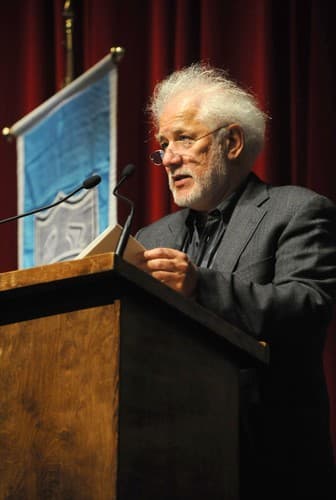
Philip Michael Ondaatje is a Sri Lankan-born Canadian poet, fiction writer, essayist, novelist, editor, and filmmaker.







