“Sometimes the greatest gifts are the ones you didn't ask for.”
— Rhiannon reflecting on her unexpected transformation and new life.

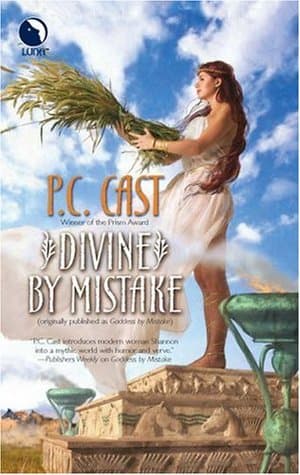
P.C. Cast (2006)
Genre
Fantasy / Young Adult / Romance
Reading Time
1170 min
Key Themes
See below
Sign in to track this book
A summer vacation to the mall takes a mythical detour when an Oklahoma teacher is accidentally swapped into a magical realm, forced to impersonate a temperamental Celtic goddess, marry a centaur, and lead a war against ancient evils, all while trying to find her way home.
Shannon Parker, an Oklahoma history teacher, enjoys her summer vacation. She finds a unique antique vase depicting the Celtic goddess Epona and buys it. Later, while admiring the vase at home, a strange light envelops her. She finds herself in an unfamiliar, fantastical world. Disoriented, Shannon realizes this is not Oklahoma. She is surrounded by beings she thought only existed in myths, and they all look at her with reverence and fear, believing her to be someone else.
Upon her arrival, the inhabitants of Partholon immediately hail Shannon as the Goddess Incarnate of Epona. She learns that the true Epona, a powerful but temperamental goddess, has gone missing. Shannon's sudden appearance, with her resemblance to the goddess, convinces everyone she is the returned deity. The people of Partholon, including centaurs, fae, and other mythical creatures, treat her with deference, but also apprehension due to the original Epona's volatile nature. Shannon struggles to understand her new reality and the expectations placed upon her.
One of the first shocking revelations Shannon faces is the news of her impending ritual marriage to Rhiannon, the King of the Centaurs. This union is part of Partholon's ancient traditions, meant to solidify alliances and bring prosperity. Shannon, a modern woman, is horrified by the idea of marrying a centaur she has just met. A pre-arranged marriage is alien to her. She tries to explain her true identity, but her pleas are dismissed as a goddess's eccentricities, further cementing her unwanted role.
As Shannon tries to accept her new identity and impending marriage, she learns about the Fomorians, an ancient, malevolent race intent on conquering Partholon. The Fomorians are monstrous and powerful, and their impending invasion casts a dark shadow. The people believe Epona's return and her marriage to Rhiannon will unite their forces and provide divine power to defeat the Fomorians. Shannon feels immense pressure to fulfill her role, despite her lack of divine abilities or military experience.
Shannon tries to embody the original Epona, a difficult task given Epona's reputation for being temperamental. Shannon often makes social blunders or expresses modern sensibilities that are misinterpreted as divine whims. She enjoys some perks of being a goddess, like lavish pampering and unquestioning obedience, but the constant pressure and fear of war weigh on her. Her main goal becomes finding a way back to Oklahoma, but each day, the task seems more insurmountable, and her responsibilities in Partholon grow.
Initially resistant to marrying Rhiannon, Shannon begins to see past his centaur form and the expectations surrounding their union. Rhiannon, though wary of 'Epona's' unpredictable nature, shows kindness, strength, and a deep love for his people. As they spend more time together, preparing for the wedding and discussing the war, Shannon feels drawn to him. Their conversations reveal mutual respect and understanding. Shannon starts to question whether returning home is what she truly wants, as her feelings for Rhiannon deepen.
The ritual marriage between Shannon, as Epona, and Rhiannon takes place. It is a grand and sacred event. Despite the circumstances, Shannon finds a genuine connection during the ceremony. Immediately following the wedding, war councils convene to strategize against the Fomorian invasion. Shannon is expected to offer divine wisdom, but her lack of actual powers forces her to rely on her teaching background and common sense. This often surprises the Partholonians with her practical, if unconventional, insights. She begins to take her role seriously, understanding the lives at stake.
Just as Shannon begins to embrace her role and her feelings for Rhiannon, the true Goddess Epona resurfaces. This creates an immediate and perilous situation. The real Epona is furious about Shannon usurping her identity and taking her place, especially with Rhiannon. Shannon is caught between two worlds, facing the wrath of a powerful goddess and the potential exposure of her deception. Her life, and the fate of Partholon, hang in the balance as the truth threatens to unravel everything.
Shannon, with Rhiannon's support, confronts the true Epona. During this intense encounter, Shannon finally reveals her true identity as Shannon Parker, a human from another world, and explains how she came to Partholon. This revelation shocks Rhiannon and the other leaders. The real Epona, still consumed by anger, demands Shannon's immediate return to her own world, threatening dire consequences if she refuses. Shannon must choose between her former life and the connections she has forged in Partholon, especially with Rhiannon and the impending war.
Faced with an impossible choice, Shannon realizes her heart belongs in Partholon, with Rhiannon and the people she cares for. She decides to stay and fight alongside them against the Fomorians, even without true divine powers. The real Epona, witnessing Shannon's genuine love and commitment, and perhaps softened by her own experiences, agrees to a compromise. She grants Shannon a fraction of her power, acknowledging her as a true champion of Partholon, and allows her to remain, accepting her as a vital part of the world's defense.
With the Fomorians' invasion imminent, Shannon, now empowered by Epona's grace, and Rhiannon lead the united forces of Partholon. The battle is fierce and devastating, pushing the heroes to their limits. Shannon uses her newfound abilities, combined with her human ingenuity and courage, to inspire and fight alongside her allies. Rhiannon is a formidable leader and warrior, protecting Shannon and his people. The fate of Partholon hangs in the balance as they face the overwhelming might of the Fomorian army, fighting for their survival and their world.
After a grueling battle, the forces of Partholon, led by Shannon and Rhiannon, defeat the Fomorians, securing their world's future. The victory solidifies Shannon's place among them, not just as a stand-in goddess, but as a true hero and leader. With the war over and peace restored, Shannon fully embraces her new life in Partholon. She and Rhiannon solidify their bond, ready to rule together. Shannon, once a simple history teacher, has found her true purpose and love in a world she never imagined, becoming a beloved queen and protector of Partholon.
The Protagonist
Shannon transforms from a skeptical, reluctant bystander into a courageous leader and a beloved queen, finding her true home and purpose in a world she never expected.
The Love Interest / Supporting
Rhiannon learns to trust and love Shannon for who she truly is, rather than just the goddess she represents, becoming her devoted partner and co-ruler.
The Antagonist / Supporting
Epona moves from vengeful anger to a grudging acceptance and eventual alliance with Shannon, recognizing the human's worth and commitment to her world.
The Antagonist
The Fomorians serve as a static, external threat that is ultimately defeated, allowing Partholon to achieve peace.
The Supporting
Morrighan's understanding of prophecy and divinity expands to include Shannon, evolving from rigid adherence to tradition to embracing new forms of leadership.
The Supporting / Mentioned
The Fae contribute to the united front against the Fomorians, showcasing the diverse strengths of Partholon's inhabitants.
The Supporting
The Centaurs unite under Shannon and Rhiannon's leadership to defend Partholon, showcasing their unwavering loyalty and bravery.
The story centers on Shannon's struggle with her identity. Initially, she resists being Epona, clinging to her human self. As she embodies the goddess, she discovers hidden strengths, leadership, and a capacity for love. Her journey shows how circumstances can reveal a deeper self. This is clear in her initial attempts to return home versus her eventual decision to stay and embrace her role, not just as Epona, but as Queen Shannon, a hero.
“She was not Epona, not truly. But perhaps, she thought, this new world could show her who Shannon Parker truly was.”
The romance between Shannon and Rhiannon explores how love can transcend physical differences and originate from unexpected circumstances. Shannon's initial horror at marrying a centaur slowly transforms into genuine affection and deep love, proving that true connection lies beyond superficial appearances. Their bond is a central part of the story, showing the power of emotional intimacy. Their love is not just personal but also crucial for uniting Partholon against the Fomorians, symbolizing hope.
“He was a centaur, a creature of myth, and she was a woman from Oklahoma, but in his eyes, she saw a soul that matched her own.”
Shannon grapples with the conflict between her desire to return home and her growing sense of duty to the people of Partholon. Her personal longing for her old life clashes with the responsibility placed upon her shoulders as the supposed Goddess Incarnate, especially with the Fomorian threat. This theme is explored as she weighs her own happiness against the survival of an entire world. Ultimately, her desire aligns with her duty as she chooses to stay and fight, finding fulfillment in her adopted role.
“Every fiber of her being screamed for Oklahoma, for normalcy, but the desperate hope in their eyes held her captive.”
The novel questions what it means to be a god or goddess. Shannon, a mortal, is treated as divine due to belief and appearance. This highlights how faith and perception can define divinity, regardless of actual power. The story also explores the burden of divinity, showing that even a 'goddess' can be flawed, fearful, and in need of help. The true Epona's eventual acceptance of Shannon suggests that divinity can be shared or manifested in unexpected ways, and that true power is in courage and compassion, not just magical abilities.
“They saw a goddess, but all she felt was a woman, terrified and out of her depth. Yet, in their faith, perhaps there was a spark of something real.”
A seemingly ordinary antique that serves as a portal between worlds.
The Epona vase acts as the central magical artifact and the primary plot device that initiates Shannon's journey. It functions as a portal or conduit, transporting her from Oklahoma to Partholon. The vase symbolizes the thin veil between worlds and the unexpected ways destiny can unfold. Its imagery, depicting Epona, foreshadows Shannon's new identity and role. Without this seemingly innocuous object, the entire adventure would never begin, making it the catalyst for all subsequent events.
Shannon is consistently mistaken for the true Goddess Epona.
Mistaken identity is a crucial plot device that drives much of the early conflict and humor in the story. Shannon's uncanny resemblance to the missing Epona forces her into a role she is completely unprepared for. This device creates tension as Shannon struggles to maintain the façade, leads to comedic misunderstandings due to her modern sensibilities clashing with divine expectations, and ultimately sets up the dramatic reveal of her true self. It also allows her to experience the world of Partholon from a unique, powerful perspective, shaping her character arc.
An ancient prophecy foretelling the goddess's return to save Partholon.
The prophecy of Epona's return is a classic plot device that provides a powerful justification for Shannon's arrival and the expectations placed upon her. It instills hope in the people of Partholon and gives a sense of urgency to her 'divine' duties, particularly regarding the Fomorian threat. The prophecy frames Shannon's journey as fated, even though she is an accidental participant. It also raises the stakes, as her failure would not only be a personal defeat but also a betrayal of ancient beliefs and the doom of an entire world.
The imminent threat of the Fomorian invasion.
The looming war with the Fomorians serves as the overarching external conflict and a powerful motivator for the characters. It provides a clear objective for the 'Goddess Incarnate' and galvanizes the various races of Partholon into action. The threat of war accelerates Shannon's acceptance of her role, forcing her to mature and take responsibility. It also adds a constant undercurrent of tension and danger, pushing the narrative forward towards a climactic confrontation and providing a clear stakes for the entire world.
“Sometimes the greatest gifts are the ones you didn't ask for.”
— Rhiannon reflecting on her unexpected transformation and new life.
“Magic isn't about power, it's about connection.”
— Epona teaching Rhiannon about the true nature of the goddess's magic.
“Love doesn't always make sense, but it always makes a difference.”
— Rhiannon pondering her feelings for both Lord Macha and the mortal, Michael.
“You can't run from who you are, no matter how fast you try.”
— A realization Rhiannon has about her divine heritage.
“The past holds lessons, not chains.”
— Epona advising Rhiannon not to be bound by past mistakes or prophecies.
“Even gods can make mistakes, and sometimes those mistakes lead to something beautiful.”
— A general theme throughout the book regarding Rhiannon's accidental divinity.
“True strength isn't about never falling, but about rising every time you do.”
— Rhiannon facing numerous challenges and setbacks in her new role.
“Sometimes the greatest battles are fought within your own heart.”
— Rhiannon struggling with her divided loyalties and desires.
“The world is full of wonders, if only you open your eyes to see them.”
— Rhiannon experiencing the magical world of the Tuatha Dé Danann for the first time.
“Family isn't always blood. It's the people who stand by you, no matter what.”
— Rhiannon finding a new family among the goddesses and her mortal friends.
“Fear is a choice. So is courage.”
— Rhiannon steeling herself before confronting a difficult situation.
“A goddess without compassion is just a tyrant with power.”
— Epona emphasizing the importance of empathy in leadership.
“You don't have to be perfect to be powerful.”
— Rhiannon, initially insecure, learning to embrace her imperfect but potent divinity.
“The threads of fate are intricate, but you always have a hand in weaving your own.”
— A philosophical thought on destiny versus free will.
Ready to see how well you understood this book? Take our interactive quiz with 10 questions.

Biography coming soon.







