“The darkness was not just an absence of light, but a presence unto itself, a living, breathing thing that pressed in from all sides.”
— Describing the oppressive atmosphere of the town after a series of disappearances.

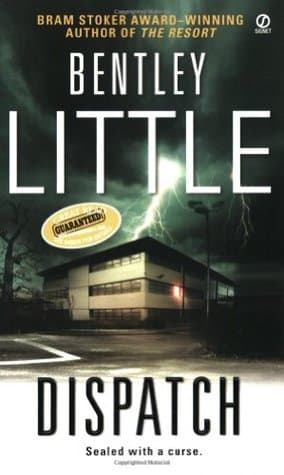
Bentley Little (2005)
Genre
Thriller / Fantasy / Mystery
Reading Time
8-10 hours
Key Themes
See below
Sign in to track this book
A master of persuasive prose finds his life unraveling letter by letter when his unique talent for written influence becomes a terrifying, soul-consuming curse.
Jason Handford, a writer in Phoenix, Arizona, is good at crafting letters. Whether it is a complaint to a cable company, a love letter, or an editorial, his words always get the desired result. His letters to companies solve problems instantly, his love letters reignite old passions, and his political letters sway public opinion. Jason first uses this gift for himself and to help friends, often writing under other names. He enjoys the power his words have, even though he is somewhat confused by the consistent and often strong reactions they cause in recipients, who seem forced to act exactly as he suggests.
One day, Jason gets a mysterious letter from a company called 'Dispatch,' offering him a high-paying job as a professional letter writer. The letter acknowledges his unique skill and promises an environment where he can fully use his abilities. Despite his initial doubt and the vague details about the company's work and purpose, the appeal of a steady income and a chance to improve his craft is too strong. He accepts the offer, not fully understanding the group's nature or the effect this decision will have on his life, believing it to be a real, if unusual, business.
Jason starts working at Dispatch, located in a plain, isolated building. The office feels unsettling; his coworkers are odd and distant, each having their own strange skills—from a woman who can make people feel guilty with a single phrase to a man who can compel actions with spoken commands. The company's main job is to write letters for clients, for everything from corporate deals to personal feuds, all with a guarantee of success. Jason is happy at first with the challenge and the immediate, clear power of the letters he now writes for Dispatch, but he also feels a sinister undercurrent.
As Jason works more at Dispatch, his letters' effects become more clear and often disturbing. He writes a letter to a competitor that leads to their financial ruin and even suicide. A letter to a lover causes an irrational obsession. The letters do not just influence; they compel. Jason sees his coworkers' letters achieving similar, often disastrous, results. While he is initially fascinated by this immense power, a growing unease settles over him as he sees the destructive effects of his words. He realizes the company's methods are far from good or ethical.
Jason's personal life begins to merge with his work. He uses his letter-writing skill to influence a difficult landlord, get a better apartment, and even manipulate romantic interests. While these actions bring him temporary satisfaction, they also deepen his moral struggle. He battles with the ethics of holding such absolute power, even for seemingly small personal gains. The line between right and wrong becomes more blurry as he gets used to the immediate satisfaction and control his letters provide, pulling him further into Dispatch's dark influence.
Driven by growing suspicion, Jason begins to investigate Dispatch's history and its leader, Mr. Pinter. He discovers that Dispatch is not just a powerful company but an ancient, possibly supernatural, entity that has existed for centuries, manipulating events throughout history through its 'correspondence.' The group thrives on chaos and control, feeding off the despair and subjugation it creates. Jason learns that his coworkers are not just talented individuals but are, in some cases, beings who have been corrupted or empowered by Dispatch's dark influence, serving its evil agenda across generations.
As Jason continues to write for Dispatch, he feels his own personality and morality wearing away. He becomes more unfeeling, more distant from the human effects of his letters. He feels a growing emptiness inside, as if his soul is being drained by the constant use of his persuasive power. The once-exciting feeling of control is replaced by a chilling realization that he is becoming a tool, an extension of Dispatch's will, losing his own identity. He starts to question if the immense power is worth the ultimate personal cost.
Disturbed by his soul's corruption and Dispatch's evil nature, Jason tries to resist. He tries to write letters that go against Dispatch's goals or to simply stop writing. However, he finds himself increasingly bound by an unseen force, a compulsion to continue his work. He discovers that leaving is not an option, as the company has subtle yet strong ways of keeping its employees. His attempts at rebellion are met with psychological pressure, unsettling incidents, and the chilling realization that Dispatch has deep roots in society, making escape almost impossible.
Jason finally confronts Mr. Pinter, the seemingly ageless and all-knowing head of Dispatch. Pinter reveals the full extent of Dispatch's ancient origins and its true purpose: to control humanity, shaping history and individual lives through the power of written and spoken word. He explains that Jason's gift is not just a talent but a link to this primal force, and that by working for Dispatch, Jason is fulfilling a predetermined role. Pinter's calm, unsettling manner and the sheer scale of his revelations make Jason feel small and trapped, facing a power far beyond his understanding.
In a desperate last effort, Jason tries to write a letter that could somehow dismantle Dispatch or break his connection to its power. He pours all his remaining will and corrupted talent into this final letter, hoping to use the very tool that enslaved him to gain freedom. The act is mentally and spiritually painful, a battle for his very being. The outcome of this letter is uncertain, a final gamble against an ancient, seemingly unbeatable force, representing his last bit of independent will against the overwhelming darkness that has consumed his life.
Despite his efforts, Jason's final letter fails to destroy Dispatch. Instead, it is twisted and absorbed by the company's power. Jason eventually gives in, losing his individuality and becoming fully integrated into Dispatch's ancient, evil network. He is transformed, physically or spiritually, into a permanent part of the organization, destined to write its letters forever, stripped of his former self. The novel ends with Jason, or what remains of him, continuing his work, a chilling example of Dispatch's subtle and inescapable power, and the ultimate cost of using such a dark gift.
The Protagonist
Jason transforms from an ordinary man discovering a unique talent into a corrupted, enslaved instrument of an ancient evil, losing his soul in the process.
The Antagonist
Pinter remains a static, omnipotent force, revealing the unchanging, eternal nature of Dispatch's evil.
The Supporting
They serve as a static representation of what Jason will become, already fully integrated into Dispatch's system.
The Mentioned
Her brief appearance emphasizes Jason's early use of his power and the moral lines he was willing to cross.
The novel explores how unchecked power can erode one's morality and identity. Jason's gift, initially satisfying, slowly turns him into a tool of manipulation. The immediate success of his letters leads him to ignore ethical boundaries, ending in a complete loss of self as he becomes part of Dispatch's evil will. This theme is clear in how Jason's early, seemingly harmless letters for personal gain escalate to causing ruin and despair for others, showing a gradual decline into moral decay.
“The words were no longer his; they were merely channeled through him, a current of pure, irresistible will.”
As Jason learns more about Dispatch, he loses his sense of self. His personality, values, and even his free will are consumed by the organization's influence. Writing becomes less about creativity and more about being a channel for Dispatch's ancient agenda. This theme is shown through Jason's thoughts, where he notes his increasing emotional distance and the feeling that his soul is being drained, leaving an empty shell. His change is a chilling depiction of how an individual can be completely taken over by a powerful, outside force.
“He was a pen. Nothing more. A tool. The words flowed, but the meaning, the intent, was no longer his own.”
Dispatch shows how subtle control can be more powerful than obvious force. The company does not use violence; it uses words to subtly, yet completely, compel actions and shape destinies. This form of control is inescapable, affecting every part of life, from personal relationships to global events. The novel shows how even attempts to resist are subtly turned against the individual, highlighting the frightening effectiveness of psychological and linguistic manipulation over brute strength.
“You don't break free from us, Mr. Handford. You become us.”
The novel mixes supernatural horror with a modern setting, suggesting that ancient evils persist and adapt to new forms of communication and influence. Dispatch is not just a company; it is an ancient entity rooted in history, working through the timeless power of persuasion. This theme reveals how the ordinary act of writing a letter can become a channel for deep, evil forces. The contrast between the normal office and the cosmic horror of Dispatch's true nature emphasizes that evil can hide in plain sight, using everyday tools for its sinister purposes.
“We have always been here. In the scrolls, in the proclamations, in the very words that shaped empires.”
A magical ability to write letters that compel absolute, undeniable results from recipients.
This is the central plot device. Jason's gift is not merely persuasive; it is absolute. Any letter he writes, for any purpose, elicits the exact desired response. This immediate and powerful feedback mechanism drives the plot, as Jason explores the limits and consequences of his ability. It acts as both a blessing and a curse, drawing him into Dispatch's orbit and ultimately leading to his downfall. The supernatural aspect elevates the story from a mundane thriller to a horror narrative, as the power becomes increasingly dark and uncontrollable.
A shadowy, ancient entity masquerading as a modern corporation, employing individuals with unique persuasive talents.
Dispatch serves as the primary antagonist and the catalyst for Jason's transformation. Its mysterious nature, hidden motives, and the unsettling talents of its employees create an atmosphere of dread and suspicion. The organization functions as a trap, luring Jason with promises of wealth and purpose, only to enslave him. Its ancient origins and malevolent agenda reveal the true stakes of Jason's involvement, moving the story from a personal struggle to a battle against an insidious, cosmic evil.
Jason's ongoing internal reflections on his power and its consequences, charting his moral decline.
Jason's internal monologue is crucial for conveying the theme of corrupting power and loss of self. His thoughts and struggles provide insight into his initial fascination, growing unease, and eventual despair. This device allows the reader to witness his gradual moral erosion firsthand, as he rationalizes increasingly unethical actions and feels his identity slipping away. It makes his descent into Dispatch's control more poignant and terrifying, as the reader experiences the internal battle he eventually loses.
An unseen, irresistible force that binds Jason to Dispatch and compels him to continue his work.
Beyond the initial job offer, Jason is bound to Dispatch by an invisible, supernatural compulsion. He cannot simply quit or refuse to write; an internal or external force drives him. This mechanism highlights the inescapable nature of Dispatch's power and Jason's lack of free will, transforming him from an employee into a prisoner. It raises the stakes of his struggle, showing that even if he wanted to escape, he is physically and spiritually tethered to the organization, making his eventual succumb all the more tragic.
“The darkness was not just an absence of light, but a presence unto itself, a living, breathing thing that pressed in from all sides.”
— Describing the oppressive atmosphere of the town after a series of disappearances.
“There are some secrets that the earth itself tries to keep buried, and some men are foolish enough to try and dig them up.”
— A character's ominous warning about uncovering ancient evils.
“The town had a way of consuming people, not just their bodies, but their very souls.”
— Reflecting on the malevolent influence the town holds over its inhabitants.
“He felt a cold dread, not the fear of an animal, but the existential terror of a soul confronting something utterly alien.”
— A detective's internal reaction to the supernatural elements of the case.
“History wasn't just written by the victors; sometimes, it was rewritten by something far older and more patient.”
— Hinting at an ancient power manipulating events over centuries.
“The line between reality and nightmare was not merely blurred; it had ceased to exist.”
— As the supernatural intrusions become more frequent and profound.
“Every shadow seemed to hold a watching eye, every whisper a hidden threat.”
— The protagonist's growing paranoia and sense of being constantly observed.
“Some evil doesn't need a motive; it simply *is*.”
— A character's grim realization about the nature of the malevolent force.
“The past wasn't dead; it was merely waiting, breathing beneath the surface, for its moment to rise again.”
— Discovering that ancient horrors are reawakening.
“He had seen monsters before, but never one that wore the skin of normalcy so perfectly.”
— Encountering a seemingly ordinary person who is deeply sinister.
“Hope was a dangerous thing in this place; it only made the eventual despair more profound.”
— A character's cynical view of optimism in the face of overwhelming evil.
“The silence was not peaceful, but heavy, pregnant with unspoken horrors.”
— Describing the unsettling quietude of a location touched by malevolence.
“Fear was a language they all understood, a universal dialect spoken in screams and trembling hands.”
— Observing the widespread terror gripping the community.
“Sometimes, the only way to fight a monster is to understand what makes it tick, even if that understanding drives you mad.”
— A character's desperate attempt to comprehend the antagonist's nature.
Ready to see how well you understood this book? Take our interactive quiz with 10 questions.







