“It was what they did, the way they handled things, and it was the only way they knew.”
— Reflecting on the Tull family's coping mechanisms and ingrained habits.

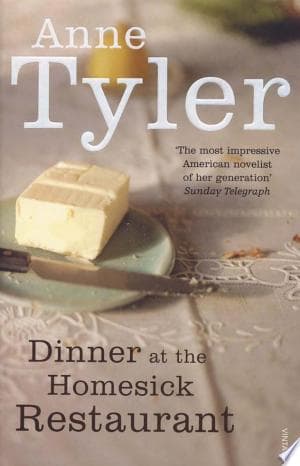
Anne Tyler (2012)
Genre
Literary Fiction
Reading Time
6-8 hours
Key Themes
See below
Sign in to track this book
With an absent father, an independent mother, and a complicated family history, the Tull children spend their lives navigating misunderstandings, resentments, and brief moments of connection, all while trying to find their own place in a family that is never quite in sync.
Pearl Tull grows up in a cold home, raised by an emotionally distant mother after her father's death. This early experience makes her reserved and often critical. She meets Beck Tull, a charming but unreliable traveling salesman, and marries him, seeing it as an escape from her stifling home. At first, their marriage is marked by Beck's occasional appearances and grand gestures, which Pearl accepts, believing in the promise of a family. However, Beck's absences become more frequent and longer, leaving Pearl to raise their growing family—Cody, Ezra, and Jenny—mostly alone. She holds a deep resentment toward Beck, which she struggles to show directly, letting it simmer beneath her calm exterior.
One day, Beck Tull leaves for a sales trip and never comes back. He abandons Pearl and their three young children: Cody, the ambitious and often troublesome oldest; Ezra, the gentle and sensitive middle child; and Jenny, the spirited and independent youngest. Pearl is left to deal with the emotional and financial burden of single parenthood in 1940s Baltimore. Her pride keeps her from seeking help, and she often directs her anger and frustration at her children, especially Cody, who reminds her of Beck. She struggles to provide for them, often working multiple jobs, and the children experience a childhood marked by instability, poverty, and their mother's emotional distance. This abandonment becomes the central wound around which the Tull family's lives unfold.
Ezra Tull, the most sensitive and caring of the siblings, dreams of creating a place where people can feel at home and enjoy good food. He eventually opens his own restaurant, which he names the 'Homesick Restaurant.' His main goal is to create the warmth and belonging he felt was missing from his own childhood. However, his attempts to bring his family together for meals at the restaurant consistently go wrong. Each time, something inevitably happens—a sibling leaves upset, Pearl makes a sharp comment, or an unexpected event ruins the gathering. These failed dinners become a repeated symbol of the family's inability to truly connect and heal their deep wounds, despite Ezra's good intentions.
Cody Tull, the oldest, grows up feeling ignored and unfairly compared to his younger brother, Ezra, whom he sees as Pearl's favorite. This perceived favoritism fuels a lifelong rivalry and a strong drive for success. Cody becomes a clever and ambitious businessman, always trying to outdo Ezra, not just in business but in life. He often takes advantage of Ezra's gentle nature, even marrying Ruth, Ezra's longtime girlfriend, a move that deeply hurts Ezra and worsens the brothers' strained relationship. Cody's actions, while often hurtful, come from a deep insecurity and a desperate need for his mother's approval, which he believes Ezra easily gets.
Jenny Tull, the youngest and most independent sibling, rebels against her family's emotional limits. She becomes a psychiatrist, a job that ironically involves dealing with the emotional complexities her own family struggles with. Jenny marries several times, each marriage an attempt to find stability and happiness outside her childhood home. Her relationships are often passionate but ultimately do not provide the lasting fulfillment she seeks. Despite her outward success and independent spirit, Jenny remains deeply affected by her family's past, especially her father's leaving and her mother's guarded nature, often returning to Baltimore to face or avoid her family.
As Pearl Tull gets older, her health starts to decline, making her face the end of her life. This period brings a softening of her usually rigid manner, and she begins to think about her past, especially her marriage to Beck and her relationships with her children. She deals with the lasting pain of abandonment and regrets about how she raised her children, acknowledging her emotional shortcomings. These thoughts are often fragmented and colored by her pride, but they show a vulnerability rarely seen before. She remains independent, even when ill, but there are moments when her desire for connection and understanding appears, particularly concerning her children.
Throughout their adult lives, Cody, Ezra, and Jenny, despite their individual problems and lingering resentments, repeatedly try to connect within their fractured family. Ezra's 'Homesick Restaurant' is a constant, though often failed, place for these attempts. Cody, despite his rivalry with Ezra, shows moments of concern for his family, especially in his later years. Jenny, though often distant, returns to Baltimore for important family events, trying to understand her mother and siblings. These interactions are rarely smooth; old wounds easily reopen, and misunderstandings are common. Yet, beneath the conflict and awkwardness, a deep, unspoken love and loyalty remain, drawing them back to each other.
Ezra Tull has a deep and lasting love for Ruth, a woman he met when he was young. Their connection is pure and gentle, and Ezra believes they are meant to be together. However, Cody, always trying to outdo his brother, steps in and marries Ruth, leaving Ezra heartbroken. This betrayal deeply affects Ezra, confirming his view of himself as the overlooked and undervalued brother. Despite the pain, Ezra keeps a quiet dignity and never truly lets go of his feelings for Ruth. Her presence in the family as Cody's wife creates a constant, subtle tension, and Ezra's unreturned love becomes a defining part of his gentle, melancholic character, shaping his interactions and his lasting desire for a harmonious family.
As Pearl Tull dies, stiffly held by her pride and solitude, her children gather around her. In her last clear moments, she begins to speak, revealing old secrets and showing glimpses into her true feelings. She confesses her lasting love for Beck, despite his abandonment, and expresses a deep, though flawed, love for her children, especially Ezra. She acknowledges her regrets about how she raised them, admitting her own emotional limits and the pain she carried. These revelations, though late, give her children a new view of their mother and family history, allowing for a fragile sense of understanding and perhaps even forgiveness to emerge after her death. Her final words are a poignant attempt to bridge the emotional gap that separated them.
After Pearl's death, Cody, Ezra, and Jenny are left to process her final revelations and the complex legacy she leaves. Her death, while expected, marks a turning point, forcing the siblings to confront their shared history and the impact of their parents' choices. They begin to see their mother not just as the rigid, critical figure they knew, but as a woman shaped by her own pain and circumstances. The revelations allow them to re-evaluate their own roles within the family. While the wounds are not entirely healed, there is a sense of closure and a fragile hope for a different kind of connection among them, as they carry forward the stories and secrets of the Tull family.
The Matriarch/Protagonist
Pearl begins as a rigid, emotionally distant mother, slowly softening in her old age to reveal her hidden vulnerabilities and a complex love for her family.
The Son/Antagonist (at times)
Cody starts as a resentful, competitive boy and grows into a successful but still insecure man, eventually softening slightly in his understanding of his family.
The Son/Protagonist
Ezra remains consistently gentle and hopeful, despite repeated disappointments, continually striving for family connection.
The Daughter/Supporting
Jenny evolves from a rebellious girl into an independent woman who, despite her professional understanding, struggles to apply it to her own family, eventually gaining a more nuanced perspective.
The Father/Mentioned
Beck's arc is defined by his abandonment, which sets the entire plot in motion and whose legacy is slowly uncovered.
The Supporting
Ruth's arc is largely static; she remains a gentle presence whose choices profoundly impact the Tull brothers.
The novel carefully shows how childhood experiences and parental relationships affect adult lives. Pearl's own emotionally deprived upbringing makes her unable to show affection, which in turn affects her children's emotional growth. Beck's abandonment creates a central wound, causing resentment in Pearl and a competitive drive in Cody, a longing for connection in Ezra, and a restless independence in Jenny. The repeated, failed family dinners at Ezra's restaurant symbolize the ongoing difficulty of overcoming these deep-seated patterns and the endless attempts to fix broken bonds, even decades later.
“What you remember most is the way your parents looked at you; the way they said your name.”
A main theme is the characters' desire for a true sense of 'home'—not just a physical place, but a feeling of belonging, acceptance, and emotional security. Ezra's 'Homesick Restaurant' is the most direct example of this, an attempt to create the warmth and family unity he lacked. Each sibling, in their own way, seeks this elusive home: Jenny through her many marriages and career, Cody through his material success and efforts to control his surroundings, and Pearl through her fierce independence and guarded memories. The novel suggests that true home is an internal state, often found in unexpected moments of connection.
“He wanted to provide people with what he himself had missed.”
Anne Tyler skillfully portrays the complex mix of love and resentment within the Tull family. Pearl, despite her husband's abandonment, has a deep, conflicted love for Beck, along with great bitterness. This mix of emotions is then passed down, in different forms, to her children. Cody's love for his family is mixed with jealousy and a need to show dominance, while Ezra's gentle love is often tinged with quiet pain and forgiveness. The novel shows that love within families is rarely simple; it is often messy, complicated by past hurts, and shown imperfectly, yet it remains a strong binding force.
“Families are like that. You can't get rid of them.”
The story often shifts perspective and time, showing how each character remembers and understands past events differently. This highlights how subjective memory is and how it shapes individual identities and family stories. Beck's abandonment, for instance, is recalled with varying clarity and emotional impact by each child. Pearl's eventual, fragmented revelations in her final days make her children rethink their understanding of their family history, showing that the 'truth' of the past is often more nuanced and complex than individual memories suggest. The past is not fixed but continuously reinterpreted through the lens of the present.
“She had rewritten history so many times that she couldn't remember the original version.”
A recurring setting symbolizing the family's yearning for unity and their repeated failures to achieve it.
Ezra's restaurant serves as a central hub and a powerful symbol throughout the novel. It represents Ezra's persistent, almost desperate, desire to create a warm, welcoming 'home' for his fragmented family, a haven of comfort that was missing from his own childhood. However, every attempt to gather the family for a meal there inevitably ends in chaos, arguments, or sudden departures. These recurring, failed dinners underscore the deep-seated emotional wounds and communication breakdowns that prevent the Tull family from truly connecting, despite their underlying love. The restaurant itself, meant to be a place of solace, becomes a poignant symbol of their collective inability to heal.
The story is told through the viewpoints of different family members and jumps in time, revealing the subjective nature of memory.
Anne Tyler employs a non-linear narrative structure, frequently jumping between different time periods and shifting the point of view among Pearl, Cody, Ezra, and Jenny. This technique allows the reader to experience the same events from multiple subjective angles, highlighting how individual memories and interpretations shape each character's understanding of their shared past. This fragmentation mirrors the family's own disunity and the difficulty of arriving at a single, objective 'truth' about their history. It deepens the psychological realism, showing how personal biases and emotional scars color perceptions and contribute to ongoing misunderstandings within the family.
Characters often write letters or harbor thoughts they never express, revealing their inner lives and communication failures.
Throughout the novel, characters, particularly Pearl and Ezra, are shown to write unsent letters or to dwell on thoughts and feelings they never articulate aloud. These internal monologues and uncommunicated messages serve as a window into their true desires, regrets, and affections, which they are unable or unwilling to express directly to their family members. This device emphasizes the profound communication breakdown within the Tull family, where crucial emotions and understandings remain locked away. It highlights the irony that while they live in close proximity, they are often emotionally distant, unable to bridge the gaps between their hearts and minds.
“It was what they did, the way they handled things, and it was the only way they knew.”
— Reflecting on the Tull family's coping mechanisms and ingrained habits.
“She had always felt that she was living in a kind of temporary arrangement, waiting for the real life to begin.”
— Pearl Tull's perpetual sense of unfulfillment and anticipation.
“You can't just take people as they are. You have to take them as they were, too.”
— Cody's realization about understanding the past to understand the present.
“Every time they ate out, it was as if they were performing some ritual of togetherness, which always ended in fragmentation.”
— Description of the Tull family's recurring disastrous restaurant dinners.
“He seemed to have a genius for making the wrong choice, for picking the one path that would lead to the most confusion.”
— Levin's tendency towards indecisiveness and creating complications.
“Children were like a foreign language that she had never quite mastered.”
— Pearl's struggles with understanding and connecting with her own children.
“People always changed, but they never really started over.”
— A reflection on the enduring impact of one's past.
“The past was like a collection of broken dishes, impossible to mend but still occupying space.”
— The lingering presence and weight of past events on the Tull family.
“She often felt as if she were a character in a play, and everyone else knew their lines but her.”
— Jenny's feeling of being out of sync with her family and the world.
“It was the sort of family where you could never quite tell who was angry at whom, or why, or for how long.”
— The subtle and pervasive undercurrent of unresolved conflict in the Tull family.
“He had a way of looking at her as if she were a puzzle he was determined to solve, even though she knew she was just a jumble of pieces.”
— Cody's intense scrutiny of Pearl, and her own self-perception.
“Life seemed to be a series of adjustments, a constant re-evaluation of what you thought you knew.”
— A general observation about the fluidity and uncertainty of life.
“They were always going to be the Tulls, for better or worse, and there was no getting around it.”
— The inescapable bond and shared identity of the Tull family.
“The restaurant was her way of trying to make things right, a place where people could come and be fed, even if their own homes were empty.”
— Pearl's motivation for opening the Homesick Restaurant.
Ready to see how well you understood this book? Take our interactive quiz with 10 questions.

Anne Tyler is an American novelist, short story writer, and literary critic. She has published twenty-four novels, including Dinner at the Homesick Restaurant (1982), The Accidental Tourist (1985), and Breathing Lessons (1988). All three were finalists for the Pulitzer Prize for Fiction, and Breathing Lessons won the prize in 1989. She has also won the Janet Heidinger Kafka Prize, the Ambassador Book Award, and the National Book Critics Circle Award. In 2012 she was awarded The Sunday Times Award for Literary Excellence. Tyler's twentieth novel, A Spool of Blue Thread, was shortlisted for the Man Booker Prize in 2015, and Redhead By the Side of the Road was longlisted for the same award in 2020. She is recognized for her fully developed characters, her "brilliantly imagined and absolutely accurate detail", her "rigorous and artful style", and her "astute and open language."







