“Hope for the best, plan for the worst.”
— A recurring theme of preparedness and pragmatism.

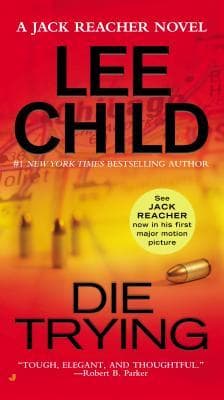
Lee Child (1998)
Genre
Thriller / Mystery
Reading Time
500 min
Key Themes
See below
Sign in to track this book
Framed for an FBI agent's abduction and pursued by a relentless federal dragnet, Jack Reacher must outwit ruthless kidnappers and clear his name before he becomes a casualty of the very agency trying to save its own.
In downtown Chicago, former military police major Jack Reacher helps a woman, Holly Johnson, pick up her dry cleaning. They are abducted at gunpoint by two men. They are forced into a car, and Reacher recognizes the efficiency of their captors. A dentist, Dr. David Young, was also abducted earlier and put in the trunk of his own Lexus, which the kidnappers then abandoned with Holly's belongings, gasoline, and a lit match, creating a diversion. Reacher and Holly are moved to a different car and driven away from Chicago, starting an ordeal where they are bound, gagged, and kept unaware of their destination and motives.
The abandoned Lexus with Dr. Young and the fire prompts a major FBI response. When they find Holly Johnson's abandoned identification, they realize she is a Special Agent from their Chicago office. Her abduction becomes a top priority. The FBI, led by Special Agent-in-Charge Burke, uses all resources to find her. Their initial idea, based on the diversion and the disappearance of two people, is that Reacher is one of the kidnappers. This misunderstanding puts Reacher in a bad spot, as the FBI wants to rescue their agent and catch her perceived captor, even if it means using lethal force.
Reacher and Holly have a long, disorienting journey, blindfolded and bound, through several vehicle changes. Reacher uses his senses to gather clues about their route and the number of captors. They arrive at a remote, fortified compound in the Montana wilderness. They are held in separate cells, though Holly gets slightly better treatment. Reacher starts to understand details about their captors, noting their military precision and the isolated stronghold, realizing they are dealing with an organized and dangerous group with a significant plan.
During their captivity, Reacher learns that Holly Johnson is not just an FBI Special Agent, but the daughter of General Richard Johnson, the Chairman of the Joint Chiefs of Staff. This dramatically raises the stakes of their abduction. Holly explains she was working undercover in the Chicago office to avoid attention to herself and her father's position. Her abduction is an act of political terrorism, meant to use her father's power. Reacher understands their captors want a larger, more dangerous geopolitical goal, not ransom, making escape more important.
Reacher and Holly meet the leader of their captors, Beau Borken. Borken is a Serbian nationalist, wanting to free his imprisoned leader, Slobodan Danilovic, a war criminal held by the United States. Borken plans to use Holly as leverage, demanding General Johnson arrange Danilovic's release. He broadcasts his demands globally, making the abduction an international incident. Reacher realizes Borken's group is a trained, armed militia, ready for a siege, making a direct escape very hard.
Despite being held, Reacher observes his surroundings, the guards' routines, and the compound's layout. He uses every chance, even during interrogations or brief movements, to get information. He tries small acts of defiance and sabotage, testing security and looking for weaknesses. He talks secretly with Holly, planning an escape. Reacher's military training helps him assess their chances and plan to overcome their armed captors, knowing time is short before Borken's demands escalate.
Through investigation, the FBI, despite misunderstanding evidence and still thinking Reacher is involved, traces the abductors to the Montana compound. They send a large force, including HRT teams and snipers, preparing for an assault. Their main goal is to rescue Holly and stop Reacher, whom they see as the main threat. This mistake creates a dangerous situation for Reacher, as he will be caught between the militia and an FBI force that sees him as the enemy, making any escape attempt more complex.
As the FBI assaults the compound, a gun battle starts. Reacher uses the chance, creating a diversion by setting off an explosion and drawing the attention of some of Borken's men. This lets him break free and move towards Holly. He uses his combat skills to stop several militia members, moving through the intense firefight. The compound becomes a war zone, with bullets from both the FBI and Borken's forces, while Reacher works to protect Holly and plan their escape, knowing he is also a target for FBI snipers.
Reacher and Holly escape the compound but are pursued by Borken and his remaining men. A chase follows through the Montana wilderness. Reacher confronts Borken in a brutal hand-to-hand fight. Reacher, though injured and tired, overpowers and kills Borken, stopping the operation's leader. This confrontation ensures their immediate safety from the militia, but they are still in hostile territory, with the FBI closing in and still seeing Reacher as a criminal, creating new challenges.
After Borken's death, Reacher and Holly are found by the FBI. Holly, now safe, immediately explains Reacher's innocence and his role in protecting her. However, the FBI's initial error and their resources still make Reacher uncomfortable. Despite Holly's requests for him to stay and be recognized, Reacher, true to his nature, quietly leaves before he can be officially processed or caught in the aftermath. He leaves Holly to reunite with her father and the FBI to clean up, disappearing into America again, his mission done.
The Protagonist
Reacher is unwillingly thrust into a high-stakes international incident, demonstrating his innate heroism and capacity for violence when protecting the innocent, ultimately reaffirming his preference for a solitary existence.
The Supporting
Holly endures a terrifying ordeal, revealing her strength and resourcefulness, and ultimately gains a deeper appreciation for the sacrifices made by individuals like Reacher.
The Antagonist
Borken orchestrates a high-stakes international kidnapping, but his fanatical resolve ultimately leads to his downfall at Reacher's hands.
The Supporting
General Johnson faces the ultimate test of his leadership and fatherhood, demonstrating his unwavering commitment to both his country and his daughter.
The Supporting
Burke leads a complex and high-pressure investigation, eventually realizing his initial misjudgment of Reacher's involvement.
The Mentioned
Danilovic's continued imprisonment serves as the catalyst for the entire plot, without any personal arc.
The Mentioned
Dr. Young is a victim used as a plot device and has no personal arc.
The Supporting
Vas remains a loyal enforcer for Borken until his death during the FBI siege or Reacher's escape.
This theme is central to Reacher's character. While the FBI works within legal rules, Reacher often acts outside them to get justice. He stops the kidnappers efficiently, without waiting for legal permission or worrying about due process, which is different from the FBI's slower methods. This is clear when he leaves at the end, avoiding legal trouble after his actions, choosing his own sense of right over formal recognition.
“He knew the law. He just didn't care for it much.”
Identity is explored through both Reacher and Holly. Holly's true identity as the General's daughter is hidden to protect her, making her FBI agent identity a cover. Reacher, a man with no fixed address or identity, is wrongly seen by the FBI as a kidnapper, showing the dangers of assumptions and incomplete information. The plot relies on the FBI's mistaken identity of Reacher, leading to a dangerous situation where the rescuer is seen as the enemy, making him fight on many fronts.
“They had him pegged. And pegged wrong.”
The book explores the motives and methods of political terrorism through Beau Borken and his Serbian nationalist group. It shows how strong beliefs can lead people to extreme acts, using innocent people as leverage for geopolitical demands. The careful planning of the abduction, the use of international media to broadcast demands, and the willingness to use violence all show the complex nature of modern terrorism, and the international effects of such acts.
“He wasn't interested in money. He wanted a statement. A message.”
Both Reacher and Holly show resilience and a will to survive against tough odds. Holly, despite not having combat experience, endures captivity with courage. Reacher, with his military background, plans, fights, and adapts to his environment, never giving up on escape. Their ability to endure physical hardship, mental stress, and constant danger shows human capacity for survival, especially when facing threats from an organized and ruthless enemy.
“He wasn't going to die here. Not like this. Not for them.”
Trust is important. Holly first suspects Reacher, but their shared experience forces them to trust each other. Conversely, the FBI's initial distrust and mistaken identity of Reacher as a kidnapper almost leads to a fatal error, where their own forces are ready to kill him. This theme looks at how trust is earned under pressure and how institutional biases can lead to dangerous mistakes, creating moral problems for the characters.
“He looked at her, and for the first time, he saw a glimmer of trust.”
The FBI's incorrect belief that Reacher is a kidnapper.
The FBI's initial and persistent belief that Jack Reacher is one of Holly Johnson's abductors, rather than her protector, serves as a crucial plot device. This misunderstanding creates constant tension, as Reacher must not only fight his captors but also avoid being killed by the very forces meant to rescue Holly. It complicates rescue efforts, adds layers of danger for Reacher, and highlights the challenges of intelligence gathering and the dangers of confirmation bias under pressure. This device drives much of the conflict and adds a ticking clock element for Reacher's survival.
The war criminal whose release is the kidnappers' ultimate goal.
Slobodan Danilovic, the imprisoned Serbian war criminal, functions as a MacGuffin. While he is never seen or directly involved, his existence and the demand for his release are the central motivation behind Beau Borken's entire kidnapping operation. This device provides the 'why' for the abduction, escalating the stakes to an international level without requiring the character itself to be present or developed. It effectively drives the plot, giving the antagonists a clear, high-stakes objective that impacts the powerful General Johnson.
Reacher, the nomadic drifter, thrust into an international political crisis.
The 'fish out of water' device is applied to Reacher. A man who intentionally lives off the grid, with no attachments or political leanings, is suddenly and unwillingly thrust into a high-stakes international political crisis involving the daughter of the Chairman of the Joint Chiefs of Staff. This device emphasizes Reacher's unique skills and perspective, as he navigates a world of espionage and political maneuvering that he actively tries to avoid. His detached perspective allows him to see situations clearly, unclouded by political agendas or bureaucratic constraints, making him uniquely effective.
The abduction of a dentist and the staged car explosion.
The abduction of Dr. David Young and the subsequent staging of his car with Holly's belongings, gasoline, and a lit match serves as a crucial diversionary tactic. This plot device is designed by the kidnappers to mislead law enforcement, making them believe the primary target was a local FBI agent and creating a chaotic scene to obscure the true, larger-scale abduction. It effectively buys the kidnappers time to transport Reacher and Holly and misdirects the initial FBI investigation, contributing to the mistaken identity of Reacher.
“Hope for the best, plan for the worst.”
— A recurring theme of preparedness and pragmatism.
“The past never really goes away. It just waits.”
— Reflecting on how past events continue to influence the present.
“Every battle is won or lost before it's ever fought.”
— Emphasizing the importance of preparation and strategy.
“Sometimes the easiest way to solve a problem is to make it someone else's problem.”
— A cynical but sometimes effective approach to difficult situations.
“You can't outrun your own shadow.”
— A metaphor for inescapable truths or consequences.
“The world is full of obvious things which nobody by any chance ever observes.”
— Highlighting a lack of attention to detail by most people.
“Fear is a powerful motivator. But so is anger.”
— Exploring the different emotional drivers behind human action.
“When you're fighting for your life, there are no rules.”
— Justifying extreme measures in dire circumstances.
“The bigger they are, the harder they fall.”
— A classic adage applied to taking down formidable opponents.
“Trust no one. Not even yourself, sometimes.”
— A reflection on the pervasive distrust in high-stakes situations.
“Silence can be louder than any scream.”
— Describing the impactful nature of quiet moments or unspoken threats.
“Some doors, once opened, can never truly be closed.”
— Referring to irreversible actions or revelations.
“The best way to hide something is in plain sight.”
— A tactic for concealment and deception.
“You don't get to choose your battles, but you do get to choose how you fight them.”
— Emphasizing agency and choice even when circumstances are forced.
“Sometimes the only way out is through.”
— A mantra for facing difficulties head-on.
Ready to see how well you understood this book? Take our interactive quiz with 10 questions.

Biography coming soon.







