“The city is what it is because we are what we are. The city is our mirror.”
— A reflection on the nature of Bellona and its inhabitants.

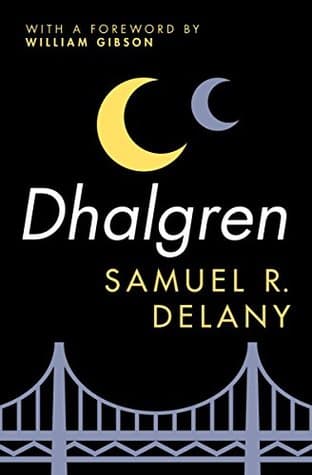
Samuel R. Delany (1975)
Genre
Fantasy / Science Fiction
Reading Time
1500 min
Key Themes
See below
Sign in to track this book
In the shattered, time-bending city of Bellona, a nameless drifter known only as 'the Kid' navigates a surreal landscape where reality warps and the marginalized find a strange, violent freedom amidst impossible phenomena.
A young man, known only as the Kid, or sometimes 'Loin,' stumbles into the enigmatic city of Bellona. He carries a notebook, mostly blank, and a bag, but has no memory of his past or how he arrived. Bellona is a place where reality is fluid: buildings burn and reappear, time moves inconsistently, and a perpetual haze often covers the sky, sometimes revealing two moons. The city is largely abandoned by its original inhabitants, now populated by a transient, often violent youth culture and various marginalized individuals. The Kid, suffering from amnesia, immediately observes and records his surroundings in his notebook, though his writing is often disjointed and poetic, reflecting the city's own fractured reality. He scavenges for food and shelter, quickly learning Bellona's strange rhythms.
Early in his time in Bellona, the Kid encounters a street gang called the Scorpions. Their charismatic leader, Ring, takes an interest in the Kid, who is initially wary but also drawn to the group's structure and the sense of belonging it offers. The Scorpions, like many other gangs in Bellona, engage in ritualistic violence, often wearing elaborate optical implants and masks. The Kid observes their complex social dynamics, their use of drug-like substances, and their often-performative acts of aggression. He begins to spend time with them, slowly integrating into their world, though he remains an outsider due to his amnesia and his habit of writing in his notebook, which the Scorpions find both intriguing and unsettling.
While exploring Bellona, the Kid meets Tak, a member of another prominent gang, the Brass. Tak is more intellectual and less overtly violent than many of the Scorpions, and he introduces the Kid to different facets of the city's underground culture, including its artistic and philosophical elements. The Kid's interactions with Tak show the diverse range of individuals drawn to Bellona. He also encounters other characters, such as Denny, a young boy, and his sister, who represent a more innocent, albeit vulnerable, side of the city's population. These encounters deepen the Kid's understanding of Bellona's complex social fabric, where alliances are fluid and danger is ever-present.
The Kid's notebook, initially a jumble of observations and fragmented thoughts, gradually becomes a collection of increasingly coherent and powerful poetry. His work, often reflecting Bellona's surreal and disorienting reality, begins to circulate among the city's artistic and intellectual residents. He is recognized for his unique voice and his ability to capture the essence of their shared, bizarre existence. This new identity as a poet gives him a sense of purpose and belonging that his amnesia had denied him. His poetry helps him process the city's chaos and connect with others, providing him with a role beyond that of a mere drifter.
The Kid finds a more stable living situation in a large loft apartment shared by a group of artists, writers, and intellectuals who form a counter-culture community within Bellona. This loft is a hub for discussions, creative endeavors, and social gatherings, offering the Kid a sense of belonging and intellectual stimulation. He engages in long, philosophical conversations about art, reality, and Bellona itself. This period marks a significant shift for the Kid, moving him from a solitary wanderer to an integrated member of a community. He continues to write, refining his craft and exchanging ideas with his new companions, further solidifying his identity as a poet.
Bellona's fluid social norms extend to sexuality, and the Kid engages in diverse sexual encounters that challenge and shape his understanding of himself. These experiences range from casual encounters to more profound connections, often blurring gender and conventional relationships. He explores his desires and vulnerabilities, using these interactions to connect with others and to further understand his own identity in the absence of a past. These encounters are often intense and raw, reflecting the uninhibited nature of life in Bellona, where societal constraints seem to have dissolved, allowing for radical freedom of expression.
Throughout the narrative, there is an underlying tension regarding the 'originals' – the few remaining pre-disaster inhabitants of Bellona who did not flee. These individuals often view the new, transient population with suspicion and hostility. There are rumors of a larger, more organized force of originals who might seek to reclaim the city or impose order. This threat creates a constant sense of unease among the gangs and artists, highlighting the precarious nature of their existence in Bellona. The Kid becomes aware of this growing conflict, which adds another layer of danger and uncertainty to his already strange life in the city.
As the Kid spends more time in Bellona, he experiences increasingly bizarre manifestations of the city's unique condition. Time distortions become more pronounced, with days passing for some while only hours pass for others. Buildings burn down and reappear intact, and geographical landmarks shift. The two moons become a more frequent sight, and the perpetual haze sometimes lifts to reveal a sky unlike any other. These phenomena are not just background details; they actively shape the characters' perceptions and experiences, challenging their understanding of reality itself. The Kid's poetry often attempts to capture the ineffable nature of these anomalies, turning the city's chaos into inspiration.
The Kid's poetry and his unique perspective continue to gain traction within Bellona's diverse communities. He becomes a recognized figure, not just as a member of the loft community but as someone who genuinely understands and articulates the city's perplexing reality. His writings are shared, discussed, and even performed. He chronicles Bellona, capturing its ephemeral beauty and terror in his verses. This growing influence grants him a certain status and protection, allowing him to navigate the city's dangers with a degree of confidence he lacked upon his arrival. His amnesia, once a weakness, becomes a blank slate upon which Bellona inscribes its own strange narrative through his art.
Bellona experiences a major festival, a chaotic event that brings together various factions of the city's inhabitants. This celebratory atmosphere is tinged with tension, as the underlying conflict between the transient population and the 'originals' reaches a boiling point. The festival culminates in a violent confrontation, a large-scale clash between the gangs, including the Scorpions and the Brass, and the more established residents who seek to control or expel them. The Kid is caught in the midst of this urban warfare, witnessing the brutal realities of Bellona's power struggles. This event is a climax, highlighting the inherent instability and violence that defines the city.
After the intense festival and subsequent conflicts, a sense of exhaustion and resolution settles over Bellona. The Kid, having experienced profound changes and found a voice through his poetry, begins to contemplate his departure from the city. He reflects on the experiences that have shaped him, the people he has met, and the strange reality he has inhabited. While his amnesia remains, he has gained a new identity and purpose. The city, though still enigmatic, no longer holds the same overwhelming mystery for him. He has absorbed its lessons and expressed its essence, and now feels a pull towards an uncertain future outside its unique confines.
The Kid ultimately leaves Bellona, walking out of the city much as he walked in. His departure is ambiguous, leaving the reader to ponder the true nature of his journey and Bellona itself. The narrative structure subtly suggests a cyclical nature, hinting that the Kid's story might be one of many similar arrivals and departures, or even that he is destined to return. His final act of writing in his notebook reinforces the idea that Bellona is a place that transforms those who enter it and demands to be chronicled. The city remains a mysterious, ever-shifting entity, its disaster and subsequent reality a permanent fixture in the novel.
The Protagonist
From an amnesiac wanderer, the Kid transforms into a celebrated poet, finding identity and purpose through his art and experiences in Bellona.
The Supporting
Ring maintains his dominant position as a gang leader, serving as a constant, powerful force in Bellona's landscape.
The Supporting
Tak serves as a stable intellectual presence and friend to the Kid, his character remaining consistent in his role as a thoughtful observer of Bellona.
The Supporting
Denny remains a symbol of vulnerability and innocence, his interactions with the Kid providing moments of tenderness.
The Supporting
The loft residents maintain their role as a communal artistic hub, fostering creativity and intellectual exchange throughout the Kid's stay.
The Antagonist
The originals maintain their antagonistic role, representing the clash between old and new Bellona, culminating in conflict.
The novel explores identity through the Kid's amnesia. Stripped of his past, he constructs a new self within Bellona. His self-discovery is intertwined with his artistic development, as his poetry is the primary means through which he defines himself. The fluidity of Bellona's reality mirrors the Kid's uncertain identity, suggesting that identity is not fixed but constantly reshaped by environment and experience. His lack of memory allows him to be a blank canvas for the city to paint upon.
““I came to Bellona and I was nothing, no one. Now I am a poet.””
Bellona itself is a distorted reality, where time, space, and physical laws are mutable. This constant flux challenges the characters' and the reader's understanding of their world. The two moons, the burning and rebuilding structures, and inconsistent time force a re-evaluation of what is 'real.' The novel suggests that reality is subjective and constructed through perception and narrative, particularly through the Kid's poetic interpretations. Bellona is a crucible where conventional notions of reality dissolve.
““The city was a place where what had been, might be again, and what was, might not be.””
For the Kid and many others in Bellona, art – particularly poetry and writing – is not merely an aesthetic pursuit but a vital tool for survival and making sense of an incomprehensible world. The Kid's notebook is his anchor, his way of imposing order on chaos and finding meaning in the face of amnesia and absurdity. His poetry allows him to connect with others, to articulate the ineffable, and to forge an identity. In a city where traditional structures have collapsed, art provides a new framework for understanding and existing. The loft community exemplifies this theme, showing art as a form of collective resistance and creation.
““I write because the world makes no sense, and if I don't write it, it makes even less.””
Bellona is a city populated by the marginalized: the young, the poor, the queer, the violent, the outcast. The novel explores how these individuals, rejected by mainstream society, form new, often unconventional, communities within the ruined city. From the hierarchical street gangs like the Scorpions to the bohemian artists in the loft, these groups provide belonging, protection, and a sense of shared identity. The city examines alternative social structures and the complexities of human connection when traditional societal norms are stripped away. Despite the violence, a strong sense of community, however fractured, persists.
““We are the junk of the world, thrown together in this broken place, and we make our own rules.””
The protagonist's lack of memory, serving as a blank slate for new experiences.
The Kid's amnesia is a central plot device. It immediately establishes him as an outsider and allows the reader to experience Bellona through fresh, unburdened eyes. It removes any preconceived notions or past identity, making his transformation entirely a product of the city. This blank slate allows Delany to explore the construction of identity from scratch, emphasizing how environment and interaction shape who we become. The amnesia also fuels the Kid's need to write, as his notebook becomes a way to record and thus create his own history and self.
The Kid's blank notebook, which becomes a record of his journey and his poetic expression.
The notebook is a crucial plot device, serving multiple functions. Initially, it symbolizes the Kid's empty past and his desperate need to record his present. As he fills it, it becomes a literal manifestation of his evolving identity and his artistic voice. The excerpts from his poetry within the novel provide direct insight into his perceptions of Bellona and his internal state. The notebook is both a personal diary and a creative outlet, allowing the reader direct access to the Kid's consciousness and the surreal beauty he finds in the city's chaos. It is his means of making sense of the nonsensical.
The city's reality-bending phenomena, creating an unstable and symbolic setting.
Bellona's inconsistent time, shifting geography, and surreal events (like the two moons or buildings burning and reappearing) are not just background details but active plot devices. They create a constantly disorienting environment that challenges character and reader perceptions of reality. These anomalies serve to emphasize the themes of subjective reality and the breakdown of order. They also contribute to the dreamlike, mythic quality of the narrative, making Bellona a character in itself—a crucible for transformation rather than a mere setting. The unpredictability of the city mirrors the internal struggles of its inhabitants.
Elaborate visual devices worn by gang members, symbolizing altered perception and social hierarchy.
The optical implants worn by Ring and other Scorpions are a striking visual motif and a significant plot device. They symbolize the altered perceptions and heightened, often aggressive, reality of the gang members. These implants are not just fashion; they are part of a ritualistic identity, enhancing the wearer's vision in unusual ways and contributing to their intimidating presence. They highlight the themes of performance and the construction of identity within Bellona's subcultures. The implants also draw attention to the subjective nature of sight and how technology can mediate and distort experience.
“The city is what it is because we are what we are. The city is our mirror.”
— A reflection on the nature of Bellona and its inhabitants.
“All stories are true. Some of them even happened.”
— A statement about the fluid line between fiction and reality within the narrative.
“I have fallen in love with a city, and I have fallen in love with a city that doesn't exist.”
— Kid's growing attachment to Bellona, despite its ephemeral nature.
“The past is a foreign country; they do things differently there.”
— A general observation on the disconnect between time periods, often applied to Bellona's history.
“Memory is not a recording device, but a creative one.”
— Exploration of how characters recall and reshape their experiences.
“We are all just trying to get by, in our own ways, in this strange, broken place.”
— A character's observation on the inhabitants of Bellona and their struggles.
“The world is not what it seems, and it never was.”
— A recurring theme about the illusory nature of reality in Bellona.
“You can't go home again, not if home is a place that never really was.”
— Kid's realization about the impossibility of returning to a stable past or origin.
“Every act of writing is an act of faith.”
— Reflection on the creative process and the commitment required to create a narrative.
“The only way out is through.”
— A character's mantra for dealing with the labyrinthine challenges of Bellona.
“Language is a virus from outer space.”
— A provocative statement on the pervasive and transformative power of language, often attributed to William S. Burroughs but echoed in Delany's exploration of text.
“There are no beginnings and no endings, only an endless middle.”
— A philosophical take on the cyclical and fragmented nature of time and narrative in the novel.
“We build our own cages and then we wonder why we can't fly.”
— A commentary on self-imposed limitations and the human tendency to restrict freedom.
“The map is not the territory, but it's all we've got.”
— An acknowledgment of the limitations of understanding and representation in a complex reality.
Ready to see how well you understood this book? Take our interactive quiz with 10 questions.
Biography coming soon.







