“We are not just students; we are detectives!”
— Caius declares this to his friends when they decide to investigate a crime at their school.

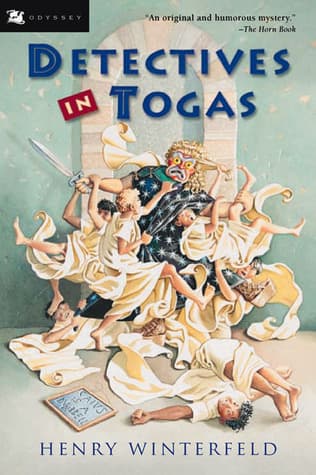
Henry Winterfeld (1956)
Genre
Children's / Historical Fiction / Mystery / Young Adult
Reading Time
249 min
Key Themes
See below
Sign in to track this book
When a schoolboy's prank escalates into a temple defilement and his own teacher's kidnapping, seven young Roman sleuths must race against time and confusing clues to unmask the true culprit before their friend is condemned.
The story begins in ancient Rome with seven schoolboys: Caius, Rufus, Antonius, Publius, Mucius, Flavius, and Julius. Their day changes when 'CAIUS IS A DUMBBELL' appears painted in red on the Temple of Minerva. The handwriting matches Rufus's. Rufus had written the same insult on his wax tablet earlier, but he denies painting it on the temple. Their teacher, Xantippus, is angry, and everyone, including Rufus's father, Senator Vinicius, suspects Rufus. The boys realize that if they do not solve this mystery, Rufus faces severe punishment, possibly being sent to a gladiatorial school or exile.
The six friends begin their investigation to clear Rufus's name. They first ask Rufus about his wax tablet, which he says was stolen from his desk. The boys then return to the schoolroom, hoping to find more clues. They are surprised to find their teacher, Xantippus, tied up and gagged on the floor. He had been locked inside the schoolroom after everyone left. This new event makes the mystery deeper and more urgent, as it now seems someone framed Rufus and then silenced their teacher. The boys realize they face a clever and dangerous opponent.
After freeing Xantippus, the boys and their teacher examine the schoolroom. They find a broken window latch and signs of forced entry, proving that Xantippus was a victim and not involved in the temple incident. Xantippus recalls hearing a noise the previous night but ignored it. More importantly, they confirm that Rufus's wax tablet, with 'CAIUS IS A DUMBBELL' on it, is missing. This confirms Rufus's story and suggests the culprit stole the tablet to copy Rufus's handwriting and frame him. The reason for such a plan is still unclear, but the boys are sure Rufus is innocent.
The boys, with Xantippus's guidance, continue their detective work. They interview a slave named Stichus, who works for Senator Vinicius (Rufus's father). Stichus says he saw a 'flying pig' during the night of the temple incident. Initially, the boys think this is nonsense, but Xantippus tells them to consider all possibilities. They realize Stichus might have seen something unusual, not a real flying pig, but an object carried or moved strangely. This testimony, though seemingly odd, starts a new line of inquiry, suggesting the culprit might have used an unusual method to reach the temple wall.
Following Xantippus's advice to think about the 'flying pig,' the boys search the area around the Temple of Minerva more carefully. They soon find a hidden makeshift ladder. The ladder is made from rough planks and appears to have been used to reach the upper parts of the temple wall. On one plank is a symbol: a pig. This immediately reminds them of Stichus's 'flying pig' and the symbol. They trace the symbol to a local pig-seller named Barbus, who often uses a similar mark on his goods. This is the first lead to a possible suspect.
The boys confront Barbus, the pig-seller, who denies any involvement in the temple defacement or the attack on Xantippus. He claims he knows nothing about a ladder or any 'flying pig.' However, the boys, suspicious of his defensive manner, decide to investigate his property. They sneak into a hidden workshop behind Barbus's stall, where they find tools and evidence of recent woodworking. They also discover a large, hollow wooden pig, designed to be moved and perhaps used as a disguise or a container, which explains Stichus's unusual sighting.
Inside Barbus's workshop, the boys uncover a counterfeiting operation: Barbus makes fake Roman coins. The wooden pig they found is a device used to transport the fake currency or materials. They realize that the 'CAIUS IS A DUMBBELL' inscription on the Temple of Minerva and the attack on Xantippus were distractions. By creating a scandal involving Rufus and the temple, Barbus drew attention away from his illegal activities. He had used the ladder to paint the inscription, framing Rufus, and then tied up Xantippus to prevent him from discovering the truth or identifying him.
With this information, the boys return to Xantippus and explain their findings. Xantippus, at first doubtful, is convinced by the evidence and the boys' logical thinking. Together, they plan to catch Barbus. They decide to create a situation that will force Barbus to reveal his counterfeiting operation and confess to framing Rufus. The plan involves surveillance and a trick to make Barbus believe his secret is about to be exposed, making him act. The boys are nervous but want justice for Rufus.
The boys put their plan into action. They arrange for a message to reach Barbus, implying his workshop has been discovered. Panicked, Barbus rushes to his workshop to move his counterfeiting equipment. The boys, with Xantippus and some Roman guards they had alerted, ambush him. Caught with his fake coins and tools, Barbus confesses. He admits to painting the inscription on the Temple of Minerva, stealing Rufus's tablet, and tying up Xantippus, all to divert suspicion from his illegal counterfeiting business. Rufus's name is cleared, and Barbus is taken away.
With Barbus's confession, Rufus is cleared. His father, Senator Vinicius, who had believed Rufus guilty, shows relief and pride in his son and his friends. The boys are praised for their cleverness and persistence in solving the mystery. Even Xantippus, their stern teacher, acknowledges their intelligence. The incident strengthens their bond as friends and detectives, and they return to their studies, having learned about justice, observation, and not judging too quickly. The Temple of Minerva is cleaned, and peace returns to their part of Rome.
The Protagonist
Caius learns the importance of loyalty and critical thinking when faced with a personal slight that turns into a wider crime.
The Protagonist
Rufus learns the severe consequences of careless actions and experiences the power of friendship in overcoming adversity.
The Supporting
Antonius hones his observational skills and learns the value of collaboration in solving complex problems.
The Supporting
Publius develops his deductive reasoning and learns the importance of thorough analysis in problem-solving.
The Supporting
Mucius learns to temper his impulsiveness with careful planning, while retaining his adventurous spirit.
The Supporting
Flavius discovers the power of quiet observation and its crucial role in solving mysteries.
The Supporting
Julius overcomes some of his timidity, gaining confidence through his participation in the investigation.
The Supporting
Xantippus learns to trust his students' abilities and to apply his scholarly logic to real-world problems.
The Antagonist
Barbus's criminal enterprise is exposed, leading to his downfall and capture.
The Mentioned
Stichus's observation, initially misunderstood, helps to unravel a complex crime.
The Mentioned
Senator Vinicius moves from initial condemnation to proud exoneration of his son, learning the importance of thorough investigation.
The main theme is the pursuit of justice for Rufus, who is wrongly accused. The boys want to find the truth, even when adults, including Rufus's father and their teacher, are quick to judge. Their careful investigation, despite their youth, shows that truth can be found through observation and logic, regardless of first impressions. The ending brings justice for Rufus and the community.
“'It is not enough to be innocent, Rufus,' Xantippus had said. 'You must prove it. And that, my boys, is what we shall do.'”
The friends' loyalty to Rufus is a strong part of the story. Even with Rufus's initial mistake (writing the insult), his friends believe he is innocent of the temple defacement and work to clear his name. Their combined effort, support, and refusal to give up on Rufus show how strong their friendship is. This theme means that true friends stand by each other, especially in hard times.
“'We must help Rufus. He's our friend, even if he did call Caius a dumbbell,' Antonius declared, summing up the boys' resolve.”
The boys' journey from confusion to solving a crime shows the power of logical thinking. Guided by Xantippus, they learn to analyze clues, question assumptions, and connect unrelated information. From understanding the 'flying pig' to tracing the ladder and finding the counterfeiting operation, their success comes from thinking systematically and critically, turning small details into important evidence.
“'A good detective does not ignore anything, no matter how foolish it may sound. Sometimes the most ridiculous clue holds the greatest truth,' Xantippus lectured.”
This theme is central to the mystery. Rufus appears guilty because of his handwriting, but he was framed. Barbus appears to be a simple pig-seller, but he is a counterfeiter. The 'flying pig' seems absurd, but it is a real, disguised object. The story constantly asks characters and readers to look beyond appearances and find hidden truths. This theme reinforces that things are not always what they seem.
“'The world is full of disguises, boys. What seems obvious is often a trick,' Xantippus mused, after the truth about Barbus began to unfold.”
The initial focus on Rufus's insult diverts attention from the real crime.
The inscription 'CAIUS IS A DUMBBELL' and Rufus's matching handwriting serve as a classic red herring. This seemingly obvious clue immediately points to Rufus as the culprit, drawing suspicion away from the true criminal's activities. The initial focus on Rufus's personal misdeed effectively distracts everyone, including the authorities and even Rufus's own father, from the larger, more serious crime of counterfeiting and the elaborate framing device. This misdirection is crucial for the antagonist's plan to succeed, making the boys' eventual discovery of the real plot more impactful.
Stichus's 'flying pig' testimony, initially dismissed, becomes a vital clue.
The slave Stichus's report of seeing a 'flying pig' is an example of cryptic or initially unreliable testimony. At first, the boys and Xantippus dismiss it as a hallucination or exaggeration. However, Xantippus later encourages them to consider its literal meaning, leading them to search for a physical 'pig' object. This device highlights the importance of not dismissing seemingly absurd clues and training oneself to interpret information creatively. It ultimately leads the boys directly to Barbus, the pig-seller, and his unique method of transporting goods, turning a bizarre statement into a breakthrough.
Xantippus being tied up in the locked schoolroom adds complexity and urgency.
The discovery of Xantippus tied up inside the schoolroom, which had been locked from the outside, introduces a 'locked-room mystery' element. This event not only proves Rufus's innocence in that specific act but also establishes the presence of an unknown, cunning perpetrator. It creates a secondary mystery that needs to be solved alongside the temple defacement, adding layers of intrigue and increasing the stakes. The boys must figure out how the culprit entered, tied up Xantippus, and exited without being seen, ultimately leading them to discover the broken latch and the forced entry.
The pig symbol, from the inscription to the pig-seller, connects clues.
The symbol of the pig is a recurring motif and a significant plot device. It first appears as the 'flying pig' in Stichus's testimony, then as the symbol etched on the ladder, and finally identifies Barbus as the pig-seller and the owner of the hollow wooden pig. This consistent symbol serves as a breadcrumb trail for the boys, allowing them to connect disparate pieces of evidence and ultimately identify the culprit. It demonstrates how seemingly trivial details, when observed and connected, can lead to the resolution of a complex mystery.
“We are not just students; we are detectives!”
— Caius declares this to his friends when they decide to investigate a crime at their school.
“In Rome, even a slave can be a hero.”
— Reflecting on how their investigation reveals unexpected bravery in people of all statuses.
“A true friend stands by you, even when the evidence seems against you.”
— One of the boys defends another falsely accused during their mystery.
“The truth is like a hidden coin in the sand—you must dig to find it.”
— Used to encourage persistence in solving the mystery.
“In Rome, the law is for all, but justice must be fought for.”
— A lesson learned about the legal system during their investigation.
“Sometimes, the smallest clue can solve the biggest mystery.”
— The boys realize a minor detail cracks the case wide open.
“We may be young, but our minds are as sharp as any senator's.”
— Boasting about their deductive skills while investigating.
“Fear not the unknown, for it holds the answers we seek.”
— Encouraging each other to explore dangerous or unfamiliar situations.
“In friendship, we find strength greater than any army.”
— The group relies on their bond to overcome obstacles.
“A riddle from the past can teach us about the present.”
— Connecting historical clues to their modern-day mystery.
“Even in togas, we can run faster than trouble.”
— A humorous remark during a chase scene in the story.
“The greatest lessons are not in scrolls, but in life's adventures.”
— Reflecting on how their detective work taught them more than school.
“To accuse without proof is to build a house on sand.”
— Cautioning against jumping to conclusions in their investigation.
“In every mystery, there is a thread that leads to the truth.”
— Describing their methodical approach to solving the case.
Ready to see how well you understood this book? Take our interactive quiz with 10 questions.

Biography coming soon.

Dan Gemeinhart
4.5
Kate O'Hearn
4.4

Jeanne Birdsall
4.4

Jen Wang
4.4
Wendelin Van Draanen
4.3

John Marsden
4.3

Chris Van Allsburg
4.3
Jennifer A. Nielsen
4.2