“Justice is a fire. It can cook your food, but it can also burn your house down.”
— Empress Hesina reflects on the nature of justice and its potential for destruction.

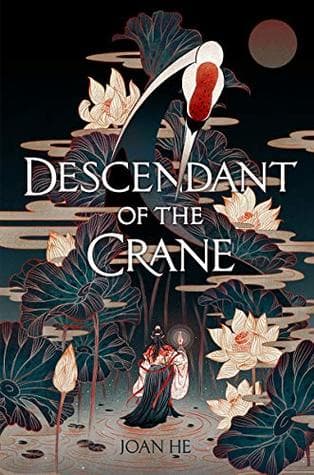
Joan He (2019)
Genre
Fantasy / Historical Fiction / Mystery / Young Adult
Reading Time
10-12 hours
Key Themes
See below
Sign in to track this book
In a kingdom where magic is illegal and emotions are traded, a princess risks her throne and life, hiring a forbidden soothsayer and a criminal to find her father's killer amid court deceptions.
Princess Hesina, known for her studies more than politics, is preparing for her father Emperor Sian's seasonal travel when she learns of his sudden death. The official cause is a stroke, but Hesina quickly finds clues suggesting foul play: a missing jade crane pendant, a strange burn mark on his arm, and a cryptic note about 'the crane's descendant.' Overwhelmed and suspicious, Hesina realizes she is now empress of Yan, a kingdom with political problems and a strict ban on magic. Her grief is made worse by the immediate need to find the truth behind her father's death, as she suspects a deeper plot than a simple illness.
Desperate for answers, Hesina commits a treasonous act by secretly consulting a soothsayer, a practice punishable by death in Yan. The soothsayer's cryptic words tell her to find a 'convicted criminal' to uncover the truth. Following this illegal advice, Hesina visits the prison and chooses Akira, a smart but mysterious investigator jailed for forging imperial documents. She offers him a pardon if he helps solve the emperor's murder, knowing that trusting a criminal is risky. Akira, at first unwilling, agrees, starting an unusual partnership filled with suspicion and hidden motives.
As Hesina begins her reign, she must deal with her manipulative older brother, Caius, who openly questions her leadership and hints at his own claim to the throne. Her younger brother, Sanjing, seems supportive but also has secrets. Hesina's aunt, Lady Arin, a powerful court figure, offers advice but her intentions are unclear. Akira, with his sharp observations, points out the different groups and hidden loyalties within the court, making Hesina increasingly paranoid. She realizes the killer could be someone in her own family or inner circle, making every interaction a possible trap and every trusted face a possible betrayer.
Akira, using his intelligence and unusual methods, uncovers clues linking the emperor's murder to forbidden soothsaying and the ancient prophecy of the 'crane's descendant.' They discover that Emperor Sian was secretly investigating the return of magic and a hidden society dedicated to it. The missing jade crane pendant, a symbol of the royal family, takes on new meaning. Hesina learns that the 'crane's descendant' refers to someone with a special connection to ancient magical power, suggesting her father's death is part of a larger, magical plot rather than just a political killing.
Hesina's secret soothsayer, Tian, is captured by the Imperial Guard, forcing Hesina to publicly condemn her to keep up appearances, even as she secretly plans to save her. During an interrogation, Tian reveals she was not just a soothsayer, but also a member of a hidden community of magic-users and, surprisingly, an ally of Emperor Sian. She confesses that the Emperor was trying to understand and possibly bring magic back into Yan society, believing it could prevent future disasters. Tian's capture and confession reveal a deeper part of the conspiracy, suggesting the emperor was killed not for outlawing magic, but for trying to bring it back.
Hesina discovers that her brother Caius was indeed plotting against her to take the throne, but he did not murder their father. Instead, she uncovers that Sanjing, her seemingly innocent younger brother, was involved in a secret society of soothsayers and was manipulated into a more active role in the events leading to their father's death. Sanjing, wanting to protect the soothsayers and bring back magic, believed he was acting for the greater good, but his actions unintentionally helped the assassination. This revelation shatters Hesina's trust and forces her to face the painful truth about her family.
Akira, whom Hesina had come to trust, reveals his true identity as a powerful soothsayer and a key figure in the hidden magical society. His imprisonment was a calculated move to gain access to the palace and Hesina. He confesses that the soothsayers, believing Emperor Sian was moving too slowly or dangerously in his attempts to restore magic, orchestrated his death to cause change. Their goal is to install a ruler who will fully embrace magic and restore its proper place in Yan. Hesina feels a deep sense of betrayal, realizing she was merely a pawn in their plan, her grief and desire for justice manipulated for a larger political agenda.
Hesina confronts Akira and the soothsayer leaders, learning the full extent of their plan. They reveal that Hesina herself is the true 'crane's descendant,' possessing an innate magical ability they intend to awaken and use to lead Yan into a new era of magic. They offer her a choice: embrace her power and rule with them, restoring magic to the kingdom, or resist and face the consequences of a kingdom in chaos. Hesina is torn between her duty to uphold the law, her desire for justice for her father, and the undeniable pull of a world where magic could solve many of Yan's problems.
To maintain order and prevent civil war, Hesina stages a public trial. She publicly condemns Akira and the soothsayers for treason, but secretly negotiates a deal to spare their lives and allow them to operate in the shadows, under her strict control. She understands that getting rid of magic entirely is no longer possible or perhaps even desirable, given the soothsayers' power and magic's potential benefits. Hesina makes a difficult public sacrifice, appearing to uphold the law while secretly preparing for a future where magic and governance might coexist, though precariously.
Hesina, now a hardened empress, accepts leadership with a new understanding of its burdens and compromises. She begins to quietly explore her own growing magical abilities, acknowledging her role as the 'crane's descendant.' She makes difficult decisions to stabilize the kingdom, including addressing corruption in the court and balancing the official law with the growing magical underground. Hesina realizes that being a good ruler means making impossible choices and that truth is often far more complex than simple justice. She wants to forge a new path for Yan, one that acknowledges its past while carefully embracing its magical future.
The Protagonist
Hesina transforms from a sheltered scholar into a shrewd and pragmatic empress, learning to wield power and make difficult sacrifices for her kingdom.
The Antagonist/Supporting
Akira moves from being a seemingly trustworthy ally to a revealed manipulator, demonstrating that his loyalty lies with the soothsayer cause.
The Supporting
Caius remains a political rival, his ambition consistent, but he is ultimately revealed not to be the primary antagonist in the murder plot.
The Supporting
Sanjing's innocence is shattered as he is revealed to be a participant in the conspiracy, driven by misguided loyalty to the magical cause.
The Mentioned
His death acts as the inciting incident, and his character is revealed posthumously through Hesina's investigation.
The Supporting
Tian transitions from a mysterious informant to a revealed ally of the late Emperor and a key figure in the soothsayer community.
The Supporting
Lady Arin consistently acts as a political advisor and a symbol of traditional court power.
This theme explores the conflict between personal justice and the wider duties of leadership. Hesina first wants only to find her father's killer. But as she uncovers the deeper plot involving magic and her kingdom's stability, she must weigh personal revenge against the practical needs of her people and Yan's fragile peace. Her decision to publicly condemn the soothsayers while secretly working with them shows this difficult balance, suggesting that true justice for her father might be impossible if it risks destroying her kingdom. The story implies that a ruler's duty often requires compromises that personal justice cannot make.
“Justice is a luxury. Duty is a burden.”
The novel constantly questions what is true and what is simply an act or a lie. Hesina's investigation constantly uncovers layers of deception, from the official story of her father's death to the true identities and motives of those around her. Akira's entire identity is a lie, and even her seemingly innocent brother, Sanjing, is revealed to be involved in secrets. The story suggests that truth is rarely simple or singular, often hidden by political goals, personal desires, and the very act of seeking it. Hesina learns that to rule effectively, one must not only tell truth from lies but also sometimes use deception oneself for the greater good.
“Sometimes the truth is a weapon, and sometimes it's a shield.”
This theme explores the societal conflict between strict law and order (the ban on magic) and the inherent, often wild, power of magic. Yan has centuries of history built on suppressing magic, seeing it as dangerous. However, the return of magic, and the revelation that the late Emperor was secretly exploring its potential, challenges this established order. The soothsayers believe magic is essential for the kingdom's prosperity and that its suppression is harmful. Hesina must decide if magic is a threat to be removed or a force that can be used, ultimately choosing a path that tries to integrate it, though carefully, into the existing structure, marking a shift in the kingdom's core beliefs.
“Magic is not chaos. It is merely misunderstood order.”
Hesina's journey is closely tied to the theme of family loyalty and the pain of betrayal. Her search for justice begins with her father's murder, but she quickly discovers that the deceit extends to her closest relatives. Her ambitious brother, Caius, constantly plots against her, and her seemingly innocent younger brother, Sanjing, played a role in their father's death. The deepest betrayal comes from Akira, whom she comes to trust, only to discover he was manipulating her all along. This theme shows how personal relationships can be corrupted by power, ambition, and different beliefs, forcing Hesina to question who she can truly trust.
“The sharpest knives are always those you give to family.”
A prophecy foretelling a unique individual connected to ancient magic.
This prophecy serves as a central mystery and a driving force behind the plot. Initially, it's a cryptic clue left by the murdered Emperor, hinting at a magical element to his death. As the story progresses, it's revealed to refer to a person, ultimately Hesina, who possesses an innate connection to ancient magic. The prophecy justifies the soothsayers' actions, as they believe they are fulfilling a destined path by installing Hesina. It adds a layer of destiny and supernatural influence to the political machinations, elevating the stakes beyond a simple murder mystery to the fate of an entire magical lineage and the future of Yan.
The outlawed practice of magic that is central to the conspiracy.
The strict prohibition of magic, particularly soothsaying, is the foundational plot device that creates the central conflict. It establishes the rigid societal rules of Yan and the high stakes of Hesina's investigation, as her consultation with a soothsayer is a treasonous act. The existence of a hidden soothsayer society, and their manipulation of events, drives the conspiracy. The 'forbidden' nature of magic creates an immediate sense of danger and mystery, forcing characters to operate in shadows and make dangerous alliances. It also sets up the thematic tension between order and power, and the potential for a new era in Yan.
A symbolic object that serves as a key clue in the murder investigation.
The jade crane pendant is a physical plot device that acts as a crucial clue in Emperor Sian's murder. Its absence from his body immediately signals foul play to Hesina. As the investigation unfolds, the pendant's significance deepens, linking to the 'crane's descendant' prophecy and the royal lineage. It serves as a tangible representation of the underlying magical conspiracy, connecting the seemingly mundane act of a missing object to the ancient, forbidden powers at play. Its symbolic weight as an imperial artifact further emphasizes the connection between the emperor's death and the broader fate of the kingdom.
Using a supposedly disgraced individual for their unique skills.
This device, embodied by Akira, allows Hesina to access unconventional methods and perspectives outside the rigid confines of the imperial court. Akira's criminal status provides a plausible reason for him to be outside the trusted circle, yet his renowned intelligence makes him indispensable. It creates a dynamic of forced alliance, mistrust, and eventual betrayal, as Akira's true motives as a soothsayer are revealed. This device allows for a protagonist to break rules and challenge norms, pushing the boundaries of what is acceptable in their world, and ultimately revealing the hidden truths that official channels could not.
“Justice is a fire. It can cook your food, but it can also burn your house down.”
— Empress Hesina reflects on the nature of justice and its potential for destruction.
“When you have nothing left to lose, you have everything to gain.”
— Hesina faces a dire situation, realizing the freedom in her desperation.
“History is written by the victors, but truth is whispered by the dead.”
— A philosophical thought on the malleability of history versus enduring truths.
“A good ruler does not seek power, but accepts it as a burden.”
— Hesina grapples with the weight of her new responsibilities as empress.
“The greatest lies are often hidden in plain sight, disguised as inconvenient truths.”
— Hesina uncovers deceptions that were always present, but dismissed.
“Sometimes, the hardest thing to do is to forgive yourself.”
— Hesina struggles with guilt and past decisions.
“Every secret comes with a price, and the longer it's kept, the higher the cost.”
— The consequences of hidden truths begin to unfold.
“To truly know someone, you must see them not just for who they are, but for who they pretend to be.”
— Hesina learns to look beyond appearances and understand motivations.
“Hope is a dangerous thing, but despair is a deadlier one.”
— A reflection on the balance between optimism and hopelessness in challenging times.
“The past is never truly gone; it merely waits for the right moment to return.”
— Past events and their impact resurface to confront the present.
“Power is not about what you can take, but what you can protect.”
— Hesina redefines her understanding of what it means to wield authority.
“Even the clearest water can hide the deepest secrets.”
— A metaphor for the deceptive appearances of seemingly transparent situations.
“A kingdom is only as strong as the trust between its people and its ruler.”
— Hesina considers the foundation of stable governance.
“The truth is a weapon, and like any weapon, it can be used to heal or to harm.”
— Hesina contemplates the dual nature of revealing difficult truths.
Ready to see how well you understood this book? Take our interactive quiz with 10 questions.







