“Eve knew it wasn't a good sign when her first thought upon waking was how much she wanted a cup of coffee and a loaded gun.”
— Eve's morning routine and general disposition.

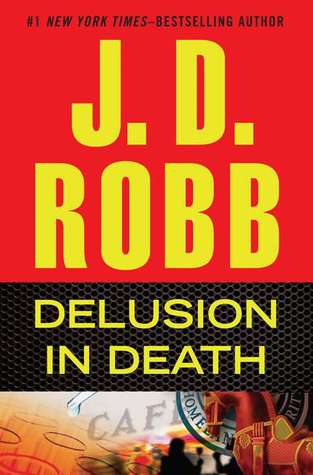
Genre
Thriller / Mystery / Science Fiction / Romance
Reading Time
388 min
Key Themes
See below
Sign in to track this book
Lieutenant Eve Dallas races against time to uncover who unleashed an airborne cocktail of drugs and chemicals that turned a happy hour into a hallucinatory massacre, before the invisible terror can strike again.
Detective Lieutenant Eve Dallas is called to The Downside, a bar owned by her husband Roarke, after a horrific incident leaves eighty people dead and many more injured. Witnesses describe a sudden onset of extreme paranoia, rage, and hallucinations, with many claiming to have seen monsters or swarms of insects. The scene is one of chaos, with victims having turned on each other in a frenzy of violence. Eve, alongside her partner Detective Peabody, begins the task of piecing together what happened, confronting the shocking reality of a mass murder without a clear motive or perpetrator. The inexplicable nature of the event immediately suggests something far more sinister than a typical crime.
Dr. Mira, the police psychologist, and Chief Medical Examiner Morris confirm the presence of a powerful psychoactive cocktail in the victims' systems. This concoction, later identified as a blend of chemicals and illegal drugs, can induce temporary insanity, aggression, and vivid hallucinations. The discovery explains the bizarre witness testimonies and the uncharacteristic violence. Eve and her team realize they are dealing with a deliberate act of bioterrorism or chemical warfare, designed to cause widespread panic and death. The airborne nature of the agent makes the threat even more terrifying, as it could be deployed anywhere.
Roarke, disturbed by the attack on his property and the loss of life, launches his own investigation, focusing on corporate security and potential vulnerabilities. While he initially fears he might have been the target, the scale and nature of the attack suggest a broader agenda. He works closely with Eve, providing resources and insights from his network. His investigation reveals that a new, secure air filtration system was recently installed at The Downside, making it an unlikely target for an airborne attack unless the system itself was compromised or bypassed. This leads them to consider that the perpetrator had knowledge of Roarke's operations.
Despite increased vigilance, a second, smaller-scale attack occurs in a public plaza, replicating the symptoms and chaos of the Downside incident. This confirms Eve's fears: the perpetrator is not targeting Roarke specifically but is testing or deploying the agent in different environments. The second attack solidifies the understanding that the threat is airborne and could strike anywhere. The public is gripped by fear, and the authorities struggle to reassure them while trying to contain the panic. Eve feels the immense pressure of a killer operating with an invisible weapon, threatening society.
Through collaboration, Dr. Mira, Morris, and their teams isolate and identify the specific psychoactive compound responsible for the attacks. They call it 'Delusion' due to its effect on perception and behavior. The compound is sophisticated, designed to spread rapidly through air and induce its effects almost instantaneously. Understanding its chemical makeup is the first step towards developing a countermeasure, but the immediate challenge remains identifying its source and the person or group behind its creation and deployment. The scientific community is horrified by this weapon.
Eve and Peabody, following leads from Roarke's corporate investigation and their own forensics, begin to narrow down their suspect pool. They focus on individuals with advanced chemical and biological knowledge, particularly those who might have access to the resources needed to synthesize 'Delusion'. They also look for individuals with a history of grievances, radical ideologies, or a desire for chaos. The investigation leads them through academic and corporate circles, uncovering a network of disgruntled scientists and former employees who felt wronged by powerful corporations or the system. The challenge is identifying the one capable of such a heinous act.
The investigation leads Eve to Dr. Cyrus Arnette, a brilliant but embittered scientist who had been disgraced and fired from a prominent research institution years prior. Arnette harbored resentment against society, believing it to be corrupt and deserving of a 'reset' through manufactured chaos. He saw his creation, 'Delusion,' as the tool to expose humanity's savagery and bring about a new world order. His motive is not profit or personal gain, but a twisted ideological conviction. He planned the attacks, using his scientific genius to craft the weapon and delivery system.
Eve and Roarke, using their combined resources, uncover Arnette's sophisticated delivery system. He wasn't relying on single-point deployments but had devised a method to disperse 'Delusion' through seemingly innocuous means. He had infiltrated various public utility systems, disguised the dispersal devices as common maintenance equipment, and planned to unleash a massive, simultaneous attack across the city. His plan was to create widespread, uncontrollable chaos, paralyzing the city and forcing society to collapse. The scale and ingenuity of his plan are terrifying, highlighting the depth of his delusion and hatred.
With the full scope of Arnette's plan revealed, Eve, Roarke, and the entire police force, along with federal agencies, launch a massive operation to locate and neutralize his dispersal devices. It's a race against time, as Arnette has set a deadline for his final, devastating attack. The team combs through schematics, surveillance footage, and intelligence, trying to predict Arnette's next move and find his hidden devices. The pressure is immense, as failure would mean untold casualties and the breakdown of societal order. Every second counts as they work to prevent a catastrophe.
Eve tracks Arnette to his final lair, a hidden laboratory where he is overseeing the activation of his remaining devices. A tense confrontation ensues, with Arnette unrepentant and convinced of his actions. Eve, using her intellect and resolve, outmaneuvers him, preventing the final, city-wide dispersal. Arnette is apprehended, and his network of devices is neutralized just in time. The city breathes a sigh of relief, but the trauma of the attacks lingers. Eve reflects on the fragility of order and the insidious nature of delusion, even as justice is served.
The Protagonist
Eve confronts a new form of terrorism, challenging her understanding of human evil and pushing her to adapt her investigative methods.
The Supporting
Roarke uses his immense influence and intelligence to assist Eve, reaffirming his commitment to their shared fight against injustice, despite his personal connection to the initial crime scene.
The Supporting
Peabody continues to develop her investigative skills and confidence, proving her worth in a high-stakes, unconventional case.
The Supporting
Dr. Mira plays a critical role in analyzing the effects of 'Delusion' and understanding the perpetrator's disturbed psychology, further solidifying her bond with Eve.
The Supporting
Dr. Morris's forensic brilliance is instrumental in identifying the chemical weapon, showcasing the vital role of science in solving complex crimes.
The Supporting
Commander Whitney provides consistent leadership and support to Eve, demonstrating effective command during a city-wide crisis.
The Antagonist
Arnette is revealed as the mastermind, driven by a twisted ideology to unleash mass chaos, ultimately being apprehended by Eve.
The Supporting
Summerset provides his usual steadfast support and care, offering stability amidst the external chaos.
The novel shows how easily social order can collapse under the influence of fear and manufactured chaos. The Downside massacre, where ordinary people turn on each other, highlights the thin veneer of civilization. The subsequent public panic and the threat of widespread attacks underscore the constant vigilance required to maintain societal stability. Eve's fight against Arnette is not just against a killer, but against a force that seeks to unravel society, forcing humanity to confront its primal fears and aggression.
“One day, everything is normal. The next, people are tearing each other apart over nothing. It makes you wonder, doesn't it, what's really holding us all together?”
The plot revolves around a chemical agent that induces 'delusion' and madness. This theme explores how perception can be manipulated and how easily individuals can be driven to irrationality and violence when their minds are compromised. Dr. Arnette himself embodies a profound delusion, believing his actions are a necessary 'reset' for humanity. The novel explores the psychological underpinnings of mass hysteria and individual psychosis, showing how a twisted ideology can be as dangerous as any physical weapon. Dr. Mira's psychological expertise is important for understanding this theme.
“He didn't just want to kill them. He wanted them to kill each other. To prove some sick point about humanity.”
Science is presented as a double-edged sword. While Dr. Arnette perverts his scientific genius to create a weapon of mass destruction, the collective scientific expertise of Dr. Morris and Dr. Mira is essential in identifying 'Delusion,' understanding its effects, and developing countermeasures. Roarke's technological prowess also aids the investigation. The theme highlights the ethical responsibilities of scientific discovery and the battle between those who use knowledge for destructive ends and those who strive to harness it for protection and healing. It's a reminder that tools are neutral, but their application defines their moral weight.
“Science isn't good or evil, Eve. It's just knowledge. It's what people do with it that matters.”
Despite the horror and chaos, the novel emphasizes human connection, teamwork, and resilience. Eve and Roarke's bond provides a stable anchor amidst the madness. The loyalty and dedication of Eve's team – Peabody, McNab, Dr. Mira, and Dr. Morris – show how collective effort and mutual support are vital in overcoming threats. Even as society faces its darkest impulses, the acts of courage, empathy, and determination by the protagonists offer hope, proving that human connection can withstand the most severe pressures.
“When the world goes mad, you hold onto what's real. You hold onto each other.”
A psychoactive chemical agent driving the plot's central conflict.
'Delusion' is the fictional psychoactive chemical agent that serves as the primary catalyst for the entire plot. Its mysterious origin, devastating effects (inducing paranoia, rage, and hallucinations), and airborne nature drive the investigation. While its precise chemical makeup is eventually understood, its initial unknown qualities create suspense and urgency. The race to identify, understand, and neutralize 'Delusion' is the central thrust of Eve's investigation, making it a classic MacGuffin that propels the characters and narrative forward.
A looming deadline for a city-wide attack creates intense urgency.
The 'ticking clock' device is employed effectively once Dr. Arnette's full plan is revealed. His intention to launch a massive, simultaneous city-wide dispersal of 'Delusion' by a specific deadline creates immense urgency and pressure for Eve and her team. This device heightens the stakes, forcing characters to act quickly and decisively, adding a layer of tension to the investigation and the final confrontation. The race against time ensures that every decision and every lead is critical, making the climax particularly impactful.
Initial suspicions are diverted to mislead the investigation.
Early in the investigation, there is initial speculation that the attack on The Downside bar might have been specifically aimed at Roarke due to his ownership and complex past. This serves as a red herring, diverting initial suspicions and allowing the true nature of the perpetrator's broader ideological motive to remain hidden for a time. This misdirection helps to build suspense and allows the true, more terrifying scope of the threat to unfold gradually, keeping both the characters and the reader guessing about the true target and motive of the attacks.
Witnesses' delusional perceptions create unreliable but crucial information.
The initial witness accounts of the Downside massacre serve as a form of unreliable narration. Survivors describe seeing 'monsters' and 'swarms of bees,' which are later understood to be hallucinations induced by 'Delusion.' While these accounts are not literally true, they provide crucial, albeit distorted, information about the chemical's effects. Eve must sift through these delusional perceptions to extract the underlying reality of extreme fear, rage, and paranoia, making the early stages of the investigation particularly challenging and intriguing.
“Eve knew it wasn't a good sign when her first thought upon waking was how much she wanted a cup of coffee and a loaded gun.”
— Eve's morning routine and general disposition.
“The dead had their secrets, but the living had more.”
— Eve reflecting on the complexities of her cases.
“Sometimes the monster wasn't under the bed, it was in the mirror.”
— A character grappling with their own dark side.
“She had learned long ago that the truth was rarely simple, and almost never pretty.”
— Eve's jaded perspective on uncovering facts.
“It wasn't about justice, not really. It was about stopping the next one.”
— Eve's driving motivation in her work.
“In the end, all the fancy tech and forensic wizardry just brought you back to basic human evil.”
— Eve's observation about the underlying cause of crime.
“He knew her, truly knew her, and that was a weapon more potent than any blade.”
— Roarke's understanding of Eve.
“The city never slept, and neither did its demons.”
— Describing the relentless nature of crime in New York.
“Fear was a powerful motivator, but sometimes, so was pure, unadulterated malice.”
— Considering the different reasons behind violent acts.
“She was a cop first, last, and always. Everything else was secondary, even him, sometimes.”
— Eve's dedication to her profession.
“The past had a way of reaching out, even across decades, to strangle the present.”
— The lingering effects of past events on current crimes.
“There was a fine line between genius and madness, and some people danced on it with alarming grace.”
— Reflecting on the nature of the killer's mind.
“He was her anchor, her safe harbor in a world that often felt like a storm.”
— Eve's feelings about Roarke.
“Every victim told a story, even in silence. It was the detective's job to listen.”
— Eve's approach to investigating homicides.
Ready to see how well you understood this book? Take our interactive quiz with 10 questions.

Biography coming soon.







