“I was going to die. I was going to die and I was going to like it.”
— Lewis reflects on his fate during a perilous moment on the river.

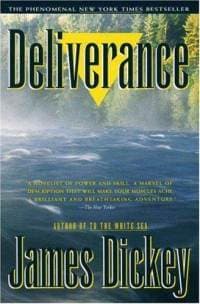
James Dickey (1970)
Genre
Literary Fiction / Thriller
Reading Time
6-8 hours
Key Themes
See below
Sign in to track this book
Four city men on a Georgia whitewater canoe trip find their adventure shatter into a fight for survival against the wilderness and human evil, forcing one to become the hunter to save them from their choices.
Lewis Medlock, an outdoorsman, convinces his friends Ed Gentry, Bobby Trippe, and Drew Ballinger to join him on a canoe trip down the Cahulawassee River in northern Georgia. The river will soon be dammed, making this their last chance to see its untouched beauty. Lewis wants to reconnect with nature and test his skills. Ed, a graphic artist, is more hesitant but goes along with Lewis. Bobby and Drew, less experienced, agree to the trip as an escape from city life. They arrange for their cars to be driven to a pickup point downriver, ready for their wilderness immersion.
The four men arrive in Aintry, a small, isolated town, the starting point for their trip. They immediately notice the poverty and suspicion of the locals, especially a group of men at a gas station. Lewis tries to pay two men to drive their cars to the takeout point, but the interaction is tense. One menacing man with missing teeth and his silent, younger companion make them uneasy. Drew, a moral man, expresses discomfort with the locals, sensing hostility. Despite their concerns, they unload their canoes and prepare to leave the unsettling town.
The men launch their two canoes onto the Cahulawassee. Lewis and Ed share one; Drew and Bobby share the other. At first, the experience is exciting, a thrilling ride through rapids and a deep connection with the clean wilderness. Ed, despite his earlier doubts, finds himself drawn to the river's raw beauty and the challenge of the whitewater. They bond over the adventure, feeling a primal freedom. As they go downstream, the feeling of isolation grows, and the vast wilderness begins to feel less freeing and more threatening, watching their journey.
While scouting ahead, Ed and Bobby get separated from Lewis and Drew. Two dirty, armed mountain men ambush them. One, the toothless man from Aintry, holds them at gunpoint. The other, younger and silent, helps him. The men tie Ed to a tree. The toothless man forces Bobby to undress, then rapes him at gunpoint. Ed, helpless, is forced to watch. The experience deeply traumatizes Bobby and Ed, destroying their sense of safety. The wilderness, once a source of freedom, becomes a place of terror.
As the toothless man prepares to rape Ed, Lewis and Drew arrive, having heard the noise. Lewis, with his bow, shoots the toothless man through the chest, killing him. The younger mountain man runs into the woods. The three remaining men now face a dead body and the fact that they have committed a crime, though in self-defense. Drew, horrified, insists they report it. Lewis argues that no one would believe their story, given the remote location and the suspicious locals. He suggests burying the body and continuing as if nothing happened.
Against Drew's moral objections, Lewis, Ed, and Bobby bury the toothless man's body. The act is gruesome, further involving them. As they go downriver, Drew becomes agitated, his conscience bothering him. He refuses to paddle, his eyes distant. Suddenly, their canoe hits something, and Drew falls into the water. He is found downstream, dead, with an unusual wound on his head. Lewis believes the surviving mountain man shot him. Ed suspects a heart attack or a fall onto a sharp rock. His death complicates their desperate situation.
Soon after Drew's death, their canoe tips in rapids, and Lewis breaks his leg badly. With Lewis unable to move and Bobby in shock, Ed must take charge. He realizes the surviving mountain man is still out there, possibly hunting them. Driven by a need for survival and revenge, Ed decides he must hunt and kill the remaining attacker before they are all killed. This decision marks a big change in Ed, turning him from a hesitant observer to a determined killer.
Ed, with Lewis's bow, climbs the bluffs above the river, determined to find the second mountain man. He spends a terrifying night in the wilderness, hunting and being hunted. He eventually sees the man on the opposite bank, aiming a rifle at their camp. Ed, with new resolve and a hunter's instinct, takes a difficult shot with the bow and arrow, hitting the man. The man falls into the river and disappears, likely dead. Ed, shaken by the act, feels a grim satisfaction and accomplishment in protecting his friends. He returns to Lewis and Bobby, the immediate threat gone.
With both attackers seemingly dead, the three surviving men—Ed, Lewis, and Bobby—decide to stick to Lewis's plan: report nothing. They create a detailed story about a boating accident and Drew's death, agreeing to never speak of the true events. They manage the remaining rapids, and a local family by the river eventually finds them. The family helps transport Lewis and Drew's body to civilization. The local sheriff, suspicious but without proof, questions them. The men stick to their fabricated story, and the sheriff, unable to prove otherwise, lets them go, allowing them to escape legal consequences.
Back in Atlanta, the men go back to their normal lives, but the Cahulawassee experience leaves a lasting mark. They keep their pact of silence, never discussing the true events, not even with their wives. Ed, especially, finds himself changed. The instincts he used during the ordeal, the cold efficiency of his kill, stay with him. He sees the world differently, with a deeper understanding of its brutal side. While they were ‘delivered’ from immediate danger, they are forever haunted by the violence they saw and took part in, bound by their shared secret.
The Protagonist
Transforms from a passive, urban man into a primal hunter and survivor, forever changed by the violence he commits.
The Supporting Character / Catalyst
Begins as the confident, dominant leader but is incapacitated, forcing him to rely on Ed and observe his friend's transformation.
The Supporting Character / Victim
From a jaded urbanite to a traumatized victim, his innocence and sense of security are irrevocably lost.
The Supporting Character / Moral Compass
Maintains his moral integrity despite the horror, leading to his demise as the wilderness rejects his civilized principles.
The Antagonist
Introduced as a menacing threat, he is quickly dispatched, serving as the catalyst for the group's downward spiral.
The Antagonist
Serves as a persistent, silent threat after his partner's death, eventually hunted down by Ed.
The Mentioned / Supporting
Remains an external figure representing the law, ultimately unable to penetrate the survivors' fabricated narrative.
The main theme explores the clash between civilized man and wild nature. The Cahulawassee River is not just a setting but an active force, testing the physical and moral limits of the four friends. At first, the wilderness offers freedom, but it quickly becomes a brutal place where societal rules disappear. The men lose their city comforts and must face their basic survival instincts, showing how thin the layer of civilization is. Ed's change from a hesitant artist to a cold hunter shows this, a direct response to nature's demands.
“What happened on the river was a dream, if it happened. If it happened, it happened to someone else. I was there, but I was not there.”
The novel shows a deep loss of innocence, especially for Ed and Bobby. The adventure quickly turns into a nightmare of rape, murder, and cover-up. The men are 'delivered' from their comfortable, naive lives into a brutal reality where violence is not only present but necessary for survival. They escape the wilderness physically, but the terrible things they saw and did mark them forever. The 'deliverance' is not salvation but a harsh trial by fire, leaving them with a permanent psychological scar. Bobby's rape and Ed's kills are key moments in this theme.
“The river was a god, and it was a god that had chosen them.”
The book closely looks at different types of masculinity. Lewis shows a tough, almost mythical masculinity, believing in man's power over nature and a return to basic strength. Ed struggles with his own perceived lack of masculinity, feeling less adequate than Lewis, until the crisis forces him to develop a ruthless, protective instinct. Bobby represents a less traditionally 'masculine' type, making him a target for the mountain men's aggression. The ordeal makes the men redefine what strength, courage, and their roles as men mean in a world without social norms.
“I was learning to take my place in the violence of the world.”
A significant theme is the moral compromises the men must make and the guilt that follows. Drew's strong moral objection to burying the first body highlights the group's slide into ethical uncertainty. Lewis's practical decision to hide the murders, driven by self-preservation, forces the others to be involved. The men's promise of silence after their rescue ensures their freedom but dooms them to a lifetime of shared guilt and secrecy. They are haunted by their actions, especially Ed, who struggles with the man he became in the wilderness.
“He knew that the river had been there for millions of years, and that it would be there for millions more. But they would not.”
A powerful, symbolic setting that acts as a character and catalyst.
The Cahulawassee River is more than just a location; it is a central character and a potent symbol. It represents untamed nature, a 'last chance' for wildness before human intervention. Its rapids and deep canyons serve as both a source of exhilarating freedom and a deadly trap. The river isolates the men, strips them of their societal roles, and forces them into a primal struggle for survival. It acts as a crucible, forging new identities and revealing the brutal core of humanity. The impending damming of the river underscores the theme of nature's vulnerability to civilization.
A primitive weapon symbolizing a return to primal instincts.
Lewis's bow and arrow, initially a symbol of his love for primitive hunting and self-sufficiency, becomes a crucial plot device. It is the weapon used to kill both mountain men, first by Lewis in self-defense, then by Ed in a deliberate hunt. Its use contrasts sharply with modern firearms, emphasizing a return to ancient, more personal forms of violence. For Ed, mastering the bow represents his complete transformation from a civilized man to a primal hunter, a skilled killer who must shed his inhibitions to survive and protect his friends.
A post-event agreement that binds the survivors and creates lasting psychological impact.
After the violence, the three surviving men — Ed, Lewis, and Bobby — agree to a strict pact of silence, never revealing the true events of the trip. This device is crucial for their physical escape from legal consequences but traps them in a shared psychological burden. It highlights the theme of moral compromise and the lasting impact of trauma. The silence becomes a heavy weight, shaping their future lives and relationships, and ensuring that their 'deliverance' is not a true liberation but a haunted existence.
Early interactions with locals hint at the dangers to come.
The initial encounters with the impoverished and suspicious locals in Aintry, particularly the menacing toothless man and his silent companion, serve as strong foreshadowing. These interactions immediately establish a sense of unease and hostility, suggesting that the wilderness holds not just natural dangers but human ones as well. Drew's discomfort and Lewis's pragmatic but tense dealings with the locals set a foreboding tone, hinting that the men's journey will involve more than just navigating rapids, preparing the reader for the inevitable confrontation.
“I was going to die. I was going to die and I was going to like it.”
— Lewis reflects on his fate during a perilous moment on the river.
“Sometimes you have to lose yourself to find anything.”
— Ed ponders the nature of their journey and its impact on them.
“The river was beautiful, but it was also a monster.”
— A general observation about the duality of nature in the film.
“We don't know what's out there.”
— One of the men expresses apprehension about the unknown wilderness.
“You ought to see what's in these hills.”
— A local man's ominous warning to the city dwellers.
“Paddle faster! I hear banjos!”
— Bobby's panicked cry, a famous line from the film adaptation.
“I never knew what the hell I was doing until I did it.”
— Ed reflecting on the impulsive and instinctual actions taken during the ordeal.
“There are times when you have to do things you don't want to do.”
— Lewis's pragmatic view on the harsh realities of their situation.
“The only thing that matters is that we get out of here alive.”
— A desperate plea emphasizing the primary goal of survival.
“We beat it. We beat it, didn't we?”
— Ed's attempt to reassure himself and others after the ordeal.
“It was the best thing I ever did.”
— Lewis's surprising reflection on the extreme events, hinting at a transformative experience.
“The river had changed them all, not necessarily for the better, but irrevocably.”
— A concluding thought on the lasting impact of the journey.
“There was a look in his eyes I had never seen before; a look of total, absolute knowledge of what he was doing.”
— Ed observing Lewis's transformation into a primal hunter.
“The land was a presence, a thing that watched them.”
— Describing the oppressive and watchful nature of the wilderness.
“What they had done, and what had been done to them, would never leave them.”
— A reflection on the indelible psychological scars left by the events.
Ready to see how well you understood this book? Take our interactive quiz with 10 questions.

Biography coming soon.







