“I love you. I remember you.”
— Lena's final thoughts, an act of defiance against the cure.

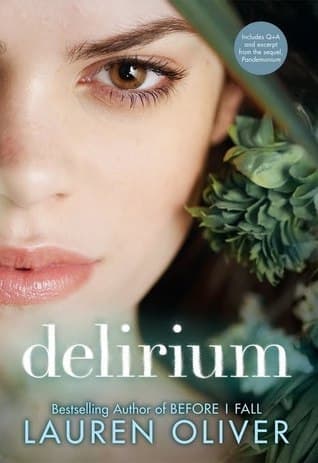
Lauren Oliver (2010)
Genre
Fantasy / Science Fiction / Young Adult / Romance
Reading Time
9-10 hours
Key Themes
See below
Sign in to track this book
In a world where love is a curable disease, a young woman awaiting her 'treatment' finds her future and her heart threatened by a forbidden encounter, just ninety-five days before she's meant to forget.
Lena Haloway lives in Portland, Maine, where love, or 'deliria,' is a disease, and all citizens are 'cured' at eighteen. She lives with her Aunt Carol, Uncle William, and cousins, Jenny and Grace. Her mother, a 'deliria' sufferer, died by suicide. With only 95 days until her own Procedure, Lena looks forward to the safety the Cure promises, believing it will prevent her mother's fate. She follows societal rules, fearing anything that might jeopardize her future. Her best friend, Hana Tate, is more rebellious and often hints at the appeal of the uncured world.
Lena has her final evaluation before the Procedure, a stressful event to assess her readiness. During the evaluation, the Evaluators create a riot simulation to test candidates. In the chaos, Lena sees a boy with striking blue eyes watching her from the observation deck, which is unusual. This boy, Alex, is an 'Invalid'—someone from the Wilds, the uncured territories outside the controlled cities. His presence disrupts Lena's world and sparks a new curiosity, challenging her fear of the uncured.
After their first meeting, Alex starts appearing in Lena's life, seemingly by chance. He works various jobs around the city, always finding Lena. He invites her to explore forbidden parts of Portland, including abandoned houses and the 'Wilds' just beyond the city's fences. These are areas the cured are not supposed to visit. Lena is hesitant at first, her fear of breaking rules clashing with a growing interest in Alex and his world. These secret meetings slowly chip away at Lena's beliefs about 'deliria' and the safety of a cured life, introducing her to a freedom she never knew.
Hana Tate, Lena's best friend, shows increasing rebellious behavior, attending illegal parties and pushing against norms. Lena discovers Hana has a secret boyfriend, a 'Regulator' named Brian, showing how 'deliria' exists even within controlled society. Meanwhile, Lena's relationship with Alex grows deeper. They share intimate moments, discussing fears and dreams, and Lena begins to feel emotions she was taught to fear: love. Alex reveals he is an Invalid, working undercover in the city to help others escape, which further complicates Lena's understanding of her world.
Alex, sensing Lena's lingering trauma about her mother's suicide, takes her to a hidden part of the Wilds. There, he reveals a shocking truth: Lena's mother, Carol, did not die by suicide. Instead, the government took her away for being 'uncured' and imprisoned her in the Crypts, a notorious prison for 'deliria' sufferers. Alex shows Lena a hidden message carved into a tree near a secret entrance to the Crypts, left by her mother. This revelation shatters Lena's understanding of her past and family, fueling her distrust in the government and strengthening her bond with Alex.
With the truth about her mother exposed and her love for Alex clear, Lena realizes she cannot undergo the Cure. She and Alex begin to plan their escape to the Wilds. Alex, with his knowledge of the city's hidden areas and the Wilds, outlines a route and a meeting point. The plan is dangerous; the city is heavily monitored, and 'Invalid' sympathizers are constantly sought. Lena faces internal conflict, torn between her fear of the unknown and her desire for freedom and love with Alex, knowing failure means the Cure or worse.
Lena attends an illegal party in the Wilds with Hana. The party is a celebration of life and love, a sharp contrast to the regulated city. However, the Regulators, the government's enforcement, raid the party. In the chaos, Lena and Hana are separated. Hana is captured, and Lena barely escapes thanks to Alex's quick actions. This event shows the extreme risks of their rebellion and the harsh reality of their society, strengthening Lena's resolve to escape but also leaving her worried for her friend.
As Lena's Procedure date nears, tension rises. She makes final preparations for her escape, gathering supplies and preparing herself for the journey. However, her Aunt Carol notices Lena's secretive behavior and late-night disappearances and becomes suspicious. Aunt Carol discovers evidence of Lena's relationship with Alex and her escape plans. This discovery leads to a confrontation. Aunt Carol, wanting to protect Lena from what she believes is a dangerous disease, threatens to report her, creating a desperate race against time for Lena and Alex.
With Aunt Carol aware of their plans, Lena and Alex must speed up their escape. Under darkness, they navigate the city's perimeter, using Alex's knowledge of hidden passages and weak points in the fence. The escape is tense, with the constant threat of discovery by Regulators or surveillance systems. They face various obstacles, testing their courage and commitment as they move towards the freedom of the Wilds, leaving everything Lena has known.
As Lena and Alex reach the final barrier—a heavily guarded, electrified fence—Regulators ambush them. In the struggle, Alex, knowing they cannot both make it, makes the ultimate sacrifice. He shoves Lena through a breach in the fence, ensuring her escape, while he is captured and seemingly killed by the Regulators. Lena watches in horror as Alex falls, his sacrifice in her mind. Devastated but determined, Lena continues into the Wilds, carrying Alex's love and the promise of a free life, forever changed.
The Protagonist
Lena transforms from a passive, rule-abiding girl into a courageous, love-driven rebel who chooses freedom over safety.
The Love Interest / Supporting
Alex guides Lena to embrace love and freedom, ultimately sacrificing himself to ensure her survival.
The Supporting
Hana's initial open defiance is met with the harsh reality of the system, forcing Lena to confront the dangers of rebellion.
The Supporting
Aunt Carol remains steadfast in her belief in the Cure, ultimately trying to prevent Lena's escape out of misguided love.
The Mentioned / Catalyst
Her hidden fate is revealed, transforming her from a cautionary tale into a symbol of enduring love and governmental oppression.
The central theme explores whether love is a disease to be cured or a basic human right. The society in 'Delirium' suppresses love, calling it madness and danger. Lena's journey, from wanting the Cure to embracing love with Alex, highlights the human need for connection and emotional freedom. The Wilds represent true freedom, where love is celebrated, a contrast to the controlled, emotionless city. Alex's actions show love's power to inspire rebellion and sacrifice, as he risks everything for Lena's escape.
“They say in the old days, love was a disease. And they were right. It is a disease. It's a disease that makes you want to die, or makes you want to live. It's a disease that makes you feel like you can't breathe, or makes you feel like you're flying.”
The novel shows a dystopian society where the government controls its citizens through suppressing emotions and manipulating truth. Propaganda is widespread, calling love 'deliria' and presenting the Cure as a good act. The 'Book of Shhh' and controlled media reinforce this, shaping public perception. The hidden truth about Lena's mother shows how the government maintains power by rewriting history and controlling information. The Regulators and constant surveillance further illustrate the regime's oppressive nature.
“They don't want you to have it. They don't want you to fall in love. Because then you're out of their control.”
Lena's journey is about finding her true self beyond societal expectations. Initially, her identity is defined by her fear of 'deliria' and her desire to conform. Her encounters with Alex and the forbidden Wilds force her to question everything she learned. She struggles with who she is without the Cure, eventually choosing to embrace her emotions and make her own path. This theme appears in her growing defiance, her willingness to break rules, and her decision to risk everything for love and freedom, shedding her old, compliant identity.
“I'd rather die my way than live yours.”
Manipulating memory and suppressing truth are key to the government's control. The Cure itself erases emotional memories, especially those related to love. The official story of Lena's mother's 'suicide' is a fabricated memory, meant to reinforce the dangers of 'deliria.' Alex's revelation about Lena's mother's true fate shatters Lena's understanding of her past and exposes the government's lies. This theme shows how controlling history and personal memory is essential for maintaining power in a totalitarian regime, and how reclaiming truth is a vital act of rebellion.
“They say the truth will set you free. But what if the truth is a lie?”
A surgical procedure designed to eliminate the capacity for love.
The Cure is the central plot device, driving the narrative and creating the dystopian conflict. It is presented as a mandatory, life-saving procedure performed on all citizens at age eighteen to prevent 'deliria,' the disease of love. Its existence creates the societal structure, the fear that permeates Lena's life, and the ultimate stakes of the story. The impending deadline for Lena's Cure builds suspense, forcing her to make a choice between safety and freedom. It also serves as a metaphor for societal repression and the dangers of conformity.
The uncivilized, uncontrolled territories outside the city walls.
The Wilds serve as a symbolic and literal counterpoint to the controlled, sterile cities. They represent freedom, danger, and the untamed nature of human emotion. For Lena, the Wilds are initially a place of fear and taboo, but they gradually become a symbol of hope and a refuge for the uncured. Alex's origins in the Wilds imbue him with a sense of mystery and defiance. The journey to the Wilds is Lena's ultimate act of rebellion, signifying her embrace of a life lived authentically, outside the government's oppressive reach.
A government-issued book of propaganda and rules.
The Book of Shhh is a propaganda tool used by the government to indoctrinate citizens from a young age. It contains sanitized histories, cautionary tales about 'deliria,' and strict rules for behavior. It reinforces the official narrative and suppresses any independent thought or questioning of the system. For Lena, it represents the oppressive weight of societal expectations. Its teachings are gradually dismantled in her mind as she learns the truth about love and her mother, highlighting the power of indoctrination and the struggle to break free from it.
A hidden prison for those afflicted with 'deliria'.
The Crypts are a secret, horrifying prison where 'invalids' – those who are uncured or have 'relapsed' – are held. They represent the dark underbelly of the government's control, a place where dissenters are hidden away and forgotten. The revelation that Lena's mother is imprisoned there, rather than having committed suicide, is a pivotal plot device. It shatters Lena's foundational beliefs, exposes the government's lies, and provides a powerful, personal motivation for her to join the rebellion and escape the system.
“I love you. I remember you.”
— Lena's final thoughts, an act of defiance against the cure.
“It is an established fact that the unable to love are the most dangerous.”
— An excerpt from a government text, justifying the cure.
“But I don't want to be safe. I want to be in love.”
— Lena's internal conflict about choosing freedom over the supposed safety of the cure.
“The cure, they say, is a solution. A solution to the greatest disease of all: love.”
— Lena reflecting on the official narrative surrounding the cure.
“If love is a disease, I don't want to be cured. I'd rather be sick.”
— Lena's growing conviction as she experiences love with Alex.
“Everything is beautiful and nothing hurts.”
— A phrase Lena often repeats, reflecting the desired state of those who have received the cure.
“They say that love is a disease. But it's not. It's a cure.”
— Lena's realization that love, not the cure, is what truly heals and completes her.
“You can't be happy unless you're unhappy sometimes.”
— Alex sharing his philosophy on emotions and the human experience with Lena.
“There is no freedom without choice.”
— Lena's growing understanding of the oppressive nature of her society.
“Love: The most dangerous of all human afflictions.”
— Another official government statement about 'deliria'.
“Sometimes, I think the best way to get to know someone is to ask them what they're afraid of.”
— Alex trying to understand Lena on a deeper level.
“It’s not a cure, it’s a lobotomy.”
— Alex's stark description of the procedure designed to remove 'deliria'.
“They don't want us to remember. They want us to forget.”
— Lena realizing the true purpose behind the cure and the societal structure.
“The greatest freedom is to be yourself.”
— Lena's journey towards self-discovery and rejecting societal norms.
Ready to see how well you understood this book? Take our interactive quiz with 10 questions.

Biography coming soon.







