“The world isn't broken, it's just… different. And maybe that's okay.”
— Elara reflects on the changes in her world after the Defect.

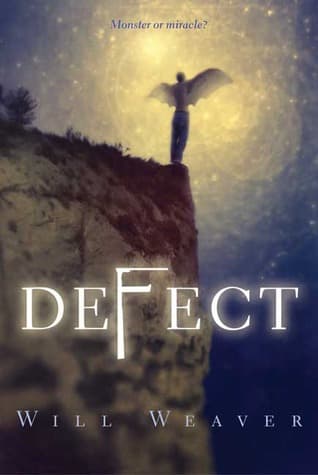
Will Weaver (2007)
Genre
Fantasy / Science Fiction / Young Adult / Romance
Reading Time
240 min
Key Themes
See below
Sign in to track this book
A visually impaired foster teen with hidden wings finds courage and connection with a girl, making him question if his ability is a blessing or a curse.
Fifteen-year-old David lives with his foster parents, the Larsons, in a secluded rural area. He is very aware of his physical differences — bug eyes, a pinched face, and hearing aids — which make him feel like an outcast. His biggest secret is a thin layer of skin under each arm, letting him glide short distances. David practices this ability in complete secrecy, usually late at night or in remote spots, terrified of being found out. His past, marked by abandonment and foster care, has made him deeply distrustful of others, especially doctors, who he fears would study him if his 'defect' were revealed. This fear causes his isolation and careful behavior, making him hesitant to form real connections.
The Larsons move, so David enrolls in a new high school. His appearance quickly makes him a target for bullies, particularly a group led by Brad. David tries to be invisible, but it does not work. During physical education, he accidentally shows unusual agility, making Brad more suspicious. Amid this unwanted attention, David notices a girl named Cheetah. She has a limp and uses a crutch, but her lively personality and confidence immediately interest him. Cheetah’s openness about her own physical challenges contrasts sharply with David's secret life, drawing him to her despite his caution.
Cheetah, whose real name is Sarah, approaches David in the school hallway. She does not mock him; instead, she shows genuine curiosity and empathy. She openly discusses her disability, a leg condition that causes her limp, and shares her nickname, 'Cheetah,' which she accepts with pride. Her direct and accepting manner disarms David, who is not used to such kindness. Cheetah's ability to handle her challenges with such spirit begins to break down David's protective shell, suggesting a different kind of life than the one he has always known, one where he might not have to hide so completely.
David and Cheetah start spending time together outside of school. Cheetah's real interest and lack of judgment make David feel comfortable enough to open up, though carefully, about parts of his life. They share stories and experiences, and David finds himself enjoying her company more than anyone he has ever known. Cheetah's presence adds a new dimension to David's isolated world, offering him a glimpse of companionship and understanding. He still guards his deepest secret, but his growing friendship with Cheetah begins to challenge his long-held belief that he must face the world alone, making him question his extreme secrecy.
Brad and his friends continue to bother David, but their bullying becomes more focused. Brad, having seen David's unusual agility and speed during gym class, suspects David is more than just an easy target. He starts watching David closely, convinced David is hiding some special physical ability. Brad's constant taunts and attempts to provoke David grow, causing David constant anxiety. The threat of discovery is greater than ever, as Brad's determination to uncover David's secret puts immense pressure on David to maintain his carefully built normal facade, further complicating his already fragile sense of security.
During one of their outings, David is forced to use his gliding ability to prevent an accident or help Cheetah. Seeing his feat, Cheetah is stunned but quickly understands what she has seen. Instead of fear or judgment, she reacts with wonder and acceptance. This moment is a turning point in their relationship. David, having finally revealed his deepest secret, feels a great sense of relief and vulnerability. Cheetah's reaction strengthens their bond, as she not only accepts him fully but also shares her own dreams and fears, creating a strong sense of mutual trust and understanding between them.
With Cheetah now aware of his ability, David begins to explore it more openly, though still in secret. Cheetah encourages him to practice and improve his gliding, helping him see it not as a 'defect' but as a unique and powerful gift. She challenges his internalized shame and fear, making him consider the possibilities his ability offers. Her unwavering belief in him empowers David to start rethinking how he sees himself. He begins to feel joy and freedom while gliding, something he had always suppressed due to fear. This change in perspective, largely thanks to Cheetah, is essential for his self-acceptance.
Brad's suspicions become an obsession. He sets traps and actively stalks David, determined to catch him. He even involves his friends in his plans, making David's life at school very difficult. The constant surveillance and threats push David to his breaking point. Brad's relentless pursuit ends in a dangerous confrontation where David is cornered. The situation forces David to choose: reveal his secret to escape or risk serious harm. This high-stakes encounter shows the danger of his secret and how far Brad will go to expose him, creating a critical turning point in the story.
During a final, desperate confrontation with Brad and his gang, David must use his gliding ability publicly to protect himself or Cheetah from serious harm. The revelation is dramatic and clear. The immediate aftermath is a mix of shock, awe, and fear from those who witness it. While some are simply bewildered, others, like Brad, react with disbelief and anger. The event throws David's life into chaos, as his carefully guarded secret is now public. This exposure forces David to face the long-term effects of his ability, and he must decide how to navigate a world that now knows his extraordinary truth.
After his public revelation, David faces intense scrutiny, but also unexpected support. The Larsons, his foster parents, are surprised but ultimately loving and protective. More importantly, Cheetah stands by him, her acceptance firm. David, no longer burdened by the need to hide, begins to truly accept his unique identity. He learns that while his ability might set him apart, it also makes him special. With Cheetah's steady companionship and encouragement, David starts to imagine a future where he can use his gift responsibly, perhaps even for good, rather than fearing it. He understands that his 'defect' is, in fact, a blessing, and his bond with Cheetah offers him hope and belonging.
The Protagonist
David transforms from a fearful, isolated boy ashamed of his 'defect' into a self-accepting individual who embraces his unique abilities and finds belonging through his relationship with Cheetah.
The Supporting/Love Interest
Cheetah remains consistently strong and self-assured, serving as David's anchor and guiding him towards self-acceptance without undergoing a major personal arc herself.
The Antagonist
Brad's character remains largely static, serving as the persistent external threat that forces David to confront his fears and ultimately reveal his secret.
The Supporting
Their arc is minor, primarily showing their loving acceptance of David even after his secret is revealed, reinforcing their role as a supportive family unit.
This theme is central to David's journey. Initially, David sees his ability to glide as a 'defect' and his appearance as a source of shame, leading to deep isolation. Cheetah, with her own disability, shows self-acceptance and teaches David to embrace his uniqueness. Her belief in him allows David to slowly lose his fear and see his ability as a gift. The story explores how fear of judgment can lead to self-rejection, and how true acceptance, both from oneself and from others (like Cheetah and eventually the Larsons), is essential for growth and happiness. This is clear when David finally reveals his secret, and Cheetah's reaction is wonder, not fear, letting David see himself differently.
““Maybe it wasn’t a defect at all. Maybe it was a gift.””
David's life is defined by the heavy burden of keeping his gliding ability a secret. This secrecy causes intense anxiety, isolation, and a constant fear of discovery, stopping him from forming real connections or feeling joy. The story shows how hiding one's true self can be more harmful than the 'defect' itself. As David slowly opens up to Cheetah, he feels relief and connection. His eventual public revelation, though forced, ultimately frees him, allowing him to live authentically. This is powerfully shown by the contrast between David's initial anxious life and his later sense of freedom after sharing his secret.
““The secret was a weight, heavier than any backpack, always pressing down.””
The novel directly questions what 'normal' and 'defective' mean. David's appearance and hidden ability are called 'defects,' leading to his being left out. However, Cheetah, with her visible disability, redefines strength and normalcy through her confidence and spirit. The story suggests that 'defects' can be sources of unique strength and perspective, and that true 'normalcy' is an illusion. Brad, the bully, ironically shows a kind of 'defect' in his inability to accept difference, highlighting that internal flaws can be more damaging than physical ones. The story prompts thought on societal judgments and the arbitrary nature of such labels.
““What made one person normal and another a freak? Was it just what people could see?””
David's journey is about finding a place where he belongs and forming real connections. His early life in foster care and his physical differences contribute to a deep feeling of being an outsider. His secret ability further isolates him, as he fears no one could ever understand or accept him. Cheetah changes everything; she is the first person to truly see and accept him for who he is, including his 'defect.' Their relationship becomes the anchor that allows David to overcome his isolation and find belonging. The theme ends as David, no longer alone, looks towards a future shared with Cheetah, having found his 'tribe.'
““With Cheetah, he wasn’t just David, the kid with the bug eyes and the secret. He was just David.””
David's secret power to glide, which serves as both a source of fear and potential.
David's ability to glide is the central plot device. Initially, it functions as his greatest fear and the reason for his extreme secrecy and isolation. It makes him 'defective' in his own eyes and the eyes of a judgmental society. However, as the story progresses, particularly through Cheetah's influence, it transforms into a symbol of his unique identity and potential. It drives the conflict with Brad, forces David into a public revelation, and ultimately becomes the catalyst for his self-acceptance and freedom. It's the core mystery and the ultimate source of his transformation.
David's physical and hidden differences symbolize any perceived flaw or uniqueness.
David's 'bug eyes,' 'pinched face,' hearing aids, and especially his gliding ability serve as a powerful metaphor for any characteristic that makes an individual feel different or 'defective' from societal norms. This device allows the story to resonate with a broad audience, as most people experience feelings of inadequacy or uniqueness. By exploring David's journey from shame to acceptance, the narrative universalizes the experience of struggling with self-worth due to perceived flaws, ultimately delivering a message of embracing individuality and challenging conventional definitions of perfection.
Cheetah's role in initiating and accelerating David's personal growth.
Cheetah functions as a classic catalyst character. She doesn't undergo a significant arc herself but profoundly impacts David's transformation. Her open acceptance of her own disability, her vibrant personality, and her unwavering belief in David challenge his deeply ingrained fears and self-doubt. She is the first person he trusts with his secret and the one who helps him reframe his 'defect' as a 'gift.' Without Cheetah's presence and influence, David would likely remain isolated and fearful, making her crucial to the protagonist's development and the story's central themes of acceptance and authenticity.
“The world isn't broken, it's just… different. And maybe that's okay.”
— Elara reflects on the changes in her world after the Defect.
“Hope is a dangerous thing in a world that thrives on despair.”
— Kaelen warns Elara about the dangers of showing emotion.
“Sometimes, the biggest strengths are found in the flaws.”
— Elara realizes her 'defect' might be her greatest asset.
“Love isn't a luxury; it's a necessity, even when it hurts.”
— Elara grapples with her feelings for Kaelen despite their difficult circumstances.
“The past is a phantom, but its chains are real.”
— Kaelen struggles with the trauma of his past.
“We are all just trying to find a place where we belong, even if that place is just with one other person.”
— Elara muses on the universal human need for connection.
“Fear can be a weapon, but it can also be a shield.”
— Elara learns to use her fear to her advantage in dangerous situations.
“The greatest rebellion is often simply to choose to be yourself.”
— Elara defies societal norms imposed by the Enforcers.
“Silence can be louder than any scream, if you know how to listen.”
— Elara observes the unspoken truths in her oppressive society.
“Even in the darkest corners, a spark of light can ignite a fire.”
— Elara finds hope and inspiration in unexpected places.
“Trust is built on whispers, but broken by shouts.”
— Elara reflects on the fragile nature of trust in her world.
“The future isn't written; it's forged, one choice at a time.”
— Elara realizes her actions have the power to shape her destiny.
“Sometimes, the only way to save yourself is to save someone else.”
— Elara makes a selfless decision to protect Kaelen.
Ready to see how well you understood this book? Take our interactive quiz with 10 questions.







