“In a world of secrets, a single truth can be a weapon.”
— A thematic statement reflecting the core premise of the novel's intrigue.

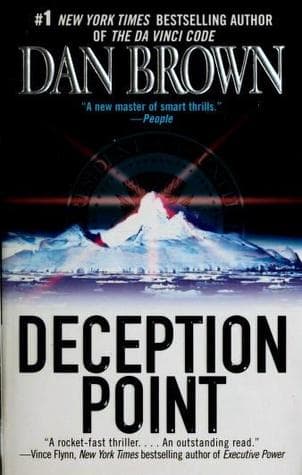
Dan Brown (2001)
Genre
Thriller / Mystery / Science Fiction
Reading Time
927 min
Key Themes
See below
Sign in to track this book
An intelligence analyst uncovers a deadly conspiracy surrounding a miraculous Arctic discovery, forcing her to flee assassins and expose a scientific deception that could shatter a presidential election.
NASA, led by Director Zach Herney, announces a discovery: a meteor in the Milne Ice Shelf in the Canadian Arctic. They claim this meteor contains fossilized evidence of extraterrestrial insect life. This find could revitalize the struggling agency and greatly impact the upcoming presidential election. The incumbent President, Zachary Herney, a former astronaut and NASA Director, is running for re-election against Senator Sedgewick Sexton, who has criticized NASA's budget. The discovery is presented as proof of NASA's value and a potential game-changer for understanding life beyond Earth, creating immediate global excitement and skepticism.
President Herney sends Rachel Sexton, an intelligence analyst for the NRO (National Reconnaissance Office), to the Milne Ice Shelf to independently verify the meteor's authenticity. Rachel is the estranged daughter of Senator Sedgewick Sexton, making her a seemingly impartial and politically sensitive choice for this task. She joins a team of civilian scientists: Dr. Michael Tolland, an oceanographer and TV personality; Dr. Wailee Ming, a paleontologist; Dr. Norah Mangor, a glaciologist; and Dr. Corky Withers, an astrophysicist. Their mission is to confirm the meteor's legitimacy before the President makes a public announcement.
At the NASA research station in the Arctic, the team conducts initial tests on the meteor. The initial findings, including its composition and the fossilized insect, seem to support NASA's claims. However, Rachel Sexton, with her sharp eye, notices a small, out-of-place object — a shark's tooth — in the ice core taken from around the meteor. This tooth should be millions of years younger than the surrounding ice. At the same time, Michael Tolland observes unusual mineral patterns in the meteor's surrounding ice, suggesting recent disturbance, not ancient formation. These subtle differences begin to raise doubts about the discovery's true nature, leading them to suspect a hoax.
As Rachel and Michael investigate further, their suspicions grow. They discover that the ice around the meteor is not as old as claimed, and the meteor itself shows signs of being deliberately placed. Dr. Mangor identifies the ice as less than a century old, a clear contradiction to the millions of years NASA asserted. Furthermore, Dr. Ming discovers that the 'extraterrestrial' fossils are actually terrestrial plankton, cleverly altered to appear alien. The team realizes they are dealing with an elaborate deception. They try to contact President Herney to relay their findings, but their communications are mysteriously cut off, increasing their alarm.
Before they can expose the truth, a Delta Force team, led by Commander Admr. William Pickering, arrives at the research station with orders to eliminate the verification team. Rachel, Michael, Corky, Ming, and Mangor realize their lives are in danger. A desperate chase begins across the Arctic. Dr. Ming and Dr. Mangor are killed during the escape attempt, leaving Rachel, Michael, and Corky to flee. They manage to take a Snowcat and escape into the blizzard, pursued by the heavily armed Delta Force operatives, who seem to be acting under official orders.
Rachel, Michael, and Corky endure a harrowing chase across the frozen Arctic. The Delta Force team pursues them relentlessly, using advanced technology and brutal tactics. The survivors evade their pursuers through quick thinking and luck, navigating dangerous ice formations and blizzard conditions. Eventually, a U.S. Navy submarine, the USS Toledo, rescues them. It was diverted to their location by a cryptic message Michael sent before their communications were fully cut. They believe they are safe, but the identity of their attackers and the mastermind behind the deception remain unknown.
Aboard the USS Toledo, Corky Withers, the astrophysicist, makes a startling revelation. He explains that while the meteor presented by NASA at the Arctic station was fake, a real meteor containing extraterrestrial life was discovered by the NOAA (National Oceanic and Atmospheric Administration) in the Greenland Sea. NASA later acquired this meteor, which is different from the Arctic find. The true meteor is still at the bottom of the ocean, undisturbed. This explains the initial confusion and the elaborate staging of the fake meteor at the Milne Ice Shelf. The genuine meteor's existence adds complexity to the conspiracy.
Rachel, Michael, and Corky deduce that the Delta Force team is not working for President Herney. Through intercepted communications and Rachel's intelligence expertise, they uncover that the assassins work for Commander Admr. William Pickering, Senator Sexton's chief aide and a powerful figure. Pickering, wanting to discredit NASA and ensure Senator Sexton's presidential victory, orchestrated the entire deception. He planted the fake meteor, knowing it would be exposed, thus humiliating President Herney and guaranteeing a win for Sexton. His motive is purely political, aimed at manipulating public opinion.
Rachel, Michael, and Corky race to expose Pickering's plot before he can fully execute his plan and before Senator Sexton makes a public statement based on the fabricated evidence. They reach Senator Sexton's campaign plane. Rachel confronts her father, revealing Pickering's deception and his willingness to kill to protect his secret. Pickering, realizing his plot is unraveling, tries to escape and silence Rachel. In a confrontation, Pickering is killed, and the truth about the fake meteor and the genuine discovery comes to light, preventing a catastrophic political and scientific scandal.
With Pickering's plot exposed, the genuine meteor discovered by NOAA in the Greenland Sea is revealed. President Herney, whose integrity was questioned, is cleared and seen as a victim of a political smear campaign. The real extraterrestrial discovery is announced, reigniting global wonder and affirming NASA's true scientific value. Rachel Sexton reconciles with her father, Senator Sexton, who expresses remorse for his unwitting involvement in Pickering's scheme. The event reshapes the political landscape and humanity's perception of its place in the universe, highlighting the dangers of political manipulation in scientific matters.
The Protagonist
Rachel begins as a detached analyst verifying a claim and transforms into a hunted individual fighting for her life to expose a global conspiracy, ultimately reconciling with her father.
The Protagonist
Michael transitions from an enthusiastic scientist to a desperate survivor and then a key figure in exposing the deception, forming a deep bond with Rachel.
The Antagonist (unwitting)
Senator Sexton is initially an antagonist to NASA and Rachel, but he becomes a victim of betrayal and ultimately reconciles with his daughter, learning the cost of unchecked ambition.
The Supporting
President Herney's reputation is threatened by the deception but is ultimately vindicated, solidifying his image as an honest leader.
The Antagonist
Pickering acts as the unseen puppet master, orchestrating the conspiracy, until his identity is revealed and his plot is foiled.
The Supporting
Corky, initially a quirky scientist, becomes a vital survivor and exposer of the truth, revealing the existence of the genuine meteor.
The Supporting
Dr. Ming helps uncover the initial deception but is tragically killed before he can fully expose it.
The Supporting
Dr. Mangor's expertise helps reveal the fake meteor, but she is killed before she can share her findings with the world.
The central theme is the battle between truth and the deceptions used to hide it. The entire plot is driven by the revelation of a massive scientific hoax for political gain. Rachel Sexton's commitment to objective truth, even risking her life, contrasts sharply with William Pickering's cynical manipulation of facts. The story explores how easily public perception and political outcomes can be swayed by fabricated evidence, as seen in NASA's initial announcement and Senator Sexton's campaign. The ultimate triumph of the genuine meteor's discovery reinforces that truth, no matter how hidden, will emerge.
“The truth is a hard thing to kill. It has a way of rising up, no matter how deep you bury it.”
The novel examines how political ambition and the pursuit of power can corrupt individuals and institutions. Commander William Pickering's scheme to fake the meteor comes from a desire to ensure Senator Sexton's presidential victory, showing a willingness to sacrifice scientific integrity and human lives for political ends. Senator Sexton, though unknowingly involved, also shows how ambition can blind one to others' manipulations. The struggle for control over NASA's budget and its public image highlights how scientific discoveries can be politicized and used in elections, blurring the lines between legitimate scientific pursuit and political maneuvering.
“In politics, truth is merely a matter of perspective.”
This theme explores the sanctity of scientific discovery and the ethics of those who conduct and present scientific findings. The novel initially shows NASA as an agency struggling for relevance, leading to the temptation to fake a discovery for funding and prestige. The verification team, especially Rachel and Michael, represents the scientific ideal of rigorous, unbiased investigation. Their determination to expose the hoax, even at great personal risk, emphasizes scientific integrity and the dangers of letting political agendas dictate scientific truth. The eventual revelation of the *real* meteor reaffirms the value of genuine scientific endeavor.
“Science is not about what we want to believe. It's about what we are able to prove.”
Beneath the high-stakes political thriller, there is a theme of family dynamics and reconciliation. Rachel Sexton's strained relationship with her father, Senator Sedgewick Sexton, is an emotional subplot. Their estrangement comes from past conflicts and different views. However, as Rachel uncovers the conspiracy, she confronts her father, not just as a political figure, but as a man manipulated and betrayed. The climax shows a tentative reconciliation between them, hinting at healing even deeply fractured family bonds, especially when faced with external threats and shared crises. It adds a personal dimension to the global stakes.
“Sometimes, the hardest truths are the ones we need to hear from those we love most.”
The initial 'discovery' of the meteor containing alien life is a deliberate misdirection.
The entire premise of the book, NASA's announcement of an extraterrestrial meteor in the Arctic, serves as a grand red herring. It is designed to mislead the reader, the public, and even the characters into believing one narrative, while the true plot – a political conspiracy and a different, genuine meteor – unfolds in the background. The detailed description of the fake meteor's 'authenticity' and the initial excitement surrounding it draws the audience in, only for them to realize it was all a meticulously crafted lie. This device heightens the mystery and the sense of betrayal when the truth is revealed.
The impending presidential election and the President's public announcement create urgency.
The impending presidential election and President Herney's scheduled public announcement regarding the meteor create a powerful ticking clock device. Rachel and her team have a limited window to verify the discovery before the President makes a statement that could irrevocably alter the election and public perception. This time constraint intensifies the pressure on the characters to uncover the truth quickly. After the deception is revealed, the clock continues to tick as they race to expose Pickering's plot before he can fully implement his plan and before Senator Sexton makes a damaging public statement based on false information, adding suspense to their escape and subsequent efforts.
Characters misinterpret the loyalties and motivations of others, particularly the Delta Force team.
This device is primarily seen in the initial understanding of the Delta Force team's mission. Rachel and her colleagues initially assume the Delta Force operatives are acting on behalf of President Herney, either to protect the discovery or to silence them if they find it's a hoax. This mistaken assumption adds to their desperation and confusion. The later revelation that the Delta Force team is actually working for William Pickering, Senator Sexton's aide, under false pretenses, completely shifts the narrative and exposes the true antagonist. This misdirection about who is hunting them and why, fuels much of the early chase and suspense.
The 'meteor' serves as the central object driving the plot, though its true nature changes.
The meteor, or rather, the idea of an extraterrestrial meteor, functions as the primary MacGuffin. It is the object that everyone is either trying to prove, disprove, or control. Initially, it's the 'discovery' that NASA needs for its reputation and the President needs for re-election. Later, it becomes the 'fake' that Rachel and Michael must expose. Crucially, the *actual* existence of a genuine meteor (albeit a different one) is revealed near the end, providing a satisfying resolution to the scientific mystery while the political one is resolved separately. The meteor's importance is in driving the characters' actions and the overall plot.
“In a world of secrets, a single truth can be a weapon.”
— A thematic statement reflecting the core premise of the novel's intrigue.
“The greater the lie, the more people will believe it.”
— A recurring idea concerning the manipulation of public perception.
“Every lie we tell plants a seed of doubt that will eventually grow and choke out the truth.”
— Rachel Sexton's internal reflection on the consequences of deceit.
“Faith is a choice. It's not a fact. It's not a truth. It's a choice.”
— Discussed in relation to belief in scientific findings versus personal conviction.
“There are no coincidences. Only the inevitable.”
— A character's cynical view on the unfolding events, suggesting a predetermined path.
“The greatest trick the devil ever pulled was convincing the world he didn't exist. The greatest trick the government ever pulled was convincing the world it was on your side.”
— A cynical observation about the nature of power and public trust.
“Science is not a religion. It is a tool. And like any tool, it can be used for good or for ill.”
— A discussion about the ethical implications of scientific discovery and its application.
“In the absence of data, speculation rules.”
— Relates to the media's role and public reaction when information is scarce.
“Sometimes the greatest threat is not what you see, but what you don't.”
— A suspenseful thought highlighting hidden dangers and unseen forces.
“The truth is rarely pure and never simple.”
— A character's realization about the complex layers of the conspiracy.
“Power corrupts, and absolute power corrupts absolutely.”
— A classic adage applied to the motivations of those at the highest levels of government.
“There are no secrets in Washington, only carefully guarded information.”
— A cynical view on the transparency (or lack thereof) in political circles.
“The only way to keep a secret is if you tell no one.”
— A character's grim understanding of the difficulty of maintaining secrecy.
“What people believe to be true often becomes more important than what actually is true.”
— A core theme exploring the manipulation of public perception and its impact.
“Sometimes the best way to hide something is in plain sight.”
— A strategy employed by the antagonists to conceal their deception.
Ready to see how well you understood this book? Take our interactive quiz with 10 questions.

Daniel Gerhard Brown is an American author best known for his thriller novels, including the Robert Langdon novels Angels & Demons (2000), The Da Vinci Code (2003), The Lost Symbol (2009), Inferno (2013), and Origin (2017). His novels are treasure hunts that usually take place over a period of 24 hours. They feature recurring themes of cryptography, art, and conspiracy theories. His books have been translated into 57 languages and, as of 2012, have sold over 200 million copies. Three of them, Angels & Demons, The Da Vinci Code, and Inferno, have been adapted into films, while one of them, The Lost Symbol, was adapted into a television show.







