“The greatest enemy of a good plan is the dream of a perfect plan.”
— Ryan reflecting on strategic planning and the compromises necessary in the real world.

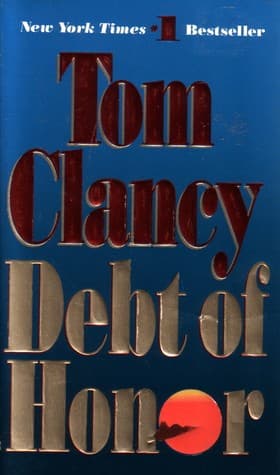
Tom Clancy (1994)
Genre
Thriller / Mystery
Reading Time
1650 min
Key Themes
See below
Sign in to track this book
When a vengeful Japanese industrialist orchestrates a devastating economic and military assault on the United States, newly appointed National Security Advisor Jack Ryan must uncover the mastermind before America is brought to its knees.
The story opens with a car crash in rural Tennessee. A family dies when their Japanese-made car's faulty gas tank ignites. Congressman Gerry Hendley, a protectionist politician, uses the public outrage and media attention to push through a punitive trade bill targeting Japan. Hendley's bill aims to impose severe tariffs and restrictions on Japanese imports, ostensibly to protect American jobs and consumers, but also to punish Japan for perceived unfair trade practices. This legislative action, intended to economically squeeze Japan, inadvertently provides the spark for a much larger, more sinister plan being orchestrated by a powerful Japanese industrialist.
Raizo Yamata, a wealthy Japanese industrialist, views the new American trade bill as a direct insult to Japan's honor and economic sovereignty. Driven by a deep personal mission to avenge his parents, who he believes were victims of American post-WWII policies, Yamata has meticulously crafted a multi-pronged plan to humble the United States. His scheme involves economic warfare and a strategic military component designed to cripple American capabilities in the Pacific and elevate Japan to a dominant position. He sees the trade bill as the perfect justification and cover to launch his intricate and long-prepared operation, leveraging his vast resources and connections.
Following the passage of the Hendley Bill, Yamata puts the first phase of his plan into action. Using his vast financial network and influence over other Japanese companies, he orchestrates a massive, coordinated sell-off of US Treasury bonds and other American securities. This sudden withdrawal of capital from the US market sends shockwaves through Wall Street, causing the stock market to plummet and the dollar to weaken significantly. The American economy begins to reel, facing a severe financial crisis as confidence in its stability erodes. This economic attack is designed to create chaos and weaken the US's ability to respond to further threats.
At the same time as the economic assault, Yamata's network initiates a series of sophisticated cyberattacks targeting critical American infrastructure. These attacks are designed to cause widespread disruption, focusing on financial networks, transportation systems, and even military communications. While not immediately catastrophic, they sow confusion and make it difficult for the US government to coordinate a response to the unfolding crisis. The cyber warfare is a key part of Yamata's strategy, aiming to blind and disorient the United States, preventing it from fully grasping the scope and origin of the attacks, and creating an environment for further escalation.
President Roger Durling finds himself in an unprecedented national crisis. The economic collapse and cyber disruptions baffle the administration, as the source and coordination of the attacks remain unclear. Recognizing the gravity of the situation, President Durling turns to Dr. Jack Ryan, who has recently returned to government service. Ryan is appointed as the new National Security Advisor, tasked with unraveling the complex web of attacks and advising the President on a response. Ryan immediately begins to connect the dots, seeing patterns that suggest a deliberate, coordinated assault rather than isolated incidents, and starts to suspect a foreign adversary.
As the US grapples with its internal crises, Yamata's plan enters its military phase. Japanese Self-Defense Forces, under the influence of Yamata's allies within the government, conduct a series of coordinated and unexpected military actions in the Pacific. These include the seizure of the Mariana Islands, including Guam, a strategic US territory, and attacks on US naval vessels and airbases in the region. These actions are executed with precision and speed, catching the US off guard and demonstrating Japan's enhanced military capabilities. The goal is to establish Japanese dominance in the Pacific and further humiliate and cripple the American military presence.
Working tirelessly, Jack Ryan and his team at the CIA and NSA begin to piece together intelligence from various sources. They analyze financial data, cyberattack signatures, and decrypted communications. Ryan's analytical mind connects the economic attacks, the cyber warfare, and the military moves in the Pacific, realizing they are all part of a single, integrated operation. He identifies Raizo Yamata as the central figure, recognizing his immense influence and the historical grievances that drive him. Ryan presents his findings to President Durling, confirming that the United States is under a full-scale, undeclared war initiated by Japan.
In a shocking and devastating turn of events, President Durling, along with most of the US Cabinet and Congress, is killed when a Japanese commercial airliner, piloted by a kamikaze terrorist, crashes into the Capitol Building during an emergency joint session of Congress. This horrific act of terrorism decapitates the US government. Due to a complex chain of succession and the elimination of other eligible officials, Jack Ryan, as the recently appointed Vice President (a position he reluctantly accepted prior to the Capitol attack), is suddenly sworn in as the President of the United States. He now leads a nation in crisis and war.
Immediately upon assuming the presidency, Jack Ryan demonstrates resolve and leadership. He addresses the stunned nation, vowing to avenge the fallen and restore American sovereignty. He quickly consolidates power and begins to organize a military and economic counter-offensive. Ryan's first priority is to stabilize the economy and re-establish national morale. He then authorizes a daring plan to reclaim the Mariana Islands and neutralize the Japanese military threat. His leadership style is direct and pragmatic, focusing on intelligence-driven decisions and leveraging the full might of the American military, despite the severe losses and disruptions.
Under President Ryan's command, the US military launches a counter-offensive in the Pacific. Naval and air forces engage in battles with the Japanese Self-Defense Forces, particularly around the Mariana Islands. The fighting is intense and costly, but American forces, driven by a desire for vengeance and guided by superior intelligence, gradually begin to push back the Japanese. The conflict highlights the advanced capabilities of both sides, but the US eventually gains the upper hand through strategic planning and overwhelming force, beginning to dismantle Yamata's territorial gains and military objectives.
As the US counter-offensive gains momentum, Yamata's plan begins to unravel. The economic pressure from the US, combined with the military setbacks, starts to create dissent within Japan's political and military establishment. International pressure also mounts against Japan. Yamata's allies within the Japanese government begin to distance themselves as the true cost and illegality of his actions become undeniable. Ultimately, facing overwhelming American military might and internal collapse, Yamata's scheme fails. The Japanese government, under pressure, is forced to concede defeat and retreat from its occupied territories, ending the military conflict.
With the war concluded, President Ryan faces the task of rebuilding a shattered nation. The economic damage is immense, the political landscape is in turmoil, and the psychological scars of the attacks run deep. Ryan immediately focuses on restoring economic stability, ensuring national security, and bringing to justice those responsible for the attacks. He initiates efforts to repair diplomatic relations and re-establish America's position on the world stage. The book concludes with Ryan firmly in charge, facing the challenges of a post-war presidency, but with a clear vision for the future and a commitment to protecting the United States.
The Protagonist
Reluctantly accepting the role of National Security Advisor, Ryan is thrust into the presidency after a catastrophic attack, forcing him to evolve from an analyst into a decisive wartime leader.
The Antagonist
Yamata begins as a shadowy mastermind orchestrating a complex plan for revenge and global dominance, only to see his intricate scheme unravel due to American resilience and his own overconfidence.
The Supporting
President Durling is a leader overwhelmed by a crisis he struggles to fully grasp, ultimately becoming a tragic casualty of the war he inherited.
The Supporting
Hendley's actions, driven by political ambition, inadvertently ignite a global conflict, highlighting the unintended consequences of short-sighted policy.
The Supporting
Jackson rises to the challenge of leading critical naval operations during a major conflict, demonstrating unwavering loyalty and strategic acumen.
The Supporting
Adler navigates complex international relations during wartime, adapting his diplomatic skills to the realities of open conflict.
The Supporting
Cathy endures the extreme pressures of her husband's unexpected rise to power during a national catastrophe, maintaining her professional life while providing unwavering family support.
The Supporting
Foley plays a key role in intelligence gathering, demonstrating her analytical prowess and contributing significantly to uncovering the enemy's strategy.
The novel explores how global economies can be weaponized. Yamata's initial attack is financial, leveraging Japan's vast holdings of US debt to destabilize the American economy. This highlights the vulnerability in economic interdependence. Congressman Hendley's protectionist trade bill, intended to 'protect' American interests, inadvertently provides Yamata with the justification for his full-scale assault. The theme suggests that short-sighted economic nationalism can have catastrophic international consequences, turning economic partners into adversaries and triggering unforeseen military conflict, as seen when the US stock market crashes after Yamata's sell-off.
“The greatest armies in the world could not protect a nation whose economic heart had been ripped out.”
A central theme is the sudden burden of leadership, particularly when thrust upon an unprepared individual. Jack Ryan, a man who avoids political power, finds himself abruptly elevated to the presidency after a devastating attack decapitates the US government. The narrative explores his struggle to adapt from an analytical role to that of a wartime commander-in-chief, making life-or-death decisions for an entire nation. His initial reluctance and eventual resolve highlight the personal sacrifice and pressure associated with such a position, especially in a time of unprecedented crisis, as he addresses the nation from a makeshift command center.
“He had never wanted this. Never sought it. But now, it was his, and there was no turning back.”
'Debt of Honor' is both the title and a driving force behind the antagonist, Raizo Yamata. His actions are motivated by a personal and culturally significant 'debt' he feels towards his parents and his nation, believing they suffered at the hands of the United States after World War II. This theme explores how historical grievances, even generations old, can fester and be twisted into a justification for extreme acts of revenge and aggression. Yamata's interpretation of honor leads him to orchestrate a global conflict, demonstrating the destructive power of unresolved historical wounds and the distortion of cultural values when seeking retribution.
“A man's honor, his family's honor, his nation's honor... these were things for which a man would sacrifice everything.”
The novel portrays a multi-faceted approach to modern warfare that extends beyond traditional military engagements. Yamata's strategy begins with economic sabotage (massive sell-offs of US bonds) and cyberattacks targeting critical infrastructure, before escalating to conventional military action in the Pacific. This shows the increasing complexity of conflict in the modern era, where financial markets and digital networks are as vulnerable as military bases. The US's initial struggle to identify the source and coordinated nature of these attacks highlights the challenge of defending against a 'total war' that encompasses economic, informational, and kinetic dimensions.
“The first shots of this war were not fired with bullets, but with keystrokes and financial transactions.”
Despite facing catastrophic losses, including the decapitation of its government and severe economic and military setbacks, the United States ultimately shows resilience. The theme explores the nation's ability to rally, adapt, and fight back in the face of overwhelming adversity. This is personified by Jack Ryan's unexpected leadership, the unwavering dedication of the military, and the public's eventual resolve. It suggests that while external forces can inflict immense damage, the underlying strength of a nation lies in its people, its institutions, and its capacity to overcome despair and unite against a common threat, as seen in the national response after the Capitol attack.
“They had struck us hard, but they had not broken our spirit. Not now, not ever.”
A seemingly minor legislative act that triggers a global conflict.
The Hendley Bill, a protectionist trade law targeting Japan, serves as a crucial MacGuffin. While its immediate intent is economic, its true function in the plot is to provide Raizo Yamata with the 'justification' and catalyst he needs to launch his pre-planned, multi-pronged attack against the United States. The bill itself is not the central conflict, but it is the object that sets the entire intricate plot in motion, allowing Yamata to frame his aggressive actions as a response to American provocation, rather than unprovoked aggression.
A sudden, unexpected event that dramatically alters the protagonist's role.
The catastrophic attack on the Capitol Building, which eliminates the President, Vice President, and most of the line of succession, is a classic Deus ex Machina. It unexpectedly thrusts Jack Ryan, who was only recently appointed Vice President, into the highest office. This event is not directly caused by the ongoing conflict in a conventional sense (though it is a terrorist act by Yamata's allies) but fundamentally changes the protagonist's position and the trajectory of the plot, placing the analytical Jack Ryan in a position of ultimate executive power and responsibility that he otherwise would not have attained.
Misdirection that initially focuses attention on an economic dispute.
The initial focus on the economic dispute between the US and Japan, exacerbated by the Hendley Bill and Yamata's subsequent financial maneuvers, acts as a red herring. While the economic warfare is real and damaging, it initially distracts both the characters and the reader from the true, broader scope of Yamata's plan, which includes cyber warfare and military aggression. This misdirection makes it harder for the US government to immediately grasp the full scale of the threat and allows Yamata to gain significant strategic advantages before his true intentions are fully understood by Jack Ryan.
Internal divisions within an enemy nation that complicate the conflict.
The plot device of the 'unreliable ally' is manifested through the factions within the Japanese government and military who are either complicit with or manipulated by Raizo Yamata. While not all of Japan is actively hostile to the US, Yamata's influence allows him to commandeer significant portions of the nation's resources and personnel for his own agenda. This creates a complex situation where the US is fighting not just a nation, but a powerful, internal conspiracy within that nation, making diplomatic solutions difficult and complicating the understanding of the enemy's true intent and control.
“The greatest enemy of a good plan is the dream of a perfect plan.”
— Ryan reflecting on strategic planning and the compromises necessary in the real world.
“You can't be a little bit pregnant, and you can't be a little bit dead.”
— A character making a point about the absolute nature of certain situations, specifically regarding military action.
“The price of freedom is eternal vigilance.”
— A recurring theme and a direct quote from a character discussing national security and the threats facing the US.
“Power is never given, it is taken.”
— A philosophical observation on the nature of political power and influence.
“There are no easy answers, only hard choices.”
— Ryan grappling with difficult decisions that have far-reaching implications.
“Diplomacy without arms is music without instruments.”
— A statement emphasizing the importance of military strength in supporting diplomatic efforts.
“The most dangerous thing in the world is a man with nothing to lose.”
— A character analyzing the motivations and threat posed by an desperate adversary.
“Mistakes are a fact of life. It is the response to error that counts.”
— Ryan reflecting on the importance of learning from errors rather than being paralyzed by them.
“You never really know a man until you've stood in his shoes and walked around in them.”
— A character advocating for empathy and understanding of an opponent's perspective.
“The world is a dangerous place, not because of those who do evil, but because of those who look on and do nothing.”
— A sentiment about the responsibility of individuals to act against injustice and danger.
“War is not a game. War is a lot of people dying.”
— A stark reminder of the brutal reality and human cost of armed conflict.
“Sometimes you have to break a few eggs to make an omelet.”
— A common idiom used to justify taking drastic measures for a desired outcome, often in a strategic context.
“Trust but verify.”
— A principle applied to intelligence gathering and international agreements, emphasizing caution.
“There is no substitute for victory.”
— A military maxim highlighting the ultimate goal in conflict.
Ready to see how well you understood this book? Take our interactive quiz with 10 questions.

Biography coming soon.







