“The only real power is the power to choose.”
— Richard's reflection on the nature of freedom and responsibility.

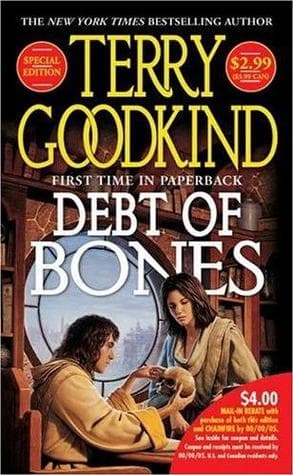
Terry Goodkind (2001)
Genre
Fantasy
Reading Time
160 min
Key Themes
See below
Sign in to track this book
On the brink of war, a young woman's plea for a wizard's help forces both to face an old betrayal and make a difficult choice that changes their lives and a child's fate.
The story begins with Abby, a young woman from Ebinissia, seeking Zedd Zorander, the First Wizard. She finds him in a crucial meeting about the D'Haran Empire's advance, tasked with protecting the Pass of the Andolians. Abby's village is under attack by the wizard Sully, who is slowly killing its people with a magical plague, including her daughter, Jana. She carries a bone doll, a reminder of a past debt, and insists Zedd is the only one who can help. Her persistence interrupts Zedd's important war preparations, showing the great pressure he is under.
Zedd first dismisses Abby's plea, explaining that his current duty to protect the Pass of the Andolians is most important for the safety of many lives. He prepares for a major battle against D'Haran forces led by General Reibisch. However, Abby reveals the true nature of her request: she claims Zedd owes her family a 'debt of bones' — an old obligation passed down. This revelation troubles Zedd, forcing him to face a past he thought was hidden. He understands the weight of this old promise and the possible results of ignoring it, even during the coming war.
Abby explains the history of the 'debt of bones.' Generations ago, Zedd, then a young wizard, caused the death of Abby's ancestor, a healer named Adie, with a misplaced magical attack meant for another target. Before Adie died, Zedd promised to repay the debt to her descendants, a promise sealed with a bone doll — a magical token of the oath. Abby now presents this doll, demanding Zedd fulfill his old vow by helping her against Sully. This personal history adds guilt and responsibility to Zedd's already heavy burden, making his decision harder.
Zedd's generals, including General Reibisch, grow frustrated by Abby's presence and Zedd's distraction from the D'Haran army. They see Abby's problem as a small personal matter compared to the Pass's strategic importance. Reibisch, a military leader, urges Zedd to focus only on the war, stressing the severe consequences if the Pass falls. This conflict shows the clash between personal morality and public duty, putting Zedd in an impossible situation where both choices carry great weight and potential disaster.
After much inner conflict and pressure from Abby, Zedd decides to honor the old 'debt of bones.' He recognizes that his personal honor and the promise's sacredness are as vital as his war duty. He tells his generals to prepare for battle, but he commits to going with Abby to Ebinissia to confront Sully. His commanders are dismayed, fearing it will risk their defense. Zedd, however, believes that breaking such a deep vow could have even more devastating, though less obvious, effects on his spirit and the balance of magic.
Zedd and Abby begin the dangerous journey to Ebinissia. During their travels, Abby reveals more about Sully's terror and the slow, painful deaths he causes. Zedd, seeing the suffering and fear, starts to understand Abby's desperation. He also senses a darker, more evil magic, confirming Sully is no ordinary enemy. The journey strengthens their bond and Zedd's resolve to confront the rogue wizard, even as the war continues in the background, a constant, threatening presence.
Upon reaching Ebinissia, Zedd confronts Sully, a wizard driven by a twisted desire for power and control. Sully reveals he is attacking Ebinissia not just for conquest, but to draw out Zedd, believing Zedd caused his own family's death in a past magical conflict. Sully has used dark magic, twisting life and death, to create a horrifying plague. The confrontation is tense, as Sully's magic is strong and his hatred for Zedd is deep, making him a powerful and unpredictable opponent. Zedd realizes Sully's actions come from a deep sense of injustice and a warped understanding of past events.
During the confrontation, Zedd uses his wisdom and magic to learn about Sully's past, discovering that Sully's family was not killed by Zedd, but by a different magical event, perhaps even one Sully himself caused in a misguided attempt to gain power, or simply a tragic accident. Zedd had been blamed due to a misunderstanding of the magical signs. This truth shatters Sully's anger, showing the depth of his delusion and the tragedy of his vengeful path. The truth, however, does not immediately calm Sully, who is too far gone in his quest for revenge.
A fierce magical battle breaks out between Zedd and Sully. Zedd, using his great knowledge of magic, counters Sully's dark spells, which cause pain and death. Abby, despite her fear, helps Zedd by giving important information about Sully's methods and the plague's effects. The fate of Abby's daughter, Jana, hangs in the balance, as does the entire village. Zedd's power is immense, but Sully's desperation makes him dangerously unpredictable. The fight is not just a clash of spells, but a battle for Ebinissia's soul and the correction of past mistakes.
Zedd defeats Sully, not only by overpowering him but by forcing him to face the truth of his delusions. Sully's magic falls apart as his hatred crumbles. With Sully stopped, Zedd uses his healing magic to cure Jana and the other villagers with the plague. The 'debt of bones' is repaid, not just for Abby's ancestor, but also in a way for Sully, by bringing truth to his twisted past. Abby is relieved and grateful, her daughter saved, and her village free from terror.
With Ebinissia safe and his debt fulfilled, Zedd returns to the Pass of the Andolians. He finds the war has grown, but his generals, though stressed, have held their ground. His short absence has not caused the disaster they feared, but it has affected the strategic situation. Zedd is changed; his experience with Abby and Sully has deepened his understanding of how individual lives and large conflicts connect. He now has a greater appreciation for the personal stories often lost in war, and the profound weight of both old promises and immediate duties.
The events in Ebinissia leave a lasting mark on Zedd Zorander. The 'debt of bones' is settled, but its effects will shape his future actions and decisions. He has learned that sometimes, the biggest battles happen on the smallest stages, and that personal honor and old vows can be as important as military victories. The story ends with the understanding that while the larger war continues, Zedd's journey has been deeply shaped by this personal quest, strengthening his character and setting the stage for his role as First Wizard in the wider Sword of Truth series.
The Protagonist
Zedd begins as a wizard focused on the grand strategy of war, but through honoring his ancient debt, he reaffirms the importance of individual lives and personal integrity amidst larger conflicts.
The Protagonist
Abby transforms from a desperate supplicant into a brave participant in the fight for her home, ultimately finding relief and gratitude.
The Antagonist
Sully's arc is one of tragic defeat, as his delusions are shattered and his power broken, ending his reign of terror.
The Supporting
Jana's arc is one of recovery, as she is healed from the plague by Zedd's magic.
The Supporting
Reibisch remains steadfast in his military duty, representing the constant pressure of the war on Zedd.
The Mentioned
Adie's story is revealed through Abby's recounting, establishing the historical context for the central conflict.
This theme is central to Zedd's conflict. He is torn between his duty as First Wizard, protecting many lives from the D'Haran Empire, and his personal honor in fulfilling an old 'debt of bones' to Abby's family. His decision to help Abby, despite the strategic risks, shows that true leadership sometimes means putting moral integrity before only practical concerns. The story suggests that breaking a sacred promise could have consequences as severe, though less obvious, as losing a battle, as Zedd weighs the spiritual cost of dishonor against the immediate military threat.
“"Some debts are written in blood, and some in bones. But all debts must be paid."”
The entire plot centers on the 'debt of bones,' an old promise a young Zedd made to Adie's family. This theme explores how vows, even those made generations ago, can deeply shape the present. Abby's strong belief in this debt's validity makes Zedd act, showing the lasting power of a spoken word or a magical oath. It stresses that promises carry great weight and moral obligation, going beyond time and personal convenience. The bone doll itself symbolizes this lasting commitment.
“"A promise made by a wizard is not a thing to be taken lightly. It can echo through generations."”
The story constantly contrasts the large, impersonal war with Abby's and her village's deeply personal struggle. Zedd first sees Abby's problem as unimportant compared to the war, but he comes to understand that individual lives and their suffering are linked to the larger conflict. Jana's and Ebinissia's plight shows that the 'greater good' is made of many individual good acts, and ignoring one's suffering can harm the moral fabric of the whole. This theme emphasizes that even in war, personal compassion and justice remain vital.
“"The smallest stone can divert the mightiest river, if placed in the right spot."”
Sully's character shows the destructive power of delusion fueled by grief and a twisted view of the past. His belief that Zedd killed his family leads him to cause great suffering in Ebinissia. The story explores how unchecked grief, combined with a misunderstanding of events, can lead to terrible acts. Zedd's victory over Sully involves not just magic, but also revealing the truth, shattering Sully's delusions. This theme warns about the importance of truth and self-awareness in overcoming personal tragedy.
“"Hatred, when nurtured, becomes a prison of your own making."”
An ancient, magically binding promise that drives the plot.
This is the central plot device. It's a magical and moral obligation Zedd made generations ago to Abby's ancestor, Adie, to compensate for Adie's accidental death by Zedd's magic. The 'debt of bones' is represented by a bone doll, carried by Abby, which serves as a tangible reminder and proof of the vow. Its existence forces Zedd to confront his past and choose between his immediate duty to the war and his personal honor, directly propelling the story forward and creating the core conflict.
A physical token symbolizing the ancient 'debt of bones.'
The bone doll is a crucial symbolic and literal plot device. It is a small, carved bone figure that Abby carries, serving as the physical proof and reminder of the 'debt of bones' Zedd owes her family. It validates Abby's claim and forces Zedd to acknowledge the ancient promise he made. The doll acts as a constant visual prompt of the story's central theme, representing the enduring power of oaths and the heavy weight of Zedd's past actions, making the abstract concept of a debt tangible.
A critical external conflict that creates Zedd's moral dilemma.
The looming war with the D'Haran Empire and the immediate threat to the Pass of the Andolians serve as a powerful external conflict and a major source of Zedd's internal struggle. This device creates immense pressure on Zedd, making his decision to help Abby incredibly difficult and high-stakes. It highlights the clash between personal morality and public duty, as Zedd's generals constantly remind him of the larger strategic importance of his presence. The war acts as a ticking clock, amplifying the tension of Zedd's choice.
“The only real power is the power to choose.”
— Richard's reflection on the nature of freedom and responsibility.
“It is the nature of a Confessor to know truth, and to use that truth to guide others to what is right.”
— Kahlan explaining the role and burden of a Confessor.
“There is no 'they' that will save us. Only us.”
— Richard's realization about the necessity of personal action.
“Hate is a chain. It binds you to the one you hate.”
— Zedd's wisdom imparted to Richard about the destructive nature of hatred.
“The world is not as it should be. It is as it is.”
— A pragmatic observation about the state of the world.
“Sometimes the greatest courage is not to fight, but to choose to live.”
— Richard grappling with difficult choices and survival.
“Magic is not good or evil. It is a tool. It is what one does with it that matters.”
— Zedd's explanation of the neutrality of magic.
“Truth is a stubborn thing. It can be ignored, but it cannot be changed.”
— A reflection on the enduring nature of truth.
“The future is not written. It is made by our choices, moment by moment.”
— Richard's understanding of free will and destiny.
“Fear is a powerful weapon, but it can also be a powerful motivator.”
— Considering the dual nature of fear.
“To deny a debt of bones is to deny who you are.”
— Richard's internal struggle with the meaning of his pledge.
“There are no easy answers, only difficult choices.”
— A recurring theme when faced with moral dilemmas.
“The greatest evil is to do nothing when you know what is right.”
— Richard's conviction about the importance of action against injustice.
“Love is not a weakness. It is the greatest strength of all.”
— Richard's evolving understanding of love and its power.
Ready to see how well you understood this book? Take our interactive quiz with 10 questions.

Biography coming soon.







