“The desert was a vast, silent, and deadly place.”
— Ben encounters the harsh reality of the desert environment.

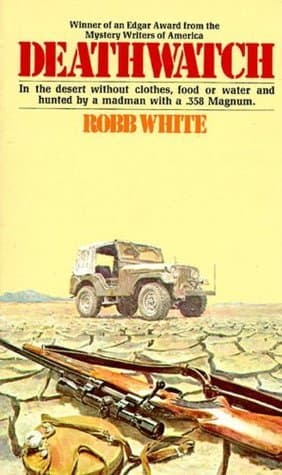
Robb White (1972)
Genre
Thriller / Mystery / Young Adult
Reading Time
224 min
Key Themes
See below
Sign in to track this book
A desperate college student's guiding job in the desert transforms into a deadly game of cat and mouse when his wealthy, sadistic client accidentally kills a prospector and hunts Ben to silence him.
Ben, a young college student working as a desert guide, is hired by the wealthy, arrogant businessman Madec for a bighorn sheep hunting trip in the Mojave Desert. Ben needs the money for his college education. Madec arrives with an expensive rifle and an air of superiority. Ben senses Madec's ruthlessness and disregard for rules, especially when Madec wants to kill the largest sheep possible, even if it means bending regulations. They drive deep into the desolate area, setting up a temporary camp. Ben, experienced in the desert, is cautious of Madec's lack of respect for the environment and the dangers of the harsh terrain.
While tracking bighorn sheep, Madec, impatient, fires at a movement, believing it is a large ram. They discover he has shot and killed an old, harmless prospector. Madec immediately realizes the seriousness of the situation and the potential harm to his reputation and career. Instead of reporting the accident, he plans to frame Ben for the murder. Madec thinks Ben, being a local guide, could be more easily implicated, and his less influential background would make him an easier scapegoat. The prospector's body is hidden, and Madec begins to manipulate the scene.
Madec forces Ben to strip naked, takes all his clothes, shoes, water, and supplies, and then leaves him in the desert. Madec wants Ben to die from exposure, thirst, or hunger, making it appear as if Ben, distraught after the 'accident,' wandered off and died. Madec takes Ben's jeep, rifle, and all other evidence that Ben was with him, planning to return to civilization with a made-up story. Ben is left with only his wits and his knowledge of the desert to survive. The sun is intense, and the terrain is harsh, making his chances of survival slim.
Against expectations, Ben, using his desert survival skills, endures the initial shock and extreme conditions. He finds a small amount of water in a hidden crevice and uses his understanding of animal behavior to find temporary shelter from the sun. Despite being naked and having no tools, Ben's determination to clear his name and expose Madec pushes him. He realizes Madec will return to civilization to report the 'discovery' of the prospector's body and accuse Ben. Ben decides his only chance is to follow Madec, gather proof, and confront him. He begins a difficult, barefoot trek across the desolate area, watching for Madec's jeep.
Madec, believing Ben is dead, eventually returns to the area where he left Ben, supposedly to 'search' for him and 'find' the prospector's body. He is surprised and angry to find Ben alive and pursuing him. The roles reverse into a chase. Madec, armed with his rifle and the jeep, hunts Ben, trying to shoot him and eliminate the only witness to his crime. Ben, despite his disadvantage, uses his knowledge of the desert's terrain, its hidden caves, water sources, and animal trails, to evade Madec's desperate attempts to kill him. Ben's goal changes from just surviving to actively outmaneuvering Madec.
Ben realizes he needs proof to counter Madec's story. He knows the prospector's body, specifically the bullet wound, will be important. While Madec is tracking him, Ben makes a risky move. He circles back to the location of the prospector's hidden body. Under cover of darkness or a lapse in Madec's watch, Ben approaches the corpse. He extracts the large-caliber bullet from the prospector's body, knowing its unique marks will match Madec's powerful rifle, not his own smaller-caliber rifle that Madec has taken. This bullet becomes Ben's only hope for justice, and he must protect it.
Ben, tired but determined, understands he cannot defeat Madec in the desert on his own. He plans to draw Madec to a place where he might be seen or heard by others. He leads Madec toward the main desert road, knowing Madec will eventually have to drive out. Madec, growing frustrated and desperate to silence Ben, falls for the trap, believing he is finally cornering his prey. The chase ends near the highway, where Ben hopes to use the unexpected presence of civilization, however sparse, to his advantage. The tension builds as Madec closes in, rifle in hand.
Just as Madec is about to close in on Ben near the highway, a game warden, Mr. Hogan, arrives on patrol. This unexpected event panics Madec, but he quickly composes himself, maintaining his act. Ben, seeing his chance, tries to signal to the warden, but his naked, emaciated state makes him appear disoriented. Madec, acting as the concerned citizen, tries to dismiss Ben as a madman. Ben, however, conveys enough urgency and desperation to make the warden suspicious, preventing him from dismissing Ben's claims immediately.
With the game warden present, Ben tells his story, though Madec denies everything, calling Ben a deranged person. The warden, initially doubtful of Ben's tale of murder and abandonment, listens more closely as Ben, despite his physical state, explains the details of Madec's crime. The turning point comes when Ben reveals the evidence he retrieved: the large-caliber bullet from the prospector's body. The warden, examining the bullet and Madec's rifle, recognizes the match. Madec's lies fall apart, and the evidence is undeniable. Faced with the truth, the game warden arrests Madec, ending Ben's ordeal.
The Protagonist
Ben transforms from a guide in a transactional relationship to a determined survivor and hunter of justice, ultimately clearing his name and exposing Madec.
The Antagonist
Madec descends from a man of respected status to a desperate, hunted criminal, his arrogance ultimately leading to his downfall.
The Mentioned
His death serves as the inciting incident, revealing Madec's true character and initiating Ben's struggle for survival and justice.
The Supporting
He moves from a patrolling officer to the instrument of justice, ensuring Madec's apprehension.
A main theme is Ben's struggle for survival against the desert and Madec's pursuit. Ben's knowledge of the desert—finding water, shelter, and navigating—is important. His mental strength, refusing to give up after being stripped and abandoned, shows human resilience. This theme is clear in every step Ben takes, from finding water to enduring the sun and cold nights, all while being hunted. His will to live and seek justice drives him against impossible odds.
“The desert was his friend, his enemy, his teacher. He knew its secrets, and now those secrets were his only hope.”
The novel explores the injustice of Madec's attempt to frame Ben for murder, contrasting with Ben's fight for justice. Madec, believing his wealth gives him freedom from punishment, tries to manipulate the legal system by eliminating the witness. Ben's quest is to survive, clear his name, and expose the truth. The climax, with the game warden's arrival and the bullet's presentation, shows how truth and evidence, even small, can win against power and deception. It is a fight for what is right against a corrupt and selfish person.
“He wasn't just fighting for his life anymore; he was fighting for his name, for the truth.”
The story contrasts Ben and Madec, exploring human nature. Ben represents integrity, resourcefulness, and respect for life. Madec, on the other hand, shows arrogance, cruelty, and a disregard for human life and morals when his reputation is at stake. His change from an arrogant hunter to a cold-blooded murderer reveals the darkness that can be hidden. The desert acts as a test, removing societal masks and showing the true character of each man under extreme pressure.
“Some men broke under pressure; others became diamond-hard.”
Beyond the conflict between Ben and Madec, the desert itself is a strong character. The Mojave Desert, with its extreme temperatures, lack of water, dangerous animals, and isolating landscape, is a constant threat to Ben. His survival depends on his knowledge and respect for this environment. Madec, despite his hunting experience, lacks this deep connection and often underestimates the desert's power, relying on technology instead. The theme explores how humanity adapts to or is broken by the natural world, and how respecting nature can be key to survival.
“The desert did not forgive mistakes. It simply waited for them.”
The extreme environment actively challenges the protagonist and reveals character.
The Mojave Desert is not merely a backdrop but a crucial, active antagonist. Its harsh conditions—scorching heat, freezing nights, lack of water, and dangerous terrain—are major obstacles Ben must overcome. It strips away all of Ben's material possessions, forcing him to rely solely on his wits and inherent survival skills. The desert also acts as a crucible, revealing the true, brutal nature of Madec and highlighting Ben's resilience and deep connection to the natural world. The vastness and isolation of the desert intensify the psychological tension and the feeling of hopelessness for Ben.
A physical object that drives the plot and proves Madec's guilt.
The bullet extracted from the prospector's body serves as a classic MacGuffin, a plot device that is intensely desired by both the protagonist and antagonist, driving their actions. For Ben, it is the sole piece of irrefutable evidence that can clear his name and convict Madec. For Madec, it is the ultimate threat to his freedom and reputation, which he must prevent Ben from presenting. The bullet's unique rifling marks, matching Madec's rifle, make it a powerful and undeniable piece of forensic evidence, ultimately leading to Madec's downfall and the resolution of the conflict.
A narrative structure where the roles of hunter and hunted frequently shift.
The narrative employs a classic cat-and-mouse structure, where Madec initially is the hunter (abandoning Ben to die), and Ben becomes the hunted (fleeing Madec's rifle). However, the roles subtly shift as Ben, using his desert expertise, begins to outwit Madec, turning the tables. Ben's pursuit of justice and his strategic maneuvers to lead Madec to the road transform him into a form of hunter himself. This dynamic creates sustained tension and suspense, with each character trying to anticipate and counter the other's moves, making the desert a deadly chessboard for their psychological and physical battle.
Early hints of Madec's cruel nature and the dangers of the trip.
Foreshadowing is used early in the novel to build tension and hint at Madec's true character. Ben's initial unease with Madec's arrogance, his disregard for hunting regulations, and his general ruthlessness (e.g., his 'only time he ever laughed was when he told some story about how smart he was') all subtly prepare the reader for Madec's eventual turn to murderous villainy. These early observations by Ben establish Madec as a dangerous and unpredictable individual, making his drastic actions later in the plot more believable and impactful, rather than coming completely out of left field.
“The desert was a vast, silent, and deadly place.”
— Ben encounters the harsh reality of the desert environment.
“There was no law out here, just the law of the strong.”
— Ben realizes the brutal lack of authority in the wilderness.
“A man's worth was measured by his ability to stay alive.”
— Ben reflects on the ultimate test of survival.
“Fear was a cold hand on his throat, but he couldn't let it win.”
— Ben battles his own terror in a perilous situation.
“Every sound was a warning, every shadow a potential threat.”
— Ben's heightened senses in the dangerous desert.
“He was hunting, but he was also being hunted.”
— Ben's dual role in the deadly game.
“The old man had a look in his eyes that Ben had never seen before—a look of pure, unadulterated hatred.”
— Ben observes Madec's intense animosity.
“Water was life, and without it, there was only death.”
— Ben's desperate need for water in the desert.
“He had to think like an animal, cunning and patient.”
— Ben adopts a primal mindset for survival.
“The desert could hide anything, even a body.”
— Ben contemplates the vastness and secrecy of the desert.
“Madec wasn't just trying to kill him; he was trying to break him.”
— Ben realizes Madec's psychological warfare.
“The only way out was through.”
— Ben's determination to face his challenges head-on.
“He was alone, utterly and completely alone, in a world that wanted him dead.”
— Ben's profound sense of isolation and danger.
“Justice was a luxury he couldn't afford out here.”
— Ben acknowledges the absence of formal justice in the wilderness.
Ready to see how well you understood this book? Take our interactive quiz with 10 questions.

Biography coming soon.







