“All year the flax-dam festered in the heart / Of the townland; green and heavy headed / Flax had rotted there, weighted down by stones / To ripen quietly.”
— Opening lines describing the sensory experience of the flax-dam.

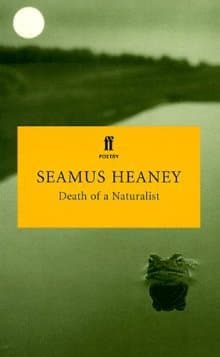
Seamus Heaney (1966)
Genre
Literary Fiction
Reading Time
30 min
Key Themes
See below
Sign in to track this book
Seamus Heaney's first collection shows a childhood in rural Ireland, exploring nature's beauty and decay through a young poet's precise observations.
The poem opens with the narrator, likely Seamus Heaney, at his desk, pen in hand, listening to his father digging outside. This sound brings back a memory of his grandfather, a skilled peat-digger who could cut more turf in a day than anyone else. Heaney vividly remembers his grandfather's strong build and the precise way he used the spade. The narrator compares his ancestors' physical work with his own writing, noting their different tools: his father and grandfather used a spade, while he uses a pen. He ends by saying he will 'dig with it,' showing his commitment to his craft.
The poem describes a young boy's first delight and wonder at seeing frogspawn in a flax-dam near his home. He carefully collects the 'jellied' spawn, fascinated by the developing tadpoles. The boy learns about the life cycle from his teacher, Miss Walls, who explains how tadpoles become frogs. However, his peaceful view breaks when the flax-dam fills with large, croaking frogs. Their sudden numbers, 'gross-bellied' look, and loud croaks overwhelm and sicken him. The boy feels a primal fear and disgust, convinced the frogs are hostile, and he runs away, vowing never to return. This experience marks a loss of childhood wonder.
The poem vividly tells of the yearly blackberry-picking in late summer. Children, including the narrator, look forward to the berries ripening, their hands stained purple from the juice. They brave briars and nettles, eager to fill their buckets with the 'glossy' fruit. The initial joy of the harvest is clear, with children competing for the largest, sweetest berries. They bring their haul home, hoping to keep them. However, the poem turns sad as the collected berries inevitably begin to rot, growing a 'fungus, blooming and white.' The narrator expresses a childish frustration at this unavoidable decay, a first encounter with nature's impermanence and the impossibility of holding onto perfection.
The poem details the narrator's experience of being called home from boarding school after a family tragedy. He arrives to find neighbors and relatives gathered, offering sympathy. The atmosphere is heavy with grief, and he sees his father openly crying, an unusual sight. He meets his mother, who is also upset, and notes a priest is present. The poem's peak is his visit to the room where his younger brother's body lies in a coffin. He describes his brother's peaceful look, noting the 'poppy bruise' on his temple, the only visible sign of the accident. The final lines sadly reveal the brother was four years old, emphasizing his short life and the narrator's deep, quiet sorrow.
The poem describes the inside of a barn, showing it as a mysterious, almost sacred place from a child's view. The narrator remembers the 'dim-lit' interior, filled with the smell of hay and unseen creatures. He uses clear images to evoke dusty light shafts, the 'great haycock' like a sleeping animal, and the 'flicker' of bats. The barn is a place of exploration and discovery, where the boy faces his fears and curiosities. It is also a space where he begins to feel nature's cycles and time passing, the 'warm-blooded' animal life contrasting with the stillness of stored crops. The barn becomes a small version of the natural world, both comforting and slightly unsettling.
The poem is a sad reflection on the relationship between a son and his father, focusing on the father's skill as a ploughman. The narrator vividly describes his father's strong body and his easy control of the plough, turning 'a bright steel share' with precision. The son, as a young boy, follows his father in the fields, tripping, eager to help but clumsy. He admires his father's strength and skill, seeing him as 'mettlesome.' The poem shifts to the present, where roles are subtly reversed: the father, now old and weak, follows the son, no longer a strong leader but dependent. This reversal highlights the passage of time and the changing dynamics of their relationship.
The poem details the hard but satisfying process of churning butter, a regular task in rural Ireland. The narrator describes the preparation, the 'crock' of cream, and the rhythmic, steady effort needed to turn the churn. He evokes the sounds and smells of the process—the 'slap and plop' of the butter, the 'sour-sweet' smell of buttermilk. The poem emphasizes the group effort, often with children taking turns. There is a sense of anticipation as the butter begins to form, a 'gold fleck' appearing, signaling the end of their work. The final product, the 'rich, thick-clabbered' butter, is presented as a clear reward for their shared labor, connecting the family to the land and its food.
The poem focuses on a single gnat, caught in a strong gust of wind, struggling to fly. The narrator observes the tiny insect's brave but failing fight against the unseen force. He describes the gnat's wild movements, its 'zigzag' dance, as it is tossed by the wind. There is a sense of both the gnat's smallness and its strong will to live. The poem reflects on how vulnerable small creatures are against nature's vast, uncaring forces. The gnat becomes a symbol of fragile life and the constant fight for existence in a world where even a small change in environment can have big effects. The poet's observation is detached but empathetic.
The poem describes the narrator's encounter with a rat in a drain, a moment that mixes childhood fear with a growing, almost spiritual, awareness. He first feels disgust and wants to kill the creature. However, as he observes the rat, its 'whiskered' face and 'bright eyes,' something changes. The rat, usually linked with dirt and disease, takes on a mysterious, almost ancient quality. The narrator feels a strange connection, a sense of shared life with the creature that lives in the world's 'dark' underside. He acknowledges the rat's 'mastery' of its domain. This encounter becomes an 'advancement of learning,' a moment of deep, if unsettling, insight into nature's raw, wild parts and his own place within it, moving beyond simple disgust.
The poem is a statement about poetry, comparing the narrator's childhood exploration of wells to his adult work as a poet. As a child, he was fascinated by wells—their dark, cool depths, echoes, strange reflections, and the creatures inside. He describes peering into them, seeing his own face and the 'sky's inverted bowl.' These wells, often ignored and overgrown, were sources of mystery and wonder. Heaney connects this early curiosity with his later calling, suggesting his poetry is a similar act of 'sounding' the depths, exploring hidden meanings and bringing them to light. The wells become a metaphor for inspiration and for looking deeply into the world, just as a poet explores language and experience.
The Protagonist
Heaney moves from a childlike wonder and occasional revulsion towards nature to a more mature, reflective, and appreciative understanding of its complexities and his place within it.
The Supporting
His arc shows a transition from a powerful, leading figure to a more dependent, elderly presence, symbolizing the passage of time and generational shift.
The Supporting
His character is static, serving as a symbolic representation of ancestral strength and tradition.
The Antagonist/Symbolic
They evolve from objects of scientific curiosity to symbols of primal fear and the end of childhood innocence.
The Mentioned
His character is static, serving as a poignant symbol of innocence lost and the brevity of life.
The Supporting
Her character is largely static, representing the emotional bedrock of the family.
The Symbolic
Its perception by the narrator shifts from a pest to a creature of mysterious significance.
This theme is central to the collection, especially in 'Death of a Naturalist' and 'Blackberry-Picking.' In 'Death of a Naturalist,' the boy's happy fascination with frogspawn turns to fear and disgust when he sees the mature, 'gross-bellied' frogs. His idealized view of nature breaks down when faced with its raw, chaotic reality. Similarly, in 'Blackberry-Picking,' the initial joy of harvesting ripe fruit turns to disappointment as the berries rot, teaching the children about impermanence and the impossibility of keeping perfect moments. These experiences mark a shift from naive wonder to a more complex, often darker, understanding of the world.
“I sickened, turned, and ran. The great slime kings / Were gathered there for vengeance and I knew / That if I dipped my hand the spawn would clutch it.”
Heaney often uses clear childhood memories to explore deep truths. Poems like 'Digging,' 'Follower,' and 'Personal Helicon' are rooted in recollections of his youth and family life in rural Ireland. These memories are not just nostalgic; they form a basis for understanding his present self and his poetic calling. The sensory details—the smell of peat, the sound of digging, the feel of cold water—give these memories an immediate power, showing how early experiences shape identity and provide inspiration. The past is a living presence that constantly informs the poet's view.
“By God, the old man could handle a spade. / Just like his old man. My grandfather cut more turf in a day / Than any other man on Toner's bog.”
The collection explores the many sides of the relationship between humans and the natural world. Nature is shown as both beautiful and wonderful ('Blackberry-Picking,' 'The Barn') and a source of danger and decay ('Death of a Naturalist,' 'The Gnat'). Heaney often contrasts the physical labor of his ancestors, who worked the land directly ('Digging,' 'Follower'), with his own more thoughtful engagement as a poet. There is deep respect for nature's cycles, its wildness, and its ability to both nurture and challenge. The poems suggest a complex interdependence, where humans are part of, not separate from, the natural environment.
“All year the flax-dam festered in the heart / Of the townland; green and heavy headed / Flax had rotted there, weighted down by stones / To ripen quietly.”
A recurring theme is the narrator's struggle to define his own identity in relation to his family heritage and the rural Irish landscape. In 'Digging,' he clearly contrasts his pen with his ancestors' spades, acknowledging his different path from a line of manual laborers while also asserting his own form of 'digging.' 'Follower' highlights the generational shift and changing family roles. Heaney grapples with his past, recognizing its deep influence while forging his unique path. His identity is deeply tied to the land, his family's history, and the language he inherited, all contributing to a strong sense of place and belonging.
“But I’ve no spade to follow men like them. / Between my finger and my thumb / The squat pen rests. / I’ll dig with it.”
The certainty of death and the experience of loss appear in several poems. 'Mid-Term Break' is a clear and sad portrayal of a child's sudden encounter with his younger brother's death, highlighting raw grief and the chilling reality of mortality. In 'Blackberry-Picking,' the rotting fruit symbolizes the short nature of joy and life's unavoidable decay. Even 'Death of a Naturalist' can be read as the death of a certain innocent perception, replaced by a darker awareness. These instances confront the reader with life's fragility and the deep impact of its end, often through a child's first experiences with such heavy concepts.
“A four foot box, a foot for every year.”
Vivid descriptions appealing to sight, sound, smell, touch, and taste.
Heaney's poetry is renowned for its rich and precise sensory details, immersing the reader in the physical world of his poems. He uses 'squelch and slap' for digging, the 'festered' smell of the flax-dam, the 'fungus, blooming and white' on rotting blackberries, and the 'sour-sweet' smell of buttermilk. This intense focus on sensory experience makes the poems incredibly immediate and visceral, allowing the reader to fully inhabit the landscapes and moments described. It grounds his abstract reflections in concrete, tangible reality and is a hallmark of his style.
Objects or actions representing deeper, abstract ideas.
Heaney masterfully employs symbolism to imbue everyday objects and natural phenomena with deeper meaning. The 'spade' in 'Digging' symbolizes ancestral labor and heritage, contrasted with the 'pen' which symbolizes his chosen path of poetry. The 'frogs' in 'Death of a Naturalist' symbolize lost innocence and the darker, overwhelming aspects of nature. The 'wells' in 'Personal Helicon' symbolize the wellspring of poetic inspiration and the act of delving into hidden depths. These symbols enrich the poems, allowing for multiple layers of interpretation beyond the literal.
Placing contrasting elements side-by-side to highlight differences or create tension.
Heaney frequently uses juxtaposition to create powerful contrasts and explore complex themes. In 'Digging,' he contrasts the physical, earth-bound labor of his father and grandfather with his own intellectual, linguistic work. In 'Death of a Naturalist,' the initial innocent fascination with frogspawn is sharply juxtaposed with the later revulsion towards the adult frogs. In 'Follower,' the young son's clumsy attempts to follow his skilled father are contrasted with the later reversal of roles. This device highlights shifts in perspective, generational differences, and the often-conflicting aspects of nature and human experience.
The story is told from the perspective of 'I,' often the poet himself.
The consistent use of a first-person narrator provides an intimate and personal lens through which the reader experiences the events and reflections. This perspective allows for direct access to the narrator's thoughts, feelings, and memories, fostering a strong sense of empathy and authenticity. It makes the collection feel like a personal memoir in verse, drawing the reader into Heaney's specific experiences and observations, which then resonate with universal themes of childhood, family, nature, and identity. The 'I' is often a child, allowing for a perspective of wonder and dawning awareness.
“All year the flax-dam festered in the heart / Of the townland; green and heavy headed / Flax had rotted there, weighted down by stones / To ripen quietly.”
— Opening lines describing the sensory experience of the flax-dam.
“Then one day / When catching frogs, I took up a muddy / Slab of stone, and saw a white face peering / From the bottom.”
— The speaker's discovery of a dead frog while playing.
“The air was thick with a hot, sweet smell of corruption.”
— Describing the smell emanating from the flax-dam.
“Oh, for the day of the good clean earth, the good clean rain!”
— A moment of longing amidst the description of the flax-dam's decay.
“And now, every spring, when I hear the frogs / Croaking, I remember my first encounter / With the animal world, and the knowledge / That it's not all sweetness and light.”
— Reflecting on the lasting impact of the flax-dam experience.
“I was a naturalist / With an eye for things that were not quite right.”
— The speaker's self-identification and keen observation skills.
“The cold smell of potato mould, the squelch and slap / Of soggy peat, the curt cuts of an edge / Through living roots awaken in my head / The heavy headed threat of other years.”
— Sensory details evoking the experience of digging peat.
“By God, the old man could handle a spade. / Just like his old man. / My grandfather could cut more turf in a day / Than any other man on Toner's bog.”
— Admiration for his ancestors' skill in peat cutting.
“But I've no spade to follow men like them. / Between my finger and my thumb / The squat pen rests. / I'll dig with it.”
— The speaker's realization of his different path, choosing writing over manual labor.
“The all of him there, in the air and in the earth, / The smell of him, the feel of him, the sound of him.”
— Describing the pervasive presence of his father in 'Follower'.
“He would not go away.”
— The closing line of 'Follower', indicating his father's enduring presence.
“I sat staring at the black / Oozing, festering, bubbling mass of frogs.”
— The overwhelming and somewhat frightening sight of the frogs at the flax-dam.
“And I knew that if I went back to the flax-dam / They would all jump at me with their great slimy bellies / And their heads with their bulging eyes, and I knew / I had to leave.”
— The speaker's final retreat from the flax-dam, marking a loss of innocence.
“The cold iron of the pump still tasted of the well / And the water tasted of the earth, the way it should.”
— A simpler, more wholesome memory of water from a well.
Ready to see how well you understood this book? Take our interactive quiz with 10 questions.
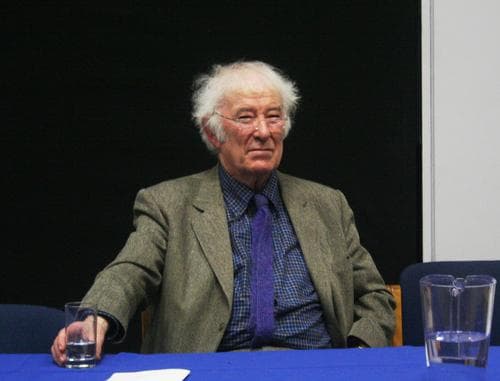
Seamus Justin Heaney was an Irish poet, playwright and translator. He received the 1995 Nobel Prize in Literature. Among his best-known works is Death of a Naturalist (1966), his first major published volume. Heaney was and is still recognised as one of the principal contributors to poetry in Ireland during his lifetime. American poet Robert Lowell described him as "the most important Irish poet since Yeats", and many others, including the academic John Sutherland, have said that he was "the greatest poet of our age". Robert Pinsky has stated that "with his wonderful gift of eye and ear Heaney has the gift of the story-teller." Upon his death in 2013, The Independent described him as "probably the best-known poet in the world".







