“I'm Death. I come at the end. But I'm not the end. I'm just a part of the cycle.”
— Death introducing herself and her role.

Sign in to track this book
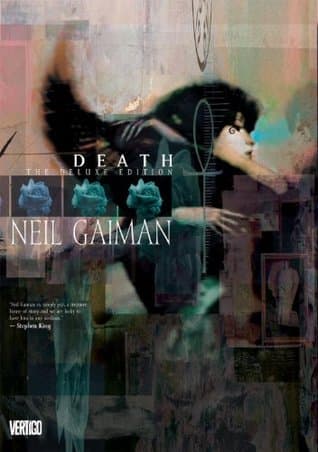
A cheerful, punk-rock Goth girl named Death visits Earth once a century, not to collect souls, but to understand the lives she will one day gently end.
Once every century, Death, one of the Endless, takes human form for a day to better understand humanity. On this day, she becomes a young, pale girl named Didi. She wakes up in a run-down apartment building in London, initially confused by her mortal senses. She soon meets Sexton Furnival, a young man struggling with suicidal thoughts who has been evicted. Didi, with her cheerful manner, immediately talks to him, showing a surprising lack of judgment despite her eternal nature. She helps him with his immediate sadness, offering a unique view on life's value, even as she experiences the everyday frustrations and small joys of human life.
Didi, in her human disguise, walks with Sexton through the streets of London. Sexton is initially dismissive and cynical, but Didi's steady optimism and unusual insights begin to soften him. She shares simple observations about life's beauty and sadness, often comparing them to the larger cosmic order she oversees, though Sexton does not fully grasp her true identity. Their journey includes small, seemingly random encounters that show how fragile and resilient human existence is. Didi's presence encourages Sexton, making him confront his reasons for wanting to end his life and, more importantly, consider reasons for choosing to live.
While walking through a market, Didi and Sexton meet Hazel, an eccentric, homeless woman who claims to be 250 years old and has literally lost her heart. Hazel believes her heart was stolen by a magician named Mad Hettie centuries ago, and she now exists without joy. Didi, recognizing Hazel's unique situation, takes an interest in her story. This meeting shifts the focus from Sexton's personal problem to a broader look at what it means to truly live and feel. Hazel's search for her lost heart becomes a metaphor for the emotional and spiritual emptiness many people experience, even if they haven't literally lost an organ.
Didi, with Sexton reluctantly following, decides to help Hazel find Mad Hettie. Their search takes them through different parts of London, exploring its hidden areas and unusual subcultures. Along the way, Didi continues to share her wisdom about life, death, and how everything is connected. Sexton, initially just watching, becomes more involved in Hazel's search, finding a purpose beyond his own sadness. The journey is not just about finding a physical object, but about restoring hope and meaning to Hazel's long, empty life, and in doing so, subtly changing Sexton's view on his own future.
Eventually, they find Mad Hettie, a decrepit but sharp old woman who is more than she seems. Hettie confirms that she does have Hazel's 'heart,' but it is not a literal organ. Instead, she reveals that Hazel, in her youth, had made a deal to escape the pain of love and loss, effectively giving away her ability for deep emotion. Hettie explains that the 'heart' she holds is a collection of Hazel's past experiences and feelings, which Hazel chose to abandon. This revelation makes Hazel confront her own choices and the results of her desire to avoid suffering.
Mad Hettie, with Didi's subtle encouragement, returns Hazel's 'heart' — not as a physical object, but as the reawakening of her ability to feel. Hazel experiences a deep emotional rebirth, overwhelmed by centuries of suppressed joy and sorrow. She understands that to truly live means embracing both the beauty and the pain of existence. This moment transforms Hazel, who finally accepts the full range of human experience. Sexton sees this rebirth, further strengthening his own changed view on the value and meaning of life, realizing that even sorrow is a part of living.
As the sun sets, marking the end of her day as a mortal, Didi begins to feel the familiar pull of her true form. She has a final, emotional conversation with Sexton, reinforcing the lessons of life and the importance of cherishing every moment. With a gentle touch and her usual smile, Didi changes back into Death, the Endless, leaving Sexton alone but fundamentally changed by their meeting. He is left with a renewed sense of purpose and an understanding that life, even with its difficulties, is a precious gift. Death then returns to her duties, having once again gained insight into the lives she will one day guide.
After Didi leaves, Sexton processes the extraordinary events of the day. He no longer considers suicide and begins to actively seek meaning and connection in his life. The encounter with Didi, Hazel, and Mad Hettie has given him a deep appreciation for the fragility and beauty of existence. He remembers Didi's infectious optimism and her unique view on life and death, using it as a guiding principle. His life, though still ordinary in many ways, now has a sense of purpose and a deeper understanding of the 'high cost of living' and the value of every moment.
In the second story, 'The Time of Your Life,' we meet Rainie, a successful pop star dealing with the pressures of fame and the secret of her true sexual orientation. She is deeply in love with her girlfriend, Foxglove, a fellow musician, but their relationship remains hidden from the public and their managers due to career concerns. Rainie is torn between her desire for honesty and the demands of her public image. The story explores the anxieties of living a double life, the fear of judgment, and the desire for acceptance, setting the stage for a dramatic turning point in her life.
Foxglove, Rainie's beloved partner, suddenly becomes very ill. Her condition quickly worsens, and doctors cannot provide a diagnosis or effective treatment. As Foxglove weakens, Rainie is consumed by fear and desperation, realizing she might lose the person she loves most. This crisis makes Rainie confront her deepest fears and the true value of her relationship with Foxglove, pushing her to consider revealing their secret to the world before it's too late. The shadow of Death begins to hang over their lives, threatening to take Foxglove away.
As Foxglove lies on her deathbed, Death herself appears to her, not in her mortal Didi form, but as the Endless. Death speaks to Foxglove calmly and kindly, explaining the nature of her upcoming transition. Death does not come as a terrifying figure but as a comforting presence, offering Foxglove a chance to reflect on her life and find peace with her journey. This meeting gives Foxglove a unique view on her mortality and the 'miracle of death,' allowing her to face her fate with some serenity, even as Rainie struggles with the impending loss.
Driven by the fear of losing Foxglove and the desire to honor their love, Rainie bravely decides to publicly reveal her relationship with Foxglove, despite potential career consequences. This act of love and defiance is a key moment for Rainie, marking her acceptance of authenticity. Meanwhile, Foxglove, having spoken with Death, is presented with a choice or an understanding of her path. The story ends with Foxglove's final decision about her life, and its deep impact on Rainie, showing that love, even with death, can bring about deep change and a deeper appreciation for 'the time of your life.'
The Protagonist
Death's arc is less about personal change and more about her role in facilitating change in others, reinforcing her compassion and understanding of human existence.
The Supporting
Sexton transforms from suicidal despair to a renewed appreciation for life, thanks to Didi's influence.
The Supporting
Hazel reclaims her capacity for emotion and finds meaning after centuries of emotional emptiness.
The Supporting
Hettie's arc is more about her role as an ancient observer and facilitator, revealing truths rather than undergoing personal transformation.
The Protagonist
Rainie evolves from hiding her true self to publicly embracing her love and identity, finding strength in vulnerability.
The Supporting
Foxglove faces her own mortality with grace, ultimately making a decision that impacts Rainie's future.
The Mentioned
Not applicable in this summary, as he is only mentioned.
The Mentioned
Not applicable in this summary, as he is only mentioned.
The main theme in both stories is that life's preciousness is linked to its finite nature. Death, in her cheerful and kind way, consistently shows that death is not an ending to fear, but a natural, unavoidable part of existence that gives life its meaning. In 'The High Cost of Living,' Didi helps Sexton realize that even suffering is part of the human experience, and avoiding it is avoiding living. In 'The Time of Your Life,' Foxglove's acceptance of her fate, helped by Death, allows Rainie to fully embrace their love and live honestly. The stories argue that accepting mortality allows one to truly appreciate and live life fully.
“You get a lifetime. No more. No less. You get a lifetime.”
This theme is particularly clear in 'The Time of Your Life' with Rainie's struggle. Rainie, as a pop star, must maintain a public image that contradicts her true identity and her love for Foxglove. The pressure to perform a role for her career conflicts with her desire to live honestly. Her eventual decision to publicly acknowledge her relationship, despite the potential consequences, highlights the importance of living truthfully, even when it is difficult. This struggle also subtly reflects Hazel's earlier choice to numb her emotions, living a life without feeling, which ultimately led to emptiness.
“Sometimes you have to stop living someone else's life and start living your own.”
Both stories emphasize the power of love and human connection. In 'The High Cost of Living,' Didi's genuine empathy and connection with Sexton and Hazel help them overcome their sadness and emotional numbness. Hazel's 'lost heart' represents a broken connection to her own ability to love and grieve. In 'The Time of Your Life,' the deep love between Rainie and Foxglove drives Rainie's courage and her final decision to live honestly. The stories suggest that true love, whether romantic or platonic, is a vital force that gives meaning to life and helps people face their greatest challenges, including death.
“Every person is a universe. Every person is a world.”
Through Didi's human experience, the story highlights the beauty and importance found in everyday life. Didi, experiencing human senses and emotions for the first time in a century, finds wonder in simple things like a cup of coffee or a street market. This perspective helps Sexton, who initially sees only despair, to recognize the small joys and connections that make life worthwhile. The stories encourage readers to appreciate the 'high cost of living' by finding meaning and beauty in the ordinary, rather than constantly seeking grand, external validations. Even with cosmic entities, the most important lessons come from human interaction.
“It's all part of the big picture, Sexton. The little bits and the big bits. They all matter.”
Abstract concepts, like Death, are given human form and personality.
This is the core plot device of the series. Death, an abstract cosmic force, is personified as a charming, empathetic young woman. This allows Gaiman to explore profound philosophical questions about life and death through relatable human interactions. By making Death a character with agency and a unique perspective, the narrative demystifies and humanizes the concept of mortality, making it less terrifying and more understandable. Her human form, Didi, further grounds these cosmic ideas in everyday reality.
Death's century-long ritual of experiencing mortality.
Death's tradition of spending one day a century as a mortal, known as the 'walkabout,' serves as a narrative framework for 'The High Cost of Living.' This device allows Death to gain fresh insights into humanity, directly experiencing the joys, sorrows, and frustrations of life. It provides a unique lens through which to examine human existence from both an eternal and a mortal perspective, and it facilitates her encounters with characters like Sexton and Hazel, whose lives she profoundly impacts during her brief time as Didi.
Hazel's literal 'lost heart' symbolizes emotional numbness.
Hazel's claim of having literally lost her heart to Mad Hettie is a powerful metaphor for emotional detachment and the avoidance of pain. It functions as a tangible representation of her centuries-long state of emotional numbness. The quest to retrieve it becomes a journey of self-discovery and re-engagement with the full spectrum of human feeling, illustrating that true living requires embracing both joy and sorrow. Its resolution is not a physical retrieval but an emotional reawakening.
Foxglove's illness acts as a catalyst for Rainie's growth.
In 'The Time of Your Life,' Foxglove's sudden, unexplained illness and impending death serve as a potent plot device. It acts as an external pressure that forces Rainie to confront her deepest fears, her secret relationship, and her desire for authenticity. The threat of loss accelerates Rainie's personal growth and leads to her courageous public confession. It also provides the direct impetus for Death's appearance, bringing the cosmic and the personal together in a poignant exploration of love and loss.
“I'm Death. I come at the end. But I'm not the end. I'm just a part of the cycle.”
— Death introducing herself and her role.
“You get a little life, and then it's over.”
— A simple, direct statement about human existence.
“You lived what anybody gets, Marge. You lived a life. No more, no less.”
— Death comforting a woman named Marge who is about to die.
“Everyone lives, Marge. And everyone dies. It's the order of things.”
— Death explaining the universality of life and death.
“It's a gift. That's what it is. A gift. And it's a privilege to be alive.”
— Death reflecting on the value of life itself.
“You don't get to choose when. You just get to choose how.”
— A reflection on agency in the face of inevitable death.
“There are things in life that are worth dying for.”
— A statement about the ultimate sacrifices people make.
“Every person has a world inside them. A whole world, Marge. And when they die, that world dies with them.”
— Death explaining the unique inner life of each individual.
“I don't take anything away. I just make sure it's over.”
— Death clarifying her role, not as a destroyer but an endpoint.
“The end of one thing is just the beginning of another.”
— A hopeful perspective on the continuity beyond death.
“I'm not the enemy. I'm just part of the process.”
— Death trying to convey her neutral, essential role.
“It's important to live, Marge. Really live. While you can.”
— Death encouraging Marge to embrace life fully.
“There are no easy answers. Just the journey.”
— A philosophical reflection on life's complexities.
“People live and people die. That's the way it's always been, and that's the way it always will be.”
— Death stating a fundamental truth about existence.
“We all have a story, Marge. And every story has an ending.”
— Death relating life to a narrative with a natural conclusion.
Ready to see how well you understood this book? Take our interactive quiz with 10 questions.

Neil Richard MacKinnon Gaiman is an English author of short fiction, novels, comic books, graphic novels, audio theatre, and a screenwriter. His works include the comic book series The Sandman and the novels Good Omens, Stardust, Anansi Boys, American Gods, Coraline, and The Graveyard Book. He has won numerous awards, including the Hugo, Nebula, and Bram Stoker awards, as well as the Newbery and Carnegie medals. He is the first author to win both the Newbery and the Carnegie medals for the same work, The Graveyard Book (2008). In 2013, The Ocean at the End of the Lane was voted Book of the Year in the British National Book Awards. It was later adapted into a critically acclaimed stage play at the Royal National Theatre in London.







