“The world is full of things that can kill you, and some of them are in your own head.”
— Harry's internal monologue about the dangers he faces, both external and psychological.

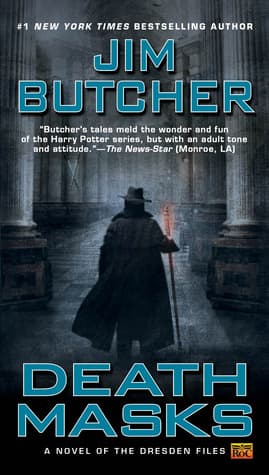
Jim Butcher (2003)
Genre
Fantasy / Mystery
Reading Time
540 min
Key Themes
See below
Sign in to track this book
Caught between a vampiric duel, a sacred relic theft, and his semi-vampire ex-girlfriend's return, Chicago wizard Harry Dresden faces a supernatural storm where each win might lead him closer to his end.
Harry Dresden, Chicago's only professional wizard, is contacted by Father Vincent from Holy Name Cathedral about the upcoming Shroud of Turin exhibition. At the same time, Mavra, a powerful Black Court vampire, sends a ghoul to deliver a challenge to Harry from the Red Court of Vampires' champion, Duke Ortega. This death duel will decide the war between the White Council and the Red Court. Harry accepts, bound by magical law. Soon after, the Shroud of Turin is stolen from Holy Name Cathedral, and Harry becomes a suspect due to his magic and past with supernatural items. He investigates the theft, hoping to clear his name and find the relic.
Harry's ex-girlfriend, Susan Rodriguez, now a half-vampire of the Red Court, returns to Chicago to work on a documentary about the Shroud. Her presence complicates Harry's feelings, especially with her new companion, the mysterious Martin. As Harry investigates the Shroud's theft, professional hitmen, the Denarians, target him. They seem to work for an unknown party. He also faces attacks from ghouls, linked to Mavra, who are also looking for the Shroud. During one attack, Harry finds a handless and headless body, later identified as a minor supernatural community member, adding a murder investigation to his problems.
Harry forms an uneasy alliance with Susan and Martin, who also seem to be looking for the Shroud, for different reasons. Martin shows unusual knowledge of the supernatural world. The Denarians, humans possessed by fallen angels through 30 silver coins, become more aggressive, trying to get the Shroud for their own plans. Harry realizes the Shroud's theft is part of a larger, more dangerous plot involving powerful supernatural beings. He also learns that Nicodemus Archleone, a legendary and terrifying figure in the supernatural underworld, and his daughter Deirdre lead the Denarians.
The duel arrives, and Harry faces Duke Ortega, the Red Court's champion, in a magically enforced arena. Despite Ortega's power and experience, Harry uses clever tactics and luck to defeat him. The victory is costly. The duel, while meeting the challenge's terms, does not end the war as expected. Instead, the conflict seems to grow, especially due to the Denarians' manipulation. The Red Court is hurt by their champion's loss, but their resolve remains, and they seek revenge.
Harry, with help from Bob, his skull-dwelling spirit, and Karrin Murphy, his police contact, uncovers the Denarians' plan. He discovers the stolen Shroud is a replica. The Denarians, led by Nicodemus, plan a ritual using the real Shroud and several powerful items to unleash a devastating force on Chicago. Their goal is to break the city's spirit and corrupt its people. The headless and handless body Harry found earlier is revealed to be part of their dark magic, a sacrifice meant to empower their ritual.
Harry, Susan, Martin, and a small group of allies, including Thomas Raith, confront Nicodemus and his Denarian followers at the Field Museum. The Denarians are trying to perform their ritual, using the real Shroud of Turin, which they had been hiding. A fierce battle begins, with Harry and his allies fighting the fallen angels and their human hosts. During the chaotic fight, several characters' true natures are revealed, and sacrifices are made. Harry uses his full magical power, pushing his limits to stop the ritual.
In a twist, Martin, who seemed an ally, reveals he is a Denarian, possessed by a fallen angel. He betrays Harry and Susan, working with Nicodemus. This betrayal deeply hurts Susan and complicates Harry's understanding of the situation. Martin's goal, to gain power and influence among the Denarians, becomes clear. Harry realizes the threat is more insidious than he first thought, and that trust is rare in the supernatural world.
During the final confrontation, Harry, desperate to stop Nicodemus and save the city, uses the holy power of the Shroud of Turin. The Shroud, with divine grace, proves a strong weapon against the fallen angels. Harry disrupts Nicodemus's ritual and defeats several Denarians. With his allies' help and the Shroud's purifying energy, he prevents the Denarians' dark power from fully manifesting. The Shroud is recovered, though its journey has left a mark on those who touched it.
After the battle, Susan decides to leave Chicago again. She knows her semi-vampiric nature and the dangers around Harry make a normal life impossible for them. Her departure is a sad moment, showing the sacrifices made in the fight against evil. The immediate threat from Nicodemus is gone, but the Denarians remain a powerful danger. Harry knows he will see them again, and the war against darkness is not over. He considers the true cost of his magical life.
In the aftermath, Harry faces the results of his actions and the Denarian attack. He returns the Shroud of Turin to Father Vincent, earning some respect from the Church. The Red Court is still a threat, and the White Council is not happy with Harry's methods, despite his success in stopping the Denarian ritual. Harry thinks about good and evil, the sacrifices in his job, and the dangers hidden beneath Chicago. He understands more about the forces in his world and is determined to protect it.
The Protagonist
Harry confronts the emotional turmoil of Susan's return and the immense power of the Denarians, forcing him to grow in magical prowess and accept the heavy cost of his chosen path.
The Supporting
Susan confronts her vampiric nature and the dangers it brings, ultimately choosing to protect Harry by maintaining a distance.
The Antagonist
Nicodemus attempts to execute a devastating ritual but is ultimately thwarted by Harry, though he remains a powerful and lingering threat.
The Supporting
Murphy continues to adapt to the supernatural world, providing crucial support and maintaining her strong moral compass amidst escalating chaos.
The Supporting
Bob continues to provide essential magical knowledge and sarcastic commentary, deepening his bond with Harry.
The Supporting
Martin's true nature as a Denarian is revealed, exposing his betrayal and cementing his role as an antagonist.
The Supporting
Deirdre remains a loyal and dangerous enforcer for her father, showcasing her unwavering commitment to the Denarian cause.
The Mentioned
Ortega serves as the Red Court's champion, fighting and ultimately losing to Harry in the duel, a significant blow to the Red Court.
The book shows the blurred lines between good and evil, especially through the Denarians, who are humans possessed by fallen angels. Characters like Martin seem kind before showing their corrupt nature. Harry constantly struggles with making hard moral choices, often using 'darker' methods for a greater good, questioning where the line is. The holy power of the Shroud of Turin contrasts with the Denarians' evil, but even its use has risks and needs a good heart.
“There are no heroes, only survivors.”
Many characters make personal and physical sacrifices. Susan's choice to leave Harry for his safety and her struggle with being a vampire show the personal cost of their world. Harry constantly risks his life and endures pain and magical backlash to protect others. The duel with Ortega is a sacrifice of his safety, and the fight against Nicodemus demands great magical effort and physical endurance. This shows that victory often comes at a high price, with lasting emotional and physical effects for everyone.
“Every victory has its price.”
Trust is fragile in Harry's world, shown clearly by Martin's betrayal. Martin first appears as a helpful ally to Susan and Harry, but his true identity as a Denarian working for Nicodemus breaks that trust. This betrayal makes Harry question his judgment and highlights the constant need for caution when dealing with supernatural beings who often have hidden plans. Even in alliances, there is underlying suspicion, forcing characters to always assess loyalties.
“Trust is a weapon that can cut both ways.”
Harry's magical power, while needed to fight evil, is also a heavy burden. It separates him from normal society, makes him a target for powerful beings, and endangers his loved ones. The duel with Ortega and the fight with Nicodemus push Harry to his magical limits, showing the great responsibility that comes with his abilities. The Denarians' vast power is shown to be corrupting, highlighting that power without morals can cause great destruction. The Shroud's power is holy, but even it needs a pure heart to use effectively.
“With great power comes a great big pile of trouble.”
A powerful holy artifact that serves as the central MacGuffin.
The Shroud of Turin acts as the primary MacGuffin, driving much of the plot. Its theft initiates Harry's investigation and brings him into conflict with the Denarians. As a holy relic, it possesses immense spiritual power that becomes a crucial weapon against the fallen angels, particularly in the climax. It represents a focal point of power that both sides are desperate to acquire, its absence and eventual recovery dictating the flow of the narrative and the ultimate confrontation.
Silver coins each containing a fallen angel, used for possession and power.
The Denarian coins are central to the antagonists' power structure. Each coin contains a fallen angel that can possess a human host, granting them immense supernatural abilities. These coins are the source of the Denarians' strength and their threat. They are also a symbolic representation of corruption and temptation, as humans willingly take up the coins for power, sacrificing their souls. The coins allow for a clear hierarchy within the villains and provide a tangible weakness and goal for Harry to target.
A magical, legally binding challenge to a fight to the death.
The duel challenge from the Red Court's champion, Duke Ortega, is a classic plot device that immediately establishes a high-stakes conflict for Harry. It's a magically binding agreement that Harry cannot refuse, forcing him into a direct confrontation that has repercussions for the ongoing war between wizards and vampires. This device provides a clear, time-sensitive goal early in the story and serves as a major turning point, testing Harry's combat skills and magical ingenuity.
The complicated romantic relationship between Harry, Susan, and Martin.
The re-introduction of Susan Rodriguez, coupled with her new companion Martin, creates a significant emotional plot device for Harry. This love tension serves to humanize Harry, highlighting his vulnerabilities and emotional struggles amidst the supernatural chaos. It also introduces an element of personal stakes and emotional manipulation, particularly when Martin is revealed to be a Denarian. The unresolved feelings between Harry and Susan add depth to their interactions and provide motivation for Harry to protect her.
“The world is full of things that can kill you, and some of them are in your own head.”
— Harry's internal monologue about the dangers he faces, both external and psychological.
“There are no heroes, only people who try to do the right thing.”
— Harry's cynical but ultimately hopeful view on morality and heroism.
“I don't believe in happy endings, but I do believe in good ones.”
— Harry reflecting on the outcomes of his struggles and the nature of justice.
“Power always comes with a price, and the price is usually paid by someone else.”
— Harry observing the consequences of magical power and political maneuvering.
“Sometimes, the only way to save someone is to let them go.”
— Harry's painful realization about the limits of his ability to help others.
“Fear is a tool. It can be used to control, or it can be used to protect.”
— Harry contemplating the dual nature of fear in the face of danger.
“The monster you can see is rarely the one you should fear.”
— A warning about hidden threats and the deceptive nature of appearances.
“Never underestimate the power of a good lie, especially when it's mixed with a little bit of truth.”
— Harry's understanding of manipulation and the effectiveness of well-crafted lies.
“Sometimes, the only way to get a straight answer is to ask a crooked question.”
— Harry's approach to interrogations and his willingness to use unconventional methods.
“It's a strange thing, but the more you hurt, the more you learn.”
— Harry reflecting on the lessons learned from his painful experiences.
“Even a blind squirrel finds a nut once in a while.”
— Harry's self-deprecating humor about his own occasional successes despite his blunders.
“The past is a stubborn thing. It doesn't like to be forgotten.”
— Harry's observation about how past events continue to influence the present.
“There's a fine line between bravery and stupidity, and I walk it like a tightrope walker on a unicycle.”
— Harry's characteristic self-awareness of his reckless tendencies.
“Magic is a tool, not a solution.”
— Harry's pragmatic view on the limitations and applications of magic.
“You can't always choose your battles, but you can always choose how you fight them.”
— Harry's conviction about agency and determination in the face of adversity.
Ready to see how well you understood this book? Take our interactive quiz with 10 questions.

Biography coming soon.







