“Sure, that's life for you, it's a dirty business, and no mistake.”
— Milly discussing the harsh realities of life in Ireland.

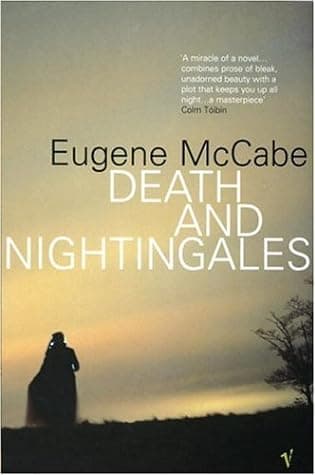
Eugene McCabe (1992)
Genre
Literary Fiction / Historical Fiction
Reading Time
240 min
Key Themes
See below
Sign in to track this book
On her twenty-fifth birthday in 1883 Fermanagh, Beth Winters, caught between her stepfather's cruelty and a charismatic rogue, races against a family curse to escape a life of pain and betrayal before it consumes her.
The story begins on the eve of Beth Winters' 25th birthday, May 19, 1883, in County Fermanagh, Ireland. Beth describes her life of servitude and emotional abuse under her Protestant stepfather, Billy Winters, a landowner and mill owner, after her Catholic mother's death. She has secretly planned to elope with Liam Ward, a Catholic man from the local village, on her birthday night. Her escape involves meeting Liam and a boat journey across the lough. Beth thinks about her past, her mother's tragic life, and her father's absence, all of which drive her desire for freedom from her home, Carrickdrin. She carefully prepares her few belongings and steels herself for the dangerous night, knowing her stepfather's temper.
Billy Winters, consumed by suspicion and a hatred for Catholics, watches Beth's preparations. He knows about her upcoming birthday and her inheritance from her biological father, money he controls. Billy's thoughts show his past: his affair with Beth's mother, Annie, while her husband was alive, and his marriage to Annie after her husband's death, which he arranged. He believes Beth has been meeting someone and wants to prevent her from leaving, seeing her as his property and a worker. He watches Beth closely, scrutinizing her every move, especially when she goes towards the lough or the village. His paranoia is clear, driven by a fear of losing control and guilt over past actions.
On her birthday night, Beth and Billy share a tense dinner. Billy, pretending to be concerned, tries to talk to Beth, but his questions are loaded, looking for signs of her intentions. He subtly reveals he knows about her secret meetings, mentioning the paths she takes and people she might see. Beth, while appearing innocent, feels a growing dread as she realizes how much he watches her. Billy offers her a glass of drugged milk, supposedly to help her sleep, but Beth, expecting this, spills most of it. The dinner is a psychological battle, with Billy trying to dominate and Beth trying to hide her escape, all while fearing her plan might already be known.
As the night goes on, Beth slips out of the house, going towards the meeting point by the lough. She feels terror and excitement, freedom almost within reach. Liam Ward arrives as planned; his presence is a sign of hope for Beth. He is charming and reassuring, confirming their plan to escape together to America. Beth feels a strong connection to Liam, believing he will save her. She tells him about her life under Billy's tyranny, and Liam listens. They discuss their escape, including the boat journey and the money Beth has. Despite the danger, Beth's resolve strengthens, convinced Liam is her only way out.
By the lough, Beth tells Liam a shocking secret: her mother, Annie, poisoned her biological father, Frank, to be with Billy. This deeply bothers Liam, who struggles with the moral implications. Beth, driven by desperation and a desire to protect Liam, suggests a similar solution for Billy, offering the poisoned milk Billy had intended for her. She proposes they use it to incapacitate or kill Billy, ensuring their escape and protecting her inheritance. Liam, at first hesitant and repulsed, is persuaded by Beth's conviction and the money. Their pasts and the bleakness of their future without this action push them towards a terrible decision, blurring the lines between victim and perpetrator.
Beth and Liam return to Carrickdrin, the air thick with tension and their unspoken pact. Billy is still awake, seemingly unaware of their meeting or their conversation. Beth, with Liam's support, approaches Billy, pretending concern and offering him the poisoned milk, saying it will help him sleep. Billy, confident in his control and believing Beth is under his influence, accepts the drink. The scene has a chilling politeness, as Beth and Liam play their parts, each moment heavy with the coming act. The house, usually a place of oppression for Beth, now becomes the stage for a desperate and dangerous confrontation, with the roles of predator and prey seemingly reversed.
Beth, with Liam's help, gives the poisoned milk to Billy. He drinks it, believing it to be a harmless sedative. The poison quickly takes effect, and Billy begins to choke and convulse. A violent struggle follows as Billy realizes what is happening. He fights for his life, accusing Beth of betrayal, his strength surprising even in his weakened state. Beth and Liam must physically restrain him, a brutal act. The scene is chaotic and terrifying, as the reality of their actions hits them. The struggle is messy and desperate, far from the quick death they might have imagined, leaving them both traumatized and marked by their deed.
Billy Winters dies from the poison, his last breaths filled with accusations and a revelation. As he dies, he whispers a secret to Beth, a truth that shatters her understanding of her entire life: he is her biological father. This changes her relationship with him, her mother, and her own identity. The man she hated, the man she just killed, was her true father. This revelation sends Beth into profound shock and despair, turning her act of liberation into patricide. Liam, seeing this exchange, is also deeply affected, realizing the full weight of their actions and the depth of the lies that shaped Beth's life.
After Billy's death and his shocking revelation, Liam Ward's true character appears. Instead of comfort or support, he shows his mercenary intentions. He takes Beth's inheritance money, the sum meant for their escape and new life, and abandons her. He leaves her alone with the dead body of her father/stepfather, the weight of her actions, and the devastating truth of her parentage. Beth is left alone and betrayed, her dreams of freedom and a new life with Liam shattered. The man she believed would save her instead exploited her and left her to face the consequences of their crime by herself. Her despair is complete, as she realizes her naivety and the tragedy of her choices.
As dawn breaks over Carrickdrin, Beth Winters is in the house with Billy Winters' body and the wreckage of her life. The realization that Billy was her father, along with Liam's betrayal, leaves her devastated. She reflects on her mother's tragic life, her own desperate choices, and the cycle of violence and deceit that has affected her family. The freedom she wanted has come at an unbearable cost, leaving her isolated and burdened by an unspeakable crime. The story ends with Beth alone, facing the consequences of her actions, the Fermanagh landscape mirroring her inner desolation. Her future is uncertain, but she is changed by the events of her 25th birthday, forever marked by death and betrayal.
The Protagonist
Beth transforms from a hopeful, naive escapee to a heartbroken and utterly betrayed individual, forced to confront the devastating truths of her family's past and her own complicity.
The Antagonist
Initially a tyrannical figure, Billy's character is recontextualized by his deathbed confession, revealing him as both Beth's abuser and her biological father, a man whose dark past irrevocably shaped her life.
The Supporting
Liam's character arc moves from Beth's perceived savior to her ultimate betrayer, revealing his true opportunistic nature.
The Mentioned
Though deceased, Annie's story is revealed incrementally, showing her transformation from a trapped wife to a desperate woman who commits murder, leaving a legacy of tragedy.
The Mentioned
Frank's character is static, a victim whose death drives much of the narrative's underlying tension and secrets.
The Supporting
Mary remains a static character, a background figure who embodies the submissive role of servants and the fear of authority.
The Mentioned
The community serves as a static, watchful entity, reflecting the social and religious divisions of the time.
Beth's journey is a quest for identity, first defined by her desire to escape her stepfather and her idealized view of her biological father. The revelation that Billy is her true father at his death completely changes her understanding of herself, her parentage, and her place in the world. She grapples with her mother's choices and her own acts, forcing her to confront who she is outside of the stories she's been told or created. Her identity shifts from victim to perpetrator, from hopeful escapee to betrayed and isolated individual.
““I was a child, and now I am a woman. And I have killed my father. And I don’t know who I am.””
Betrayal is a constant theme, happening on many levels. Beth's mother betrayed her first husband with Billy and then poisoned him. Billy betrays Beth's trust and manipulates her for years. Liam betrays Beth's love and trust by abandoning her and stealing her money. Beth even betrays her own moral compass by agreeing to the poisoning. The novel reveals layers of deceit, showing how secrets and lies within a family and community can lead to devastating consequences, leaving characters isolated and destroyed. Liam's abandonment is the ultimate betrayal for Beth, leaving her to face the aftermath alone.
““He had promised her the world, and now he had taken everything.””
Beth's main motivation is her desperate need for freedom from her stepfather, Billy. Her home, Carrickdrin, is shown as a prison, and her life as servitude. The beautiful but harsh Fermanagh landscape ironically reflects her trapped existence. Her escape plan with Liam is her perceived path to liberation, but the novel explores the reality that true freedom often comes at an unbearable cost, or is an illusion. Ultimately, Beth's act of rebellion, while freeing her from Billy's physical presence, leaves her psychologically imprisoned by her actions and the truths she uncovers.
““For twenty-five years I have been a prisoner in this house. Tonight, I will be free.””
The novel shows how violence, both physical and psychological, and trauma are passed down through generations. Beth's mother poisoned her father, a secret Beth uses to justify poisoning Billy. Billy's abusive nature and control come from his own dark past and desires. Beth's act of patricide, though born of desperation, continues this cycle of violence within the family. The trauma of her upbringing and her mother's choices directly lead to Beth's tragic decisions, suggesting that escaping such a cycle is difficult, if not impossible, in a society steeped in historical grievances and personal wounds.
““The past was not dead. It was not even past.””
While not the main focus, the sectarian tensions between Protestants and Catholics in 19th-century Fermanagh subtly shape the story. Billy Winters' prejudice towards Catholics is clear in his thoughts and actions, and Beth's Catholic identity influences her desire to escape his Protestant household. Liam Ward, a Catholic, offers Beth a perceived escape to a different world. The social divisions contribute to the characters' motivations and the sense of isolation, reflecting Ireland's broader historical context. The religious difference between Beth and Billy highlights the cultural gap separating them and makes their relationship impossible.
““He hated the Papists with a passion that burned like a peat fire.””
Provides intimate access to Beth's thoughts, fears, and motivations.
The novel is primarily narrated from Beth Winters' first-person perspective, interspersed with sections from Billy Winters' viewpoint. Beth's narration is crucial for establishing her subjective experience of oppression, her desperate hope for freedom, and her internal struggle with her conscience. It allows the reader to deeply empathize with her plight and understand her radical actions, even as they unfold into tragedy. This intimate perspective makes the final betrayals and revelations all the more devastating, as we have been privy to her deepest desires and fears.
Offers contrasting views and reveals hidden truths through shifting viewpoints.
The narrative alternates between Beth's first-person perspective and Billy Winters' third-person, limited perspective. This dual viewpoint is a powerful device. Beth's sections highlight her victimhood and yearning for escape, while Billy's sections reveal his paranoia, control, and the dark secrets of his past, including his role in Frank's death and his true relationship with Beth. This juxtaposition creates dramatic irony and suspense, as the reader often knows more than Beth, particularly about Billy's surveillance and intentions, until the final, shocking revelation that unites their narratives in a tragic way. It allows for a more comprehensive, albeit unsettling, understanding of the complex power dynamics.
Hints at future events and reveals discrepancies between character knowledge and reality.
The novel employs significant foreshadowing, particularly through Billy's internal monologues, which hint at his dark past and his true relationship with Beth long before the final reveal. Beth's reflections on her mother's actions also foreshadow her own. Dramatic irony is present throughout, as the reader often understands Billy's sinister intentions (e.g., the poisoned milk) before Beth does, intensifying the tension. The most profound use is the irony of Beth's desperate act of killing her 'stepfather' only to discover he was her biological father, transforming an act of liberation into patricide, a twist that redefines the entire narrative.
The bleak, beautiful Fermanagh landscape mirrors the characters' internal states and the story's grim tone.
The Fermanagh landscape, with its loughs, hills, and isolated farmsteads, functions as more than just a backdrop; it is almost a character itself. Its beauty is often juxtaposed with the harshness and violence of the human drama unfolding within it. The lough, in particular, symbolizes both escape and danger, a path to freedom but also a place of secrets and potential death. The isolation of Carrickdrin mirrors Beth's emotional isolation and entrapment. The bleak, unforgiving nature of the land reflects the grim, fatalistic tone of the story and the characters' struggles against their circumstances, a silent witness to their despair and desperate acts.
A symbolic object representing manipulation, betrayal, and a cyclical pattern of violence.
The poisoned milk is a potent symbol in the novel. Initially, Billy offers it to Beth to sedate her, a tool of his control and manipulation. Beth, aware of his intent, then turns it against him, transforming it into an instrument of her perceived liberation. This act echoes her mother's use of poison to kill Beth's biological father, establishing a horrific cycle of violence and betrayal within the family. The milk, usually a symbol of nourishment and innocence, becomes corrupted, representing the dark, twisted nature of the relationships and the desperate measures taken for freedom or revenge. It is the literal and symbolic pivot point of the plot.
“Sure, that's life for you, it's a dirty business, and no mistake.”
— Milly discussing the harsh realities of life in Ireland.
“The past is a foreign country; they do things differently there.”
— A reflection on the historical setting and the different moral codes of the past.
“There's no good in looking back, none at all. What's done is done.”
— Milly's pragmatic view on not dwelling on past events.
“God forgive us all for what we do and what we leave undone.”
— A plea for forgiveness, highlighting the moral complexities faced by the characters.
“The wind was a living thing, tearing at the thatch, howling round the corners of the house.”
— Describing the wild, untamed nature of the Irish landscape.
“Love is a strange thing, it can make a fool of the wisest man.”
— A general observation on the unpredictable and powerful nature of love.
“Silence. The kind of silence that screams.”
— Conveying a moment of intense unspoken tension or dread.
“Some things are best left buried, deep down where they belong.”
— A character's desire to suppress painful or dangerous secrets.
“The world was a dark place, full of dark deeds.”
— Milly's somber assessment of the world around her, reflecting the book's tone.
“Hope is a dangerous thing, a cruel mistress.”
— A cynical view on the nature of hope in a bleak situation.
“The air was thick with unspoken words, with fears and desires.”
— Describing the palpable tension and hidden feelings between characters.
“A man’s word, once given, is his bond.”
— Emphasizing the importance of honor and promises in the rural community.
“There are some things you never get over, no matter how long you live.”
— A reflection on enduring grief and trauma.
“The land itself seemed to breathe, a living, ancient thing.”
— Portraying the deep connection between the characters and the Irish landscape.
Ready to see how well you understood this book? Take our interactive quiz with 10 questions.







