“I’m Dexter, and I’m not sure what I am. I just know there’s something dark inside me, and I’m pretty sure it’s a good thing.”
— Dexter's internal monologue about his nature early in the book.

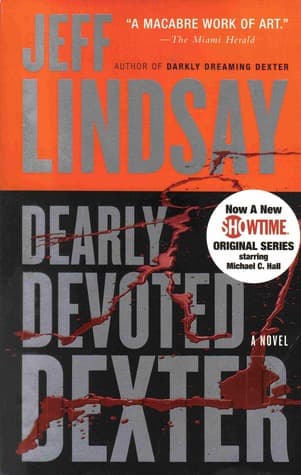
Jeff Lindsay (2005)
Genre
Thriller / Mystery
Reading Time
360 min
Key Themes
See below
Sign in to track this book
Miami's favorite vigilante serial killer, Dexter Morgan, struggles to maintain his 'normal' facade and evade a suspicious detective while a new, shockingly brutal psychopath reignites his own dark urges, forcing him into a twisted hunt where only a monster can catch a monster.
Dexter Morgan struggles to maintain his 'normal' persona, living with his girlfriend Rita and her children, Astor and Cody. This domestic bliss is a carefully constructed charade designed to throw off Sergeant Doakes, who is suspicious of Dexter. Dexter, a blood-spatter analyst for the Miami Police Department and a serial killer who only targets other murderers, finds this enforced normalcy stifling. His 'Dark Passenger' – the urge to kill – is growing restless, making him irritable. He longs for the thrill of the hunt and the satisfaction of dispensing his unique brand of justice, but Doakes's constant surveillance forces him to suppress his true self, leading to frustration and boredom.
Miami is afraid as a new, exceptionally brutal serial killer emerges. The media calls him the 'Dissector.' This killer leaves victims meticulously dismembered and arranged in bizarre, almost artistic displays. The grotesque nature of the crimes, involving surgical precision and a deep understanding of anatomy, fascinates Dexter. He sees a kindred spirit, though one whose methods are more public and theatrical than his own. This new killer awakens Dexter's dormant Dark Passenger, providing a potential outlet for his suppressed urges and a target that might satisfy his unique moral code. The Dissector offers Dexter a welcome distraction from his domestic charade and the constant threat of Doakes.
Dexter's adoptive sister, Deborah Morgan, a newly promoted detective, is assigned to the Dissector case, to her excitement and Dexter's concern. Deborah is ambitious and determined to prove herself, but her involvement also puts Dexter in a precarious position. While he wants to help her, he also sees the Dissector as his personal project. He begins subtly manipulating the investigation, using his expertise in blood spatter and criminal psychology to guide Deborah's team, all while secretly hoping to get close enough to the killer to claim him for himself. He enjoys the intellectual challenge of piecing together the killer's motives and methods, viewing it as a twisted game.
Dexter works with Deborah on the Dissector case, examining the crime scenes. He is impressed by the killer's meticulousness and the ritualistic nature of the dismemberments. Each victim is a young woman, and their bodies are arranged with a strange, almost artistic flair, suggesting a psychological motivation beyond simple sadism. Dexter notes the surgical precision and the absence of any struggle, indicating the killer either knew his victims or was skilled at incapacitation. He recognizes a twisted sense of artistry, a dark reflection of his own careful, ritualistic kills. This analysis further fuels his desire to understand and eventually confront the Dissector.
Throughout the investigation, Sergeant Doakes remains a constant, menacing presence in Dexter's life. Doakes believes Dexter is a serial killer and watches his every move, making it nearly impossible for Dexter to indulge his Dark Passenger without risking exposure. Doakes's unwavering suspicion forces Dexter to maintain his 'normal' facade, even as the Dissector case increasingly tempts him. The tension between them is palpable, a silent battle of wills. Dexter finds Doakes's persistence irritating but also a strange sort of validation; someone finally sees him for what he truly is, even if it's an enemy. Doakes's presence is a perpetual threat, but also a challenge Dexter enjoys circumventing.
As Dexter looks deeper into the Dissector's work, he begins to see a pattern beyond mere dismemberment. The arrangement of the body parts, the specific organs removed, and the locations where the bodies are found seem to be part of a larger, cryptic message. Dexter suspects the Dissector is not just killing but is trying to convey something disturbing through his macabre art. This realization makes the case for Dexter a complex puzzle, a dialogue between two predators. He feels a twisted kinship with the killer, an understanding of the need to express the inexpressible through violent acts.
Amidst the serial killer investigation, Rita's abusive ex-husband, Paul, is released from prison, bringing new domestic drama and stress into Dexter's life. Paul's return threatens the fragile stability Dexter has built with Rita and her children. He tries to reinsert himself into their lives, causing distress for Rita and creating an unwelcome distraction for Dexter. While Dexter is outwardly calm, he secretly considers Paul a potential candidate for his 'dark work,' seeing him as a genuine threat to Rita's happiness and the children's well-being. Paul's presence adds another layer of complexity to Dexter's already crowded emotional life.
In a shocking turn of events, Sergeant Doakes disappears. His car is found abandoned, and the circumstances suggest he might be the latest victim of the Dissector. This development makes the Miami PD frantic and, ironically, frees Dexter from Doakes's constant scrutiny. While Dexter initially feels relief, he also recognizes the dark implications. Doakes, despite being his nemesis, was a known quantity. His disappearance, especially if he's in the hands of the Dissector, is unsettling. Dexter feels a twisted sense of responsibility and a renewed urgency to find the killer, not only for Deborah but also to understand what happened to his shadow.
Following clues, Dexter uncovers the identity of the Dissector: Dr. Danco, a brilliant but deranged surgeon who was performing illicit, experimental organ transplants on unwilling victims. Dexter realizes Danco was trying to create a 'perfect' human by combining various body parts. He finds Doakes alive but severely mutilated, held captive by Danco. Doakes, despite his injuries, recognizes Dexter and is horrified to see him in action, confirming his suspicions about Dexter. The confrontation between Dexter and Danco is intense, leading to a brutal struggle where Dexter, driven by his Dark Passenger, finally kills the Dissector.
With Danco dead, Dexter carefully stages the scene to make it appear as though Danco was the one who abducted and tortured Doakes. He ensures that Doakes, who is now gravely injured and unable to speak, cannot reveal Dexter's secret. Dexter manipulates the evidence to implicate Danco fully, cementing his reputation as a hero who saved Doakes. The case is closed, Deborah is lauded, and Dexter returns to his 'normal' life, though now with the added complication of a permanently silenced Doakes and the knowledge that his secret was almost exposed. He reflects on the thrill of the hunt and the satisfaction of having dealt with a truly monstrous individual, anticipating his next victim.
The Protagonist
Dexter attempts to suppress his true nature, only to have it reawakened by a new, gruesome killer, ultimately reaffirming his identity as a predator.
The Supporting
Deborah successfully investigates a major case, solidifying her career as a detective, unaware of her brother's dark involvement.
The Supporting
Rita navigates the challenges of her ex-husband's return, finding strength in her relationship with Dexter, though still unaware of his true self.
The Antagonist
Doakes's relentless pursuit of Dexter culminates in his abduction and mutilation, confirming Dexter's true nature in his final moments of awareness.
The Antagonist
Danco operates freely until Dexter identifies him, leading to his demise at Dexter's hands.
The Supporting
Astor continues to grow up in a chaotic household, unknowingly influenced by Dexter's dark presence.
The Supporting
Cody subtly reveals a nascent dark side, prompting Dexter to consider his role as a mentor.
The Supporting
Paul's attempts to reclaim his family lead to his downfall, orchestrated by Dexter.
Dexter continuously struggles with his dual identity as a normal citizen and a serial killer. He tries to reconcile his 'Dark Passenger' with the facade of domesticity he maintains with Rita and her children. The emergence of the Dissector forces him to confront his true nature and the unique 'art' of his kills, leading to a deeper understanding of his own predatory instincts. He constantly questions what it means to be human versus what it means to be a monster, often feeling more kinship with other killers than with 'normal' people. His internal monologue reflects this ongoing search for self-definition within his unique existence.
“I really am a monster, you know. I'm just a very well-behaved monster.”
The novel explores different facets of evil through its characters. Dexter embodies a controlled, ethical evil, targeting only those who have committed heinous crimes. In contrast, Dr. Danco, the Dissector, represents a more chaotic and deranged form of evil, driven by a twisted scientific ambition rather than a moral code. The book examines the psychological motivations behind these acts, contrasting Dexter's internal struggle with Danco's detached brutality. It raises questions about whether some evil is necessary to combat greater evil, and the fine line between justice and vengeance. The narrative challenges the reader to empathize with a 'good' monster.
“I don't enjoy the killing. Not in the way a normal person enjoys anything. I enjoy the process, the hunt, the final, perfect moment of the kill, yes. But it's not joy. It's... satisfaction.”
A central theme is the contrast between Dexter's public persona and his hidden, monstrous reality. He presents himself as a charming, slightly awkward forensic analyst and devoted boyfriend/stepfather, performing the rituals of normal life. This facade is crucial for his survival, especially under the constant scrutiny of Sergeant Doakes. The entire plot revolves around Dexter's efforts to maintain this illusion while secretly indulging his true nature. The story shows how easily appearances can deceive and the often-unseen darkness that can lurk beneath a seemingly normal surface, questioning what 'normal' truly entails.
“Every day is a performance. Every smile, every nod, every small gesture of human empathy is a carefully rehearsed movement in a play no one knows I'm acting in.”
The book examines the blurred lines between justice and personal vengeance. Dexter operates outside the legal system, believing that true justice often fails to be served by conventional means. He sees himself as a necessary evil, correcting the wrongs that the police cannot. His 'Code of Harry' dictates that he only kills other murderers, positioning him as a dark angel of retribution. The existence of the Dissector, a killer with his own twisted logic, further complicates this theme, forcing Dexter to confront a different interpretation of 'justice.' The narrative implicitly asks whether Dexter's actions, though morally reprehensible, are ultimately beneficial for society.
“I don't make the rules. I just enforce them. The ones that matter, anyway.”
Dexter's internal manifestation of his homicidal urges
The Dark Passenger is Dexter's metaphorical representation of his innate, insatiable urge to kill. It functions as an internal voice, a separate entity that guides and often compels Dexter's actions. It is both a curse and a source of twisted comfort for him, defining his identity. In 'Dearly Devoted Dexter,' the Dark Passenger becomes increasingly restless due to Dexter's enforced domesticity, driving the plot forward by pushing him to seek out a new victim. It serves as a constant reminder of his true nature and the internal conflict he faces between his monstrous desires and his need to appear human.
A constant external threat that restricts Dexter's actions
Sergeant Doakes's relentless and unwavering suspicion of Dexter acts as a major external plot device. His constant surveillance forces Dexter to maintain his 'normal' facade and significantly limits his opportunities to indulge his Dark Passenger. This creates immense tension and drives Dexter's frustration, directly leading to his intensified search for a suitable victim (the Dissector) that he can pursue under the guise of police work. Doakes's presence is a critical obstacle that shapes Dexter's choices and increases the stakes of his secret life, until his dramatic removal from the scene.
A strict moral guideline for Dexter's kills
The Code of Harry is a set of rules given to Dexter by his adoptive father, Harry Morgan, designed to channel Dexter's homicidal urges towards only killing other murderers who have escaped justice. This code functions as Dexter's moral compass and justification for his actions, distinguishing him from other serial killers. It dictates his choice of victims, his meticulous planning, and his ritualistic disposal methods. In 'Dearly Devoted Dexter,' the Code is tested as he encounters the Dissector, a killer whose methods are outside the Code's usual parameters, yet still aligns with the spirit of targeting 'bad' people, allowing Dexter to rationalize his hunt.
Dexter's professional skills used to both investigate and mislead
Dexter's professional role as a blood-spatter analyst is a crucial plot device. It provides him with legitimate access to crime scenes, allowing him to gather information, analyze patterns, and subtly guide investigations. His expertise enables him to understand the methods of other killers, like the Dissector, and to anticipate police actions. Conversely, he uses this same knowledge to meticulously cover his own tracks, stage crime scenes, and mislead law enforcement when necessary. This dual application of his skills highlights his intelligence and control, making him an almost undetectable predator operating within the very system designed to catch him.
“I’m Dexter, and I’m not sure what I am. I just know there’s something dark inside me, and I’m pretty sure it’s a good thing.”
— Dexter's internal monologue about his nature early in the book.
“There was a certain satisfaction in having a secret, a very dark, very large secret, and knowing that no one else suspected.”
— Dexter reflecting on the hidden aspect of his life.
“The Dark Passenger was purring now, a low, contented rumble deep inside me.”
— Dexter's personification of his killer urges when he is close to a kill.
“Normal people. They're so fragile. You have to be careful with them, or they might break.”
— Dexter's observation of ordinary people and his own perceived difference.
“I was a monster, yes, but a monster with a code, a monster who served a purpose.”
— Dexter justifying his actions through Harry's Code.
“The world was full of monsters, and I was just one of them, albeit one with a very specific diet.”
— Dexter's cynical view of humanity and his place within it.
“Love was a complicated thing, something I didn't quite understand, but I knew it had power.”
— Dexter contemplating his relationship with Rita.
“Every time I thought I had a handle on things, life would throw another curveball.”
— Dexter's internal struggle with unexpected events in his life.
“Sometimes, the best way to hide in plain sight is to be exactly what everyone expects you to be.”
— Dexter's strategy for maintaining his facade.
“The darkness inside me wasn't a curse; it was a tool, a very sharp and efficient tool.”
— Dexter's reinterpretation of his dark urges as something useful.
“There was a certain grim humor in the fact that I, a serial killer, was trying to live a normal life.”
— Dexter's ironic perspective on his attempts at normalcy.
“The hunt was always the best part, the slow, methodical stalking, the unraveling of the prey.”
— Dexter describing the thrill of the chase before a kill.
“Justice, in my world, was a very personal thing, dispensed with a keen blade and a clear conscience.”
— Dexter's definition of his own brand of justice.
Ready to see how well you understood this book? Take our interactive quiz with 10 questions.

Biography coming soon.







