“You can't change how other people think and act, but you're in full control of you.”
— Justyce's mother advises him after a racist encounter.

Sign in to track this book
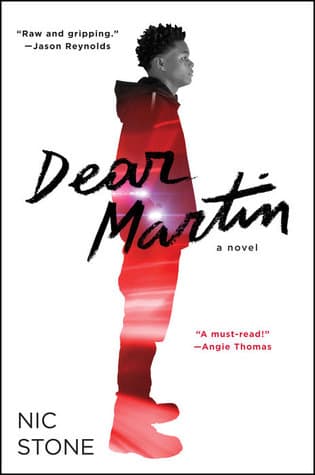
After a racially charged police encounter, an Ivy League-bound Black teenager deals with injustice by journaling to Dr. Martin Luther King Jr., then finds himself in a shooting that starts a media storm.
Justyce McAllister, a Black senior at the mostly-white Braselton Prep school, tries to help his drunk ex-girlfriend, Melo Taylor, get home from a party. As he puts her in her car, a white police officer, Officer Castillo, stops him. Even though Justyce tries to explain, the officer thinks he is a threat because of his race and violently handcuffs him. This bad experience makes Justyce angry and confused, leading him to start a journal to Dr. Martin Luther King Jr., asking for advice on how to deal with racial injustice today.
After his arrest, Justyce begins writing in his journal to Dr. King. He wonders if King's ideas of nonviolence and peaceful protest still matter in a society where he, a Black student doing well, is still seen as a threat. He faces small daily insults at Braselton Prep, especially from his debate partner, Jared Christensen, who often makes racially insensitive comments. Justyce deals with his two identities – a Black man from a less privileged area and a successful student in an elite white setting – and tries to match the unfairness he faces with Dr. King's ideals.
Problems between Justyce and Jared get worse at a Halloween party. Jared and his friends dress as 'thugs' and 'stereotypes,' making fun of racial and economic groups. Justyce and his best friend, Manny Rivers, dress as 'STATISTICAL IMPOSSIBILITIES' – a Black Panther and a Black doctor. Jared's costume, wearing a 'hoodie' and baggy pants, particularly offends Justyce. This event shows the deep racial insensitivity of some of Justyce's white classmates and makes him feel more frustrated and alone, confirming his belief that trying to 'fit in' is useless.
Justyce finds a like-minded person in Sarah-Jane Friedman, his debate partner. She truly cares about him and is clearly uncomfortable with Jared's behavior. Their connection grows during a school debate, where they argue for affirmative action. After the debate, Justyce and SJ share a close moment and start a romantic relationship. This new connection gives Justyce hope and a sense of belonging, contrasting with the racial frustrations he feels with others. He begins to feel a bit of hope that he can find understanding and love despite society's biases.
Manny, who at first was more quiet about racial issues than Justyce, starts to change. Inspired by Justyce's experiences and his own growing awareness, Manny confronts Jared and their other white friends about their racist jokes and attitudes. This leads to a physical fight between Manny and Jared. The event is a turning point for Manny, as he starts to actively recognize and challenge the racism around him. This brings him closer to Justyce's view and strengthens their friendship, but also separates them from their old social group.
While driving with Manny, listening to loud hip-hop music, they meet an off-duty white police officer, Garrett Tison, at a stoplight. Tison, annoyed by their music, shouts racial slurs and tells them to turn it down. Manny, fueled by his recent awakening and anger, refuses to obey and provokes Tison. Tison then pulls out a gun and shoots multiple times into their car. Manny dies instantly, and Justyce is shot in the arm. This senseless violence shatters Justyce's world and leaves him deeply traumatized, making him question everything he thought he knew about justice and fairness.
After the shooting, Justyce is in the hospital and then released, but his trouble continues. The media's story of the event is very biased, showing Manny and Justyce as attackers and criminals, while Tison is shown sympathetically. Justyce faces intense public scrutiny, hate mail, and online harassment. This makes his trauma and sense of injustice even worse. The story shifts from Tison's guilt to the supposed 'thuggish' behavior of the Black victims, showing systemic racism in media and justice systems.
Garrett Tison's trial begins, and Justyce, despite his injuries and trauma, is called to speak. The defense lawyer tries to discredit Justyce and Manny, focusing on the loud music and Manny's defiant words, instead of Tison's deadly reaction. Despite strong evidence and emotional testimony, the jury finds Tison not guilty of all charges. This decision is a crushing blow to Justyce, Manny's family, and the Black community. It confirms their fears about racial bias in the justice system and leaves Justyce feeling completely defeated and without hope for true justice.
After Tison is found not guilty, Justyce is consumed by sadness and anger. He struggles with depression and the desire for revenge. However, he slowly finds strength with the help of his mother, SJ, and Dr. Rivers (Manny's father). He decides to turn his pain into action, promising to honor Manny's memory by finding a way to fight for justice and make a positive difference. He realizes that while Dr. King's methods might seem hard, the underlying goal of justice and equality is still most important, and he must find his own way to help.
Inspired by Manny's memory and Dr. King's lasting message, Justyce decides to go to Yale University to study law. He realizes that his intelligence and position can be strong tools in the fight against racial injustice. He continues to write in his journal, but his entries now show a more mature understanding of the struggle's complexities. At Yale, he finds new allies and a community that supports his goals. This shows a hopeful, though challenging, future where he can actively help create a more just society, carrying Manny's legacy with him.
The Protagonist
Justyce evolves from a confused and frustrated young man seeking answers to a determined activist committed to fighting racial injustice through legal means.
The Supporting
Manny transforms from a somewhat complacent individual to someone actively aware and defiant against racial prejudice, ultimately becoming a martyr for the cause.
The Supporting
SJ remains a steadfast ally to Justyce, growing in her understanding of racial injustice and her commitment to supporting him.
The Antagonist
Jared shows limited growth, remaining largely entrenched in his prejudiced views, serving as a foil to Justyce's experiences.
The Antagonist
Tison's character remains static, serving as the catalyst for the novel's central tragedy and a symbol of racial injustice.
The Supporting
Dr. Rivers moves from a position of cautious assimilation to one of active advocacy for justice after his son's death.
The Supporting
Her arc is primarily one of consistent support and love for Justyce, enduring alongside him through his struggles.
The Supporting
Doc serves as a consistent source of wisdom and encouragement, helping Justyce navigate his emotional and intellectual struggles.
The Mentioned
Melo's primary role is to initiate the inciting incident for Justyce's journey.
This is the main theme, shown through Justyce's unfair arrest and Manny's fatal shooting. The novel clearly shows how Black people, no matter their achievements or intentions, are often seen as threats by police. It highlights the systemic nature of racism, from small daily insults by white classmates like Jared to the justice system's failure in finding Garrett Tison not guilty. The media's biased portrayal of the victims further shows the deep-seated racial prejudice in society.
“Justyce sits there, hands cuffed behind his back, watching the world through tear-filled eyes. He’s Justyce. A good kid. A decent kid. A kid who, despite growing up in a 'bad' neighborhood, has managed to stay out of trouble. Until tonight.”
Justyce deals with his identity as a Black student in a mostly white school and society. He questions how to be true to himself while handling expectations and biases. His journal to Dr. King is a journey of self-discovery, as he tries to match King's nonviolent ideas with the anger and frustration he feels. Manny's character also starts to understand his racial identity, moving from quiet acceptance to active defiance. Both characters try to define themselves beyond societal stereotypes.
“How am I supposed to be a 'good guy' when I’m being treated like a 'bad guy'?”
Dr. King's teachings are a main guide for Justyce's internal thoughts and moral compass. Justyce constantly questions if King's nonviolent principles are still relevant and useful in modern America, especially after experiencing profound injustice. The novel explores whether King's methods are still effective or if a more direct approach is needed. In the end, Justyce finds his own way to honor King's work by using legal means to fight for civil rights, adapting the spirit of King's message to today's problems.
“Is it possible for a Black man to be a 'good guy' in modern America, Dr. King?”
The strong bond between Justyce and Manny is a key part of the novel, showing how friendship helps navigate racial difficulty. Their shared experiences and growing understanding of racial injustice strengthen their connection, even as it separates them from other friends. The support Justyce finds with SJ and his family after Manny's death shows how important community help is in dealing with trauma and fighting for justice. These relationships provide emotional stability in a hostile world.
“You can't change how people think, Jus. You can only change how you react.”
The novel critically looks at how the media shapes public opinion, especially in cases with race and police violence. After Manny's shooting, the media quickly labels Justyce and Manny as 'thugs' and 'gang-affiliated,' while Officer Tison is shown sympathetically. This biased reporting affects public opinion, contributes to the injustice of Tison's not guilty verdict, and further traumatizes Justyce. It shows how stories can be twisted to justify racial prejudice and avoid accountability.
“Media’s a powerful tool, Jus. They paint a picture, and people believe it.”
A series of letters addressed to Dr. Martin Luther King Jr.
Justyce's journal entries to Dr. Martin Luther King Jr. serve as a primary narrative device. These letters allow readers direct access to Justyce's inner thoughts, questions, frustrations, and emotional journey. They function as a confessional, a means of seeking guidance, and a way for Justyce to process the racial injustices he experiences. The device also explicitly connects Justyce's contemporary struggles to the historical Civil Rights Movement, prompting reflections on its legacy and relevance today.
Realistic conversations that reveal character and societal attitudes.
The novel uses authentic and often raw dialogue, including slang and racial epithets, to portray realistic interactions between characters. This device effectively highlights the casual racism and microaggressions Justyce faces from peers like Jared, as well as the deeper prejudice of figures like Officer Tison. The contrast between Justyce's thoughtful internal monologue and the often insensitive external dialogue underscores the challenges he faces in communicating his experiences and finding understanding in a biased world.
Interspersed media reports and court documents that provide external perspective.
Throughout the narrative, Nic Stone includes excerpts of news reports, articles, and court transcripts related to Manny's shooting and Tison's trial. These external documents serve multiple purposes: they show how the media frames and often distorts events, highlight the legal processes involved, and underscore the systemic biases within the justice system. By juxtaposing these 'objective' reports with Justyce's subjective experience, the author exposes the stark disconnect between official narratives and lived realities.
A recurring rhetorical question guiding Justyce's moral dilemma.
This question, implicitly and explicitly posed by Justyce in his journal, acts as a central moral and philosophical anchor for the story. It drives Justyce's internal conflict and his attempts to navigate racial injustice. It forces him (and the reader) to consider whether nonviolence and peaceful protest are still viable and effective responses to systemic racism in contemporary society, or if other forms of resistance are necessary. The question evolves as Justyce gains experience and understanding.
“You can't change how other people think and act, but you're in full control of you.”
— Justyce's mother advises him after a racist encounter.
“I'm not a thug. I'm a person.”
— Justyce reflects on being stereotyped by police.
“Dear Martin, I'm tired of feeling like I'm not supposed to be here.”
— Justyce writes in his journal to Dr. Martin Luther King Jr.
“Sometimes I feel like I'm fighting a war and I'm the only one on my side.”
— Justyce expresses isolation in facing racism.
“You can't be what you can't see.”
— Manny discusses representation with Justyce.
“It's like no matter what I do, I'm still just a black kid to them.”
— Justyce feels reduced to his race despite achievements.
“We have to be twice as good to get half as far.”
— Justyce's mother explains systemic barriers.
“Silence is compliance.”
— A protest sign at a rally for justice.
“I'm not asking for special treatment. I'm asking for equal treatment.”
— Justyce argues with a classmate about privilege.
“The world is gonna see you the way it wants to see you.”
— Manny warns Justyce about public perception.
“You don't get to choose how you're born, but you can choose how you live.”
— Justyce reflects on his own agency.
“Hate is too great a burden to bear.”
— Justyce recalls Dr. King's teachings in his journal.
“They see a black boy in a hoodie and they see a threat.”
— Justyce describes being profiled.
“Maybe the point is to try.”
— Justyce considers giving up on fighting injustice.
Ready to see how well you understood this book? Take our interactive quiz with 10 questions.

Biography coming soon.