“The physician must be a philosopher, for philosophy is the mother of all sciences, and medicine is the highest of the sciences.”
— Luke reflecting on his medical training and the deeper purpose of healing.

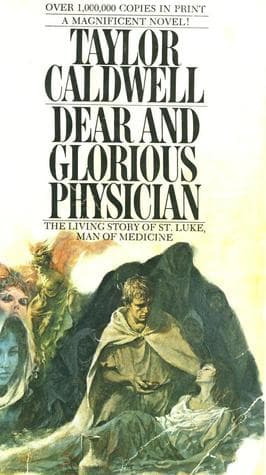
Taylor Caldwell (1959)
Genre
Historical Fiction / Spirituality
Reading Time
1500 min
Key Themes
See below
Sign in to track this book
Before he wrote his Gospel, Lucanus, a Greek physician, dealt with love, loss, and a search through ancient Judea to understand the divine man he would later write about as Luke.
Lucanus, born into a wealthy Greek family in Antioch, is a sickly child who recovers from a severe illness after his mother's prayers to an unknown God. This experience shapes his inquisitive and spiritual nature. He develops a passion for medicine and healing, studying under physicians and philosophers like Dr. Menander. Despite his studies, Lucanus experiences grief with the deaths of his sister, Livia, and his first love, Thea, who dies in childbirth. These losses leave him feeling empty and searching for deeper meaning beyond medicine and Hellenistic philosophy. He questions the Greek gods and the finality of death.
Driven by spiritual hunger, Lucanus travels the Roman world, seeking answers to life, death, and suffering. His search for the 'Unknown God' leads him to Jerusalem, a city he initially finds strange and unwelcoming because of its strict Jewish customs and the perceived fanaticism of its people. Despite his discomfort, Lucanus is interested in the Jews' unwavering faith and their devotion to one God. He observes their practices, listens to their teachings, and hears rumors of a prophet, a Messiah, who has walked among them, performing miracles and speaking with authority. These accounts, though dismissed by Roman authorities and some Jewish groups, stir Lucanus's scientific curiosity and spiritual yearning.
In Jerusalem, Lucanus meets Pontius Pilate, the Roman governor, hoping to learn about recent events concerning Jesus of Nazareth. Pilate, a pragmatic Roman, dismisses Jesus as a deluded zealot but gives Lucanus some facts about his trial and crucifixion, confirming Jesus's existence and his impact. Lucanus also meets early followers of Jesus, including Martha and Mary of Bethany, and later, Peter and John. These encounters are important. He is struck by their strong belief, their love, and the peace they show despite persecution. Their stories, though fragmented, begin to show a man unlike any Lucanus has studied, a healer and teacher whose power went beyond human ability.
Lucanus travels to Damascus and sees Saul of Tarsus, a persecutor of Christians, become Paul, a fervent apostle of Jesus. This miraculous transformation, which blinds Saul and then restores his sight, affects Lucanus deeply. He observes Paul's immediate and radical shift from hatred to devotion, and his healing by Ananias. This event, seen firsthand, gives Lucanus clear evidence of a divine power at work, a power beyond any medical or philosophical explanation. It is a turning point for Lucanus, solidifying his belief that Jesus was the Son of God and that the 'Unknown God' he sought was revealed in Him. He feels a call to understand and document this truth.
After Paul's conversion and his own deepening faith, Lucanus realizes his life's purpose: to research and write a full account of Jesus's life, teachings, miracles, and resurrection. He sees this as his unique contribution, using his skills as a physician, scholar, and historian. He travels through Judea and Galilee, interviewing many eyewitnesses, including those who knew Jesus personally, such as the apostles, Mary Magdalene, and other women who followed him. Lucanus is careful, seeking confirmation for every detail, sifting through oral traditions, and aiming for historical accuracy. His goal is not just to recount events but to present a nuanced portrait of Jesus, showing his compassion, humanity, and divine nature for a Greek-speaking audience.
A significant moment in Lucanus's research is his encounter with Mary, Jesus's mother. He travels to her home, where she lives with John the Apostle. Mary, initially reserved, eventually shares personal recollections of Jesus's birth, childhood, and the events of his life. She recounts the Annunciation, the Nativity in Bethlehem, the visit of the Magi, and the family's flight to Egypt. Her story gives Lucanus a unique perspective, showing Jesus's human development and his connection to his mother. Mary's wisdom and faith move Lucanus, giving his narrative a tender, personal dimension no other source could provide.
As Lucanus continues his work, he sees the increasing persecution of the growing Christian community. He sees apostles and other believers endure imprisonment, torture, and martyrdom for their faith. He travels with Paul on some missionary journeys, observing the hardships, dangers, and frequent arrests Paul faces. Roman authorities and some Jewish groups see Christians as a dangerous group, a threat to their established order. Despite the constant threat and personal risks, Lucanus stays firm in his mission, understanding the urgency of preserving the truth of Jesus's life before it is lost or distorted. The steadfast faith and courage of the persecuted Christians strengthen his own conviction.
After years of research, travel, and prayer, Lucanus finishes his Gospel, a detailed account of Jesus's life and ministry, written to appeal to a Greek-speaking, educated audience. His narrative emphasizes Jesus's compassion, miracles, and universal message of salvation. He then begins a second work, the Acts of the Apostles, documenting the early history of the Christian Church, focusing on Paul's missionary journeys, with whom he has a close bond. Lucanus's medical background helps him describe healings with precision, and his historical training ensures a structured and verifiable narrative. These writings become foundational texts for the new Christian faith.
Lucanus remains a loyal companion and physician to Paul throughout his later ministry, including Paul's journey to Rome and his imprisonment. Lucanus's medical skills are useful, tending to Paul's ailments and those of other prisoners and believers. He acts as Paul's scribe and confidante, documenting his letters and supporting him during his trials. Even in a Roman prison, Lucanus observes Paul's unwavering faith, tireless preaching, and impact on those around him. Lucanus's presence during these challenging times shows his deep commitment to Paul and to spreading the Gospel, demonstrating his own quiet courage and steadfastness.
Lucanus continues to serve the Christian community as a physician and evangelist long after Paul's martyrdom. He is believed to have lived a long life, dedicated to healing and faith. His Gospel and the Acts of the Apostles circulate widely and influence many, shaping the understanding of Jesus and the early Church for generations. Lucanus's initial intellectual curiosity, changed by personal loss and divine revelation, leads to a life of purpose and spiritual impact. He leaves a legacy not only as a physician but as a 'Dear and Glorious Physician' of souls, his writings showing his unwavering faith in the Christ he sought and documented.
The Protagonist
From a skeptical, grieving Hellenistic physician seeking answers in philosophy, Lucanus transforms into a devoted Christian evangelist and historian, finding ultimate truth and purpose in Jesus Christ.
The Supporting
Transforms from a persecutor of Christians to one of its most fervent and influential apostles, enduring immense suffering for his faith.
The Supporting
From a young woman chosen by God to bear the Messiah, she endures the joys and sorrows of motherhood, remaining a pillar of faith.
The Supporting
Remains largely unchanged, a representative of Roman authority, providing a historical counterpoint to the spiritual narrative.
The Mentioned
Her brief life and early death serve as a catalyst for Lucanus's spiritual journey.
The Mentioned
Her tragic death reinforces Lucanus's search for a deeper, more enduring truth beyond earthly love and life.
The Supporting
Serves as a wise, traditional mentor, representing the established knowledge that Lucanus eventually transcends in his spiritual journey.
The Supporting
From a simple fisherman to a foundational leader of the early Church, overcoming personal failings through faith.
The Supporting
From a passionate fisherman to a profound theologian and guardian of Jesus's mother, embodying deep spiritual understanding.
Lucanus's life is a search for truth, starting with his scientific inquiries as a physician and becoming a spiritual search. He is not satisfied with Hellenistic philosophy and the Roman gods, especially when faced with death and suffering. His journey to find the 'Unknown God' is driven by personal loss (Livia, Thea) and a yearning for ultimate answers. This search ends with his discovery of Jesus Christ as the truth, giving meaning beyond human understanding and medical science.
“"What manner of man was my Lord?"”
The novel explores how intellectual inquiry and spiritual belief interact through Lucanus's character. As an educated physician and philosopher, Lucanus approaches the accounts of Jesus with a critical, investigative mind, seeking evidence. However, his rational mind changes due to spiritual experiences, such as Paul's conversion and the stories of eyewitnesses. This theme shows that faith is not against reason but can extend it, providing answers where reason alone falls short. It guides Lucanus to embrace a truth beyond scientific proof.
“"He had sought the truth in the minds of men; he would find it now in the heart of God."”
As a physician, Lucanus is dedicated to physical healing, but the book presents a deeper healing: spiritual. Lucanus's early experiences with illness and death show the limits of medical science. He sees Jesus's miraculous healings and the spiritual change of individuals like Paul, which go beyond physical remedies. His own journey is one of spiritual healing from grief and emptiness. Ultimately, Lucanus's Gospel helps many souls, showing his role as a 'glorious physician' not just of the body, but of the soul, offering hope and salvation.
“"For what profit is it to a man if he gains the whole world, and loses his own soul?"”
A central theme is the importance of eyewitness testimony and documentation in preserving the truth of Jesus's life. Lucanus spends years traveling, interviewing, and cross-referencing accounts to create an accurate and full narrative. The novel emphasizes how fragile oral tradition is and how necessary written records are to ensure the lasting legacy of the Gospel. This theme highlights Lucanus's contribution as a historian and chronicler, whose diligence ensures that the story of Christ would be passed down to future generations, forming the foundation of Christian faith.
“"Many have undertaken to set down an orderly account of the events that have been fulfilled among us... I too decided, after investigating everything carefully from the very first, to write an orderly account for you."”
The novel addresses suffering, both personal and communal. Lucanus experiences grief with the deaths of Livia and Thea, which fuels his spiritual search. He also sees the suffering and persecution of early Christians, including Paul's imprisonments and the martyrdom of believers. Despite these hardships, the characters show resilience, drawing strength from their faith in Jesus. This theme shows that suffering can lead to spiritual growth and that faith provides comfort and perseverance in adversity, turning pain into purpose.
“"Blessed are you when people hate you, and when they exclude you, revile you, and defame you on account of the Son of Man."”
The story is told from Lucanus's viewpoint, detailing his personal journey and research.
While not strictly first-person, the narrative is deeply immersed in Lucanus's perspective, thoughts, and feelings. The entire story unfolds through his experiences, observations, and intellectual and spiritual struggles. This allows the reader to intimately follow his journey from a skeptical, rational inquirer to a devout believer and chronicler. The 'I' of the Gospel's introduction (Luke 1:1-4) frames the novel's approach, making Lucanus's personal quest the central lens through which the historical and spiritual events are understood and presented.
Lucanus's journey is a quest for spiritual truth and the 'Unknown God'.
The novel is structured as a classic quest narrative, with Lucanus embarking on a literal and metaphorical journey. His quest is not for a physical object but for spiritual truth and the identity of the 'Unknown God' he senses. This journey takes him across the Roman world, through different cultures and philosophies, eventually leading him to the testimonies of Jesus's followers. The 'quest' provides the overarching plot structure, driving Lucanus's actions and ultimately culminating in his discovery of Christ and his life's purpose in documenting the Gospel.
The narrative meticulously reconstructs historical events and relies on collected testimonies.
Caldwell uses Lucanus's role as a historian and physician to structure the narrative around the meticulous collection and corroboration of eyewitness accounts. The novel details Lucanus's travels, interviews with apostles, Mary, and other followers, and his critical assessment of various stories. This device lends a sense of authenticity and historical weight to the spiritual narrative, presenting the Gospel as a carefully researched and verified historical document rather than mere myth. It reflects the author's own historical research and gives credibility to the story's spiritual claims.
A recurring symbol representing Lucanus's initial spiritual longing before discovering Christ.
The 'Unknown God' motif, referenced from Acts 17:23, is a powerful symbol throughout the novel. It represents Lucanus's deep spiritual yearning and the void left by the limitations of Greek philosophy and traditional Roman religion. This motif encapsulates his intellectual and emotional search for a divine being who can provide ultimate answers to life, death, and suffering. His eventual discovery of Jesus as the fulfillment of this 'Unknown God' provides the ultimate resolution to his lifelong spiritual quest and gives meaning to his work.
“The physician must be a philosopher, for philosophy is the mother of all sciences, and medicine is the highest of the sciences.”
— Luke reflecting on his medical training and the deeper purpose of healing.
“To heal the body is nothing if the soul is sick; to heal the soul is everything.”
— Luke discussing the holistic nature of healing with a mentor.
“Faith is not believing without proof, but trusting without reservation.”
— A conversation about the nature of faith during Luke's spiritual journey.
“The greatest disease of mankind is the hardness of the heart.”
— Luke observing societal injustices and human suffering.
“In every patient, see not a case, but a person; in every illness, a story.”
— Advice given to Luke about the art of compassionate medicine.
“Love is the only medicine that never fails, if it is pure and selfless.”
— Reflecting on the limitations of physical remedies and the power of love.
“To write is to make immortal the fleeting moments of truth.”
— Luke contemplating his role as the author of the Gospel of Luke and Acts.
“Doubt is the shadow cast by the light of faith; without it, faith would have no substance.”
— A philosophical discussion on the interplay of doubt and belief.
“The body is but the temple; the spirit is the god within.”
— Luke exploring spiritual concepts during his studies.
“History is not made by events, but by the souls who endure them.”
— Reflecting on the human impact of historical events in the Roman Empire.
“A physician's first duty is to do no harm; his second, to bring hope.”
— Luke learning the ethical foundations of medical practice.
“In silence, we hear the voice of God; in stillness, we find our purpose.”
— A moment of meditation during Luke's spiritual quest.
“The rich man's gold cannot buy health, but the poor man's prayer can move mountains.”
— Observing disparities in healing and the power of faith among the poor.
“To understand Christ, one must first understand suffering.”
— Luke's insight as he researches the life of Jesus for his Gospel.
“Every life is a book written by God; our task is to read it with compassion.”
— Reflecting on the dignity and story of each individual he treats.
Ready to see how well you understood this book? Take our interactive quiz with 10 questions.
Biography coming soon.







