“Children are dying. The injustices of the world hide in those three words.”
— Duiker reflects on the horrors of war and suffering during the Chain of Dogs.

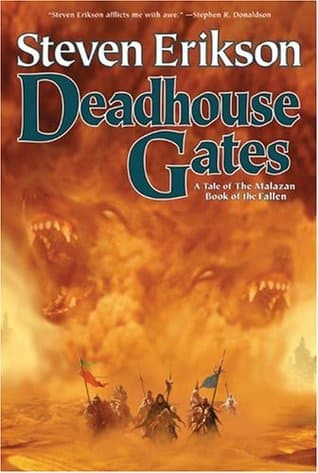
Steven Erikson (2000)
Genre
Fantasy
Reading Time
1500 min
Key Themes
See below
Sign in to track this book
In the Holy Desert Raraku, a seer's prophecy starts the Whirlwind, a huge uprising that threatens to destroy the Malazan Empire and create new legends.
After Emperor Laseen's assassination and the removal of Old Guard officers, High Fist Coltaine of the Malazan 7th Army must escort over 50,000 Malazan civilians and loyalists across the rebellious continent of Seven Cities to Aren. The rebellion, the Whirlwind, has started with great force, led by the seer Sha'ik and her followers. Coltaine, an experienced Wickan warrior, knows the challenge ahead, aware that the refugee column will be a constant target for the Whirlwind's armies. He begins the journey from Unta, forming his army into a 'Chain of Dogs' around the vulnerable civilians, ready for the attacks.
In Ehrlitan, Sergeant Fiddler, a veteran Bridgeburner, leads a small squad including Hedge, Stormy, and Truth. They are to protect Kalam, a Claw assassin, who is secretly taking Felisin Paran, Tavore Paran's younger sister, to Aren. Felisin, disgraced and enslaved after her family's fall, suffers terrible conditions and abuse, becoming very bitter. Meanwhile, the ancient Trell, Mappo Runt, and the amnesiac Jaghut, Icarium, continue their long journey. Mappo's secret mission is to stop Icarium from remembering his past and unleashing his destructive power. Their path often crosses the growing chaos of Seven Cities, suggesting deeper, ancient forces are involved.
As the Chain of Dogs moves, it faces constant attacks from the Whirlwind's forces, led by various tribal chiefs and sorcerers under Sha'ik. Coltaine's small army, mostly Wickan warriors and a few Malazan regulars, is greatly outnumbered. He uses brilliant, harsh, and often desperate tactics, with his Wickan riders for fast skirmishes and rearguard actions. Each day is a fight for survival, with thousands of refugees dying from combat, exhaustion, and hunger. The Malazan High Command, especially High Fist Pormqual in Aren, gives little help, more concerned with their own politics than Coltaine and the refugees. The huge amount of suffering and Coltaine's strong will define this difficult march.
Felisin Paran, with the former historian Heboric Light Touch and the mysterious Baudin, suffers through the slave trade, eventually sold to a mining operation in the Holy Desert Raraku. Here, Felisin's anger turns into a desire for revenge against the Malazan Empire and her sister, Tavore. She sees the growing power of Sha'ik and the Whirlwind, whose influence is complete in the desert. Heboric, having lost his hands and marked by the Crippled God, starts to show strange abilities connected to the Jade Giants. Baudin, a former Claw, secretly watches Felisin, his true reasons unclear. The desert changes them, as Sha'ik's power base grows, using ancient magic and the rebellion's passion.
Kalam, with Fiddler's squad, continues his journey to Aren. His real goal is to assassinate Empress Laseen in Malaz City. He carries a message from the Bridgeburners, demanding an end to the purges. Along the way, he navigates the political situation of Seven Cities, using his Claw skills to survive. Meanwhile, Mappo and Icarium travel through the desert. Mappo is increasingly burdened by his duty to stop Icarium from remembering his past, which would unleash his destructive power. Their bond is strong, but Mappo's deception troubles him, especially as Icarium's memories sometimes appear, hinting at his destructive potential.
After a difficult journey through the desert, Felisin, Heboric, and Baudin arrive at Sha'ik's camp in Raraku. The original Sha'ik, a child, is a vessel for a powerful entity. Through a ritual involving the Crippled God's influence and ancient powers, Felisin is chosen to become the new Sha'ik. She undergoes a painful transformation, gaining the original Sha'ik's memories, power, and the title of the Whirlwind Goddess. This rebirth gives her great magical abilities and the complete loyalty of the rebellion's followers. Her personal revenge now combines with the divine purpose of the Whirlwind, making her a powerful and dangerous figure, driven by both ancient prophecy and personal pain.
The Chain of Dogs endures more suffering. Coltaine's army, though shrinking, performs miracles daily, constantly outsmarting and defeating larger Whirlwind forces. The refugees, now tens of thousands, are a constant drain on resources and a source of sadness. Malazan commanders like Pormqual in Aren are unwilling or unable to send help, actively hindering Coltaine's efforts due to political maneuvering and fear of the Empress. The Malazan administration in Seven Cities falls apart around Coltaine, leaving him alone. Despite the great difficulties, Coltaine's leadership, the loyalty of his Wickan warriors, and the desperate hope of the refugees keep the Chain of Dogs moving.
Kalam, having left Fiddler's squad (who returned to the Chain of Dogs), goes to Malaz City, the Empire's capital. He gets into the capital and confronts Empress Laseen, delivering the Bridgeburners' message. The meeting is tense, showing Laseen's harshness and complex reasons. Kalam, understanding the Claw's power and Laseen's control, barely escapes Malaz City with his life, helped by unexpected allies. His mission, while not fully assassinating the Empress, gives insight into the Empire's internal problems and Laseen's strong hold on power, leaving him disappointed but determined to protect his friends.
After months of marching and fighting, the Chain of Dogs reaches the plains outside Aren. However, High Fist Pormqual, fearing Coltaine's popularity and challenge to his authority, closes the city gates and refuses entry. The Whirlwind forces, now led by the newly powerful Sha'ik, launch their final, large attack. Coltaine, understanding the betrayal, makes a heroic last stand with his remaining Wickan warriors, buying time for the refugees to reach the safety of Aren. His sacrifice, and that of his entire army, allows most of the surviving refugees to enter the city, fulfilling his promise. The Chain of Dogs ends in glory and tragedy, making Coltaine a legend.
The surviving refugees enter Aren, forever changed by their experience. Coltaine's death impacts the Empire, cementing his legend. High Fist Pormqual's cowardice and betrayal are revealed, leading to his eventual downfall. Tavore Paran, now an Adjunct, arrives in Aren to take command, tasked with ending the Whirlwind rebellion, putting her on a path to confront her sister, Sha'ik. Fiddler, Hedge, and the few remaining Bridgeburners are among the survivors, deeply affected by what they saw. The Chain of Dogs reshapes the politics of Seven Cities and the Malazan Empire, setting up future conflicts, with Felisin/Sha'ik at its center, wielding great power.
The Protagonist
Coltaine begins as a respected High Fist and transforms into a legendary figure through his heroic, self-sacrificing leadership of the Chain of Dogs.
The Protagonist/Antagonist
Felisin transforms from a naive, privileged noble into a hardened, vengeful prophetess, Sha'ik, leading the rebellion that consumed her.
The Protagonist
Kalam shifts from a disillusioned assassin to a more morally conflicted figure, seeking to protect his friends and challenge the Empire's corruption.
The Protagonist
Fiddler endures the horrors of the Chain of Dogs, becoming a symbol of resilience and quiet leadership amidst chaos.
The Supporting
Mappo struggles with his centuries-long deception, his love for Icarium clashing with his duty to protect the world from his friend's past.
The Supporting
Icarium remains largely static in his amnesia, but the constant threat of his past returning creates immense tension for Mappo.
The Supporting
Heboric transforms from a disgraced scholar into a shamanistic figure, unwillingly connected to the Crippled God and ancient powers.
The Supporting
Baudin's true loyalty is revealed as he consistently protects Felisin, fulfilling a hidden mission even at great personal cost.
The Supporting/Mentioned
Sha'ik's arc is brief, serving as the initial catalyst and then the physical vessel for the transfer of power to Felisin.
The Antagonist
Pormqual's ambition and cowardice lead to his betrayal of Coltaine and ultimately his own downfall.
Deadhouse Gates clearly shows the terrible realities of war, especially through the Chain of Dogs. The constant losses, hunger, disease, and mental strain on soldiers and civilians are central. Erikson details the injuries, the despair of refugees, and the moral compromises commanders like Coltaine must make. The sheer amount of death and suffering shows that there are no true winners in such conflicts, only survivors marked by their experiences. The book highlights that war's cost is paid not just in lives, but in the permanent damage to souls and places.
“For the living, the Chain of Dogs was a journey into hell, and few would ever return.”
Coltaine's story shows duty and sacrifice. His strong commitment to protecting the refugees, even if it means losing his entire army and his own life, defines this theme. The book looks at the burden of leadership, the impossible choices commanders make, and the loyalty inspired by true selflessness. It contrasts Coltaine's noble duty with the self-serving ambition of figures like Pormqual, showing the range of morality in Malazan leadership. The ultimate sacrifice of the Chain of Dogs makes duty a spiritual concept, creating legends.
“He had sworn an oath. He would keep it. No matter the cost.”
Many characters change greatly in Deadhouse Gates. Felisin's journey from spoiled noble to vengeful slave and then to the powerful Sha'ik is important. Heboric's physical injuries and later spiritual awakening, marked by the Crippled God, also show this. The harsh environment of Seven Cities and the Whirlwind rebellion force characters to face their old selves and create new identities, often through great suffering. This theme questions if identity is natural or created by experience, especially under extreme pressure, and how past trauma affects future actions and beliefs.
“This was not the girl she had been. That girl was dead, lost to the desert and the whips.”
Betrayal is a theme throughout the story, from the political scheming within the Malazan Empire (Laseen's purges, Pormqual's treachery) to personal deceptions (Mappo's secret about Icarium). The lack of support for Coltaine's Chain of Dogs by Malazan command is a big betrayal that directly leads to the tragedy. This shows the widespread corruption, self-interest, and short-sightedness that weaken even powerful empires. Betrayal drives plot points and reveals moral decay within institutions and people, contrasting sharply with the loyalty and sacrifice of others.
“The Empire had abandoned them. Not the Empress, perhaps, but certainly the High Command.”
The Whirlwind rebellion is driven by strong religious belief, prophecy, and Sha'ik's rise as a divine figure. The book explores how faith can unite whole populations but also lead to extreme violence and strong devotion to a cause, often at the cost of individual lives. The influence of the Crippled God and other ancient beings on the rebellion shows the role of divine involvement and manipulation in mortal affairs. The prophecies about Sha'ik and the Whirlwind shape the destinies of many characters, blurring the lines between fate and free will.
“The Whirlwind was not merely a rebellion; it was a storm of faith, consuming all in its path.”
A desperate, extended march of an army protecting refugees
The Chain of Dogs is both a literal and symbolic plot device. Literally, it is the formation Coltaine's 7th Army adopts to protect the vast column of Malazan refugees across Seven Cities. Symbolically, it represents an unbroken line of duty, sacrifice, and endurance against overwhelming odds. It is the central narrative thread for one major storyline, driving the plot through a relentless series of battles, attrition, and moral tests. The device allows Erikson to explore themes of leadership, the cost of war, and human resilience on a grand, epic scale, culminating in a tragic, heroic climax.
Two distinct storylines that converge and contrast
Erikson employs a dual narrative structure, primarily following two distinct but occasionally intersecting storylines: the Chain of Dogs led by Coltaine and the journey of Felisin, Heboric, and Baudin towards becoming Sha'ik. A third, less central arc follows Kalam and Fiddler. This allows for a panoramic view of the Seven Cities rebellion from different perspectives – the Malazan military, the enslaved, and the Whirlwind's emerging leadership. The contrast between Coltaine's desperate defense and Felisin's rise to power provides thematic depth, showing different facets of the same conflict and building towards future confrontations.
A malevolent divine entity subtly manipulating events
The Crippled God serves as a background plot device, a malevolent, unseen force whose influence subtly drives many events. His mark on Heboric, his connection to the Jade Giants, and his role in the original Sha'ik's power and Felisin's transformation are critical. While not a direct character, his presence is felt through his agents and the dark magic he imbues. This device introduces a cosmic, divine layer to the conflict, suggesting that mortal wars are often pawns in larger, older struggles between powerful entities, adding a layer of tragic inevitability to many events.
A character's forgotten past holding immense, destructive power
Icarium's amnesia and the immense, destructive power he possesses when his memories return serve as a constant source of tension and a ticking clock. This device provides a personal, internal conflict for Mappo, whose entire existence is dedicated to preventing his friend's awakening. It hints at ancient cataclysms and the scale of power in the world. While Icarium's power is not fully unleashed in this book, the threat of it looms large, demonstrating the fragility of peace and the potential for devastating, forgotten histories to resurface and alter the course of the world.
Foretold events shaping characters' paths and the rebellion
Prophecy is a significant driving force, particularly with the rise of Sha'ik and the Whirlwind rebellion. The 'Whirlwind Goddess' is a prophesied figure, and Felisin's transformation into Sha'ik fulfills this destiny. This device creates a sense of grand, preordained events, giving the rebellion a spiritual weight beyond mere political uprising. It raises questions about free will versus fate, as characters find themselves caught in the currents of ancient predictions. Prophecy legitimizes the rebellion and elevates its leaders, making them more than just mortals, but instruments of a larger design.
“Children are dying. The injustices of the world hide in those three words.”
— Duiker reflects on the horrors of war and suffering during the Chain of Dogs.
“We humans do not understand compassion. In each moment of our lives, we betray it. Aye, we know of its worth, yet in knowing we then attach to it a value, we guard the giving of it, believing it must be earned.”
— Kalam Mekhar contemplates human nature and the rarity of true compassion.
“The heart of wisdom is tolerance.”
— Iskaral Pust shares a cryptic insight, reflecting the book's themes of understanding and patience.
“We are all strangers in a strange land.”
— A general observation on the displacement and alienation experienced by characters in the Seven Cities.
“The soul knows no greater anguish than to take a breath that begins with love and ends with grief.”
— Reflecting on the tragic love and losses endured by characters like Felisin Paran.
“History is not a tapestry of bright threads. It is a tangle of blood and betrayal.”
— Duiker's cynical view of history as he witnesses the brutal events of the Chain of Dogs.
“Hope is the last gift given, and it is the one that makes all the difference.”
— A sentiment expressed during moments of despair in the desert and siege scenarios.
“The dead are not silent. They speak in the echoes of our actions.”
— Reflecting on the lingering impact of death and memory in the war-torn landscape.
“In war, every heartbeat is a defiance.”
— Capturing the spirit of resistance and survival in the face of overwhelming odds.
“We are what we dare.”
— A concise motto for characters like Kalam or Fiddler who take bold risks.
“The desert does not forgive. It does not forget.”
— Describing the harsh, unforgiving nature of the Raraku Desert and its trials.
“Faith is a knife in the dark.”
— A cynical view on belief and religion, often associated with the Whirlwind cult.
“To lead is to serve, and in serving, to sacrifice.”
— Reflecting on the burdens of leadership, as seen in characters like Coltaine.
“In the end, we are all stories.”
— A philosophical note on legacy and the narratives that define lives and histories.
Ready to see how well you understood this book? Take our interactive quiz with 10 questions.

Biography coming soon.







