“The only thing worse than a vampire with a chip on his shoulder is a vampire with a chip on his shoulder and a bad mood.”
— Rachel musing on Kisten's demeanor.

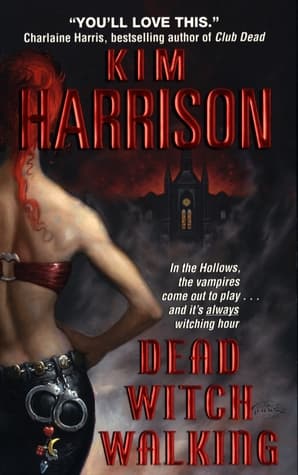
Kim Harrison (2004)
Genre
Fantasy / Romance
Reading Time
416 min
Key Themes
See below
Sign in to track this book
In a Cincinnati where vampires, witches, and demons secretly coexist, a witch bounty hunter named Rachel Morgan navigates the supernatural underworld, trying to keep the peace while dodging deadly plots and unexpected romance.
Rachel Morgan, a witch, resigns from the Inderlander Security (I.S.) with her vampire partner Ivy Tamwood and pixy Jenks. They are unhappy with the I.S.'s corrupt practices and unjust treatment of Inderlanders. Rachel's supervisor, Marshal Edden, tries to stop her, but Rachel is firm. Their decision follows a recent incident with a rogue vampire and their belief that the I.S. is not protecting the innocent. This leaves them jobless and financially unstable, as the I.S. now sees them as 'loose ends.' They decide to start their own private investigation and bounty hunting firm.
After forming their new agency, Living Accords, Rachel, Ivy, and Jenks immediately face a challenge. The I.S. places a bounty on Trent Kalamack, a powerful human businessman with ties to the city's elite and rumors of illegal genetic research. The bounty is almost impossible to collect alive, and the I.S. warns that anyone who tries will be targeted. Rachel, needing money and wanting to prove their independence, takes the contract despite Ivy's strong doubts and the danger. This decision immediately puts them against Kalamack's resources and the I.S.
Rachel's attempts to catch Trent Kalamack are difficult. She discovers he is more than just a businessman; he has powerful magic, which surprises her for a human. During her pursuit, she meets him several times, leading to tense standoffs and a growing respect between them. Trent seems interested in Rachel and even gives her information that hints at a larger conspiracy. He reveals he is being framed and that the I.S. has a hidden agenda. This makes Rachel rethink her initial opinion of him and question the true reasons behind the I.S. bounty.
Rachel's contract on Trent Kalamack attracts the unwanted attention of Piscary, a powerful master vampire. Piscary is a high-ranking member of the Cincinnati vampire coven and has significant influence. He believes Rachel is interfering with his plans and orders her 'turned' – a process where a vampire drains a human or Inderlander to near death, making them a ghoul or a new vampire, then uses them as a thrall. Rachel is attacked and almost turned, but escapes with Ivy's help and her own quick thinking. This incident shows the extreme dangers of operating outside I.S. protection and the ruthless nature of the vampire world.
While investigating Trent, Rachel uncovers a pattern of missing ghouls – humans partially turned by vampires and in servitude. She learns that Trent has been protecting these ghouls, offering them refuge and trying to find a cure for their condition. This changes Rachel's understanding of Trent, showing him to be more complex than a simple villain. Her investigation leads her to a hidden facility where Trent is keeping and studying ghouls, hinting at a larger scientific and magical project that goes beyond criminal activity and possibly involves a cure for the ghoul condition.
Rachel discovers that Piscary is not just a master vampire but a key player in a scheme to exploit ghouls. He has been manipulating events, including the bounty on Trent, to increase his power and research into ghoul biology. Trent, it turns out, was working on a cure for the ghoul condition, a cure that Piscary wants to prevent from being released because it would disrupt his control over the ghoul population. Rachel realizes that the I.S. bounty on Trent was a setup orchestrated by Piscary to remove a threat to his operations. This revelation shifts Rachel's focus from catching Trent to protecting the ghouls and exposing Piscary.
Rachel, now allied with Trent Kalamack, prepares for a direct confrontation with Piscary. She enlists the help of Jenks and Ivy, along with the ghouls Trent has been protecting. The climax takes place at a hidden facility where Piscary conducts his experiments and holds other ghouls captive. A fierce battle follows, involving Rachel's witch magic, Ivy's vampire speed and strength, Jenks's pixy agility, and Trent's advanced technology and unexpected magical abilities. Rachel must use all her skills and power to protect the ghouls and defeat Piscary, who is a formidable opponent.
In a desperate struggle, Rachel, with Ivy and Trent's help, defeats Piscary. Trent, using a specialized weapon, delivers a critical blow, while Rachel's magic weakens the master vampire. Piscary is killed, ending his control over the ghouls and exposing his illegal activities. However, the victory has a cost. The battle leaves many casualties, and Piscary's death has significant implications for the vampire coven and the I.S. Rachel and her team are now independent operators, but they have also made powerful enemies.
After Piscary's death, Rachel and her team deal with the aftermath. The I.S. investigates the incident, but Rachel avoids severe consequences by exposing Piscary's crimes. The ghouls are freed, and Trent Kalamack, though still enigmatic, is cleared of the I.S. bounty. Rachel and Trent form a fragile, uneasy alliance, recognizing their shared interests and the larger threats. Ivy and Jenks remain loyal to Rachel, strengthening their new agency. The events have changed Rachel's standing in the Hollows, making her a force to be reckoned with.
Trent Kalamack reveals that his research has produced a partial cure for the ghoul condition, allowing ghouls to regain some humanity and control. This offers hope for the affected Inderlanders, but the cure is incomplete and needs more development. The I.S. is forced to acknowledge Trent's work, though reluctantly. While Piscary is gone, the power vacuum in the vampire coven and ongoing tensions with the I.S. create new challenges for Rachel. Her relationship with Trent remains complex and flirtatious, hinting at future collaborations and conflicts. The Hollows is a dangerous place, and Rachel's journey has just begun.
The Protagonist
Rachel evolves from a disgruntled I.S. agent to an independent, respected, and feared bounty hunter, learning to trust her instincts and forge unlikely alliances.
The Supporting
Ivy begins to open up emotionally, especially to Rachel, and grapples with her identity as a living vampire, learning to control her urges for the sake of her friendships.
The Supporting
Jenks remains a steadfast and reliable ally, his loyalty to Rachel deepening as they face increasingly dangerous situations together.
The Antagonist/Supporting
Trent transforms from a perceived villain into a reluctant ally, revealing his deeper motivations and the extent of his magical and scientific capabilities.
The Antagonist
Piscary's arc is one of escalating villainy, culminating in his downfall and death at the hands of Rachel and her allies.
The Supporting
Edden remains largely static, representing the institutional hurdles Rachel must overcome.
The Mentioned
Kistian's arc is one of hope, as he represents the ghouls who stand to benefit from Trent's cure and Rachel's intervention.
The novel explores the tension between individual freedom and oppressive institutions. Rachel's resignation from the Inderlander Security (I.S.) is an act of rebellion against its corruption and inefficiency. She believes the I.S. has lost its way, prioritizing politics over justice, especially for Inderlanders. Her decision to start her own agency, Living Accords, despite the dangers, shows her desire for autonomy and her belief in doing what is right, even if it means breaking rules. This theme is clear as Rachel clashes with the I.S., proving that operating outside the system can be necessary for justice.
““The I.S. had become a monster, devouring its own, and I wasn’t going to feed it anymore.””
The Hollows is a world with much prejudice between species – witches, vampires, pixies, humans, and demons. Vampires, in particular, have significant power and often look down on or exploit other races. Rachel, a witch, often faces discrimination and danger, while Ivy, a living vampire, struggles with the stigma and fear of her nature and her own urges. The ghouls, victims of vampire turning and often treated as property, are a central example of this prejudice. The story challenges these biases, suggesting that alliances and understanding across species are necessary for survival and justice, as seen in Rachel's alliance with Trent Kalamack, a human, to fight a vampire.
““It didn’t matter what you were, only what you did.””
The book presents a complex view of morality, where characters are rarely purely good or evil. Trent Kalamack, initially a villain, is shown to have complex reasons and even a noble goal in trying to cure ghouls. The I.S., meant to be a force for good, is corrupt and ineffective. Even Rachel, the protagonist, makes morally questionable decisions in her pursuit of justice and survival. This theme challenges simple black-and-white morality, making the reader consider the shades of grey in character actions and motivations. Piscary, however, remains a clear example of ruthless evil, providing a stark contrast.
““The world wasn’t made of good and evil, but of people doing the best they could with what they had.””
Despite the dangers of their world, Rachel, Ivy, and Jenks form a strong, unconventional family unit. Their loyalty to each other is constant, providing strength and support. Rachel's decision to leave the I.S. is for herself and her partners. Ivy's struggle to control her vampiric urges for Rachel's safety, and Jenks's fierce protectiveness, show the depth of their bond. This theme highlights that when traditional institutions fail, bonds formed through shared experiences and mutual trust are important for survival and emotional well-being.
““We were a team, a family, and we would sink or swim together.””
The novel explores the corrupting influence of power, especially among the vampire hierarchy and within the I.S. Piscary's abuse of his master vampire status to control ghouls, and the I.S.'s bureaucratic overreach, are prime examples. Rachel, though powerful, must constantly deal with the responsibility of her abilities and the potential for misuse. The struggle to maintain moral integrity while having power is a challenge for many characters. Even Trent Kalamack's power, though sometimes used for good, has a dark, manipulative side.
““Power corrupted, and absolute power corrupted absolutely. The Hollows was proof of that.””
A dangerous mission that drives the initial plot.
The bounty placed on Trent Kalamack's head serves as the central inciting incident for Rachel's new independent agency. It immediately plunges Rachel, Ivy, and Jenks into a high-stakes conflict, forcing them to prove their capabilities outside the I.S. The contract is designed to be nearly impossible, setting up the challenges and dangers they face. It also acts as a red herring, masking the true motivations behind Trent's targeting and the larger conspiracy involving Piscary, compelling Rachel to dig deeper than just collecting a reward.
A medical/magical mystery that reveals deeper conspiracies.
The ghoul condition, resulting from incomplete vampire turning, and Trent's secret research into a cure, is a critical plot device. It provides a humanitarian element to the story, highlighting the plight of a vulnerable population. More importantly, it serves as the nexus for the conflict between Trent and Piscary, revealing Piscary's true villainy and Trent's complex, morally ambiguous heroism. The cure itself offers hope but also creates a new power dynamic, as its existence threatens the established order of the vampire coven and the I.S.
A unique vampiric condition creating internal and external conflict.
Ivy Tamwood's status as a 'living vampire' is a significant plot device, distinguishing her from traditional undead vampires. This condition means she requires blood to survive but is not technically dead, allowing her to operate in daylight and maintain a semblance of humanity, yet still battling powerful urges. It creates constant internal conflict for Ivy, particularly her struggle to control her desire to feed on Rachel. This unique vampirism also influences her relationships and her role in the story, offering a different perspective on vampire lore and adding a layer of danger and tension to Rachel and Ivy's bond.
A corrupt bureaucratic organization that serves as both a former employer and an antagonist.
The I.S. functions as a primary antagonistic force, not through direct malice but through its systemic corruption, bureaucracy, and inefficiency. Rachel's past association and subsequent resignation from the I.S. establish her motivations and the stakes of her independence. The I.S. constantly interferes with Rachel's investigations, places bounties, and attempts to control Inderlander affairs, often making things worse. It represents the oppressive institutional power that Rachel and her team are fighting against, even when individual members might be well-meaning. It highlights the difficulty of achieving justice within a flawed system.
“The only thing worse than a vampire with a chip on his shoulder is a vampire with a chip on his shoulder and a bad mood.”
— Rachel musing on Kisten's demeanor.
“Every time you think you've hit rock bottom, there's always a new shovel.”
— Rachel reflecting on her increasingly dire situations.
“Sometimes you have to do the wrong thing for the right reason.”
— Rachel justifying her morally ambiguous choices.
“A witch with a good sense of direction is a dangerous thing. A witch with a bad sense of direction is a disaster waiting to happen.”
— Rachel contemplating the practicalities of her powers.
“The problem with being a professional runner is that eventually, someone always catches up.”
— Rachel realizing she can't outrun her problems forever.
“Never trust a fey. They'll steal your heart, your sanity, and probably your socks.”
— Rachel's general distrust of the fey.
“If you're going to dive into trouble, might as well do it headfirst.”
— Rachel's approach to confronting dangerous situations.
“Being undead doesn't make you smart, it just makes you really, really old.”
— Rachel's opinion on the wisdom of some vampires.
“The best way to hide a secret is in plain sight.”
— Rachel considering tactics for concealment.
“Even demons have a soft spot, it's just usually covered in scales and smells like sulfur.”
— Rachel's cynical view of demonic affection.
“You can always tell a lot about a person by how they treat someone they don't need.”
— Rachel observing character.
“Magic isn't about power, it's about control. And sometimes, losing it.”
— Rachel reflecting on the nature of her magical abilities.
“Sometimes the biggest monsters are the ones that look the most human.”
— Rachel's realization about the true nature of some antagonists.
Ready to see how well you understood this book? Take our interactive quiz with 10 questions.

Biography coming soon.







