“I can't believe I'm doing this. I'm actually doing this. Living proof that a man can only take so much before he snaps.”
— Early in the diary, the narrator reflects on the drastic changes in his life and the breakdown of society.

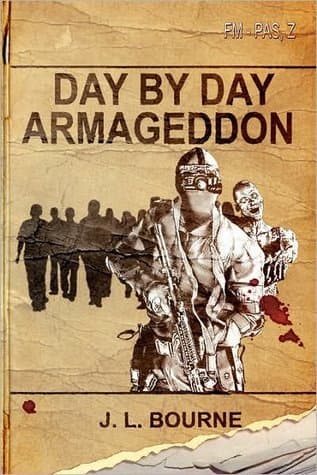
J.L. Bourne (2004)
Genre
Thriller / Fantasy / Science Fiction
Reading Time
300 min
Key Themes
See below
Sign in to track this book
A lone survivor writes in his journal about his daily life in a world overrun by the undead, where every choice is a desperate gamble against the plague.
The journal starts with the main character, a man in the suburbs, noticing unusual news reports about a fast-spreading virus. He initially dismisses them, but as the situation worsens with reports of widespread illness and chaos, he begins to prepare. He details his efforts to secure his home, gather supplies, and keep in touch with his family by phone. The power soon fails, leaving his area dark and silent. He makes a frightening discovery when he sees his neighbor, Mr. Henderson, acting strangely and violently, confirming the reality of the 'undead' plague. His first entries show disbelief, fear, and a growing sense of being alone.
Running low on supplies and needing information, the main character has his first close encounters with the infected. He describes their appearance and constant pursuit, quickly learning how to avoid and, if needed, kill them. His early scavenging trips are tense and dangerous, mostly to nearby houses and a local store. He gets essential items like food, water, and ammunition. During these trips, he sees the outbreak's devastating effects: abandoned cars, looted stores, and the constant danger of the undead. He starts to form a plan for moving through this dangerous new world.
As weeks pass, the main character realizes his suburban home is too exposed and lacks resources for long-term survival. He makes the difficult choice to leave, wanting to find his estranged wife and daughter, who he believes are at his parents' house in a more rural area. He carefully plans his journey, mapping routes and supply stashes. Before leaving, he tries to get a vehicle, facing more encounters with the infected. This phase shows a shift from reacting to survival to actively planning, driven by the hope of reuniting and needing a safer position.
The journey north tests his skills and determination. He travels by car, seeing destroyed roads, abandoned vehicles, and hordes of infected. He learns to save fuel, scavenge well, and stay alert. He describes the grim landscape of a fallen civilization and the constant mental toll of isolation and fear. He makes hard choices, like avoiding other survivors because they might be a threat or attract infected. His journal entries focus more on practical survival tips, observations about the infected, and his declining mental state, marked by loneliness and a constant sense of dread.
After weeks of travel, the main character finally reaches his parents' secluded rural home. His hope for reunion is immediately gone; the house is empty. There are no signs of his wife or daughter, or his parents. The house seems untouched, suggesting they left before the worst of the outbreak, but their absence is a crushing blow. He finds a note from his parents, saying they went to a pre-arranged safe location. This discovery, while offering a small hope that his family might still be alive, leaves him alone again and without immediate answers about his wife and daughter. He takes shelter in the house, restocking and regrouping.
Deciding to make his parents' home his new base, the main character spends much time fortifying it, setting traps, and creating a perimeter. He explores the area, finding a small, isolated group of survivors nearby. He cautiously approaches them, checking if they are trustworthy. This group includes a former military man named Frank, who becomes a helpful ally. They share information and resources, forming a tentative alliance for protection. This is a turning point, as the main character moves from surviving alone to cautious cooperation, though still keeping some independence and distrust.
Needing more specialized supplies, especially medical equipment and advanced weapons, the main character and Frank plan a dangerous scavenging raid into a larger, infected town. They prepare carefully, using their combined skills. The mission is full of danger, with close calls with large hordes of infected and navigating booby-trapped buildings. They get valuable resources, but the experience shows the extreme danger of going into urban areas. This raid strengthens the bond between the main character and Frank, as they rely on each other's combat and tactical skills to survive the intense fight.
As autumn continues, the survivors notice more infected activity around their rural home. They think colder weather or dwindling food in urban areas might be driving the hordes out. This increased threat requires more aggressive defensive preparations. The main character, Frank, and the other survivors work hard to strengthen their defenses, set up alarms, and practice defensive moves. Tensions rise as they expect a large attack. The journal entries show a growing sense of urgency and the grim realization that their safe haven might soon face its biggest test against overwhelming numbers.
Winter arrives, bringing extreme cold and an unprecedented surge of infected activity. The survivors face a long siege, fighting wave after wave of undead. Resources quickly run out, and the mental strain becomes immense. The main character details desperate measures to save ammunition, food, and fuel. There are casualties among their small group, showing the brutal reality of their situation. The fight for survival becomes a daily struggle against the weather and the relentless hordes, forcing them to make difficult tactical decisions and endure immense physical and emotional hardship.
After the brutal winter and constant threat, the main character and the remaining survivors decide their current location is no longer sustainable. They plan to move again, looking for a more defensible and resource-rich haven, possibly a military bunker or a hidden compound. The main character continues to record his observations, detailing the changing behavior of the infected and his own changing view on humanity and survival. Despite the despair, a glimmer of hope remains for finding a long-term solution and, perhaps, answers about his family's fate. The journal ends with them preparing for another dangerous journey into the unknown.
The Protagonist
Transforms from a bewildered civilian into a hardened, self-reliant survivor, constantly battling despair while maintaining a flicker of hope.
The Supporting
Introduced as a capable survivor, he becomes a steadfast and dependable comrade, sharing the burdens and dangers of the apocalypse.
The Antagonist
Their threat evolves from localized incidents to widespread, organized hordes, becoming more formidable and adaptable throughout the narrative.
The Mentioned
Serves as an early, tragic example of the plague's devastating effects, marking the beginning of the protagonist's fight for survival.
The Supporting
Their unknown fate serves as a continuous, underlying motivation for the protagonist, evolving from immediate search to a lingering hope for future reunion.
The Supporting
They represent the fluctuating fortunes of group survival, experiencing both moments of strength and tragic losses.
The novel shows the fast and brutal collapse of all societal structures after the outbreak. The main character's journal entries detail the breakdown of communication, infrastructure (power, water, roads), and government. He sees firsthand how communities become ghost towns, stores are looted, and law enforcement disappears. This theme highlights how fragile humanity is when its basic systems are removed, forcing people to rely on primal survival instincts. For example, the initial chaos and later silence of the suburbs, or the endless abandoned cars on the highway, are clear reminders of this collapse.
“Day 12: The power is gone. Not just here, but everywhere. The silence is deafening. It's like the world just decided to stop turning.”
A main theme is the deep sense of isolation the main character feels, and its psychological cost. His journal is his only confidante, showing his internal struggles, fears, and loneliness. He deals with the loss of his family, the constant threat of death, and the lack of human connection. This isolation is made worse by his choice to avoid other survivors early on, due to distrust. Even when he joins a group, he keeps some emotional distance, a defense against more loss. The entries often show his declining mental state, with vivid nightmares and a struggle to keep hope, especially after finding his parents' house empty.
“Day 37: The silence is the worst enemy. It eats at you, whispering doubts, making you question your sanity. I talk to myself more now. I have to.”
The main character's journey shows human adaptability and resourcefulness in extreme difficulty. He constantly learns new skills, from efficient scavenging and weapon maintenance to fortification and tactical movement. He devises traps, modifies vehicles for long-distance travel, and learns to analyze the infected's behavior. This theme is clear in his careful planning for journeys, his innovative use of everyday items for survival, and his ability to change from a confused civilian into a hardened survivor. His journal acts as a practical survival guide, detailing his successful and unsuccessful attempts.
“Day 68: You learn fast out here, or you die. Every mistake is a lesson, etched in blood. You become a hunter, a scavenger, a ghost.”
The novel explores the range of human behavior when people are pushed to their limits. While the main character mainly focuses on his own survival, his cautious interactions with other survivors, like Frank and his group, show the potential for cooperation and friendship. However, his initial distrust of others and his observations of societal collapse also hint at the darker side of human nature, where self-preservation can lead to aggression or indifference. The main character himself makes difficult, often ruthless, choices to ensure his survival, questioning his own morality in a world without rules. This theme is explored through his internal thoughts and his careful approach to any new encounter.
“Day 101: There are no good guys or bad guys anymore. Only the living and the dead. And sometimes, the living are worse.”
The entire narrative is presented as the protagonist's personal journal entries.
This device immerses the reader directly into the protagonist's mind, offering an intimate and unfiltered perspective on the apocalypse. It allows for direct access to his thoughts, fears, observations, and survival strategies, creating a strong sense of realism and immediacy. The journal entries are dated, providing a clear timeline of the unfolding events and the protagonist's deteriorating mental state. This format also serves as a coping mechanism for the protagonist, allowing him to process the trauma and maintain a semblance of sanity by documenting his experiences.
The protagonist's perspective is influenced by extreme stress and isolation, potentially skewing his interpretation of events.
While the protagonist strives for accuracy, his extreme isolation, psychological trauma, and constant fear mean his perception of events, particularly regarding the behavior of other survivors or the exact nature of the infected, could be subtly skewed. His interpretations are filtered through his own biases and survival instincts. This unreliability isn't overt deception but rather a product of his deteriorating mental state, making the reader question the absolute truth of his observations and enhancing the psychological tension of the narrative.
The protagonist's detailed observations and internal monologues hint at future dangers or developments.
The protagonist's meticulous documentation often includes his analysis of the infected's behavior, changes in the environment, or his own premonitions. These serve as subtle foreshadowing, building tension and preparing the reader for upcoming challenges, such as the increasing hordes in winter or the need to relocate. For instance, his early observations about the infected's sensitivity to sound or their tendency to gather hints at future large-scale encounters. This device keeps the reader engaged, constantly anticipating the next threat based on the protagonist's insights.
The protagonist's estranged family serves as his initial driving motivation.
The protagonist's wife and daughter, whose whereabouts are unknown for much of the early narrative, act as a MacGuffin. Their potential survival and the hope of reuniting with them provide the protagonist with a crucial initial goal beyond mere survival. This quest drives him through dangerous territories and pushes him to overcome immense obstacles. While their actual fate remains ambiguous, the idea of them keeps a flicker of hope alive and gives his journey a deeper personal meaning beyond simply existing in the apocalypse.
“I can't believe I'm doing this. I'm actually doing this. Living proof that a man can only take so much before he snaps.”
— Early in the diary, the narrator reflects on the drastic changes in his life and the breakdown of society.
“The world isn't going to end with a bang, it's going to end with a whimper. Or in my case, a growl.”
— The narrator's internal monologue about the slow, agonizing collapse of civilization and the new threats.
“It's funny how quickly you adapt. How quickly the things that once horrified you become normal.”
— Reflecting on the increasing brutality and grim reality of his daily existence.
“The greatest weapon isn't a gun or a knife. It's information. Knowing what's coming, knowing where to go.”
— The narrator emphasizes the importance of intelligence and planning in a post-apocalyptic world.
“Sleep is a luxury I can no longer afford. Every moment of rest feels like a moment wasted, a moment when they could be getting closer.”
— Dealing with constant threat and the psychological toll of vigilance.
“I used to worry about bills, about traffic, about what to have for dinner. Now I worry about how many bullets I have left and if I'll see another sunrise.”
— A stark comparison between pre-apocalyptic and post-apocalyptic concerns.
“There are no good guys and bad guys anymore. Just survivors and the dead. And the things that want to make you dead.”
— The narrator's realization about the moral ambiguity of the new world.
“Hope is a dangerous thing. It can keep you going, but it can also blind you to the truth.”
— A cautious reflection on the role of hope in extreme circumstances.
“The silence is almost as terrifying as the screams. It's the silence of a world that has stopped breathing.”
— Describing the eerie quiet of a depopulated and desolate landscape.
“Every day is a gift. A bloody, terrifying, painful gift, but a gift nonetheless.”
— A grim appreciation for continued existence despite the horrors.
“You learn to trust your gut. It's the only thing left that hasn't been corrupted.”
— Emphasizing instinct and intuition as vital tools for survival.
“The biggest enemy isn't always outside. Sometimes, it's the one looking back at you in the reflection.”
— The narrator grapples with his own changing nature and the psychological toll of survival.
“Sometimes, the only way to survive is to stop being human. Or at least, what you thought being human meant.”
— A dark contemplation on the sacrifices and transformations required to endure.
Ready to see how well you understood this book? Take our interactive quiz with 10 questions.







