“You can't go back and change the beginning, but you can start where you are and change the ending.”
— Narrator reflecting on Eliza's journey and transformation.

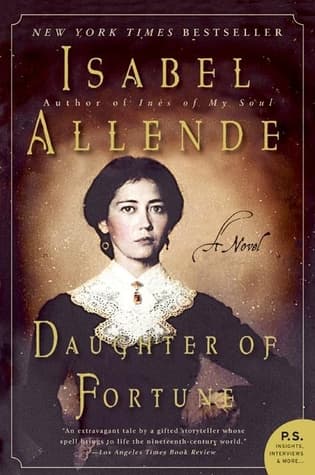
Isabel Allende (1999)
Genre
Historical Fiction / Romance
Reading Time
9-10 hours
Key Themes
See below
Sign in to track this book
In the chaos of the 1849 California Gold Rush, a sheltered Chilean orphan searches for a lost love, finding her own independence among prospectors and prostitutes.
In 1832, a baby girl is left at the home of Jeremy Sommers, a British import-export company owner in Valparaíso, Chile. Jeremy's unmarried sister, Rose, quickly takes to the infant, naming her Eliza and deciding to raise her despite Jeremy's doubts and potential scandal. Eliza grows up in the strict but loving Sommers household, with their Indigenous housemaid, Mama Fresia, who becomes a mother figure. Eliza's childhood has more freedom than other girls of her time; she learns to read and write and develops an independent spirit, often escaping Miss Rose's Victorian rules.
As Eliza becomes a teenager, she meets Joaquín Andieta, a young Chilean from a poor background who works as a clerk for Jeremy Sommers. Joaquín is charming, independent, and has revolutionary ideas, often attending secret meetings and speaking for social change. Despite their different social classes and Miss Rose's disapproval, Eliza and Joaquín fall in love, having a passionate secret affair. Eliza is drawn to Joaquín's intensity and his stories of a world outside her sheltered life, while Joaquín is captivated by her spirit and intelligence. Their love becomes the center of Eliza's life.
In 1848, news of the California Gold Rush reaches Chile, causing excitement and dreams of wealth. Joaquín, caught up in the gold fever and wanting to prove himself and secure a future for Eliza and himself, decides to leave for California. He promises to return for Eliza once he has made his fortune. Eliza is sad about his departure and then finds out she is pregnant with his child. Afraid of the scandal and desperate to be with Joaquín, Eliza decides to follow him to California, a journey full of danger.
With Mama Fresia's help, Eliza disguises herself as a cabin boy and hides on a ship going to San Francisco. The journey is hard and dangerous; she endures seasickness, crowded conditions, and constant fear of being found. During the trip, she miscarries Joaquín's baby, a traumatic event. The ship's cook, a kind Chinese doctor named Tao Chien, eventually finds her and recognizes her true identity. Tao Chien helps Eliza, protecting her, teaching her basic Chinese, and giving medical care and emotional support. They form a strong bond that will help her survive in the new world.
Eliza and Tao Chien arrive in San Francisco, a city changed by the Gold Rush into a chaotic, lawless, and quickly growing boomtown. The city is a mix of cultures, full of prospectors, merchants, and opportunists. Eliza, still disguised as a boy for safety, works with Tao Chien, who becomes a respected doctor in the Chinese community. Together, they begin the difficult search for Joaquín Andieta among the many gold seekers. Eliza is overwhelmed by California's harsh realities but is determined to find her love, holding onto hope for their reunion.
Eliza and Tao Chien travel to the gold fields, a brutal place where men work hard for little reward. Eliza, still pretending to be a young man named 'Elías,' experiences the difficulties of prospecting. She learns to ride, shoot, and survive in the wilderness, losing the last parts of her Victorian upbringing. Her search for Joaquín is constant, often following vague rumors and false leads. During this time, she sees the diverse and often violent interactions between different groups, including Chinese, Chileans, and Americans, and witnesses the greed and desperation of the Gold Rush era.
As they travel, Tao Chien tells Eliza about his painful past. He talks about his life in China, his forced exile after a political uprising, losing his family, and his journey across the Pacific. His story shows themes of displacement, resilience, and the search for belonging that Eliza understands. Sharing these personal histories strengthens their bond, making their friendship and mutual reliance solid. Tao Chien becomes more than a protector; he is Eliza's confidant, mentor, and a source of constant support when she has lost everything else.
Eliza's journey brings her into contact with many characters, including saloon owners, prostitutes like Babalu the Cuban, and other prospectors, each with their own stories of hope and despair. She hears rumors of a known bandit named Joaquín Murieta, a legendary and feared figure, and begins to think this might be her Joaquín. She has several close calls, finding people who knew her Joaquín but never quite catching up to him. These encounters, often dangerous, further shape her understanding of California's complex and often brutal reality.
After years of searching and following many leads, Eliza finally learns the truth about Joaquín. She discovers that her Joaquín Andieta became the legendary bandit Joaquín Murieta, driven to crime by the injustices and racism he faced in the gold fields. Bounty hunters eventually hunted him down and killed him, displaying his severed head as proof. This news destroys Eliza's romantic ideas and forces her to face the tragic reality of his change and death. The man she loved was gone, not just physically, but morally and spiritually changed by the new world's harshness.
Sad but also freed by the truth, Eliza finally takes off her disguise and fully accepts her identity as a woman. Her search for Joaquín, which had defined her for so long, ends, making way for a new start. She realizes that her love for Joaquín had been an anchor, but his loss allows her to find her own freedom and purpose. She decides to stay in San Francisco, working with Tao Chien, who has become her closest companion and partner. They build a life together, not as traditional lovers, but as deeply connected souls, forming a new family and community in California's changing environment.
The Protagonist
From a sheltered, lovestruck girl, Eliza transforms into a self-sufficient and independent woman who finds her own purpose beyond romantic love.
The Love Interest / Catalyst
From a hopeful revolutionary to a ruthless bandit, Joaquín's arc is one of tragic downfall and moral compromise.
The Supporting / Co-protagonist
From a solitary exile, Tao Chien finds a new purpose and a chosen family with Eliza in California.
The Supporting
Remains largely static, representing the unchanging world Eliza departs from, though she experiences quiet internal shifts.
The Supporting
Remains largely static, representing the patriarchal and colonial society.
The Supporting
Remains a steadfast source of love and wisdom, providing a grounding force for Eliza.
The Supporting
Remains a strong, independent figure, thriving in the chaos of San Francisco.
The Supporting
Remains a powerful and influential figure within her community.
The Supporting
His journey is one of disillusionment and struggle to maintain his faith amidst the chaos.
Eliza's journey from a sheltered Chilean girl to an independent woman is a main part of the novel. Her physical search for Joaquín turns into an internal journey of self-discovery. By dressing as a man ('Elías'), she breaks free from gender and societal expectations, exploring what it means to be truly free. Losing Joaquín, while initially sad, ultimately allows her to define her own identity, not through a man, but through her own experiences and choices. Her new life with Tao Chien shows a chosen identity based on mutual respect and companionship rather than traditional romance.
“What began as a search for love ends up as the conquest of personal freedom.”
The novel shows the diverse immigrant experience during the California Gold Rush, focusing on Chileans and Chinese people. Eliza, Tao Chien, and Joaquín are all immigrants looking for a new life, but they face racism, exploitation, and cultural misunderstandings. The story highlights the difficulties of keeping one's heritage while adapting to a new, often hostile, place. The Chinese community, especially, faces extreme prejudice, as shown by Tao Chien's story and how society treats Chinese immigrants. The differences between strict Victorian morality, Chilean passion, and Chinese philosophy create a rich picture of cultural interaction.
“In the streets of San Francisco, the Babel of languages was deafening.”
Freedom, especially for women, is a repeated theme. Eliza's escape from her Victorian upbringing in Valparaíso to the lawless frontier of California is a great liberation. Her male disguise gives her a lot of independence and agency, letting her travel, work, and interact in ways impossible for a woman of her time. The novel looks at different kinds of freedom: the freedom to pursue love, the freedom from societal expectations, and finally, the freedom to define one's own life and relationships, as Eliza does with Tao Chien, building a life outside conventional norms.
“She had lost Joaquín, but she had found herself.”
The California Gold Rush is a strong background for the novel, showing how the promise of wealth can corrupt and destroy. Joaquín Andieta's change from a revolutionary idealist to a ruthless bandit, Joaquín Murieta, shows the destructive power of greed and the harsh realities of the gold fields. The novel depicts the chaos, violence, racism, and desperation in the mining camps and boomtowns, showing how the search for gold often led to moral decay, broken dreams, and tragic ends for many who sought their fortune in California.
“Gold fever was a disease that changed men, twisting their souls and making them forget their past.”
The book explores different kinds of love: the passionate, all-consuming first love between Eliza and Joaquín; the unconditional maternal love of Mama Fresia and Miss Rose; and the deep, platonic, and lasting companionship between Eliza and Tao Chien. Eliza's journey, first driven by romantic love, shows that love can appear beyond traditional romantic relationships. Her bond with Tao Chien, built on shared hardship, mutual respect, and understanding, goes beyond traditional definitions of love, becoming the basis for a new kind of family and partnership.
“Their love was not of the flesh, but of the spirit, a bond forged in shared sorrow and mutual respect.”
Eliza's physical journey to California mirrors her internal transformation.
Eliza's arduous voyage from Chile to California and her subsequent travels through the gold fields serve as a powerful metaphor for her personal growth and self-discovery. Each stage of her physical journey, from the confines of the ship's hold to the vast wilderness, corresponds to a shedding of old identities and an embrace of new freedoms. The geographical displacement forces her to confront harsh realities, adapt to new cultures, and ultimately redefine her purpose beyond her initial quest for Joaquín, making the external journey a reflection of her internal evolution.
Eliza's adoption of a male identity ('Elías') as a tool for freedom and survival.
Eliza's decision to disguise herself as a boy is a crucial plot device that enables her agency and freedom in a male-dominated world. As 'Elías,' she can travel unmolested, work in the gold fields, and interact with people in a way that would be impossible for a woman. This disguise not only ensures her physical safety but also allows her to transcend gender roles and explore a more independent identity. It highlights the restrictive nature of gender expectations in the 19th century and the liberating potential of subverting them.
Letters exchanged between Eliza and Mama Fresia provide insight and maintain connection.
The exchange of letters between Eliza and Mama Fresia serves as a vital plot device. These letters not only provide a means for Eliza to stay connected to her past and her adoptive family but also offer insights into her emotional state and growth. They allow the narrator to convey information about the ongoing lives of the characters in Chile and to emphasize the enduring bond between Eliza and Mama Fresia, reinforcing the theme of chosen family and the power of communication across vast distances and changing circumstances.
The legendary figure of Joaquín Murieta intertwines with Eliza's personal quest.
The historical figure of Joaquín Murieta, a legendary California bandit, is a significant plot device. The novel cleverly uses this myth to represent the tragic transformation of Eliza's beloved Joaquín Andieta. The rumors and stories surrounding Murieta create suspense and drive Eliza's search, while also illustrating how the brutal realities of the gold rush could turn hopeful immigrants into desperate outlaws. The eventual revelation that her Joaquín became this notorious figure shatters Eliza's romantic illusions and forces her to confront the darker side of her quest.
The juxtaposition of Chilean, British, and Chinese cultures offers diverse viewpoints.
The novel employs cultural contrast as a significant plot device, presenting the story through the lens of Chilean passion, British propriety, and Chinese philosophy. The interactions between characters from these different backgrounds—Eliza, Miss Rose, Joaquín, Tao Chien—highlight varying worldviews on love, family, honor, and destiny. This contrast enriches the narrative, providing multifaceted perspectives on the events of the Gold Rush and showcasing the complexities of a multicultural society, while also emphasizing the universal human experiences of love, loss, and resilience.
“You can't go back and change the beginning, but you can start where you are and change the ending.”
— Narrator reflecting on Eliza's journey and transformation.
“Love is an act of endless forgiveness, a tender look which becomes a habit.”
— Eliza contemplating her feelings for Joaquín.
“In Chile we are taught to be discreet, but in California I learned that life is to be lived.”
— Eliza comparing her upbringing in Chile to her experiences in California.
“Gold does not change men; it only unmasks them.”
— Observation about the effects of the Gold Rush on people's true natures.
“A woman's heart is a deep ocean of secrets.”
— Reflecting on Eliza's hidden emotions and struggles.
“The world is full of obvious things which nobody by any chance ever observes.”
— Commentary on the overlooked details in life and society.
“To be brave is to love someone unconditionally, without expecting anything in return.”
— Eliza's realization about her love for Joaquín.
“In the end, we only regret the chances we didn't take.”
— Eliza reflecting on her decision to leave Chile for California.
“Home is not a place, it's a feeling.”
— Eliza's thoughts on belonging and identity during her travels.
“The strongest hearts have the most scars.”
— Describing Eliza's resilience through hardships.
“Freedom is nothing but a chance to be better.”
— Eliza's perspective on the opportunities in California.
“Sometimes the smallest step in the right direction ends up being the biggest step of your life.”
— Eliza's decision to disguise herself as a boy to search for Joaquín.
“We are all fools in love.”
— Acknowledging the irrationality of Eliza's pursuit of Joaquín.
“The past is a ghost, the future a dream, and all we ever have is now.”
— Philosophical reflection on time and living in the moment.
Ready to see how well you understood this book? Take our interactive quiz with 10 questions.

Isabel Angélica Allende Llona is a Chilean writer. Allende, whose works sometimes contain aspects of the genre magical realism, is known for novels such as The House of the Spirits and City of the Beasts, which have been commercially successful. Allende has been called "the world's most widely read Spanish-language author." In 2004, Allende was inducted into the American Academy of Arts and Letters, and in 2010, she received Chile's National Literature Prize. President Barack Obama awarded her the 2014 Presidential Medal of Freedom.







