“The Force is not a power you have. It's not an energy field you can control. It's something you are. It's a part of you, and you are a part of it.”
— Luke Skywalker reflecting on his understanding of the Force during his training.

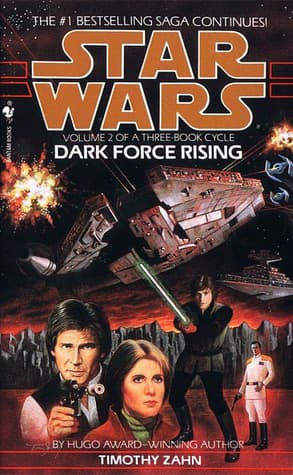
Timothy Zahn (1992)
Genre
Fantasy / Science Fiction
Reading Time
950 min
Key Themes
See below
Sign in to track this book
Grand Admiral Thrawn works to destroy the New Republic, while Han and Lando find a lost fleet, and a Dark Jedi tries to turn Luke Skywalker.
Grand Admiral Thrawn, having gotten the Spaarti Cylinders for cloning in the last book, starts his campaign against the New Republic. His forces attack the Bilbringi shipyards, drawing out New Republic defenses. Meanwhile, Luke Skywalker, bothered by visions of a Dark Jedi, goes to Jomark to investigate. He meets C'baoth, a clone of a powerful Jedi Master, who tries to manipulate Luke and get him to join his cause on Wayland. C'baoth promises to bring back the Jedi Order under his own twisted ideas. Thrawn uses cloaked asteroids and fake attacks to win battles, moving closer to his goal of bringing back Imperial rule. The New Republic, led by Leia Organa Solo and Admiral Ackbar, struggles to fight Thrawn's unexpected strategies.
Following information from the previous book, Han Solo and Lando Calrissian, with Chewbacca and R2-D2, go to find the 'Katana Fleet,' also called the 'Dark Force.' This fleet of two hundred warships, with automated hyperdrive systems, disappeared during the Clone Wars. Their search takes them through underworld contacts and dangerous situations. They race against time, knowing Thrawn is also looking for the same fleet. They eventually get navigation data from an information broker, getting them closer to the fleet's rumored location in the Outer Rim. The fleet's power could change the war for whoever controls it.
Leia Organa Solo, with C-3PO, travels to Honoghr, the Noghri homeworld. The Noghri are deadly assassins loyal to the Empire. She hopes to convince them to leave the Empire by telling them the truth about their world's destruction. Leia learns that the Empire, specifically Darth Vader, tricked the Noghri into believing their planet was ruined by a New Republic chemical spill. The Empire offered them technology and 'healing' for their world in exchange for their service. In truth, the Empire intentionally poisoned Honoghr to keep the Noghri dependent and loyal. Leia, using her connection as Vader's daughter, starts to make the Noghri, especially the clan leaders, doubt the Empire's real plans.
On Wayland, Luke Skywalker confronts Joruus C'baoth, who shows he is an unstable clone. C'baoth tries to force Luke to become his apprentice, using the Dark Side to manipulate him. He promises to create a new, stronger Jedi Order with himself in charge. Mara Jade, who tracked Luke, steps in to protect him from C'baoth. She feels conflicted between her old Imperial loyalties and her growing respect and concern for Luke. C'baoth, angry at Mara's interference, uses his powers against both of them, showing how mad he is and the danger he poses. Luke barely escapes with Mara's help, realizing the threat C'baoth is.
Grand Admiral Thrawn's goal becomes clear: he wants to capture the Katana Fleet to make his forces stronger and create an unstoppable armada. He has been distracting and weakening the New Republic while getting his own expedition ready. Meanwhile, the New Republic faces problems from within. Admiral Ackbar is falsely accused of treason, a plan set up by a mole in the Republic Council: Fey'lya. The accusations are meant to remove Ackbar from command and cause disunity. Leia and other loyalists work to find the truth, suspecting Thrawn set up Fey'lya to use the Republic's weaknesses. The political actions threaten to stop the Republic from fighting Thrawn's growing threat.
Han Solo and Lando Calrissian finally find the Katana Fleet. However, they discover that Thrawn's forces are already there, having also found the clues. A race against time begins as both sides head for the abandoned fleet. The New Republic sends a small group, including Luke Skywalker and Mara Jade, to help Han and Lando. The battle for the Katana Fleet becomes a chaotic fight in space. Both sides try to control the automated warships. The large number of ships in the fleet makes it a prize of great strategic value, and neither side wants to give it up.
The battle for the Katana Fleet is a harsh fight. Thrawn's forces, including Star Destroyers and TIE fighters, clash with the New Republic's smaller, faster ships. Han and Lando work to disable the automated control systems of the warships, while Luke Skywalker and Mara Jade fight Imperial fighters. Thrawn, always a strategist, tries to use the warships themselves as weapons, turning them against the Republic forces. The fight is not just for control of the ships, but also for the Spaarti Cylinders Thrawn needs for cloning, which are also on some of the warships. Many are lost on both sides as the war's outcome is decided.
On Honoghr, Leia Organa Solo's revelations about the Empire's lies finally get through to the Noghri clan leaders. They realize their world was intentionally poisoned by the Empire and that their service has been a lie. The Noghri, who value honor, are deeply shamed and angry by this betrayal. They start to trust Leia, seeing her as Darth Vader's true heir, someone they believed had saved them. This defection of the Noghri, Thrawn's elite assassins, is a big blow to the Grand Admiral's forces and a potential turning point in the war. They are now ready to use their skills against their former masters.
Despite strong resistance, the New Republic manages to get some of the Katana Fleet warships. This stops Thrawn from getting the whole fleet. However, Thrawn, showing his ability to turn defeat into partial victory, escapes with a number of warships and the Spaarti Cylinders. The New Republic's victory is partial; they stopped Thrawn from getting total control of the fleet but did not remove his threat. The immediate danger is gone, but the war is not over. Thrawn's strategic skill, with his new resources, means he remains a threat to the New Republic.
After the battle, the New Republic starts the big job of fixing and adding the captured Katana Fleet warships to their forces. Admiral Ackbar is cleared of all charges, and Fey'lya's betrayal is revealed, though his political power remains a worry. The Noghri officially promise loyalty to Leia and the New Republic, offering their help in the fight. Luke Skywalker continues to deal with the threat of Joruus C'baoth and the Dark Side, knowing the mad Jedi Master is a powerful and unpredictable force. Thrawn, though not winning completely, has enough resources to continue his war, setting up future fights and keeping the galaxy in danger.
The Antagonist
Thrawn continues his strategic campaign, securing a portion of the Katana Fleet and Spaarti Cylinders, solidifying his position as the New Republic's most dangerous foe.
The Protagonist
Luke confronts the dangerous clone Jedi C'baoth, learning more about the dangers of unchecked power and the Dark Side, while continuing to fight for the New Republic.
The Protagonist
Leia successfully turns the Noghri against the Empire by revealing the truth of their manipulation, showcasing her diplomatic prowess and moral authority.
The Protagonist
Han, alongside Lando, successfully locates a portion of the Katana Fleet, playing a crucial role in denying Thrawn total control.
The Supporting
Lando plays a vital role in the search and eventual partial recovery of the Katana Fleet, demonstrating his continued value to the New Republic.
The Supporting
Mara's animosity towards Luke begins to soften as she works alongside him, leading her to protect him from C'baoth and further question her past loyalties.
The Antagonist
C'baoth's madness and power grow, as he attempts to corrupt Luke and demonstrate his formidable, albeit unstable, Force abilities.
The Supporting
Pellaeon continues to serve Thrawn faithfully, learning from his master's strategic genius and witnessing the unfolding of his grand campaign.
The Supporting
Karrde continues to navigate the dangerous political landscape, providing key information that indirectly aids the New Republic, while maintaining his independent stance.
The Supporting
Fey'lya's attempts to undermine Admiral Ackbar are exposed, but he retains political influence, highlighting the ongoing internal struggles of the New Republic.
The Supporting
Ackbar is falsely accused and temporarily removed from command, only to be exonerated, reaffirming his integrity and importance to the New Republic military.
The book shows different kinds of leadership. Grand Admiral Thrawn's leadership is ruthless and analytical, while Leia Organa Solo's is compassionate and diplomatic. Thrawn leads through fear, manipulation, and smart strategies. He gets loyalty through success but demands total obedience. Leia leads with moral authority, empathy, and a commitment to fairness. She earns the loyalty of groups like the Noghri by telling the truth and offering real help. The internal political problems in the New Republic, like Borsk Fey'lya's actions against Admiral Ackbar, also show the difficulties of democratic leadership during threats.
“"He was a strategist, not a warrior. And a strategist knows that the greatest weapon is not the blaster or the starship, but the mind."”
This theme is important for several characters. Leia deals with her identity as Darth Vader's daughter, using this family connection to influence the Noghri, even though she hates her father's actions. Luke continues to try to understand his Jedi background and rebuild the Order. He faces Joruus C'baoth, a clone who shows a twisted version of Jedi power. Mara Jade struggles with her past as the Emperor's Hand. She tries to create a new identity free from Palpatine's commands, but in some ways, she is still tied to them. The Noghri's entire identity is broken and rebuilt when they learn the truth about their poisoned world and their manipulated loyalty.
“"You are Vader's daughter. It is enough."”
Manipulation is a constant force in 'Dark Force Rising.' Grand Admiral Thrawn is a master manipulator. He uses psychological tactics, false attacks, and strategic feints to outsmart the New Republic. He manipulates events, resources, and even people like Joruus C'baoth to reach his goals. The Empire's decades-long deception of the Noghri, making them believe their world was poisoned by the Rebellion and offering 'help' for service, is an example of large-scale, long-term manipulation. Within the New Republic, Borsk Fey'lya's political actions against Admiral Ackbar show that deception can come from inside, weakening the Republic from both outside and inside threats.
“"A strategist's mind is a weapon, and deception is its sharpest edge."”
The story shows how unchecked power can corrupt. Joruus C'baoth, a Force-sensitive clone, shows this theme. His great power in the Force comes with instability and a grandiose view of himself. This leads him to believe he alone can bring back the Jedi Order, even if it means enslaving or corrupting others. His desire for control and his twisted view of the Light Side show the dangers of power without wisdom or humility. Thrawn's pursuit of military power, through the Katana Fleet and Spaarti Cylinders, also shows another side of this theme: power sought for domination rather than balance.
“"The Force is mine! And I will remake the Jedi in my own image!"”
Beyond the immediate battles, the book looks at the wider costs of war, both human and moral. The ongoing conflict uses up the New Republic's resources, forces difficult ethical choices, and creates internal divisions. The Noghri's situation, with their homeworld poisoned and their culture twisted by Imperial manipulation, is a lasting cost of the galactic civil war. Even wins are often partial, needing big sacrifices and leaving threats, as seen with getting back only part of the Katana Fleet. The psychological toll on characters like Luke and Mara, constantly facing danger and moral choices, also shows the personal costs of long conflict.
“"Victory is not always about winning a battle, but about surviving to fight another day."”
A legendary lost fleet of dreadnaughts, serving as the central MacGuffin
The Katana Fleet, also known as the 'Dark Force,' is a legendary fleet of two hundred automated dreadnaughts that disappeared during the Clone Wars. It serves as the primary MacGuffin of the story, with both the New Republic and Grand Admiral Thrawn desperately racing to find and claim it. Its immense power would decisively shift the balance of the war. The search for the fleet drives the plot forward, creating urgency and connecting the storylines of Han, Lando, and eventually Luke and Mara, as they converge on its location. It represents a tangible, ultimate prize in the galactic struggle.
Cloning technology crucial for Thrawn's plans
The Spaarti Cylinders are advanced cloning devices, first introduced in the previous book, that allow for rapid, albeit imperfect, cloning. In 'Dark Force Rising,' Thrawn's acquisition and utilization of these cylinders are vital to his strategy. They enable him to quickly replenish his forces and create clones like Joruus C'baoth, albeit with the inherent instability. The cylinders represent Thrawn's technological edge and his willingness to use unconventional means to overwhelm the New Republic. Their presence on some of the Katana dreadnaughts adds another layer of importance to the battle for the fleet.
A dangerous wild card and a twisted mirror of Jedi power
Joruus C'baoth's profound mental instability, coupled with his immense Force powers, serves as a crucial plot device. His madness makes him an unpredictable and terrifying threat, providing a personal challenge for Luke Skywalker and forcing Mara Jade to reconsider her allegiances. C'baoth's warped vision of the Jedi Order and his attempts to corrupt Luke highlight the dangers of the Dark Side and unchecked power. He also serves as a pawn for Thrawn, who uses C'baoth's Force abilities for strategic advantage, demonstrating Thrawn's ability to manipulate even powerful Force-users.
A turning point through the revelation of Imperial deception
The Noghri's long-standing loyalty to the Empire, based on a monumental deception regarding their poisoned homeworld, serves as a significant plot device. Leia Organa Solo's mission to Honoghr and her revelation of the Empire's treachery leads to a dramatic shift in allegiance. This defection of Thrawn's elite assassins is a major blow to the Imperial Remnant and a significant gain for the New Republic, showcasing Leia's diplomatic prowess and the power of truth. Their change of heart demonstrates that even the most deeply entrenched loyalties can be broken by exposing fundamental lies.
A source of internal conflict and vulnerability for the New Republic
The political machinations of Borsk Fey'lya within the New Republic Council, particularly his false accusations against Admiral Ackbar, serve as a significant internal plot device. This internal strife highlights the vulnerabilities of a nascent democratic government and its susceptibility to ambition and factionalism. It distracts the New Republic leadership, weakens their ability to respond effectively to Thrawn's external threat, and forces Leia to expend valuable resources on internal investigations. It underscores that the New Republic's greatest challenges are not solely external, but also lie within its own structure and political landscape.
“The Force is not a power you have. It's not an energy field you can control. It's something you are. It's a part of you, and you are a part of it.”
— Luke Skywalker reflecting on his understanding of the Force during his training.
“Sometimes the only way to win is to not play the game.”
— Mara Jade advising on strategy in a tense situation.
“Fear is the mind-killer. But so is overconfidence.”
— Luke Skywalker warning about the dangers of arrogance in battle.
“The past is a ghost, but it can haunt the present if you let it.”
— A character discussing the impact of history on current events.
“In war, truth is the first casualty.”
— A reflection on the deceptive nature of galactic conflicts.
“Power is not about control; it's about responsibility.”
— A discussion on leadership and the use of authority.
“The darkest shadows are cast by the brightest lights.”
— A metaphorical observation on the nature of good and evil.
“Trust is a weapon as sharp as any lightsaber.”
— Highlighting the importance and danger of trust in alliances.
“Victory is not in defeating your enemy, but in understanding them.”
— A strategic insight during a military campaign.
“The galaxy is built on secrets, and some are better left buried.”
— A warning about the dangers of uncovering hidden truths.
“Courage is not the absence of fear, but the will to act despite it.”
— A motivational moment for a character facing adversity.
“The future is not written; it is forged by our choices.”
— A philosophical statement on free will and destiny.
“In the silence of space, even whispers can be heard.”
— A poetic reflection on communication and subtlety.
“The strongest chains are those we forge ourselves.”
— A comment on self-imposed limitations and mental barriers.
Ready to see how well you understood this book? Take our interactive quiz with 10 questions.

Biography coming soon.







