“The only difference between a man and a boy is the size of their toys.”
— A reflection on male ambition and material possessions.


George Eliot (2019)
Genre
Historical Fiction / Romance
Reading Time
15-20 hours (approx. 763 pages)
Key Themes
See below
Sign in to track this book
In a Victorian world grappling with identity and purpose, a young woman's quest for belonging intertwines with a man's search for his Jewish heritage, challenging societal norms and inherited destinies.
The story opens with Gwendolen Harleth, a beautiful but spoiled young woman, losing heavily at the roulette table in Leubronn. Her family's financial ruin has forced them to travel abroad, and Gwendolen, accustomed to luxury, feels trapped. She observes Daniel Deronda, a mysterious and compassionate young man, who appears to be watching her. Embarrassed by her losses and his gaze, she feels an inexplicable shame. This encounter begins a complex, unspoken connection between them, as Deronda's presence often acts as a moral mirror for Gwendolen's actions, even when he doesn't directly intervene.
Gwendolen returns to England to find her family in dire straits. She receives a marriage proposal from Henleigh Mallinger Grandcourt, a wealthy baronet known for his cold indifference and controlling nature. Despite feeling a strong aversion to him and recognizing the moral compromise involved, Gwendolen accepts him to escape poverty and secure her family's future. Her decision is heavily influenced by her fear of destitution and a desire to maintain her social standing. She ignores her own conscience and the subtle discomfort she feels in Grandcourt's presence. This choice sets the stage for her subsequent marital suffering.
Meanwhile, Daniel Deronda, raised by his wealthy guardian, Sir Hugo Mallinger, feels a deep sense of rootlessness. He knows he is not Sir Hugo's biological son and longs to discover his true parentage and heritage. This quest for identity drives much of his early narrative. He is drawn to scholarly pursuits and a deep interest in Jewish culture and history, foreshadowing his eventual discovery. His compassionate nature and intellectual curiosity are evident as he navigates his privileged but uncertain existence, often observing the world with a keen, moral eye.
During one of his contemplative walks along the Thames, Daniel sees a young Jewish woman, Mirah Lapidoth, attempting to drown herself. He rescues her and, moved by her distress, takes her under his protection. Mirah, a talented singer, reveals her tragic story of being abandoned by her manipulative father, Ezra, who exploited her musical talents. Daniel helps her find shelter with the kind German-Jewish family, the Meyricks, and assists her in reconnecting with her long-lost brother, Ezra Lapidoth (Mordecai), a passionate Jewish scholar. This act of compassion deepens Daniel's connection to the Jewish community.
Gwendolen's marriage to Grandcourt quickly becomes a source of unhappiness. Grandcourt is emotionally abusive, controlling, and indifferent, deliberately isolating her and stifling her spirit. He reveals his past mistress, Lydia Glasher, and their children, adding to Gwendolen's humiliation and moral torment. Gwendolen feels trapped and powerless. Her initial ambitions for a life of ease and social triumph are replaced by a suffocating sense of dread. She frequently seeks out Daniel Deronda, viewing him as a moral guide and confessor, though their interactions remain largely unspoken and constrained by her marriage.
Daniel becomes deeply involved with Mirah's family, especially her brother, Ezra Lapidoth, who now goes by Mordecai. Mordecai is a consumptive but brilliant Jewish scholar with a powerful, almost messianic vision for the restoration of the Jewish people and their cultural heritage in a homeland. He sees in Daniel a spiritual successor, someone capable of carrying forward his ideals. Daniel is deeply moved by Mordecai's passion and intellect, finding a profound resonance with his own search for meaning and belonging. This intellectual and spiritual connection further draws Daniel into the world of Jewish thought and identity.
During a yachting trip in Genoa, a dramatic event occurs. While on the water, Grandcourt falls overboard and drowns. Gwendolen, who was with him, witnesses the accident. Although she initially hesitates to save him, wrestling with a momentary, dark wish for his demise, she ultimately tries to help but fails. Grandcourt's death frees Gwendolen from her oppressive marriage, but it also leaves her with profound guilt and psychological trauma. She confesses her inner conflict to Daniel, who offers her moral support and guidance, further solidifying his role as her spiritual confessor.
Daniel is summoned to Genoa by a mysterious letter and finally meets his mother, the Princess Halm-Eberstein, a renowned Jewish opera singer. She reveals that Daniel is her son, born of a Jewish father, and that she entrusted him to Sir Hugo Mallinger to be raised as an English gentleman, free from the constraints of her own Jewish heritage and her artistic life. She explains her desire for freedom and her rejection of her Jewish past. This revelation deeply impacts Daniel, confirming his long-held sense of otherness and validating his growing affinity for Jewish culture. He embraces his Jewish identity with conviction.
Armed with the knowledge of his Jewish heritage, Daniel fully embraces the path Mordecai laid out. He sees his identity not as a burden, but as a calling. He resolves to dedicate his life to the Jewish people, working toward the restoration and cultural flourishing of his ancestral nation, aligning with Mordecai's Zionist ideals. This commitment marks a profound shift in Daniel's purpose, moving him from searching to resolute action. He recognizes the historical and spiritual significance of his heritage and his role in its future.
Following Grandcourt's death, Gwendolen is left a wealthy widow. She continues to rely on Daniel for moral guidance, confessing her inner turmoil and seeking his approval. Daniel, while compassionate, gently steers her toward self-reliance and moral responsibility, emphasizing that her redemption must come from within. When Daniel reveals his Jewish heritage and his intention to dedicate his life to his people, Gwendolen is initially heartbroken but ultimately accepts his path. Their final farewell marks a turning point for Gwendolen, who, though still fragile, shows signs of genuine moral growth and a commitment to living a more purposeful life.
Daniel and Mirah, whose love has steadily deepened, finally marry. Their union symbolizes the blending of their shared Jewish heritage and their mutual commitment to a life of purpose. With Mordecai, whose health is failing, they prepare to embark on a journey to the East, intending to contribute to the realization of Mordecai's vision for the Jewish people. The novel concludes with Daniel and Mirah setting off on their new life, full of hope and dedication, leaving behind the complexities of English society to pursue a higher calling rooted in their shared identity and faith.
The Protagonist
Gwendolen transforms from a superficial, self-absorbed young woman into a more morally conscious and reflective individual, seeking redemption and a purposeful life.
The Protagonist
Daniel evolves from a searching, somewhat passive observer to a man with a clear purpose, embracing his Jewish identity and dedicating his life to his people.
The Antagonist
Grandcourt remains static in his cold and oppressive nature, serving as a catalyst for Gwendolen's suffering and eventual moral awakening.
The Supporting
Mirah finds stability, love, and a renewed sense of belonging after being rescued by Daniel, ultimately marrying him and embracing their shared Jewish future.
The Supporting
Mordecai serves as a catalyst for Daniel's self-discovery, passing on his vision and finding fulfillment in Daniel's commitment to Jewish heritage.
The Supporting
Sir Hugo remains a steadfast, if somewhat conventional, guardian, representing the English world Daniel ultimately leaves behind.
The Supporting
The Princess reveals her past and Daniel's heritage, providing the pivotal information that allows Daniel to fully embrace his identity.
The Mentioned
Lydia's presence provides a constant, painful reminder of Grandcourt's past and Gwendolen's compromised position.
This theme is central to Daniel Deronda's character arc. Raised without knowledge of his true parentage, Daniel feels a deep sense of rootlessness and an inherent desire to understand his origins. His compassionate nature and intellectual curiosity lead him to explore various paths. It is his encounter with Mirah and Mordecai, and ultimately the revelation of his Jewish heritage, that provides him with a clear sense of self and purpose. This search is not merely about lineage, but about finding a community and a cause to which one can fully commit, as seen when Daniel embraces Mordecai's Zionist vision.
“What was the good of having a lot of money if you couldn't get what you wanted?”
Gwendolen Harleth's journey embodies this theme. Initially driven by vanity, fear, and a desire for social standing, she makes choices that lead to immense suffering, particularly her marriage to Grandcourt. Her internal struggles, her momentary dark wishes, and her subsequent guilt after Grandcourt's death force her to confront her moral failings. Daniel Deronda acts as her moral compass, guiding her toward self-reflection and the understanding that true redemption comes from within, through conscious effort and a commitment to living a more purposeful, less self-centered life. Her transformation, though incomplete at the novel's end, signifies a movement toward moral growth.
“The refuge of a lie is in the mouth of a fool.”
This theme is portrayed through Gwendolen's experience. Victorian society places immense pressure on women to marry for financial security and social standing, often at the expense of personal happiness and moral integrity. Gwendolen's marriage to Grandcourt is a stark example of a union devoid of love, becoming a cage of emotional abuse and control. Grandcourt's character exemplifies how social power and wealth can be used to dominate and stifle individuals. The novel critiques the societal structures that entrap women and the moral compromises they are forced to make, highlighting the devastating psychological impact of such oppressive relationships.
“What was the good of her being in the right, if Grandcourt could always make her feel in the wrong?”
A significant and innovative theme for its time, this focuses on the spiritual and cultural resurgence of the Jewish people. Through Mordecai's passionate vision, the novel explores the idea of a Jewish homeland and the preservation of Jewish heritage. Daniel Deronda's discovery of his Jewish roots leads him to embrace this cause, finding in it a profound sense of belonging and purpose. Eliot uses this theme to challenge prevailing anti-Semitic sentiments of the era and to advocate for a deeper understanding of Jewish history, culture, and future aspirations. It represents a call for collective identity and a rejection of assimilation.
“A great Jewish nation, which shall be a witness to the world.”
Daniel Deronda is an example of this theme. His compassion drives his actions, from rescuing Mirah from suicide to offering Gwendolen moral support despite her flaws. He possesses a rare ability to understand and feel for others, even those who initially seem undeserving. His empathy allows him to connect deeply with Mirah and Mordecai, and to act as a catalyst for Gwendolen's moral awakening. The novel suggests that true moral strength lies not in judgment, but in the capacity for understanding and offering guidance, encouraging growth and connection rather than condemnation.
“He felt that his life was a search, and that there was no rest for him till he had found a path.”
Daniel Deronda's presence acts as a silent moral gauge for Gwendolen.
Daniel Deronda frequently serves as a 'moral mirror' for Gwendolen Harleth. From their first encounter at the roulette table, his silent, observing presence often makes Gwendolen acutely aware of her own moral failings, vanity, and the compromises she makes. He rarely offers direct advice but his inherent goodness and integrity highlight her own conflicted conscience. This device allows Eliot to explore Gwendolen's inner turmoil and gradual moral awakening, as she constantly measures her actions and feelings against Daniel's perceived disapproval or understanding, even when he says nothing explicit.
The delayed revelation of Daniel's Jewish parentage.
The mystery surrounding Daniel Deronda's parentage is a central plot device that fuels his personal quest and shapes the novel's thematic concerns. Eliot deliberately withholds this crucial information, building suspense and allowing Daniel's character to develop a strong affinity for Jewish culture and a sense of rootlessness before his true identity is revealed. This delayed unveiling allows the reader to witness Daniel's journey of discovery and to appreciate the profound impact of his heritage, making his eventual embrace of Judaism feel earned and deeply meaningful rather than a mere accident of birth.
Grandcourt's death by drowning and Mirah's attempted drowning.
Drowning serves as a powerful symbolic motif in the novel. Mirah's attempted suicide by drowning represents her despair and the overwhelming oppression she has faced, from which Daniel rescues her, symbolizing hope and new life. Grandcourt's death by drowning, witnessed by Gwendolen, is highly symbolic. It represents the violent end of her oppressive marriage and, for Gwendolen, a moment of profound moral crisis and guilt, as she briefly contemplates letting him die. This shared motif links the two main plotlines and underscores themes of despair, rescue, moral choice, and liberation.
Mordecai's fervent and almost mystical Zionist ideals.
Mordecai's prophetic vision for the restoration of the Jewish people and their cultural heritage functions as a key plot device, providing a driving force for Daniel Deronda's ultimate purpose. His passionate monologues and intellectual arguments introduce the theme of Zionism and imbue Daniel's quest for identity with a higher, collective significance. This device elevates Daniel's personal journey beyond individual fulfillment, transforming it into a mission for an entire people, and introduces a spiritual and almost mystical element to the narrative, guiding Daniel towards his destined path.
“The only difference between a man and a boy is the size of their toys.”
— A reflection on male ambition and material possessions.
“What are our ideals to us if we are not to labour for them?”
— Gwendolen Harleth's internal struggle with her aspirations and agency.
“A human life, I think, should be a constant process of education.”
— Daniel Deronda's view on personal growth and learning.
“The highest love is that which is content to be for ever a secret, and to manifest itself only in the dedicated life.”
— A philosophical observation on the nature of profound, selfless love.
“We are on a journey, and cannot rest where we would.”
— Mordecai's mystical and prophetic view of the Jewish people's destiny.
“To be right-minded means to be in a state of mind that is ready to receive what is true.”
— A discussion on intellectual openness and the pursuit of truth.
“It is a common error to imagine that a man's heart is the whole of him.”
— A critique of simplistic views of human character, suggesting complexity.
“Every fresh trial of a new path is a fresh trial of one's own capabilities.”
— Gwendolen reflecting on her attempts to find a fulfilling life.
“The world is not a mere assemblage of facts, but a great poem, in which we are ourselves the living words.”
— Daniel's profound and poetic understanding of existence and humanity's role.
“A man's delight in his wife is not to be measured by the delight he takes in other women.”
— A subtle observation on marital affection and fidelity.
“The strongest principle of growth lies in human choice.”
— A statement emphasizing free will and its power in shaping one's life.
“We can only learn to love by loving.”
— A simple yet profound truth about the nature of developing affection.
“The beginning of an acquaintance is a delicate moment, and one that may determine the future.”
— An observation on the significance of first impressions and new connections.
“It is a rare gift to find a soul that can understand and respond to the unspoken.”
— A reflection on deep connection and empathy between individuals.
Ready to see how well you understood this book? Take our interactive quiz with 10 questions.
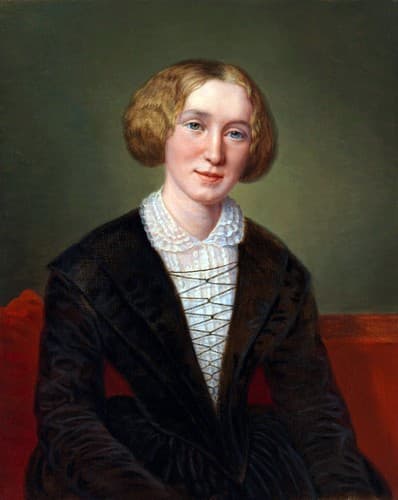
Mary Ann Evans, known by her pen name George Eliot, was an English novelist, poet, journalist, translator, and one of the leading writers of the Victorian era. She wrote seven novels: Adam Bede (1859), The Mill on the Floss (1860), Silas Marner (1861), Romola (1862–63), Felix Holt, the Radical (1866), Middlemarch (1871–72) and Daniel Deronda (1876). Like Charles Dickens and Thomas Hardy, she emerged from provincial England; most of her works are set there. Her works are known for their realism, psychological insight, sense of place and detailed depiction of the countryside.







