“The fog was a shroud, and it clung to the town like a hungry beast.”
— Describing the oppressive atmosphere in Tarker's Mills.

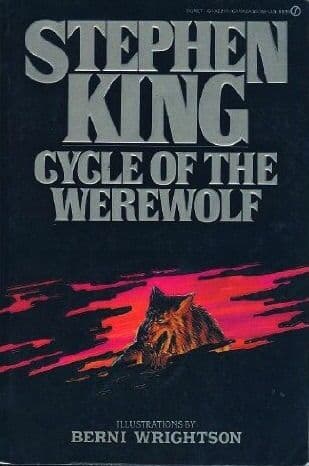
Stephen King (1983)
Genre
Thriller / Fantasy / Mystery
Reading Time
90 min
Key Themes
See below
Sign in to track this book
In the isolated town of Tarker Mills, a terrifying cycle of full moon massacres begins, leaving a trail of dismembered bodies and the chilling realization that a werewolf hunts among them.
The story opens in January, amidst a raging blizzard in Tarker Mills, Maine. Arnie Westrum, a fifty-six-year-old railwayman, is plowing snow from the tracks when he is suddenly attacked. The assailant is a massive, hairy creature with glowing red eyes and sharp claws. Arnie tries to fight back, but he is no match for the beast's ferocity. His screams are swallowed by the wind and the blizzard, and he is found the next morning, dismembered and partially devoured. The town's sheriff, George Haller, initially says the attack was by a bear, but the unnatural savagery and the lack of clear animal tracks leave him uneasy. The townspeople are unnerved, but the official explanation holds for a time.
February brings another full moon and another victim. Stella Randolph, a reclusive seamstress in her late thirties, is found dead in her locked bedroom, her throat torn out. The scene is one of horrific violence, with blood splattered across the walls and furniture. Sheriff Haller is called to the scene, and this time, the evidence is undeniable: a bear did not cause the attack. The sheer brutality and the impossible entry into a locked room suggest something supernatural. The town begins to whisper about a monster, a werewolf, and fear starts to grip Tarker Mills. People begin to lock their doors earlier and avoid going out after dark, especially when the moon is full.
In March, the victim is Clyde Corliss, a notorious town drunkard. Driven by a morbid curiosity and a desperate desire for notoriety, Clyde decides to go out during the full moon, challenging the unseen killer. He sits in his car, drinking and yelling taunts into the night. His foolish bravado quickly turns to terror when the werewolf appears, smashing through his car window. Clyde's final moments are filled with screaming as the creature drags him from the vehicle and brutally murders him. His mutilated body is discovered the next morning, reinforcing the town's growing panic. The attacks are no longer isolated incidents but a terrifying pattern, and the people of Tarker Mills realize they are dealing with something truly evil.
April sees Reverend Lester Lowe, the town's minister, take to the pulpit, his sermons becoming increasingly fervent about the 'devil's work' plaguing Tarker Mills. He preaches about the werewolf, calling for the townspeople to unite and hunt down the creature, believing it to be a manifestation of evil. However, his impassioned pleas are largely ignored by the fearful and skeptical congregation. Many prefer to believe in a deranged human killer or a wild animal, unwilling to accept the supernatural truth. The Reverend's frustration grows as the town remains paralyzed by fear and inaction, leaving him feeling isolated in his understanding of the threat.
May brings a tragic attack on a young couple, Stella and Bob, who are parked in a secluded spot. The werewolf ambushes them, tearing through the car. Bob is killed instantly, while Stella is severely wounded but manages to survive, though she is left in a state of shock and unable to provide a clear description of her attacker. This incident further escalates the town's terror, as the monster is now attacking indiscriminately, even targeting those seeking moments of intimacy. Sheriff Haller feels increasingly helpless, as his traditional law enforcement methods are useless against such a foe. The town is now a pressure cooker of fear and suspicion.
June is the turning point for Marty Coslaw, an eleven-year-old boy confined to a wheelchair. His uncle, Al, gives him fireworks for the Fourth of July. During the full moon, Marty sneaks out to set off some firecrackers, despite his disability. He is caught off guard by the werewolf, which lunges at him. In a moment of sheer terror and quick thinking, Marty shoves a string of firecrackers into the creature's eye, causing it to shriek and flee. As the werewolf retreats, Marty sees a human eye behind the damaged one, and a gold cross around its neck. This brief, horrifying encounter reveals the werewolf's true, human identity to Marty, who is now the only one who knows the truth.
In July, Marty, still recovering from his encounter, begins his own investigation. He realizes the werewolf must be someone in Tarker Mills. Remembering the gold cross, he starts observing people, looking for someone with an injured eye and a specific piece of jewelry. He decides to send anonymous letters to the potential werewolf, hoping to provoke a reaction. His letters are simple but direct, hinting that he knows who the creature is. Marty's plan is to force the werewolf into revealing itself or, at the very least, to confirm his suspicions, all while keeping his own identity a secret to avoid becoming a direct target.
August confirms Marty's suspicions: Reverend Lester Lowe is the werewolf. The Reverend receives Marty's anonymous letters, which initially confuse and then enrage him. The letters, which mention the 'one eye' and the 'cross,' slowly chip away at his sanity. He knows that someone in town has seen him in his monstrous form and survived. The Reverend's internal struggle intensifies, as he battles with the monstrous impulses of the werewolf and the facade of his human identity. He becomes increasingly paranoid and violent, both in his human form and, more lethally, as the beast, leading to more attacks as he tries to silence the person who knows his secret.
September sees Marty preparing for the final confrontation. He understands that the werewolf can only be killed by silver. He enlists the help of his uncle, Al, who, though skeptical about the werewolf, agrees to melt down a silver locket into bullets for Marty's .22 rifle, believing it's for a hunting trip. Marty, however, has a much more dangerous target in mind. He meticulously cleans and loads his rifle, knowing that the next full moon will be his last chance to end the terror plaguing Tarker Mills. He feels the weight of the town's fate resting on his young shoulders.
The climax arrives in October. Marty waits in his room, rifle loaded with the silver bullets. Reverend Lowe, having finally deduced Marty's identity through the letters and the missing eye, transforms and makes his way to the Coslaw house. The werewolf bursts into Marty's room, ready to silence him. However, Marty, despite his fear, stands his ground. He fires the silver bullet, striking the werewolf in the good eye. The creature howls in pain, reverts to human form, and dies as Reverend Lowe. The terror in Tarker Mills finally ends, though the townspeople never truly understand what happened, only that the killings have stopped.
The Protagonist
Marty transforms from a fearful witness into a courageous hero who takes matters into his own hands to protect his community.
The Antagonist
Initially a conflicted figure, Reverend Lowe descends further into madness and paranoia as his secret is threatened, culminating in his violent demise.
The Supporting
Sheriff Haller's arc reflects the futility of conventional methods against a supernatural threat, leading to his growing despair and inability to protect his town.
The Supporting
Uncle Al remains largely unchanged, serving as a catalyst for Marty's final actions and representing the everyday world oblivious to the supernatural.
The Mentioned
His death marks the beginning of the werewolf's cycle of terror.
The Mentioned
Her death escalates the town's fear and the realization that a monster is at large.
The Mentioned
His death highlights the werewolf's unstoppable nature and the danger of underestimating it.
The novel explores the idea that evil can reside in unexpected places, even within seemingly respectable figures like a town minister. The werewolf, as a physical manifestation of this evil, highlights the duality of human nature and the thin veneer of civilization. The town's reluctance to acknowledge the supernatural nature of the killings, preferring to rationalize them as animal attacks or human violence, speaks to humanity's struggle to confront the truly monstrous. Reverend Lowe's internal battle, though briefly glimpsed, shows the torment of harboring such a dark secret.
“For snarls that sound like human words can be heard whining through the wind. And all around are the footprints of a monster whose hunger cannot be sated...”
Marty Coslaw, a young, disabled boy, is innocent, yet he is the only one who truly grasps the horrific reality of the werewolf. His youthful perspective, unburdened by adult skepticism or the need for rational explanations, allows him to see the truth. The adults, including Sheriff Haller and the townspeople, are blinded by their experience and conventional thinking, making them unable to effectively combat the threat. Marty's journey from a fearful witness to a determined hero shows that sometimes, the purest hearts are best equipped to face the darkest evils.
“He knew it for what it was: a werewolf. He was only eleven, but he wasn't stupid.”
Tarker Mills is an isolated town, both geographically and psychologically. The fear of the werewolf drives the community further into isolation, as people lock themselves in their homes and grow suspicious of one another. Despite the shared terror, there is no collective action or support, only individual fear. Marty, in his wheelchair, is physically isolated, yet he is the one who tries to connect with the town by sending his letters. The town's inability to unite against the common enemy prolongs their suffering and highlights the destructive power of fear and denial on a community.
“The town was a pressure-cooker, and the only thing keeping it from blowing was the hope that the thing would eventually go away.”
The novel subtly explores the power of belief, or lack thereof. The townspeople's disbelief in the supernatural prevents them from identifying or confronting the werewolf, leading to more deaths. Sheriff Haller's insistence on rational explanations hinders his investigation. Conversely, Marty's belief in the werewolf's existence, once he witnesses it, empowers him to act. His belief in the specific weakness of a werewolf (silver) allows him to successfully defeat the creature, where adult skepticism would have failed. This theme suggests that sometimes, understanding and confronting a threat requires a leap of faith beyond the purely logical.
“He knew it had to be silver. He just knew.”
Each chapter represents a month, detailing a new werewolf attack.
The story is structured into twelve monthly chapters, each corresponding to a full moon and usually featuring a new victim. This episodic format effectively builds suspense and demonstrates the relentless, cyclical nature of the werewolf's attacks. It creates a sense of dread and inevitability, as readers anticipate the next full moon and its accompanying horror. This structure also allows for a gradual escalation of terror and the slow realization by the townspeople that they are facing a supernatural threat, mirroring the 'cycle' in the title.
The story primarily focuses on Marty Coslaw's point of view once he discovers the werewolf's identity.
While the initial chapters offer glimpses into various townspeople's perspectives, the narrative increasingly centers on Marty Coslaw after his encounter with the werewolf. This shift in perspective is crucial because Marty is the only character who truly understands the nature of the threat. His limited, yet accurate, view allows the reader to experience his fear, determination, and ingenuity. It also highlights the isolation of his knowledge and the adult world's inability to see what a child can, making his eventual triumph more impactful.
The collective narrative of Tarker Mills is initially unreliable due to its denial of the supernatural.
Initially, the town's collective narrative and Sheriff Haller's explanations attempt to rationalize the werewolf attacks as bear attacks or human serial killings. This creates an unreliable 'truth' for the reader, as the official story clashes with the horrific reality. This device builds suspense and emphasizes the theme of denial. It also serves to highlight Marty's unique insight, as he alone pierces through the town's self-deception to uncover the true nature of the evil.
Marty's wheelchair symbolizes his vulnerability and also his unique perspective.
Marty's wheelchair serves as a powerful symbol. On one hand, it represents his physical vulnerability, making his confrontation with the werewolf seem even more daunting. On the other hand, it forces him to observe the world differently, perhaps with a heightened awareness that able-bodied people lack. His physical limitation ironically becomes a catalyst for his heroism, as he is often underestimated and can move unnoticed, allowing him to gather crucial information and ultimately face the monster.
“The fog was a shroud, and it clung to the town like a hungry beast.”
— Describing the oppressive atmosphere in Tarker's Mills.
“It was the kind of night where the wind seemed to whisper secrets and the shadows danced with a life of their own.”
— Setting the scene for a night of terror.
“The full moon was a huge, malevolent eye staring down at Tarker's Mills.”
— Introducing the catalyst for the werewolf's transformation.
“There were things in the woods that were not supposed to be there, things that walked on two legs sometimes, and on four at others.”
— Hinting at the nature of the monster stalking the town.
“Even in a small town, there were dark corners where terrible things could breed.”
— Reflecting on the hidden dangers within seemingly peaceful communities.
“Fear was a cold hand gripping the heart of Tarker's Mills, squeezing tighter with each passing night.”
— Illustrating the growing terror in the town.
“He knew, with a certainty that chilled him to the bone, that he had seen the devil.”
— Marty Coslaw's realization about the werewolf's true nature.
“The beast was not just a creature of legend, but a living, breathing nightmare.”
— Emphasizing the reality of the threat.
“Sometimes, the most ordinary people could hide the most monstrous secrets.”
— A theme of the book, as the werewolf is someone from the town.
“The world was full of monsters, some with fur and claws, and some with human faces.”
— A broader commentary on the nature of evil.
“There was a fine line between courage and foolishness, and he felt himself walking it.”
— Marty's internal struggle as he decides to confront the werewolf.
“The moon was a witness, silent and indifferent, to the horrors it brought forth.”
— Highlighting the cosmic indifference to human suffering.
“Revenge was a cold dish, but sometimes it was the only thing that could warm a frozen heart.”
— Reflecting on the motivations behind the final confrontation.
“The sounds of the night were different now, sharper, more menacing, as if the world itself held its breath.”
— Describing the heightened tension and fear in the town.
“He knew that some nights, even in the safety of his own bed, the shadow of the beast would still cling to him.”
— Marty's enduring trauma after the events.
Ready to see how well you understood this book? Take our interactive quiz with 10 questions.

Stephen Edwin King is an American author of horror, supernatural fiction, suspense, crime, science-fiction, and fantasy novels. Described as the "King of Horror", his books have sold more than 350 million copies as of 2006, and many have been adapted into films, television series, miniseries, and comic books. King has published over 65 novels/novellas, including seven under the pen name Richard Bachman, and five non-fiction books. He has also written approximately 200 short stories, most of which have been published in book collections.







